
Homework Answers

Add Answer to:
Exercise 3 A firm detains a monopoly over the production of a good both in North...
A freight firm holds a monopoly over rail freight transport in Australia. The freight firm has...
A freight firm holds a monopoly over rail freight transport in Australia. The freight firm has two types of customers: • Coal mining companies’ demand for freight services is Qc = 38 − Pc . • Grain farmers’ demand for freight services is Qg = 56 − 4Pg . All quantities are measured in tonnes. The firm faces a constant marginal cost of $10 per tonne, regardless of which commodity is being transported. The firm has no fixed costs. a)...
A monopoly sells its good in the U.S. and Japanese markets. The American inverse demand function...
A monopoly sells its good in the U.S. and Japanese markets. The American inverse demand function is: Pa=100-Qa and the Japanese inverse demand function is pj=90-2Qj where both prices, Pa and Pj, are measured in dollars. The firm's marginal cost of production is m = $25 in both countries. If the firm can prevent resales, what price will it charge in both markets? (Hint: The monopoly determines its optimal (monopoly) price in each country separately because customers cannot resell the...
A monopoly sells its good in the U.S. and Japanese markets. The American inverse demand function...
 A monopoly sells its good in the U.S. and Japanese markets. The American inverse demand function is Pa = 100 - Qa and the Japanese inverse demand function is Pj = 90 - 2Qj where both prices, Pa and pi, are measured in dollars. The firm's marginal cost of production is m = $15 in both countries. If the firm can prevent resales, what price will it charge in both markets? (Hint: The monopoly determines its optimal (monopoly) price in...
2. Consider a monopolistic market a) One of the reasons for monopoly lies in the production...
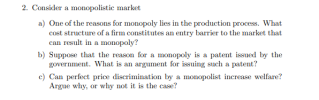 2. Consider a monopolistic market a) One of the reasons for monopoly lies in the production process. What cost structure of a firm constitutes an entry barrier to the market that can result in a monopoly? b) Suppose that the reason for a monopoly is a patent issued by the government. What is an argument for issuing such a patent? c) Can perfect price discrimination by a monopolist increase welfare? Argue why, or why not it is the case?
A monopoly sells in two countries . The demand curves in the two countries are p1...
A monopoly sells in two countries . The demand curves in the two countries are p1 = 12−q1, and p2 = 48−q2. The monopoly’s MC is $4. Now, suppose a long-running trade war between the two countries comes to an end, allowing resales between the two countries. The monopoly is now forced to charge the same price in both countries. The monopoly would have two options: (1) Sell at a price low enough (lower than 12), so that consumers from...
1. Suppose there are two potential customers in the market. One has demand function D1(p)=10-p ....
1. Suppose there are two potential customers in the market. One has demand function D1(p)=10-p . The other has demand function D2(p)=20-2p. The only firm in this market has constant marginal cost of 2. (1) Draw the two demand curves in a graph, with price on the vertical axis and demand on the horizontal axis. (2) (3rd-degree price discrimination) If the monopoly can identify the two consumers and charge different prices to them, what is the optimal price charged to...
1. Suppose there are two potential customers in the market. One has demand function D1(p)=10-p ....
1. Suppose there are two potential customers in the market. One has demand function D1(p)=10-p . The other has demand function D2(p)=20-2p. The only firm in this market has constant marginal cost of 2. (1) Draw the two demand curves in a graph, with price on the vertical axis and demand on the horizontal axis. (2) (3rd-degree price discrimination) If the monopoly can identify the two consumers and charge different prices to them, what is the optimal price charged to...
2. Suppose that a monopoly faces two markets for its product. D: Q1 = 100 -...
 2. Suppose that a monopoly faces two markets for its product. D: Q1 = 100 - P; and D2 : Q2 = 80-P The monopoly can verify consumers to decide which market they belong to so that it charge different prices in the two markets. The cost of production is CQ) = 100 where Q- Q. +Q2. a) Please write out the total profit function for the monopoly as functions of Qı and Q2 b) Find out the profit maximizing...
EC202-5-FY 10 9Answer both parts of this question. (a) Firm A and Firm B produce a homogenous good and are Cournot duopolists. The firms face an inverse market demand curve given by P 10-Q. where...
 EC202-5-FY 10 9Answer both parts of this question. (a) Firm A and Firm B produce a homogenous good and are Cournot duopolists. The firms face an inverse market demand curve given by P 10-Q. where P is the market price and Q is the market quantity demanded. The marginal and average cost of each firm is 4 i. 10 marks] Show that if the firms compete as Cournot duopolists that the total in- dustry output is 4 and that if...
1) A monopolist firm sells its output in two regions: Califomia and Florida. The demand curves...
 1) A monopolist firm sells its output in two regions: Califomia and Florida. The demand curves for each market are QF15-PF OF and Qc are measured in 1000s of units, so you may get decimal values for Q. If P-$10 and Q-1, the profit of S10 that you calculate is actually $10,000). Qc 12.5 - 2 Pc The monopoly's cost function is C 5+3Q5+3(QF+Qc) First, we'll assume that the monopoly can only charge one price in both markets. a) Calculate...
 A monopoly sells its good in the U.S. and Japanese markets. The American inverse demand function is Pa = 100 - Qa and the Japanese inverse demand function is Pj = 90 - 2Qj where both prices, Pa and pi, are measured in dollars. The firm's marginal cost of production is m = $15 in both countries. If the firm can prevent resales, what price will it charge in both markets? (Hint: The monopoly determines its optimal (monopoly) price in...
 2. Consider a monopolistic market a) One of the reasons for monopoly lies in the production process. What cost structure of a firm constitutes an entry barrier to the market that can result in a monopoly? b) Suppose that the reason for a monopoly is a patent issued by the government. What is an argument for issuing such a patent? c) Can perfect price discrimination by a monopolist increase welfare? Argue why, or why not it is the case?
 2. Suppose that a monopoly faces two markets for its product. D: Q1 = 100 - P; and D2 : Q2 = 80-P The monopoly can verify consumers to decide which market they belong to so that it charge different prices in the two markets. The cost of production is CQ) = 100 where Q- Q. +Q2. a) Please write out the total profit function for the monopoly as functions of Qı and Q2 b) Find out the profit maximizing...
 EC202-5-FY 10 9Answer both parts of this question. (a) Firm A and Firm B produce a homogenous good and are Cournot duopolists. The firms face an inverse market demand curve given by P 10-Q. where P is the market price and Q is the market quantity demanded. The marginal and average cost of each firm is 4 i. 10 marks] Show that if the firms compete as Cournot duopolists that the total in- dustry output is 4 and that if...
 1) A monopolist firm sells its output in two regions: Califomia and Florida. The demand curves for each market are QF15-PF OF and Qc are measured in 1000s of units, so you may get decimal values for Q. If P-$10 and Q-1, the profit of S10 that you calculate is actually $10,000). Qc 12.5 - 2 Pc The monopoly's cost function is C 5+3Q5+3(QF+Qc) First, we'll assume that the monopoly can only charge one price in both markets. a) Calculate...
Most questions answered within 3 hours.
-
Where is the error in this code sequence?
String s1 = "Hello";
String s2 = "ello";...
asked 11 months ago -
Financial data for Joel de Paris, Inc., for last year
follow:
Joel de Paris, Inc.
Balance...
asked 11 months ago -
Consider this reaction:
Al2(SO4)3 (aq)+ BaCl3
(aq) Al2Cl6 (aq)- +
3BaSO4(s) . What is the...
asked 11 months ago -
Suppose that Savneet is considering increasing her
recent random sample from 20 car rentals to 40...
asked 11 months ago -
Trucks arrive at an unloading terminal at an average rate of 120
per hour.
Trucks arrive...
asked 11 months ago -
Why are methanol and ethanol completely soluble in water while
octanol is not very little soluble....
asked 11 months ago -
A facilities manager at a university reads in a research report
that the mean amount of...
asked 11 months ago -
When the CuSO4 is rehydrated by adding water to the anhydrous
compound, is this an endothermic...
asked 11 months ago -
A ray of sunlight is passing from diamond into crown glass; the
angle of incidence is...
asked 11 months ago -
A block of mass 0.249 kg is placed on top of a light, vertical
spring of...
asked 11 months ago -
how do the kidneys compensate in the presences of acidosis
a) trigger hyperventilate
b) reserve acid...
asked 11 months ago -
Question 501 pts
The rental rate of capital to the firm increases. Which of the
following...
asked 11 months ago