
Homework Answers
Add Answer to:
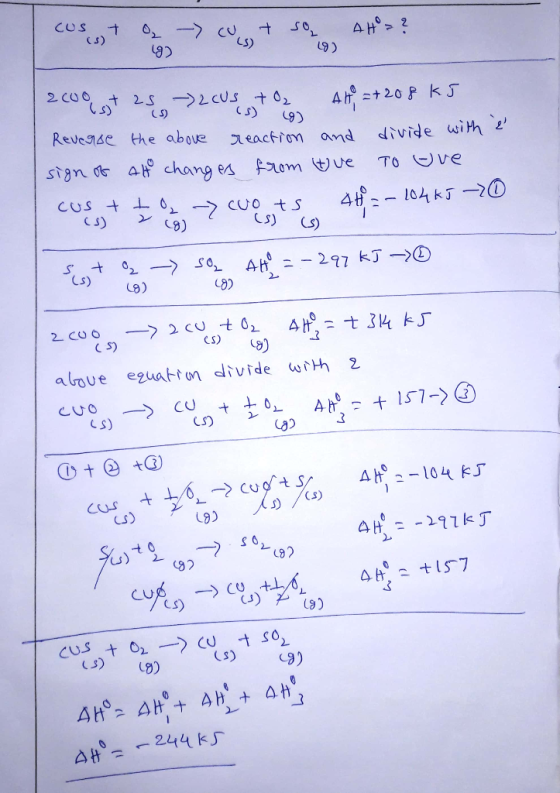
TC04M01 Use the enthalpy changes given in the data below to calculate the enthalpy change for...
TC05E04 Use the enthalpies of formation given in the table below to calculate the standard molar enthalpy change for...
 TC05E04 Use the enthalpies of formation given in the table below to calculate the standard molar enthalpy change for this reaction at 298K: 2CuS(s) 302(g)2CuO(s)+ 2SO2(g) AfH / kJ mol at 298K, standard Substance state 1 bar. CuO(s) -157 SO2(g) -297 CuS(s) -53 Select one: a. -802 kJ mol1 b. +401 kJ mol1 c. +802 kJ mol1 d. -507 kJ mol1 e. -401 kJ mol1
Use Hess's law to calculate standard enthalpy change of formation at 298K for carbon (iv) sulphide...
Use Hess's law to calculate standard enthalpy change of formation at 298K for carbon (iv) sulphide compound, Cs2. Given that: Cs2(s) + 3O2(g) - Co2(g) + 2So2(g) ∆H°298= -1113KJ/mol C(s) + O2(g) - Co2(g). ∆H°298 = -407 KJ/mol S(s) + O2(g) - So2(g) ∆H°298 = -298 KJ/mol
QUESTION 7 Calculate the enthalpy (AH) for the following equation: 2S(s) + 302(g) +2503(g) from the...
 QUESTION 7 Calculate the enthalpy (AH) for the following equation: 2S(s) + 302(g) +2503(g) from the data shown below. S(s) + O2(g) → SO2(8) AH = -297 kJ 2503(8) ► 2802(g) + O2(8) [see module 9] AH = 198 kJ 0-99 kJ O-693 kJ O-396 kW O -792 KW -17
TC05ЕОЗ Use the enthalpies of formation given in the table below to calculate the standard molar...
 TC05ЕОЗ Use the enthalpies of formation given in the table below to calculate the standard molar enthalpy change for this reaction at 298K: 2ZnS(s) 302(g) 2ZnO(s) + 2SO2(g) Att / kJ mol at 298K, standard state 1 bar, Substance ZnO(s) -350 SO2(g) -297 ZnS(s) -206 Select one: a. -441 kJ mor1 b. -853 kJ mol1 c. +882 kJ mol 1 d. +441 kJ molr1 e. -882 kJ mol1 TСОЗЕОЗ A chemical reaction carried out at an ambient pressure of 1.02...
determine the enthalpy change A student wishes to determine the enthalpy change for the decomposition of...
 determine the enthalpy change
A student wishes to determine the enthalpy change for the decomposition of sulfur trioxide into sulfur and oxygen gas: 2 SO3 -- 2 S (s) + 3 O2 (g) After experiencing some difficulty getting the above reaction to proceed, the student decides to measure the enthalpy of two other reactions, and use those results to calculate the enthalpy of the above reaction: SO2 (g) -S (s) + O2 (9) AHrx = +296.8 kJ 2 SO2 (g)...
determine the enthalpy change
A student wishes to determine the enthalpy change for the decomposition of sulfur trioxide into sulfur and oxygen gas: 2 SO3 -- 2 S (s) + 3 O2 (g) After experiencing some difficulty getting the above reaction to proceed, the student decides to measure the enthalpy of two other reactions, and use those results to calculate the enthalpy of the above reaction: SO2 (g) -S (s) + O2 (9) AHrx = +296.8 kJ 2 SO2 (g)...
data: H20(s) H20(g) ubH (298), H20(s)-H20(0) Byus 2Buk) 4. Calculate the standard enthalpy change for the...
 data: H20(s) H20(g) ubH (298), H20(s)-H20(0) Byus 2Buk) 4. Calculate the standard enthalpy change for the following reaction by using the data below C(graphite) + 02(g) CO2(g) A,H (298K) CH.(9)+20,(9)Co,(g)+ 28,0) ,H (298K)- -890.31 kJ mol" C(graphite) +2H2(g) -CH, (g) A,H (298K)--7487 k mol-
calculate delta H for the reaction 4Cu(s)+O2(g)=2Cu2O(s) given the following hypothetical data 2Cu(s)+O2(g)=2CuO(s) delt...
calculate delta H for the reaction 4Cu(s)+O2(g)=2Cu2O(s) given the following hypothetical data 2Cu(s)+O2(g)=2CuO(s) delta H=-312 kJ 2Cu2OtO2(g)=4CuO(s) delta H=-340kJ deltaH=
help Using the Hess' law to calculate the enthalpy (kJ) of the reaction of the following...
 help
Using the Hess' law to calculate the enthalpy (kJ) of the reaction of the following reaction 2502 (g) + O2(g) → 2503 (g) by using the two given reactions below 25 (s) + 302 (g) → 2503 (g) AH = -790 kJ S (s) + O2 (g) → SO2(g) AH = -297 kJ 196 O-543 1087 0-1384 0-196
help
Using the Hess' law to calculate the enthalpy (kJ) of the reaction of the following reaction 2502 (g) + O2(g) → 2503 (g) by using the two given reactions below 25 (s) + 302 (g) → 2503 (g) AH = -790 kJ S (s) + O2 (g) → SO2(g) AH = -297 kJ 196 O-543 1087 0-1384 0-196
Find the enthalpy change for the reaction CS2(l) + 3 O2(g) → CO2(g) + 2 SO2(g)...
Find the enthalpy change for the reaction CS2(l) + 3 O2(g) → CO2(g) + 2 SO2(g) when: C(s) + O2(g) → CO2(g) ΔHf = -393.5 kJ/mol S(s) + O2(g) → SO2(g) ΔHf = -296.8 kJ/mol C(s) + 2 S(s) → CS2(l) ΔHf = 87.9 kJ/mol
 TC05E04 Use the enthalpies of formation given in the table below to calculate the standard molar enthalpy change for this reaction at 298K: 2CuS(s) 302(g)2CuO(s)+ 2SO2(g) AfH / kJ mol at 298K, standard Substance state 1 bar. CuO(s) -157 SO2(g) -297 CuS(s) -53 Select one: a. -802 kJ mol1 b. +401 kJ mol1 c. +802 kJ mol1 d. -507 kJ mol1 e. -401 kJ mol1
 QUESTION 7 Calculate the enthalpy (AH) for the following equation: 2S(s) + 302(g) +2503(g) from the data shown below. S(s) + O2(g) → SO2(8) AH = -297 kJ 2503(8) ► 2802(g) + O2(8) [see module 9] AH = 198 kJ 0-99 kJ O-693 kJ O-396 kW O -792 KW -17
 TC05ЕОЗ Use the enthalpies of formation given in the table below to calculate the standard molar enthalpy change for this reaction at 298K: 2ZnS(s) 302(g) 2ZnO(s) + 2SO2(g) Att / kJ mol at 298K, standard state 1 bar, Substance ZnO(s) -350 SO2(g) -297 ZnS(s) -206 Select one: a. -441 kJ mor1 b. -853 kJ mol1 c. +882 kJ mol 1 d. +441 kJ molr1 e. -882 kJ mol1 TСОЗЕОЗ A chemical reaction carried out at an ambient pressure of 1.02...
 determine the enthalpy change
A student wishes to determine the enthalpy change for the decomposition of sulfur trioxide into sulfur and oxygen gas: 2 SO3 -- 2 S (s) + 3 O2 (g) After experiencing some difficulty getting the above reaction to proceed, the student decides to measure the enthalpy of two other reactions, and use those results to calculate the enthalpy of the above reaction: SO2 (g) -S (s) + O2 (9) AHrx = +296.8 kJ 2 SO2 (g)...
determine the enthalpy change
A student wishes to determine the enthalpy change for the decomposition of sulfur trioxide into sulfur and oxygen gas: 2 SO3 -- 2 S (s) + 3 O2 (g) After experiencing some difficulty getting the above reaction to proceed, the student decides to measure the enthalpy of two other reactions, and use those results to calculate the enthalpy of the above reaction: SO2 (g) -S (s) + O2 (9) AHrx = +296.8 kJ 2 SO2 (g)...
 data: H20(s) H20(g) ubH (298), H20(s)-H20(0) Byus 2Buk) 4. Calculate the standard enthalpy change for the following reaction by using the data below C(graphite) + 02(g) CO2(g) A,H (298K) CH.(9)+20,(9)Co,(g)+ 28,0) ,H (298K)- -890.31 kJ mol" C(graphite) +2H2(g) -CH, (g) A,H (298K)--7487 k mol-
 help
Using the Hess' law to calculate the enthalpy (kJ) of the reaction of the following reaction 2502 (g) + O2(g) → 2503 (g) by using the two given reactions below 25 (s) + 302 (g) → 2503 (g) AH = -790 kJ S (s) + O2 (g) → SO2(g) AH = -297 kJ 196 O-543 1087 0-1384 0-196
help
Using the Hess' law to calculate the enthalpy (kJ) of the reaction of the following reaction 2502 (g) + O2(g) → 2503 (g) by using the two given reactions below 25 (s) + 302 (g) → 2503 (g) AH = -790 kJ S (s) + O2 (g) → SO2(g) AH = -297 kJ 196 O-543 1087 0-1384 0-196
Most questions answered within 3 hours.
-
Where is the error in this code sequence?
String s1 = "Hello";
String s2 = "ello";...
asked 10 months ago -
Financial data for Joel de Paris, Inc., for last year
follow:
Joel de Paris, Inc.
Balance...
asked 10 months ago -
Consider this reaction:
Al2(SO4)3 (aq)+ BaCl3
(aq) Al2Cl6 (aq)- +
3BaSO4(s) . What is the...
asked 10 months ago -
Suppose that Savneet is considering increasing her
recent random sample from 20 car rentals to 40...
asked 10 months ago -
Trucks arrive at an unloading terminal at an average rate of 120
per hour.
Trucks arrive...
asked 10 months ago -
Why are methanol and ethanol completely soluble in water while
octanol is not very little soluble....
asked 10 months ago -
A facilities manager at a university reads in a research report
that the mean amount of...
asked 10 months ago -
When the CuSO4 is rehydrated by adding water to the anhydrous
compound, is this an endothermic...
asked 10 months ago -
A ray of sunlight is passing from diamond into crown glass; the
angle of incidence is...
asked 10 months ago -
A block of mass 0.249 kg is placed on top of a light, vertical
spring of...
asked 10 months ago -
how do the kidneys compensate in the presences of acidosis
a) trigger hyperventilate
b) reserve acid...
asked 10 months ago -
Question 501 pts
The rental rate of capital to the firm increases. Which of the
following...
asked 10 months ago