
Homework Answers
Add Answer to:
TC05E04 Use the enthalpies of formation given in the table below to calculate the standard molar enthalpy change for...
TC05ЕОЗ Use the enthalpies of formation given in the table below to calculate the standard molar...
 TC05ЕОЗ Use the enthalpies of formation given in the table below to calculate the standard molar enthalpy change for this reaction at 298K: 2ZnS(s) 302(g) 2ZnO(s) + 2SO2(g) Att / kJ mol at 298K, standard state 1 bar, Substance ZnO(s) -350 SO2(g) -297 ZnS(s) -206 Select one: a. -441 kJ mor1 b. -853 kJ mol1 c. +882 kJ mol 1 d. +441 kJ molr1 e. -882 kJ mol1 TСОЗЕОЗ A chemical reaction carried out at an ambient pressure of 1.02...
TC04M01 Use the enthalpy changes given in the data below to calculate the enthalpy change for...
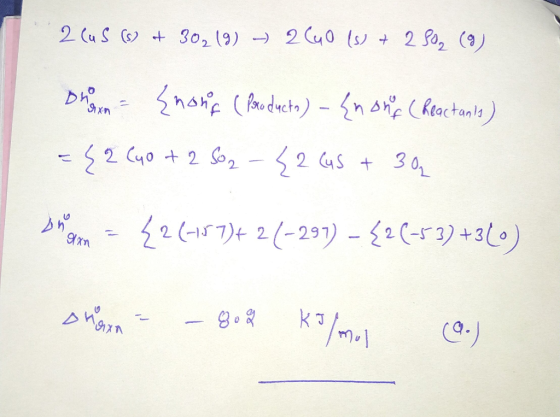
 TC04M01 Use the enthalpy changes given in the data below to calculate the enthalpy change for this reaction: Cus(s) + O2(g) → Cu(s) + SO2(9) Data: Reaction no. Reaction A.HⓇ/kJ morat 298K standard state = 1 bar. +314 2 2 CuO(s) – 2Cu(s) + O2(g) S(s) + O2(g) - S02(9) 2CuO(s) + 2S(s) - 2CuS(s) + O2(9) -297 +208 Select one: a. +225 kJ/mol b.-85 kJ/mol O C. -244 kJ/mol d. -191 kJ/mol e. -225 kJ/mol
Use Hess's law to calculate standard enthalpy change of formation at 298K for carbon (iv) sulphide...
Use Hess's law to calculate standard enthalpy change of formation at 298K for carbon (iv) sulphide compound, Cs2. Given that: Cs2(s) + 3O2(g) - Co2(g) + 2So2(g) ∆H°298= -1113KJ/mol C(s) + O2(g) - Co2(g). ∆H°298 = -407 KJ/mol S(s) + O2(g) - So2(g) ∆H°298 = -298 KJ/mol
HQ11.49 Homework Unanswered Use standard enthalpies of formation to calculate the standard enthalpy of reaction for...
 HQ11.49 Homework Unanswered Use standard enthalpies of formation to calculate the standard enthalpy of reaction for the following reaction: 2 H2S(g)+302(g)-2 H20()+2 SO2(g) AH° XT тхn Numeric Answer:
A.Using standard heats of formation, calculate the standard enthalpy change for the following reaction. N2(g) +...
A.Using standard heats of formation, calculate the standard enthalpy change for the following reaction. N2(g) + 3H2(g) = 2NH3(g) B.Using standard heats of formation, calculate the standard enthalpy change for the following reaction. CaCO3(s) = CaO(s) + CO2(g) C. A scientist measures the standard enthalpy change for the following reaction to be -2910.6 kJ: 2C2H6(g) + 7 O2(g) = 4CO2(g) + 6 H2O(g) Based on this value and the standard enthalpies of formation for the other substances, the standard enthalpy...
4. Use a standard enthalpies of formation values below to determine the change in enthalpy for...
 4. Use a standard enthalpies of formation values below to determine the change in enthalpy for each of these reactions. Reaction: NaOH(s) + HCl(g) → NaCl(s) + H2O(g) Compound NaOH(s) HCl(g) NaCl(s) H2O(g) AHF (kJ/mol) -426.7 -92.3 -411.0 -241.8
Use a standard enthalpies of formation values below to determine the change in enthalpy for each...
Use a standard enthalpies of formation values below to determine the change in enthalpy for each of these reactions. SHOW WORK PLEASE. Reaction: NaOH(s) + HCl(g) →NaCl(s) + H2O(g) Compound ∆Hf (kJ/mol) NaOH(s) -426.7 HCl(g) -92.3 NaCl(s) -411.0 H2O(g) -241.8
Using the standard enthalpies of formation in the table below, calculate the amount of heat required to form 30.21 g of...
 Using the standard enthalpies of formation in the table below, calculate the amount of heat required to form 30.21 g of liquid carbon tetrachloride from methane and chlorine gas, producing only gaseous hydrogen chloride as a byproduct. Substance AFH° / kJ mol-1 CH4(9) -74.87 CC140) -128.1 HCl(g) -92.31 Select one: o a.-28.584 kJ O b. -82.972 kJ C. -422.5 kJ O d. -25.159 kJ o e. -128.1 kJ
TABLE 7.2 Some Standard Molar Enthalpies of Fa AcHº at 298.15 K Substance kJ/mola Substance CO(g) CO2(g) CH4(g) C2H2(g)...
 TABLE 7.2 Some Standard Molar Enthalpies of Fa AcHº at 298.15 K Substance kJ/mola Substance CO(g) CO2(g) CH4(g) C2H2(g) C2H4(g) C2H6(g) C3H8(g) C4H10(g) CH3OH(1) C2H5OH(1) HF(g) HCl(g) -110.5 -393.5 - 74.81 226.7 52.26 -84.68 - 103.8 – 125.6 –238.7 –277.7 -271.1 -92.31 HBr(g) HI(g) H2O(g) H2O(1) H2S(g) NH3(g) NO(g) N2O(g) NO2(g) N204(8) SO2(g) SO3(g) aValues are for reactions in which one mole of substance is formed. M been rounded off to four significant figures. (Reference to Equation 7.22): A Hº...
 TC05ЕОЗ Use the enthalpies of formation given in the table below to calculate the standard molar enthalpy change for this reaction at 298K: 2ZnS(s) 302(g) 2ZnO(s) + 2SO2(g) Att / kJ mol at 298K, standard state 1 bar, Substance ZnO(s) -350 SO2(g) -297 ZnS(s) -206 Select one: a. -441 kJ mor1 b. -853 kJ mol1 c. +882 kJ mol 1 d. +441 kJ molr1 e. -882 kJ mol1 TСОЗЕОЗ A chemical reaction carried out at an ambient pressure of 1.02...
 TC04M01 Use the enthalpy changes given in the data below to calculate the enthalpy change for this reaction: Cus(s) + O2(g) → Cu(s) + SO2(9) Data: Reaction no. Reaction A.HⓇ/kJ morat 298K standard state = 1 bar. +314 2 2 CuO(s) – 2Cu(s) + O2(g) S(s) + O2(g) - S02(9) 2CuO(s) + 2S(s) - 2CuS(s) + O2(9) -297 +208 Select one: a. +225 kJ/mol b.-85 kJ/mol O C. -244 kJ/mol d. -191 kJ/mol e. -225 kJ/mol
 HQ11.49 Homework Unanswered Use standard enthalpies of formation to calculate the standard enthalpy of reaction for the following reaction: 2 H2S(g)+302(g)-2 H20()+2 SO2(g) AH° XT тхn Numeric Answer:
 4. Use a standard enthalpies of formation values below to determine the change in enthalpy for each of these reactions. Reaction: NaOH(s) + HCl(g) → NaCl(s) + H2O(g) Compound NaOH(s) HCl(g) NaCl(s) H2O(g) AHF (kJ/mol) -426.7 -92.3 -411.0 -241.8
 Using the standard enthalpies of formation in the table below, calculate the amount of heat required to form 30.21 g of liquid carbon tetrachloride from methane and chlorine gas, producing only gaseous hydrogen chloride as a byproduct. Substance AFH° / kJ mol-1 CH4(9) -74.87 CC140) -128.1 HCl(g) -92.31 Select one: o a.-28.584 kJ O b. -82.972 kJ C. -422.5 kJ O d. -25.159 kJ o e. -128.1 kJ
 TABLE 7.2 Some Standard Molar Enthalpies of Fa AcHº at 298.15 K Substance kJ/mola Substance CO(g) CO2(g) CH4(g) C2H2(g) C2H4(g) C2H6(g) C3H8(g) C4H10(g) CH3OH(1) C2H5OH(1) HF(g) HCl(g) -110.5 -393.5 - 74.81 226.7 52.26 -84.68 - 103.8 – 125.6 –238.7 –277.7 -271.1 -92.31 HBr(g) HI(g) H2O(g) H2O(1) H2S(g) NH3(g) NO(g) N2O(g) NO2(g) N204(8) SO2(g) SO3(g) aValues are for reactions in which one mole of substance is formed. M been rounded off to four significant figures. (Reference to Equation 7.22): A Hº...
Most questions answered within 3 hours.
-
Where is the error in this code sequence?
String s1 = "Hello";
String s2 = "ello";...
asked 11 months ago -
Financial data for Joel de Paris, Inc., for last year
follow:
Joel de Paris, Inc.
Balance...
asked 11 months ago -
Consider this reaction:
Al2(SO4)3 (aq)+ BaCl3
(aq) Al2Cl6 (aq)- +
3BaSO4(s) . What is the...
asked 11 months ago -
Suppose that Savneet is considering increasing her
recent random sample from 20 car rentals to 40...
asked 11 months ago -
Trucks arrive at an unloading terminal at an average rate of 120
per hour.
Trucks arrive...
asked 11 months ago -
Why are methanol and ethanol completely soluble in water while
octanol is not very little soluble....
asked 11 months ago -
A facilities manager at a university reads in a research report
that the mean amount of...
asked 11 months ago -
When the CuSO4 is rehydrated by adding water to the anhydrous
compound, is this an endothermic...
asked 11 months ago -
A ray of sunlight is passing from diamond into crown glass; the
angle of incidence is...
asked 11 months ago -
A block of mass 0.249 kg is placed on top of a light, vertical
spring of...
asked 11 months ago -
how do the kidneys compensate in the presences of acidosis
a) trigger hyperventilate
b) reserve acid...
asked 11 months ago -
Question 501 pts
The rental rate of capital to the firm increases. Which of the
following...
asked 11 months ago