
Also, how can I generate a plot showing this on Mathematica using integration?
Homework Answers
F(x) = -kx +kx3/
The force is 0 at x=0
=> the particle is pushed to the origin and has least PE at the origin we can take this as reference potential at set it to 0
The particle has an energy E = k/4
The particle moves in the force field until its PE is equal to
k/4 , i.e.
work done against the force.
k/4 =
-kx2/2 + kx4/4
k>0
solving this eq. we get
out of this 2 or imaginary roots.
the real roots are
The particle will oscillate between these 2 points.
To generate the plot for U(x) you must know the values for k and
You can put any assumed values in the expression and draw the
plot , you will get the shape of the curve. The shape remains same
for any values of k and
Add Answer to:
Also, how can I generate a plot showing this on Mathematica
using integration?
(40pt) A particle...
The figure shows a plot of potential energy U versus position x of a 0.280 kg particle that can t...
 The figure shows a plot of potential energy U versus
position x of a 0.280 kg particle that can travel only
along an x axis under the influence of a conservative
force. The graph has these values: UA
= 9.00 J, UC = 20.0 J and
UD = 24.0 J. The particle is released
at the point where U forms a “potential hill” of “height”
UB = 12.0 J, with kinetic energy 5.00
J. What is the speed of the...
The figure shows a plot of potential energy U versus
position x of a 0.280 kg particle that can travel only
along an x axis under the influence of a conservative
force. The graph has these values: UA
= 9.00 J, UC = 20.0 J and
UD = 24.0 J. The particle is released
at the point where U forms a “potential hill” of “height”
UB = 12.0 J, with kinetic energy 5.00
J. What is the speed of the...
A particle is constrained to move along the positive x-axis under the influence of a force...
 A particle is constrained to move along the positive x-axis under the influence of a force whose potential energy is U(x) = U_0(2 cos x/a - x/a) where U_0 and a are positive constants. Plot U versus x. A simple hand sketch is fine. Find the equilibrium point(s). For each equilibrium point, determine whether the equilibrium is stable or unstable.
A particle is moving to the right with initial kinetic energy To, subject to a force...
 A particle is moving to the right with initial kinetic energy To, subject to a force F(z)k function U(x) for this force ; (b) the kinetic energy and (c) the total energy of the particle as a function of its position; (d) find the turning points of the motion and the condition the total energy of the particle must satisfy if its motion is to exhibit turning points. (e) Sketch the potential, kinetic and total energy function (you can use...
2. Consider a point particle of mass m undergoing a one-dimensional motion under the action of...
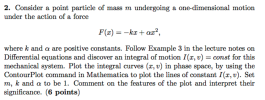 2. Consider a point particle of mass m undergoing a one-dimensional motion under the action of a force F(x) =-kx + az where k and ? are positive constants. Follow Example 3 in the lecture notes on Differential equations and discover an integral of motion I(x,v) - const for this mechanical system. Plot the integral curves (x, v) in phase space, by using the ContourPlot command in Mathematica to plot the lines of constant I(x,v). Set significance. (6 points)
Question 2: A particle of mass m moves in a potential energy U(x) that is zero...
 Question 2: A particle of mass m moves in a potential energy U(x) that is zero forェ* 0 and is-oo at r-0. This is am attractive delta function, very odd. Do not worry about the physical meaning of the potential, just roll with it for now. The system is described by the wave function Afor <0 where a is a real, positive constant with dimensions of 1/Length, and A is the normalization constant, treat it as a unknown complex-number for...
Question 7 The figure shows a plot of potential energy U versus position x of a...
 Question 7 The figure shows a plot of potential energy U versus position x of a 0.220 kg particle that can travel only along an x axis under the influence of a conservative force. The graph has these values: UA = 9.00 J, Uc = 20.0 J and UD-24.0 J. The particle is released at the point where U forms a "potential hiir of "height" UB-12.0J, with kinetic energy 5.00 J. What is the speed of the particle at (a)x...
A particle that can move along the x-axis experiences an interaction force Fx=(3x2−5x)N where x is...
A particle that can move along the x-axis experiences an interaction force Fx=(3x2−5x)N where x is in m. Find an expression for the system's potential energy. Express your answer in terms of the variables x and the constant of integration C, where C is in joules.
Up x (m) Figure 5 Figure 6 Figure 6 above shows a plot of potential energy...
 Up x (m) Figure 5 Figure 6 Figure 6 above shows a plot of potential energy U versus position x of a 0.200 kg particle that can travel only along an x axis under the influence of a conservative force. The graph has these values: UA 9.00 J, Uc-20.00 J, and UD- 24.00 J. The particle is released at the point where U forms a "potential hill" of "height" UB 12.00 J, with kinetic energy of 4.00 J. If it...
5. Consider a particle moving in the region x>0 under the influence of the potential U(x)...
 5. Consider a particle moving in the region x>0 under the influence of the potential U(x) = C (a/x + x/a), where C=1J, and a=2m. (a) Find the equilibrium positions and determine whether they are stable or unstable. (b) Find U at those equilibrium positions. (c) Sketch U(x) without using a computer (explain how you get the sketch) and discuss the motion of the particle in details in all the different regions if its total energy E1 = 2 J,...
A particle of mass 5 kg is subject to a conservative force whose potential energy (in...
 A particle of mass 5 kg is subject to a conservative force whose potential energy (in joules) as a function of position (in meters) is given by the equation U(x) =-100x5e-1x [where x > 0] (a) Determine the position xo where the particle experiences stable equilibrium (b) Find the potential energy Uo of the particle at the position x 2106 The particle is displaced slightly from position x = xo and released (c) Determine the effective value of the spring...
 The figure shows a plot of potential energy U versus
position x of a 0.280 kg particle that can travel only
along an x axis under the influence of a conservative
force. The graph has these values: UA
= 9.00 J, UC = 20.0 J and
UD = 24.0 J. The particle is released
at the point where U forms a “potential hill” of “height”
UB = 12.0 J, with kinetic energy 5.00
J. What is the speed of the...
The figure shows a plot of potential energy U versus
position x of a 0.280 kg particle that can travel only
along an x axis under the influence of a conservative
force. The graph has these values: UA
= 9.00 J, UC = 20.0 J and
UD = 24.0 J. The particle is released
at the point where U forms a “potential hill” of “height”
UB = 12.0 J, with kinetic energy 5.00
J. What is the speed of the...
 A particle is constrained to move along the positive x-axis under the influence of a force whose potential energy is U(x) = U_0(2 cos x/a - x/a) where U_0 and a are positive constants. Plot U versus x. A simple hand sketch is fine. Find the equilibrium point(s). For each equilibrium point, determine whether the equilibrium is stable or unstable.
 A particle is moving to the right with initial kinetic energy To, subject to a force F(z)k function U(x) for this force ; (b) the kinetic energy and (c) the total energy of the particle as a function of its position; (d) find the turning points of the motion and the condition the total energy of the particle must satisfy if its motion is to exhibit turning points. (e) Sketch the potential, kinetic and total energy function (you can use...
 2. Consider a point particle of mass m undergoing a one-dimensional motion under the action of a force F(x) =-kx + az where k and ? are positive constants. Follow Example 3 in the lecture notes on Differential equations and discover an integral of motion I(x,v) - const for this mechanical system. Plot the integral curves (x, v) in phase space, by using the ContourPlot command in Mathematica to plot the lines of constant I(x,v). Set significance. (6 points)
 Question 2: A particle of mass m moves in a potential energy U(x) that is zero forェ* 0 and is-oo at r-0. This is am attractive delta function, very odd. Do not worry about the physical meaning of the potential, just roll with it for now. The system is described by the wave function Afor <0 where a is a real, positive constant with dimensions of 1/Length, and A is the normalization constant, treat it as a unknown complex-number for...
 Question 7 The figure shows a plot of potential energy U versus position x of a 0.220 kg particle that can travel only along an x axis under the influence of a conservative force. The graph has these values: UA = 9.00 J, Uc = 20.0 J and UD-24.0 J. The particle is released at the point where U forms a "potential hiir of "height" UB-12.0J, with kinetic energy 5.00 J. What is the speed of the particle at (a)x...
 Up x (m) Figure 5 Figure 6 Figure 6 above shows a plot of potential energy U versus position x of a 0.200 kg particle that can travel only along an x axis under the influence of a conservative force. The graph has these values: UA 9.00 J, Uc-20.00 J, and UD- 24.00 J. The particle is released at the point where U forms a "potential hill" of "height" UB 12.00 J, with kinetic energy of 4.00 J. If it...
 5. Consider a particle moving in the region x>0 under the influence of the potential U(x) = C (a/x + x/a), where C=1J, and a=2m. (a) Find the equilibrium positions and determine whether they are stable or unstable. (b) Find U at those equilibrium positions. (c) Sketch U(x) without using a computer (explain how you get the sketch) and discuss the motion of the particle in details in all the different regions if its total energy E1 = 2 J,...
 A particle of mass 5 kg is subject to a conservative force whose potential energy (in joules) as a function of position (in meters) is given by the equation U(x) =-100x5e-1x [where x > 0] (a) Determine the position xo where the particle experiences stable equilibrium (b) Find the potential energy Uo of the particle at the position x 2106 The particle is displaced slightly from position x = xo and released (c) Determine the effective value of the spring...
Most questions answered within 3 hours.
-
Where is the error in this code sequence?
String s1 = "Hello";
String s2 = "ello";...
asked 10 months ago -
Financial data for Joel de Paris, Inc., for last year
follow:
Joel de Paris, Inc.
Balance...
asked 10 months ago -
Consider this reaction:
Al2(SO4)3 (aq)+ BaCl3
(aq) Al2Cl6 (aq)- +
3BaSO4(s) . What is the...
asked 10 months ago -
Suppose that Savneet is considering increasing her
recent random sample from 20 car rentals to 40...
asked 10 months ago -
Trucks arrive at an unloading terminal at an average rate of 120
per hour.
Trucks arrive...
asked 10 months ago -
Why are methanol and ethanol completely soluble in water while
octanol is not very little soluble....
asked 10 months ago -
A facilities manager at a university reads in a research report
that the mean amount of...
asked 10 months ago -
When the CuSO4 is rehydrated by adding water to the anhydrous
compound, is this an endothermic...
asked 10 months ago -
A ray of sunlight is passing from diamond into crown glass; the
angle of incidence is...
asked 10 months ago -
A block of mass 0.249 kg is placed on top of a light, vertical
spring of...
asked 10 months ago -
how do the kidneys compensate in the presences of acidosis
a) trigger hyperventilate
b) reserve acid...
asked 10 months ago -
Question 501 pts
The rental rate of capital to the firm increases. Which of the
following...
asked 10 months ago