

Homework Answers
Add Answer to:
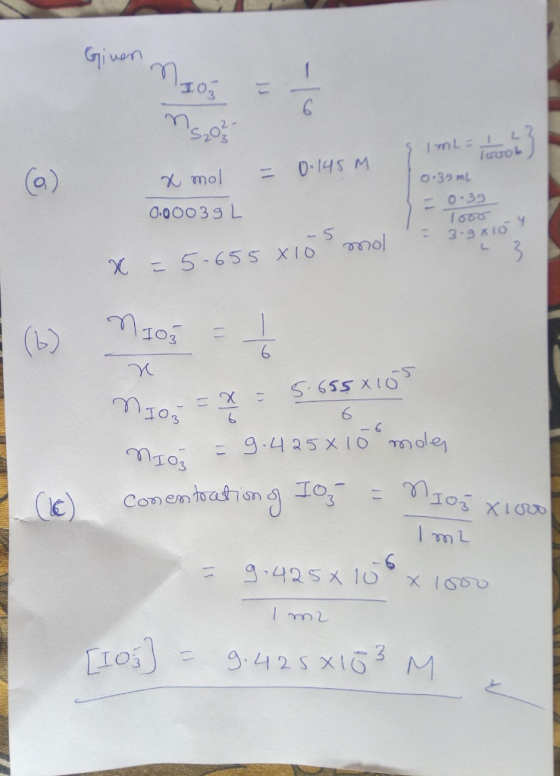
1. Solubility in water that in part one of the lab you determined that [S203= 0.145...
Pre-Lab for Determination of Solubility Product Constant 1. Write the solubility product constant (Ksp) for the...
 Pre-Lab for Determination of Solubility Product Constant 1. Write the solubility product constant (Ksp) for the following reaction as a function of the concentrations of the products: Ca(103) (s) Ca²+ (aq) + 210,- (aq) 2. Ca(IO3)2 will ionize in water to produce 10, ions. The 10, ions will react with KI. Write the reaction for this reaction. 3. We will be using starch as an indicator. Why? 4. In this experiment, we will first produce Izby mixing calcium iodate with...
Pre-Lab: Solubility and the Common-Ion Effect Name: (You must show work for credit) 1. The solubility...
 Pre-Lab: Solubility and the Common-Ion Effect Name: (You must show work for credit) 1. The solubility of silver carbonate (mm is its Ksp? 275.745), is 33.5 mg/L. What is its molar solubility, and what A student preforming the lab for the solubility of calcium iodate, titrated a 10.00 mL sample of saturated calcium iodate solution with a 0.011 M sodium thiosulfate solution, The titration required 21.62 mL to turn the solution clear. What was the concentration of the iodate in...
1. The Molar Solubility of Ca(10), in Pure Water Temperature of the saturated solution of calcium...
 1. The Molar Solubility of Ca(10), in Pure Water Temperature of the saturated solution of calcium iodate: Volume (or mass) of saturated calcium iodate solution titrated: 25 °C 10 ml (or g) Dat Trial 1 Trial 2 Trial 3 Volume of Na S o titrant Final buret reading Initial buret reading ml mL mL mL Net volume of Na So 26.621 mL 30.019 mL Calculated concentration of 10 Standardized 0.05 M sodium thiosulfate (Na,8,0,) solution (10,51(E) - TIL 10 mols.0.2...
1. The Molar Solubility of Ca(10), in Pure Water Temperature of the saturated solution of calcium...
 1. The Molar Solubility of Ca(10), in Pure Water Temperature of the saturated solution of calcium iodate: Volume (or mass) of saturated calcium iodate solution titrated: 25 °C 10 ml (or g) Dat Trial 1 Trial 2 Trial 3 Volume of Na S o titrant Final buret reading Initial buret reading ml mL mL mL Net volume of Na So 26.621 mL 30.019 mL Calculated concentration of 10 Standardized 0.05 M sodium thiosulfate (Na,8,0,) solution (10,51(E) - TIL 10 mols.0.2...
#2 please. I have attached info for part 1 goal #3 demonstrate the calculations w OIVO...
 #2 please. I have attached info for part 1 goal
#3
demonstrate the calculations
w OIVO SU UGLUUL iz. Demonstrate through mole calculations that iodate was indeed the limiting reactant in the production of triiodide in Part 1 - Goal 3 (titration) of this study. You have three reactants to consider KI, 103, and H. Refer to the titration for Molarities and quantities used for each reactant. Assume that 10 mL of Klau) contains 1 gram of Klin) Goal #3:...
#2 please. I have attached info for part 1 goal
#3
demonstrate the calculations
w OIVO SU UGLUUL iz. Demonstrate through mole calculations that iodate was indeed the limiting reactant in the production of triiodide in Part 1 - Goal 3 (titration) of this study. You have three reactants to consider KI, 103, and H. Refer to the titration for Molarities and quantities used for each reactant. Assume that 10 mL of Klau) contains 1 gram of Klin) Goal #3:...
Need help with 3-6 Determination of Solubility Product Constant 10.7 Name Section PRE-LAB 1. In your...
 Need help with 3-6
Determination of Solubility Product Constant 10.7 Name Section PRE-LAB 1. In your own words explain the common ion effect. The common ion effect is when the solubility of a salt is affected by the presence of an ion which is common to any of the ions in the salt. 2. What would happen to the volume of titrant needed to reach the equivalence point, if some of the solid particles were part of the analyte transferred...
Need help with 3-6
Determination of Solubility Product Constant 10.7 Name Section PRE-LAB 1. In your own words explain the common ion effect. The common ion effect is when the solubility of a salt is affected by the presence of an ion which is common to any of the ions in the salt. 2. What would happen to the volume of titrant needed to reach the equivalence point, if some of the solid particles were part of the analyte transferred...
1. How many moles of ions are in the following solutions: 32.5mg potassium sulfate in water;...
1. How many moles of ions are in the following solutions: 32.5mg potassium sulfate in water; 1 mol MgBr2 in C6H6? 2. Given the following reaction and solubility data, how many moles of total ions are in solution once the reaction is complete starting with 25g of each reactant in 1L? Na3PO4 + Ca(NO3)2 --> NaNO3 + Ca3(PO4)2 COMPOUND SOLUBILITY SODIUM PHOSPHATE 94.6g/100mL CALCIUM NITRATE 120g/100mL SODIUM NITRATE 91.2g/100 mL CALCIUM PHOSPHATE 2mg/100mL
As part of Lab 11 you will make and standardize a solution of NaOH(aq). Suppose in the lab you measure the solid NaOH an...
As part of Lab 11 you will make and standardize a solution of NaOH(aq). Suppose in the lab you measure the solid NaOH and dissolve it into 100.0 mL of water. You then measure 0.1993 g of KHP (204.22 g/mol) and place it in a clean, dry 100-mL beaker, and then dissolve the KHP in about 25 mL of water and add a couple of drops of phenolphthalein indicator. You titrate this with your NaOH(aq) solution and find that the...
Please help me with questions 3-5 You are expected to come to lab with these questions...
 Please help me with questions 3-5
You are expected to come to lab with these questions answered They will be taken up at the beginning of the lab period in which you perform this experiment. 1. The lab report gives you the net ionic equation rather than the molecular equation for the clock reaction. Were there any spectator ions present when you ran your reactions, if so what were they? 2. The two ions that react in this experiment are...
Please help me with questions 3-5
You are expected to come to lab with these questions answered They will be taken up at the beginning of the lab period in which you perform this experiment. 1. The lab report gives you the net ionic equation rather than the molecular equation for the clock reaction. Were there any spectator ions present when you ran your reactions, if so what were they? 2. The two ions that react in this experiment are...
Part A and Part B. Also question #3-post lab. (its circled) A. Molar Solubility and Solubility Product of Calcium Hydroxide Trial I Trial 3 Trial 2 25.0 1. Volume of saturated Ca(OH), solution (m...
 Part A and Part B.
Also question #3-post lab. (its circled)
A. Molar Solubility and Solubility Product of Calcium Hydroxide Trial I Trial 3 Trial 2 25.0 1. Volume of saturated Ca(OH), solution (mL) 2. Concentration of standardized HCl solution (molU/L) 3. Buret reading, initial (mL 4. Buret reading, final (mL) 5. Volume of HCI added (mL) 6. Moles of HCI added (mol) 7. Moles of OH" in saturated solution (mol) 8. (OH1, equilibrium (mol/L) 9. (Ca2 ], equilibrium (mol/L)...
Part A and Part B.
Also question #3-post lab. (its circled)
A. Molar Solubility and Solubility Product of Calcium Hydroxide Trial I Trial 3 Trial 2 25.0 1. Volume of saturated Ca(OH), solution (mL) 2. Concentration of standardized HCl solution (molU/L) 3. Buret reading, initial (mL 4. Buret reading, final (mL) 5. Volume of HCI added (mL) 6. Moles of HCI added (mol) 7. Moles of OH" in saturated solution (mol) 8. (OH1, equilibrium (mol/L) 9. (Ca2 ], equilibrium (mol/L)...
 Pre-Lab for Determination of Solubility Product Constant 1. Write the solubility product constant (Ksp) for the following reaction as a function of the concentrations of the products: Ca(103) (s) Ca²+ (aq) + 210,- (aq) 2. Ca(IO3)2 will ionize in water to produce 10, ions. The 10, ions will react with KI. Write the reaction for this reaction. 3. We will be using starch as an indicator. Why? 4. In this experiment, we will first produce Izby mixing calcium iodate with...
 Pre-Lab: Solubility and the Common-Ion Effect Name: (You must show work for credit) 1. The solubility of silver carbonate (mm is its Ksp? 275.745), is 33.5 mg/L. What is its molar solubility, and what A student preforming the lab for the solubility of calcium iodate, titrated a 10.00 mL sample of saturated calcium iodate solution with a 0.011 M sodium thiosulfate solution, The titration required 21.62 mL to turn the solution clear. What was the concentration of the iodate in...
 1. The Molar Solubility of Ca(10), in Pure Water Temperature of the saturated solution of calcium iodate: Volume (or mass) of saturated calcium iodate solution titrated: 25 °C 10 ml (or g) Dat Trial 1 Trial 2 Trial 3 Volume of Na S o titrant Final buret reading Initial buret reading ml mL mL mL Net volume of Na So 26.621 mL 30.019 mL Calculated concentration of 10 Standardized 0.05 M sodium thiosulfate (Na,8,0,) solution (10,51(E) - TIL 10 mols.0.2...
 1. The Molar Solubility of Ca(10), in Pure Water Temperature of the saturated solution of calcium iodate: Volume (or mass) of saturated calcium iodate solution titrated: 25 °C 10 ml (or g) Dat Trial 1 Trial 2 Trial 3 Volume of Na S o titrant Final buret reading Initial buret reading ml mL mL mL Net volume of Na So 26.621 mL 30.019 mL Calculated concentration of 10 Standardized 0.05 M sodium thiosulfate (Na,8,0,) solution (10,51(E) - TIL 10 mols.0.2...
 #2 please. I have attached info for part 1 goal
#3
demonstrate the calculations
w OIVO SU UGLUUL iz. Demonstrate through mole calculations that iodate was indeed the limiting reactant in the production of triiodide in Part 1 - Goal 3 (titration) of this study. You have three reactants to consider KI, 103, and H. Refer to the titration for Molarities and quantities used for each reactant. Assume that 10 mL of Klau) contains 1 gram of Klin) Goal #3:...
#2 please. I have attached info for part 1 goal
#3
demonstrate the calculations
w OIVO SU UGLUUL iz. Demonstrate through mole calculations that iodate was indeed the limiting reactant in the production of triiodide in Part 1 - Goal 3 (titration) of this study. You have three reactants to consider KI, 103, and H. Refer to the titration for Molarities and quantities used for each reactant. Assume that 10 mL of Klau) contains 1 gram of Klin) Goal #3:...
 Need help with 3-6
Determination of Solubility Product Constant 10.7 Name Section PRE-LAB 1. In your own words explain the common ion effect. The common ion effect is when the solubility of a salt is affected by the presence of an ion which is common to any of the ions in the salt. 2. What would happen to the volume of titrant needed to reach the equivalence point, if some of the solid particles were part of the analyte transferred...
Need help with 3-6
Determination of Solubility Product Constant 10.7 Name Section PRE-LAB 1. In your own words explain the common ion effect. The common ion effect is when the solubility of a salt is affected by the presence of an ion which is common to any of the ions in the salt. 2. What would happen to the volume of titrant needed to reach the equivalence point, if some of the solid particles were part of the analyte transferred...
 Please help me with questions 3-5
You are expected to come to lab with these questions answered They will be taken up at the beginning of the lab period in which you perform this experiment. 1. The lab report gives you the net ionic equation rather than the molecular equation for the clock reaction. Were there any spectator ions present when you ran your reactions, if so what were they? 2. The two ions that react in this experiment are...
Please help me with questions 3-5
You are expected to come to lab with these questions answered They will be taken up at the beginning of the lab period in which you perform this experiment. 1. The lab report gives you the net ionic equation rather than the molecular equation for the clock reaction. Were there any spectator ions present when you ran your reactions, if so what were they? 2. The two ions that react in this experiment are...
 Part A and Part B.
Also question #3-post lab. (its circled)
A. Molar Solubility and Solubility Product of Calcium Hydroxide Trial I Trial 3 Trial 2 25.0 1. Volume of saturated Ca(OH), solution (mL) 2. Concentration of standardized HCl solution (molU/L) 3. Buret reading, initial (mL 4. Buret reading, final (mL) 5. Volume of HCI added (mL) 6. Moles of HCI added (mol) 7. Moles of OH" in saturated solution (mol) 8. (OH1, equilibrium (mol/L) 9. (Ca2 ], equilibrium (mol/L)...
Part A and Part B.
Also question #3-post lab. (its circled)
A. Molar Solubility and Solubility Product of Calcium Hydroxide Trial I Trial 3 Trial 2 25.0 1. Volume of saturated Ca(OH), solution (mL) 2. Concentration of standardized HCl solution (molU/L) 3. Buret reading, initial (mL 4. Buret reading, final (mL) 5. Volume of HCI added (mL) 6. Moles of HCI added (mol) 7. Moles of OH" in saturated solution (mol) 8. (OH1, equilibrium (mol/L) 9. (Ca2 ], equilibrium (mol/L)...
Most questions answered within 3 hours.
-
Where is the error in this code sequence?
String s1 = "Hello";
String s2 = "ello";...
asked 11 months ago -
Financial data for Joel de Paris, Inc., for last year
follow:
Joel de Paris, Inc.
Balance...
asked 11 months ago -
Consider this reaction:
Al2(SO4)3 (aq)+ BaCl3
(aq) Al2Cl6 (aq)- +
3BaSO4(s) . What is the...
asked 11 months ago -
Suppose that Savneet is considering increasing her
recent random sample from 20 car rentals to 40...
asked 11 months ago -
Trucks arrive at an unloading terminal at an average rate of 120
per hour.
Trucks arrive...
asked 11 months ago -
Why are methanol and ethanol completely soluble in water while
octanol is not very little soluble....
asked 11 months ago -
A facilities manager at a university reads in a research report
that the mean amount of...
asked 11 months ago -
When the CuSO4 is rehydrated by adding water to the anhydrous
compound, is this an endothermic...
asked 11 months ago -
A ray of sunlight is passing from diamond into crown glass; the
angle of incidence is...
asked 11 months ago -
A block of mass 0.249 kg is placed on top of a light, vertical
spring of...
asked 11 months ago -
how do the kidneys compensate in the presences of acidosis
a) trigger hyperventilate
b) reserve acid...
asked 11 months ago -
Question 501 pts
The rental rate of capital to the firm increases. Which of the
following...
asked 11 months ago