
Homework Answers
Add Answer to:
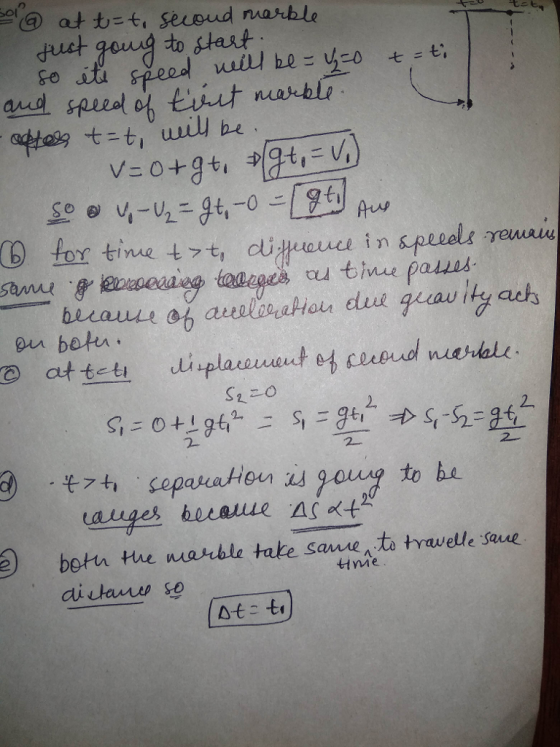
Two marbles are released from the same height. The first marble is released at time t...
A proton and an electron are released from rest at the same time from the midpoint...
A proton and an electron are released from rest at the same time from the midpoint between two charged parallel plates. The plates are charged with equal surface charge densities of opposite signs. Ignore the interaction between the electron and the proton and consider only the interaction of each charge with the electric field of the plates. After being released, the proton will accelerate toward the negative plate, and the electron will accelerate toward the positive plate. (a) Which charge...
A proton and an electron are released from rest at the same time from the midpoint...
 A proton and an electron are released from rest at the same time from the midpoint between two charged parallel plates. The plates are charged with equal surface charge densities of opposite signs. Ignore the interaction between the electron and the proton and consider only the interaction of each charge with the electric field of the plates. After being released, the proton will accelerate toward the negative plate, and the electron will accelerate toward the positive plate. (a) Which charge...
Two objects are allowed to fall from the same height to the ground. They both start...
Two objects are allowed to fall from the same height to the ground. They both start from rest at the same time. One is just released and falls straight downward. The other is placed on a frictionless inclined plane that makes an angle of θ with the horizontal. Which one hits the ground with the highest speed? Ignore air resistance. Group of answer choices You need the angle of the incline to determine the answer. The object that falls straight...
Two identical objects start at the same height above level ground. Simultaneously, object A is dropped...
Two identical objects start at the same height above level ground. Simultaneously, object A is dropped and object B is launched horizontally with a speed of 20 m/s. Assume that air resistance is negligible. a) Which object hits the ground first, or do they hit the ground at the same time? b) Which object hits the ground with the greatest speed, or do they hit the ground with the same speed? c) If the two objects started at a height...
Two stones are relensed from rest at the same height, one after the other, so that...
 Two stones are relensed from rest at the same height, one after the other, so that they fall along the me vertical line. During the time that they are free falling (ignore air resistance) which of the following three statements is true? As time passes, the distance between the two stones: A. increases B. decreases C. stays the same Two stones are released from rest at the same height, one after the other, so that they fall along the same...
one-dimensional movement exercise: Two balls are dropped in a vacuum from the same height, but at...
one-dimensional movement exercise: Two balls are dropped in a vacuum from the same height, but at different times; The second ball hits the ground 1.35 seconds after the first hits the ground. A. from the above information, deduce an expression that allows you to find the difference between your heights (∆h = h2-h1)
A ball is dropped from a height 24 m above the ground at t=0.0. Each time...
A ball is dropped from a height 24 m above the ground at t=0.0. Each time it bounces from the ground, its rebound speed is 60% of its impact speed. At the instant the first ball hits the ground, a second ball is released from the same place. Take g = 9.8 m/s2. At what height above the ground will they collide? (Take the ground as y=0.0 m)
A ball is dropped from a height 24 m above the ground at t=0.0. Each time...
A ball is dropped from a height 24 m above the ground at t=0.0. Each time it bounces from the ground, its rebound speed is 60% of its impact speed. At the instant the first ball hits the ground, a second ball is released from the same place. Take g = 9.8 m/s2. At what height above the ground will they collide? (Take the ground as y=0.0 m)
Two protons are released from rest at time t = 0 at an original separation of...
Two protons are released from rest at time t = 0 at an original separation of L. Assume no other forces are relevant for this problem. a) Write a function relating the protons’ separation L to time with all units in mks. Since it is very hard to write this as separation L as a function of time t, instead write time t as a function of separation L.
Two tanks are engaged in a training exercise on level ground. The first tank fires a...
Two tanks are engaged in a training exercise on level ground. The first tank fires a paint-filled training round with a muzzle speed of 244 m/s at an angle 11.6 ∘ above the horizontal while advancing toward the second tank with a speed of 14.0 m/s relative to the ground. The second tank is retreating at a speed of 33.5 m/s relative to the ground, but is hit by the shell. You can ignore air resistance and assume the shell...
 A proton and an electron are released from rest at the same time from the midpoint between two charged parallel plates. The plates are charged with equal surface charge densities of opposite signs. Ignore the interaction between the electron and the proton and consider only the interaction of each charge with the electric field of the plates. After being released, the proton will accelerate toward the negative plate, and the electron will accelerate toward the positive plate. (a) Which charge...
 Two stones are relensed from rest at the same height, one after the other, so that they fall along the me vertical line. During the time that they are free falling (ignore air resistance) which of the following three statements is true? As time passes, the distance between the two stones: A. increases B. decreases C. stays the same Two stones are released from rest at the same height, one after the other, so that they fall along the same...
Most questions answered within 3 hours.
-
Where is the error in this code sequence?
String s1 = "Hello";
String s2 = "ello";...
asked 10 months ago -
Financial data for Joel de Paris, Inc., for last year
follow:
Joel de Paris, Inc.
Balance...
asked 10 months ago -
Consider this reaction:
Al2(SO4)3 (aq)+ BaCl3
(aq) Al2Cl6 (aq)- +
3BaSO4(s) . What is the...
asked 10 months ago -
Suppose that Savneet is considering increasing her
recent random sample from 20 car rentals to 40...
asked 10 months ago -
Trucks arrive at an unloading terminal at an average rate of 120
per hour.
Trucks arrive...
asked 10 months ago -
Why are methanol and ethanol completely soluble in water while
octanol is not very little soluble....
asked 10 months ago -
A facilities manager at a university reads in a research report
that the mean amount of...
asked 10 months ago -
When the CuSO4 is rehydrated by adding water to the anhydrous
compound, is this an endothermic...
asked 10 months ago -
A ray of sunlight is passing from diamond into crown glass; the
angle of incidence is...
asked 10 months ago -
A block of mass 0.249 kg is placed on top of a light, vertical
spring of...
asked 10 months ago -
how do the kidneys compensate in the presences of acidosis
a) trigger hyperventilate
b) reserve acid...
asked 10 months ago -
Question 501 pts
The rental rate of capital to the firm increases. Which of the
following...
asked 10 months ago