Lily’s Lemonade Stand makes three types of lemonade: pure, raspberry, and strawberry. The lemonade is produced...
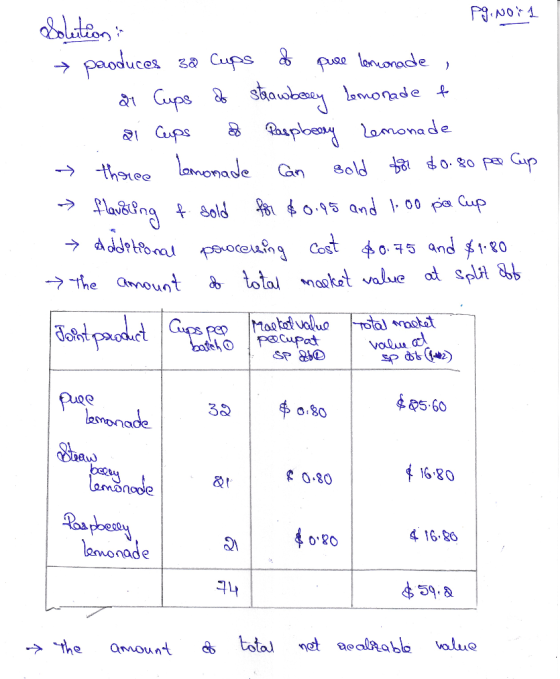
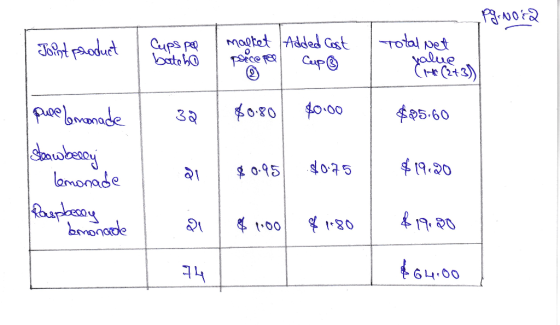
Lily’s Lemonade Stand makes three types of lemonade: pure, raspberry, and strawberry. The lemonade is produced through a joint mixing process that costs a total of $30 per batch. One batch produces 32 cups of pure lemonade, 21 cups of strawberry lemonade, and 21 cups of raspberry lemonade. After the split-off point, all three lemonades can be sold for $0.80 per cup, but strawberry and raspberry lemonade can be processed further by adding artificial coloring and flavoring and sold for $0.95 and $1.00 per cup, respectively. It is estimated that these additional processing costs are $0.75 and $1.80 per batch for strawberry and raspberry lemonade, respectively. Allocate the joint costs of production to each product using the net realizable value method
Homework Answers
Add Answer to:
Lily’s Lemonade Stand makes three types of lemonade: pure,
raspberry, and strawberry. The lemonade is produced...
Joint Cost Allocation—Net Realizable Value Method Lily’s Lemonade Stand makes three types of lemonade: pure, raspberry,...
Joint Cost Allocation—Net Realizable Value Method Lily’s Lemonade Stand makes three types of lemonade: pure, raspberry, and strawberry. The lemonade is produced through a joint mixing process that costs a total of $30 per batch. One batch produces 32 cups of pure lemonade, 21 cups of strawberry lemonade, and 21 cups of raspberry lemonade. After the split-off point, all three lemonades can be sold for $0.80 per cup, but strawberry and raspberry lemonade can be processed further by adding artificial...
Joint Cost Allocation—Net Realizable Value Method Lily’s Lemonade Stand makes three types of lemonade: pure, raspberry,...
 Joint Cost Allocation—Net Realizable Value Method
Lily’s Lemonade Stand makes three types of lemonade: pure,
raspberry, and strawberry. The lemonade is produced through a joint
mixing process that costs a total of $30 per batch. One batch
produces 32 cups of pure lemonade, 21 cups of strawberry lemonade,
and 21 cups of raspberry lemonade. After the split-off point, all
three lemonades can be sold for $0.80 per cup, but strawberry and
raspberry lemonade can be processed further by adding artificial...
Joint Cost Allocation—Net Realizable Value Method
Lily’s Lemonade Stand makes three types of lemonade: pure,
raspberry, and strawberry. The lemonade is produced through a joint
mixing process that costs a total of $30 per batch. One batch
produces 32 cups of pure lemonade, 21 cups of strawberry lemonade,
and 21 cups of raspberry lemonade. After the split-off point, all
three lemonades can be sold for $0.80 per cup, but strawberry and
raspberry lemonade can be processed further by adding artificial...
Joint Cost Allocation-Net Realizable Value Method Lily's Lemonade Stand makes three types of lemonade: pure, raspberry,...
 Joint Cost Allocation-Net Realizable Value Method Lily's Lemonade Stand makes three types of lemonade: pure, raspberry, and strawberry. The lemonade is produced through a joint mixing process that costs a total of $30 per batch. One batch produces 32 cups of pure lemonade, 21 cups of strawberry lemonade, and 21 cups of raspberry lemonade. After the split-off point, all three lemonades can be sold for $0.80 per cup, but strawberry and raspberry lemonade can be processed further by adding artificial...
1. Support department cost allocation—sequential method Becker Tabletops has two support departments (Janitorial and Cafeteria) and...
1. Support department cost allocation—sequential method Becker Tabletops has two support departments (Janitorial and Cafeteria) and two production departments (Cutting and Assembly). Relevant details for these departments are as follows: Support Department Cost Driver Janitorial Department Square footage to be serviced Cafeteria Department Number of employees Janitorial Department Cafeteria Department Cutting Department Assembly Department Department costs $310,000 $169,000 $1,504,000 $680,000 Square feet 50 5,000 1,000 4,000 Number of employees 10 3 30 10 Allocate the support...
Gordon’s Smoothie Stand makes three types of smoothies: blueberry lemon, orange swirl, and triple berry. Before...
Gordon’s Smoothie Stand makes three types of smoothies: blueberry lemon, orange swirl, and triple berry. Before all flavors are added, the smoothies go through a joint mixing process that costs a total of $43 per batch. One batch produces 21.75 cups of blueberry lemon smoothies, 29 cups of orange swirl smoothies, and 36.25 cups of triple berry smoothies. In addition, Gordon has studiously noted that the mixing process necessary for triple berry and blueberry lemon smoothies takes twice as long...
Case Overview: You are an intelligent ten-year-old child who wants to start a lemonade stand. You...
 Case Overview:
You are an intelligent ten-year-old child who wants to start a
lemonade stand. You live in Duluth, Minnesota in a middle class
neighborhood, with all of the benefits and constraints of a typical
child of that age. As a start, you have outlined three possible
business plans:
Fresh Squeezed Plan:
Your mother has agreed to loan you $5 to get your fresh squeezed
lemonade stand started and she will let you use her lemon squeezer
at no charge,...
Case Overview:
You are an intelligent ten-year-old child who wants to start a
lemonade stand. You live in Duluth, Minnesota in a middle class
neighborhood, with all of the benefits and constraints of a typical
child of that age. As a start, you have outlined three possible
business plans:
Fresh Squeezed Plan:
Your mother has agreed to loan you $5 to get your fresh squeezed
lemonade stand started and she will let you use her lemon squeezer
at no charge,...
Joint cost allocation Lovely Lotion Inc. produces three different lotions: hand, body, and foot. The lotions...
 Joint cost allocation
Lovely Lotion Inc. produces three different lotions: hand, body,
and foot. The lotions are produced jointly in a mixing process that
costs a total of $250 per batch. At the split-off point, one batch
produces 80, 40, and 25 bottles of hand, body, and foot lotion,
respectively. After the split-off point, hand lotion is sold
immediately for $2.50 per bottle. Body lotion is processed further
at an additional cost of $0.25 per bottle and then sold for...
Joint cost allocation
Lovely Lotion Inc. produces three different lotions: hand, body,
and foot. The lotions are produced jointly in a mixing process that
costs a total of $250 per batch. At the split-off point, one batch
produces 80, 40, and 25 bottles of hand, body, and foot lotion,
respectively. After the split-off point, hand lotion is sold
immediately for $2.50 per bottle. Body lotion is processed further
at an additional cost of $0.25 per bottle and then sold for...
Joint cost allocation Lovely Lotion Inc. produces three different lotions: hand, body, and foot. The lotions...
 Joint cost allocation Lovely Lotion Inc. produces three different lotions: hand, body, and foot. The lotions are produced jointly in a mixing process that costs a total of $250 per batch. At the split-off point, one batch produces 80, 40, and 25 bottles of hand, body, and foot lotion, respectively. After the split-off point, hand lotion is sold immediately for $2.50 per bottle. Body lotion is processed further at an additional cost of $0.25 per bottle and then sold for...
The Dairy Company produces three products from a joint processes using whole milk: butter, cheese, and...
The Dairy Company produces three products from a joint processes using whole milk: butter, cheese, and cream. The joint costs amount to $24,000 per batch of output. Each batch totals 50,000 liters : 25% butter, 25%cheese, 50% cream . All products are processed further without gain or loss in volume. Separable costs are butter, $0.5 per liter, cheese , $2 per liter, cream ,$0.25 per liter . The selling prices per liter are respectively; $3.50, $6, $4. Required a) How...
Glocker Company makes three products in a single facility. These products have the following unit product...
 Glocker Company makes three products in a single facility. These products have the following unit product costs: 3 Product B 5 Direct Materials $ 10.90 $ 15.80 $ 12.60 6 Direct Labor 18.50 12.60 9 .75 7 Variable Manufacturing Overhead 2.40 1.20 1.80 8 Fixed Manufacturing Overhead 11.607.209.60 9 Unit product cost $ 43.40 $ 36.80 $ 33.75 10 11 12 Additional information about the products: Product 14 15 Mixing minutes per unit 2.00 0.50 1.00 16 Selling price per...
 Joint Cost Allocation—Net Realizable Value Method
Lily’s Lemonade Stand makes three types of lemonade: pure,
raspberry, and strawberry. The lemonade is produced through a joint
mixing process that costs a total of $30 per batch. One batch
produces 32 cups of pure lemonade, 21 cups of strawberry lemonade,
and 21 cups of raspberry lemonade. After the split-off point, all
three lemonades can be sold for $0.80 per cup, but strawberry and
raspberry lemonade can be processed further by adding artificial...
Joint Cost Allocation—Net Realizable Value Method
Lily’s Lemonade Stand makes three types of lemonade: pure,
raspberry, and strawberry. The lemonade is produced through a joint
mixing process that costs a total of $30 per batch. One batch
produces 32 cups of pure lemonade, 21 cups of strawberry lemonade,
and 21 cups of raspberry lemonade. After the split-off point, all
three lemonades can be sold for $0.80 per cup, but strawberry and
raspberry lemonade can be processed further by adding artificial...
 Joint Cost Allocation-Net Realizable Value Method Lily's Lemonade Stand makes three types of lemonade: pure, raspberry, and strawberry. The lemonade is produced through a joint mixing process that costs a total of $30 per batch. One batch produces 32 cups of pure lemonade, 21 cups of strawberry lemonade, and 21 cups of raspberry lemonade. After the split-off point, all three lemonades can be sold for $0.80 per cup, but strawberry and raspberry lemonade can be processed further by adding artificial...
 Case Overview:
You are an intelligent ten-year-old child who wants to start a
lemonade stand. You live in Duluth, Minnesota in a middle class
neighborhood, with all of the benefits and constraints of a typical
child of that age. As a start, you have outlined three possible
business plans:
Fresh Squeezed Plan:
Your mother has agreed to loan you $5 to get your fresh squeezed
lemonade stand started and she will let you use her lemon squeezer
at no charge,...
Case Overview:
You are an intelligent ten-year-old child who wants to start a
lemonade stand. You live in Duluth, Minnesota in a middle class
neighborhood, with all of the benefits and constraints of a typical
child of that age. As a start, you have outlined three possible
business plans:
Fresh Squeezed Plan:
Your mother has agreed to loan you $5 to get your fresh squeezed
lemonade stand started and she will let you use her lemon squeezer
at no charge,...
 Joint cost allocation
Lovely Lotion Inc. produces three different lotions: hand, body,
and foot. The lotions are produced jointly in a mixing process that
costs a total of $250 per batch. At the split-off point, one batch
produces 80, 40, and 25 bottles of hand, body, and foot lotion,
respectively. After the split-off point, hand lotion is sold
immediately for $2.50 per bottle. Body lotion is processed further
at an additional cost of $0.25 per bottle and then sold for...
Joint cost allocation
Lovely Lotion Inc. produces three different lotions: hand, body,
and foot. The lotions are produced jointly in a mixing process that
costs a total of $250 per batch. At the split-off point, one batch
produces 80, 40, and 25 bottles of hand, body, and foot lotion,
respectively. After the split-off point, hand lotion is sold
immediately for $2.50 per bottle. Body lotion is processed further
at an additional cost of $0.25 per bottle and then sold for...
 Joint cost allocation Lovely Lotion Inc. produces three different lotions: hand, body, and foot. The lotions are produced jointly in a mixing process that costs a total of $250 per batch. At the split-off point, one batch produces 80, 40, and 25 bottles of hand, body, and foot lotion, respectively. After the split-off point, hand lotion is sold immediately for $2.50 per bottle. Body lotion is processed further at an additional cost of $0.25 per bottle and then sold for...
 Glocker Company makes three products in a single facility. These products have the following unit product costs: 3 Product B 5 Direct Materials $ 10.90 $ 15.80 $ 12.60 6 Direct Labor 18.50 12.60 9 .75 7 Variable Manufacturing Overhead 2.40 1.20 1.80 8 Fixed Manufacturing Overhead 11.607.209.60 9 Unit product cost $ 43.40 $ 36.80 $ 33.75 10 11 12 Additional information about the products: Product 14 15 Mixing minutes per unit 2.00 0.50 1.00 16 Selling price per...
Most questions answered within 3 hours.
-
Where is the error in this code sequence?
String s1 = "Hello";
String s2 = "ello";...
asked 10 months ago -
Financial data for Joel de Paris, Inc., for last year
follow:
Joel de Paris, Inc.
Balance...
asked 10 months ago -
Consider this reaction:
Al2(SO4)3 (aq)+ BaCl3
(aq) Al2Cl6 (aq)- +
3BaSO4(s) . What is the...
asked 10 months ago -
Suppose that Savneet is considering increasing her
recent random sample from 20 car rentals to 40...
asked 10 months ago -
Trucks arrive at an unloading terminal at an average rate of 120
per hour.
Trucks arrive...
asked 10 months ago -
Why are methanol and ethanol completely soluble in water while
octanol is not very little soluble....
asked 10 months ago -
A facilities manager at a university reads in a research report
that the mean amount of...
asked 10 months ago -
When the CuSO4 is rehydrated by adding water to the anhydrous
compound, is this an endothermic...
asked 10 months ago -
A ray of sunlight is passing from diamond into crown glass; the
angle of incidence is...
asked 10 months ago -
A block of mass 0.249 kg is placed on top of a light, vertical
spring of...
asked 10 months ago -
how do the kidneys compensate in the presences of acidosis
a) trigger hyperventilate
b) reserve acid...
asked 10 months ago -
Question 501 pts
The rental rate of capital to the firm increases. Which of the
following...
asked 10 months ago