Biochemistry problem: In an enzyme catalyzed reaction a Vmax of 5 nM/sec has been reported. If...
Biochemistry problem:
In an enzyme catalyzed reaction a Vmax of 5 nM/sec has been reported. If the amount of enzyme used in this reaction is 2 μg and the molecular weight of the enzyme is 120,000 then what will be the TON in this enzyme catalyzed reaction?
Homework Answers

Add Answer to:
Biochemistry problem:
In an enzyme catalyzed reaction a Vmax of 5 nM/sec has been
reported. If...
An enzyme-catalyzed reaction to the presence of 5 nM of reversible inhibitor yields a Vmax value...
An enzyme-catalyzed reaction to the presence of 5 nM of reversible inhibitor yields a Vmax value that is 80% of the value in absence of the inhibitor. The KMvalue is unchanged. a) what type of inhibition is occurring? b) what proportion of the enzyme molecule will have bound inhibitor? c) Draw the Lineweaver-Burk (known as double-reciprocal plot) for uninhibited and inhibited reaction. SHOW ALL YOUR WORK PLEASE
17. An enzyme-catalyzed reaction has a Vmax of 6 M/s and V, of 4.5 nM/s when...
 17. An enzyme-catalyzed reaction has a Vmax of 6 M/s and V, of 4.5 nM/s when the substrate concentration is 1.5 M. What is the Km of this reaction? 2.0.5 b. 1.1 c. 22.5 d. 39 18. From the reaction data below, determine whether the reaction is first-order or second-order. Time (8) Reactant (M) 0 6,67
17. An enzyme-catalyzed reaction has a Vmax of 6 M/s and V, of 4.5 nM/s when...
 17. An enzyme-catalyzed reaction has a Vmax of 6 M/s and V, of 4.5 nM/s when the substrate concentration is 1.5 M. What is the Km of this reaction? 2.0.5 b. 1.1 c. 22.5 d. 39 18. From the reaction data below, determine whether the reaction is first-order or second-order. Time (8) Reactant (M) 0 6,67
Enzyme Kinetics Problem The initial rate for an enzyme-catalyzed reaction has been determined at a number...
 Enzyme Kinetics Problem The initial rate for an enzyme-catalyzed reaction has been determined at a number of substrate concentrations. Data are given below: 5 27 23 65 1. Estimate V and K from a Michaelis-Menten graph of V versus [S] 2. Use a Lineweaver-Burk plot to analyze the same data. a. Determine V and Ka from the Lineweaver-Burk BONUS: If the total enzyme concentration was I nmol/L, what is K?
Enzyme Kinetics Problem The initial rate for an enzyme-catalyzed reaction...
Enzyme Kinetics Problem The initial rate for an enzyme-catalyzed reaction has been determined at a number of substrate concentrations. Data are given below: 5 27 23 65 1. Estimate V and K from a Michaelis-Menten graph of V versus [S] 2. Use a Lineweaver-Burk plot to analyze the same data. a. Determine V and Ka from the Lineweaver-Burk BONUS: If the total enzyme concentration was I nmol/L, what is K?
Enzyme Kinetics Problem The initial rate for an enzyme-catalyzed reaction...
Vmax of an enzyme-catalyzed reaction is A. the rate observed when the enzyme active sites are...
Vmax of an enzyme-catalyzed reaction is A. the rate observed when the enzyme active sites are saturated with substrate B. independent of the amount of enzyme present C. the rate observed at the highest substrate concentration that can be experimentally obtained D. the initial rate observed at very low substrate concentrations
What is the rate of an enzyme catalyzed reaction if the Vmax is 100µmol S→P/min and...
What is the rate of an enzyme catalyzed reaction if the Vmax is 100µmol S→P/min and the Km is 7 mM and the substrate concentration is 11mM? Is the enzyme working at Vmax? What if the substrate concentration is raised to 25mM?
5. The Km of an enzyme of an enzyme-catalyzed reaction is 6.5 uM. What substrate concentration...
 5. The Km of an enzyme of an enzyme-catalyzed reaction is 6.5 uM. What substrate concentration will be required to obtain 55% of Vmax for this enzyme? (10 pts)
What is the Turn Over Number(TON) for an enzyme reaction with a substrate having the Vmax...
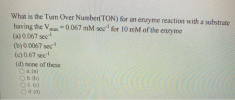 What is the Turn Over Number(TON) for an enzyme reaction with a substrate having the Vmax = 0,067 mM secl for 10 mM of the enzyme (a) 0.067 sec1 (b) 0.0067 sec ) (c) 0.67 sec (d) none of these a. (a) b. (b) ic. (c) d. (d)
At high (saturating) substrate concentrations, the rate of an enzyme-catalyzed reaction approaches Vmax. How close does...
At high (saturating) substrate concentrations, the rate of an enzyme-catalyzed reaction approaches Vmax. How close does the reaction rate actually get to Vmax? Determine how high (i.e. how many times Km) the substrate concentration must be for the reaction rate to be: a. 98% Vmax (show your work) (2) b. 99% Vmax (answer only) (1) c. 99.9% Vmax (answer only) (1)
At high (saturating) substrate concentrations, the rate of an enzyme-catalyzed reaction approaches Vmax. How close does...
At high (saturating) substrate concentrations, the rate of an enzyme-catalyzed reaction approaches Vmax. How close does the reaction rate actually get to Vmax? Determine how high (i.e. how many times Km) the substrate concentration must be for the reaction rate to be: a. 98% Vmax (show your work) (2) b. 99% Vmax (answer only) (1) c. 99.9% Vmax (answer only) (1)
 17. An enzyme-catalyzed reaction has a Vmax of 6 M/s and V, of 4.5 nM/s when the substrate concentration is 1.5 M. What is the Km of this reaction? 2.0.5 b. 1.1 c. 22.5 d. 39 18. From the reaction data below, determine whether the reaction is first-order or second-order. Time (8) Reactant (M) 0 6,67
 17. An enzyme-catalyzed reaction has a Vmax of 6 M/s and V, of 4.5 nM/s when the substrate concentration is 1.5 M. What is the Km of this reaction? 2.0.5 b. 1.1 c. 22.5 d. 39 18. From the reaction data below, determine whether the reaction is first-order or second-order. Time (8) Reactant (M) 0 6,67
 Enzyme Kinetics Problem The initial rate for an enzyme-catalyzed reaction has been determined at a number of substrate concentrations. Data are given below: 5 27 23 65 1. Estimate V and K from a Michaelis-Menten graph of V versus [S] 2. Use a Lineweaver-Burk plot to analyze the same data. a. Determine V and Ka from the Lineweaver-Burk BONUS: If the total enzyme concentration was I nmol/L, what is K?
Enzyme Kinetics Problem The initial rate for an enzyme-catalyzed reaction...
Enzyme Kinetics Problem The initial rate for an enzyme-catalyzed reaction has been determined at a number of substrate concentrations. Data are given below: 5 27 23 65 1. Estimate V and K from a Michaelis-Menten graph of V versus [S] 2. Use a Lineweaver-Burk plot to analyze the same data. a. Determine V and Ka from the Lineweaver-Burk BONUS: If the total enzyme concentration was I nmol/L, what is K?
Enzyme Kinetics Problem The initial rate for an enzyme-catalyzed reaction...
 5. The Km of an enzyme of an enzyme-catalyzed reaction is 6.5 uM. What substrate concentration will be required to obtain 55% of Vmax for this enzyme? (10 pts)
 What is the Turn Over Number(TON) for an enzyme reaction with a substrate having the Vmax = 0,067 mM secl for 10 mM of the enzyme (a) 0.067 sec1 (b) 0.0067 sec ) (c) 0.67 sec (d) none of these a. (a) b. (b) ic. (c) d. (d)
Most questions answered within 3 hours.
-
Where is the error in this code sequence?
String s1 = "Hello";
String s2 = "ello";...
asked 10 months ago -
Financial data for Joel de Paris, Inc., for last year
follow:
Joel de Paris, Inc.
Balance...
asked 10 months ago -
Consider this reaction:
Al2(SO4)3 (aq)+ BaCl3
(aq) Al2Cl6 (aq)- +
3BaSO4(s) . What is the...
asked 10 months ago -
Suppose that Savneet is considering increasing her
recent random sample from 20 car rentals to 40...
asked 10 months ago -
Trucks arrive at an unloading terminal at an average rate of 120
per hour.
Trucks arrive...
asked 10 months ago -
Why are methanol and ethanol completely soluble in water while
octanol is not very little soluble....
asked 10 months ago -
A facilities manager at a university reads in a research report
that the mean amount of...
asked 10 months ago -
When the CuSO4 is rehydrated by adding water to the anhydrous
compound, is this an endothermic...
asked 10 months ago -
A ray of sunlight is passing from diamond into crown glass; the
angle of incidence is...
asked 10 months ago -
A block of mass 0.249 kg is placed on top of a light, vertical
spring of...
asked 10 months ago -
how do the kidneys compensate in the presences of acidosis
a) trigger hyperventilate
b) reserve acid...
asked 10 months ago -
Question 501 pts
The rental rate of capital to the firm increases. Which of the
following...
asked 10 months ago