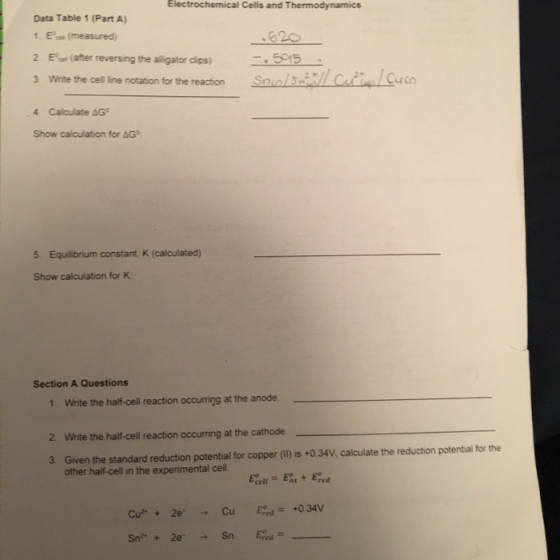
Is #3 correct? "Sn(s)/Sn+2(aq) // Cu+2(aq)/Cu(s)"
Also, I need help with #4 and #5.
Thanks! (will rate!)
Homework Answers
THANK YOU VERY MUCH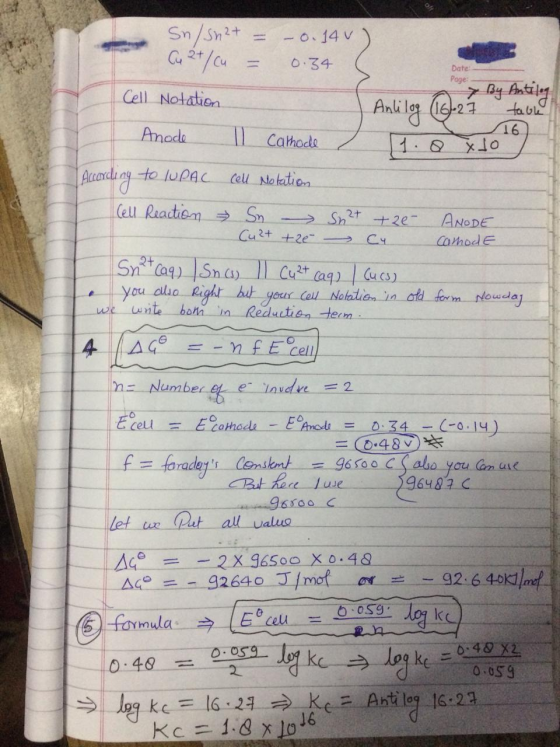
Add Answer to:
Is #3 correct? "Sn(s)/Sn+2(aq) // Cu+2(aq)/Cu(s)"
Also, I need help with #4 and #5.
Thanks! (will...
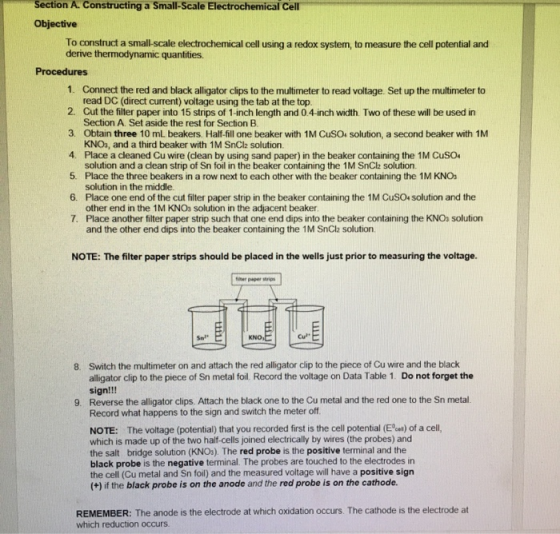
Page 1 and 2 are instructions. Please help me solve K for page 3 and page...
 Page 1 and 2 are instructions. Please help me solve K for page 3
and page 4 and please check the other work on Page 3.
Thanyou very much. Will Rate!
CHM 112 Electrochemical Cells and Thermodynamics Section A. Constructing a Small-Scale Electrochemical Cell Woodbridge Campus Objective To construct a small-scale electrochemical cell using a redox system, to measure the cell potential and derive thermodynamic quantities. Procedures 1. Connect the red and black alligator clips to the multimeter to read...
Page 1 and 2 are instructions. Please help me solve K for page 3
and page 4 and please check the other work on Page 3.
Thanyou very much. Will Rate!
CHM 112 Electrochemical Cells and Thermodynamics Section A. Constructing a Small-Scale Electrochemical Cell Woodbridge Campus Objective To construct a small-scale electrochemical cell using a redox system, to measure the cell potential and derive thermodynamic quantities. Procedures 1. Connect the red and black alligator clips to the multimeter to read...
This is an inroganic chemistry question, I just need help with number 7 but included everything...
 This is an inroganic chemistry question, I just need help with
number 7 but included everything so you can get
background. Please only answer if you can answer it correctly.
a) Obtain two 50 mL beakers. Into one beaker add 1.0 M Zn(NO302 and into the other add 1.0 M Cu(NO302. Adjust the liquid depths in each beaker such that they are approximately equal and 1-2 cm deep b) Cut a strip of filter paper that is long enough to...
This is an inroganic chemistry question, I just need help with
number 7 but included everything so you can get
background. Please only answer if you can answer it correctly.
a) Obtain two 50 mL beakers. Into one beaker add 1.0 M Zn(NO302 and into the other add 1.0 M Cu(NO302. Adjust the liquid depths in each beaker such that they are approximately equal and 1-2 cm deep b) Cut a strip of filter paper that is long enough to...
Can you help explaim and solve how to find delta G along with anything related to...
 Can you help explaim and solve how to find delta G along with
anything related to half-cells I dont even know where to begin,
thank you!
WILL probe to the piece of metal foil • Read and record the voltape. Do not forget the NOTE : The The filter paper string should be placed in the welis just prior to measuring the voltage 10. Reverse the probes Record what happens to the sign and switch the meter off NOTE: The...
Can you help explaim and solve how to find delta G along with
anything related to half-cells I dont even know where to begin,
thank you!
WILL probe to the piece of metal foil • Read and record the voltape. Do not forget the NOTE : The The filter paper string should be placed in the welis just prior to measuring the voltage 10. Reverse the probes Record what happens to the sign and switch the meter off NOTE: The...
how would you go about solving this problem via using equations just looking for the equation order i should go about solving this problem In this experiment you will be using the two half rea...
 how
would you go about solving this problem via using equations
just looking for the equation order i should go about solving this
problem
In this experiment you will be using the two half reactions Cu?"/Cu and Zn2 /Zn. The standard electrode potential, E°, for these half reactions is +0.34V and-0.76V respectively, so the Nernst Equation for these half reactions is the following Cu ea)+2e - Cus) E - 0.34V 0.0592V Cu2+] 0.0592V Zn 2 Note that solids by definition...
how
would you go about solving this problem via using equations
just looking for the equation order i should go about solving this
problem
In this experiment you will be using the two half reactions Cu?"/Cu and Zn2 /Zn. The standard electrode potential, E°, for these half reactions is +0.34V and-0.76V respectively, so the Nernst Equation for these half reactions is the following Cu ea)+2e - Cus) E - 0.34V 0.0592V Cu2+] 0.0592V Zn 2 Note that solids by definition...
Are the numbers for the E net correct? A. Znicule Reaction with sa ing 2. Place...
 Are the numbers for the E net correct?
A. Znicule Reaction with sa ing 2. Place the strip in 100 mL beaker Zn-Cu ? ●Oxidizing Reducin 3. Measure 25 mL of 0.1M CuSO4 and transfer it to the Zn beaker 4. After 5 minutes, record your observations. The trip turned black B. Pb-Cu* Reaction 5. Clean a Pb strip with sandpaper 6. Place the strip in 100 mL beaker 7. Measure 25 mL of 0.1M CuSO4 and transfer it to...
Are the numbers for the E net correct?
A. Znicule Reaction with sa ing 2. Place the strip in 100 mL beaker Zn-Cu ? ●Oxidizing Reducin 3. Measure 25 mL of 0.1M CuSO4 and transfer it to the Zn beaker 4. After 5 minutes, record your observations. The trip turned black B. Pb-Cu* Reaction 5. Clean a Pb strip with sandpaper 6. Place the strip in 100 mL beaker 7. Measure 25 mL of 0.1M CuSO4 and transfer it to...
5. What was the purpose of the NaNO3 solution in this experiment? 6. Could a solution...
 5. What was the purpose of the NaNO3 solution in this experiment? 6. Could a solution of NaCl be used instead of NaNO3? 7. What was the purpose of FeSO4 solution in this experiment? 8. Could a solution of FeCl, be used instead of FeSO4? 9. Could a solution of NaSO4 be used instead of FeSO4? 10. Calculate the standard cell potential for the spontaneous redox reaction between a Pb(s)/Pb(NO3)2(aq) half-cell and a Ag(s)/AgNO3(aq) half-cell. Which metal would be oxidized?...
An electrochemical cell is expressed as Cu(s) | Cu^2+ (0.20 M) || I^- (0.10 M) |...
 An electrochemical cell is expressed as Cu(s) | Cu^2+ (0.20 M) || I^- (0.10 M) | I_3^- (0.20 M) | Pt. I_3^- + 2e^- rightarrow 3I^-, E^0 = 0.535 V Cu^2+ + 2e^- rightarrow Cu(s) E^0 = 0.339 V Please answer the following questions: a. Write half-cell reactions at anode and at cathode. b. Write whole-cell reaction. c. Calculate the potential/voltage of the cell. d. Calculate equilibrium constant for this whole-cell reaction.
*redox reactions in electeochemical cells* c) Fe/0.1 M FeSO4//0.1 M CuSO4/Cu I soaked a porous cup in tap water for a few minutes and then i let it stand in a 100 ml beaker containing 10ml of 0.1 M Fe...
 *redox reactions in electeochemical cells*
c) Fe/0.1 M FeSO4//0.1 M CuSO4/Cu
I soaked a porous cup in tap water for a few minutes and then i
let it stand in a 100 ml beaker containing 10ml of 0.1 M FeSO4. I
added enough 0.1M CuSO4 to the cup until the two liquid levels were
the same height. I inserted a zinc strip into the 0.1 M FeSO4 and a
shiny copper strip into the 0.1 M CuSO4. I connected the...
*redox reactions in electeochemical cells*
c) Fe/0.1 M FeSO4//0.1 M CuSO4/Cu
I soaked a porous cup in tap water for a few minutes and then i
let it stand in a 100 ml beaker containing 10ml of 0.1 M FeSO4. I
added enough 0.1M CuSO4 to the cup until the two liquid levels were
the same height. I inserted a zinc strip into the 0.1 M FeSO4 and a
shiny copper strip into the 0.1 M CuSO4. I connected the...
some questions are filled out but still need help woth the remainder of this assignment part...
 some questions are filled out but still need help woth the
remainder of this assignment
part B and below needs to be answered.
Paragraph Styles . . Electrochemical Cells Objective: Investigate electrochemical potential using electrochemical cells. Information: Electric current is the flow of negatively charged particles. An electrochemical cell is a device that creates an electric current by converting chemical energy into electric current, or vice versa. Voltaic cells are electrochemical cells that produce current spontaneously by converting chemical energy...
some questions are filled out but still need help woth the
remainder of this assignment
part B and below needs to be answered.
Paragraph Styles . . Electrochemical Cells Objective: Investigate electrochemical potential using electrochemical cells. Information: Electric current is the flow of negatively charged particles. An electrochemical cell is a device that creates an electric current by converting chemical energy into electric current, or vice versa. Voltaic cells are electrochemical cells that produce current spontaneously by converting chemical energy...
Prelab Activity: Electrochemical Cells To determine the solubility product of copper(II) carbonate, CuCO3 , a concentration...
 Prelab Activity:
Electrochemical Cells
To determine the solubility product of copper(II) carbonate,
CuCO3 , a concentration cell as described on pages 71-72
of the lab handout is constructed. The temperature of the Galvanic
cell is measured to be 22.5°C, and the cell potential 282 mV (0.282
V). Using this data and Equation 8 in the lab manual, calculate the
Ksp for CuCO3 and report your answer with
three significant digits.
For the Galvanic cell you will construct in PART B,...
Prelab Activity:
Electrochemical Cells
To determine the solubility product of copper(II) carbonate,
CuCO3 , a concentration cell as described on pages 71-72
of the lab handout is constructed. The temperature of the Galvanic
cell is measured to be 22.5°C, and the cell potential 282 mV (0.282
V). Using this data and Equation 8 in the lab manual, calculate the
Ksp for CuCO3 and report your answer with
three significant digits.
For the Galvanic cell you will construct in PART B,...
 Page 1 and 2 are instructions. Please help me solve K for page 3
and page 4 and please check the other work on Page 3.
Thanyou very much. Will Rate!
CHM 112 Electrochemical Cells and Thermodynamics Section A. Constructing a Small-Scale Electrochemical Cell Woodbridge Campus Objective To construct a small-scale electrochemical cell using a redox system, to measure the cell potential and derive thermodynamic quantities. Procedures 1. Connect the red and black alligator clips to the multimeter to read...
Page 1 and 2 are instructions. Please help me solve K for page 3
and page 4 and please check the other work on Page 3.
Thanyou very much. Will Rate!
CHM 112 Electrochemical Cells and Thermodynamics Section A. Constructing a Small-Scale Electrochemical Cell Woodbridge Campus Objective To construct a small-scale electrochemical cell using a redox system, to measure the cell potential and derive thermodynamic quantities. Procedures 1. Connect the red and black alligator clips to the multimeter to read...
 This is an inroganic chemistry question, I just need help with
number 7 but included everything so you can get
background. Please only answer if you can answer it correctly.
a) Obtain two 50 mL beakers. Into one beaker add 1.0 M Zn(NO302 and into the other add 1.0 M Cu(NO302. Adjust the liquid depths in each beaker such that they are approximately equal and 1-2 cm deep b) Cut a strip of filter paper that is long enough to...
This is an inroganic chemistry question, I just need help with
number 7 but included everything so you can get
background. Please only answer if you can answer it correctly.
a) Obtain two 50 mL beakers. Into one beaker add 1.0 M Zn(NO302 and into the other add 1.0 M Cu(NO302. Adjust the liquid depths in each beaker such that they are approximately equal and 1-2 cm deep b) Cut a strip of filter paper that is long enough to...
 Can you help explaim and solve how to find delta G along with
anything related to half-cells I dont even know where to begin,
thank you!
WILL probe to the piece of metal foil • Read and record the voltape. Do not forget the NOTE : The The filter paper string should be placed in the welis just prior to measuring the voltage 10. Reverse the probes Record what happens to the sign and switch the meter off NOTE: The...
Can you help explaim and solve how to find delta G along with
anything related to half-cells I dont even know where to begin,
thank you!
WILL probe to the piece of metal foil • Read and record the voltape. Do not forget the NOTE : The The filter paper string should be placed in the welis just prior to measuring the voltage 10. Reverse the probes Record what happens to the sign and switch the meter off NOTE: The...
 how
would you go about solving this problem via using equations
just looking for the equation order i should go about solving this
problem
In this experiment you will be using the two half reactions Cu?"/Cu and Zn2 /Zn. The standard electrode potential, E°, for these half reactions is +0.34V and-0.76V respectively, so the Nernst Equation for these half reactions is the following Cu ea)+2e - Cus) E - 0.34V 0.0592V Cu2+] 0.0592V Zn 2 Note that solids by definition...
how
would you go about solving this problem via using equations
just looking for the equation order i should go about solving this
problem
In this experiment you will be using the two half reactions Cu?"/Cu and Zn2 /Zn. The standard electrode potential, E°, for these half reactions is +0.34V and-0.76V respectively, so the Nernst Equation for these half reactions is the following Cu ea)+2e - Cus) E - 0.34V 0.0592V Cu2+] 0.0592V Zn 2 Note that solids by definition...
 Are the numbers for the E net correct?
A. Znicule Reaction with sa ing 2. Place the strip in 100 mL beaker Zn-Cu ? ●Oxidizing Reducin 3. Measure 25 mL of 0.1M CuSO4 and transfer it to the Zn beaker 4. After 5 minutes, record your observations. The trip turned black B. Pb-Cu* Reaction 5. Clean a Pb strip with sandpaper 6. Place the strip in 100 mL beaker 7. Measure 25 mL of 0.1M CuSO4 and transfer it to...
Are the numbers for the E net correct?
A. Znicule Reaction with sa ing 2. Place the strip in 100 mL beaker Zn-Cu ? ●Oxidizing Reducin 3. Measure 25 mL of 0.1M CuSO4 and transfer it to the Zn beaker 4. After 5 minutes, record your observations. The trip turned black B. Pb-Cu* Reaction 5. Clean a Pb strip with sandpaper 6. Place the strip in 100 mL beaker 7. Measure 25 mL of 0.1M CuSO4 and transfer it to...
 5. What was the purpose of the NaNO3 solution in this experiment? 6. Could a solution of NaCl be used instead of NaNO3? 7. What was the purpose of FeSO4 solution in this experiment? 8. Could a solution of FeCl, be used instead of FeSO4? 9. Could a solution of NaSO4 be used instead of FeSO4? 10. Calculate the standard cell potential for the spontaneous redox reaction between a Pb(s)/Pb(NO3)2(aq) half-cell and a Ag(s)/AgNO3(aq) half-cell. Which metal would be oxidized?...
 An electrochemical cell is expressed as Cu(s) | Cu^2+ (0.20 M) || I^- (0.10 M) | I_3^- (0.20 M) | Pt. I_3^- + 2e^- rightarrow 3I^-, E^0 = 0.535 V Cu^2+ + 2e^- rightarrow Cu(s) E^0 = 0.339 V Please answer the following questions: a. Write half-cell reactions at anode and at cathode. b. Write whole-cell reaction. c. Calculate the potential/voltage of the cell. d. Calculate equilibrium constant for this whole-cell reaction.
 *redox reactions in electeochemical cells*
c) Fe/0.1 M FeSO4//0.1 M CuSO4/Cu
I soaked a porous cup in tap water for a few minutes and then i
let it stand in a 100 ml beaker containing 10ml of 0.1 M FeSO4. I
added enough 0.1M CuSO4 to the cup until the two liquid levels were
the same height. I inserted a zinc strip into the 0.1 M FeSO4 and a
shiny copper strip into the 0.1 M CuSO4. I connected the...
*redox reactions in electeochemical cells*
c) Fe/0.1 M FeSO4//0.1 M CuSO4/Cu
I soaked a porous cup in tap water for a few minutes and then i
let it stand in a 100 ml beaker containing 10ml of 0.1 M FeSO4. I
added enough 0.1M CuSO4 to the cup until the two liquid levels were
the same height. I inserted a zinc strip into the 0.1 M FeSO4 and a
shiny copper strip into the 0.1 M CuSO4. I connected the...
 some questions are filled out but still need help woth the
remainder of this assignment
part B and below needs to be answered.
Paragraph Styles . . Electrochemical Cells Objective: Investigate electrochemical potential using electrochemical cells. Information: Electric current is the flow of negatively charged particles. An electrochemical cell is a device that creates an electric current by converting chemical energy into electric current, or vice versa. Voltaic cells are electrochemical cells that produce current spontaneously by converting chemical energy...
some questions are filled out but still need help woth the
remainder of this assignment
part B and below needs to be answered.
Paragraph Styles . . Electrochemical Cells Objective: Investigate electrochemical potential using electrochemical cells. Information: Electric current is the flow of negatively charged particles. An electrochemical cell is a device that creates an electric current by converting chemical energy into electric current, or vice versa. Voltaic cells are electrochemical cells that produce current spontaneously by converting chemical energy...
 Prelab Activity:
Electrochemical Cells
To determine the solubility product of copper(II) carbonate,
CuCO3 , a concentration cell as described on pages 71-72
of the lab handout is constructed. The temperature of the Galvanic
cell is measured to be 22.5°C, and the cell potential 282 mV (0.282
V). Using this data and Equation 8 in the lab manual, calculate the
Ksp for CuCO3 and report your answer with
three significant digits.
For the Galvanic cell you will construct in PART B,...
Prelab Activity:
Electrochemical Cells
To determine the solubility product of copper(II) carbonate,
CuCO3 , a concentration cell as described on pages 71-72
of the lab handout is constructed. The temperature of the Galvanic
cell is measured to be 22.5°C, and the cell potential 282 mV (0.282
V). Using this data and Equation 8 in the lab manual, calculate the
Ksp for CuCO3 and report your answer with
three significant digits.
For the Galvanic cell you will construct in PART B,...
Most questions answered within 3 hours.
-
Where is the error in this code sequence?
String s1 = "Hello";
String s2 = "ello";...
asked 10 months ago -
Financial data for Joel de Paris, Inc., for last year
follow:
Joel de Paris, Inc.
Balance...
asked 10 months ago -
Consider this reaction:
Al2(SO4)3 (aq)+ BaCl3
(aq) Al2Cl6 (aq)- +
3BaSO4(s) . What is the...
asked 10 months ago -
Suppose that Savneet is considering increasing her
recent random sample from 20 car rentals to 40...
asked 10 months ago -
Trucks arrive at an unloading terminal at an average rate of 120
per hour.
Trucks arrive...
asked 10 months ago -
Why are methanol and ethanol completely soluble in water while
octanol is not very little soluble....
asked 10 months ago -
A facilities manager at a university reads in a research report
that the mean amount of...
asked 10 months ago -
When the CuSO4 is rehydrated by adding water to the anhydrous
compound, is this an endothermic...
asked 10 months ago -
A ray of sunlight is passing from diamond into crown glass; the
angle of incidence is...
asked 10 months ago -
A block of mass 0.249 kg is placed on top of a light, vertical
spring of...
asked 10 months ago -
how do the kidneys compensate in the presences of acidosis
a) trigger hyperventilate
b) reserve acid...
asked 10 months ago -
Question 501 pts
The rental rate of capital to the firm increases. Which of the
following...
asked 10 months ago