
Homework Answers


Add Answer to:
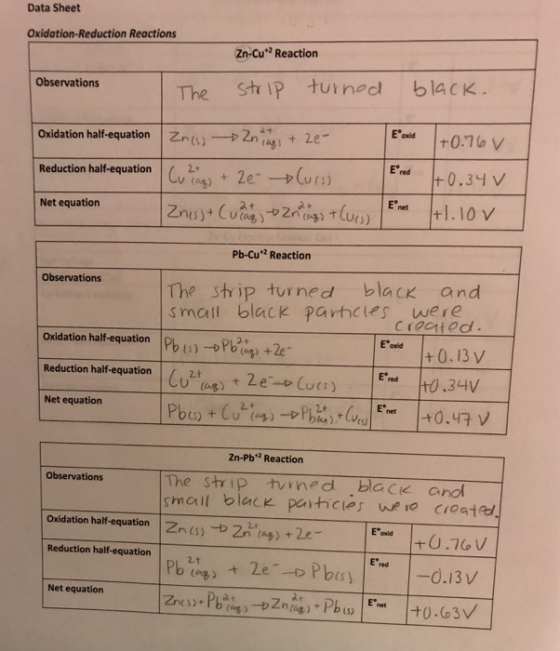
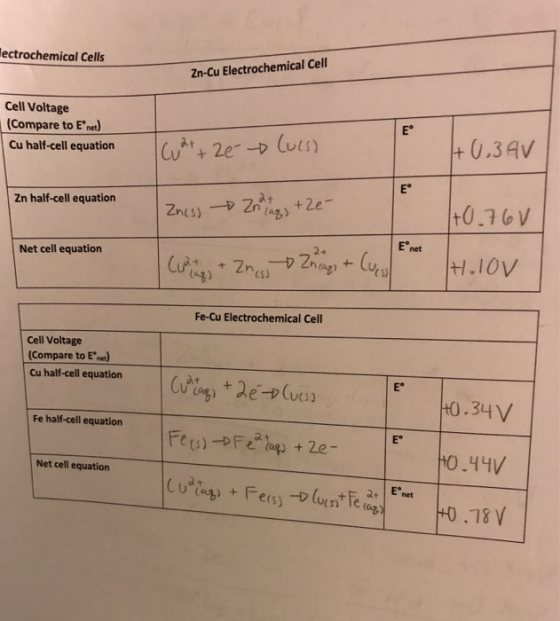
Are the numbers for the E net correct?
A. Znicule Reaction with sa ing 2. Place...
Is #3 correct? "Sn(s)/Sn+2(aq) // Cu+2(aq)/Cu(s)" Also, I need help with #4 and #5. Thanks! (will...
 Is #3 correct? "Sn(s)/Sn+2(aq) // Cu+2(aq)/Cu(s)"
Also, I need help with #4 and #5.
Thanks! (will rate!)
Section A. Constructing a Small-Scale Electrochemical Cell Objective To construct a small-scale electrochemical cell using a redox system, to measure the cell potential and derive thermodynamic quantities. Procedures 1. Connect the red and black alligator clips to the multimeter to read voltage. Set up the multimeter to read DC (direct current) voltage using the tab at the top. 2. Cut the filter paper...
Is #3 correct? "Sn(s)/Sn+2(aq) // Cu+2(aq)/Cu(s)"
Also, I need help with #4 and #5.
Thanks! (will rate!)
Section A. Constructing a Small-Scale Electrochemical Cell Objective To construct a small-scale electrochemical cell using a redox system, to measure the cell potential and derive thermodynamic quantities. Procedures 1. Connect the red and black alligator clips to the multimeter to read voltage. Set up the multimeter to read DC (direct current) voltage using the tab at the top. 2. Cut the filter paper...
This is an inroganic chemistry question, I just need help with number 7 but included everything...
 This is an inroganic chemistry question, I just need help with
number 7 but included everything so you can get
background. Please only answer if you can answer it correctly.
a) Obtain two 50 mL beakers. Into one beaker add 1.0 M Zn(NO302 and into the other add 1.0 M Cu(NO302. Adjust the liquid depths in each beaker such that they are approximately equal and 1-2 cm deep b) Cut a strip of filter paper that is long enough to...
This is an inroganic chemistry question, I just need help with
number 7 but included everything so you can get
background. Please only answer if you can answer it correctly.
a) Obtain two 50 mL beakers. Into one beaker add 1.0 M Zn(NO302 and into the other add 1.0 M Cu(NO302. Adjust the liquid depths in each beaker such that they are approximately equal and 1-2 cm deep b) Cut a strip of filter paper that is long enough to...
Page 1 and 2 are instructions. Please help me solve K for page 3 and page...
 Page 1 and 2 are instructions. Please help me solve K for page 3
and page 4 and please check the other work on Page 3.
Thanyou very much. Will Rate!
CHM 112 Electrochemical Cells and Thermodynamics Section A. Constructing a Small-Scale Electrochemical Cell Woodbridge Campus Objective To construct a small-scale electrochemical cell using a redox system, to measure the cell potential and derive thermodynamic quantities. Procedures 1. Connect the red and black alligator clips to the multimeter to read...
Page 1 and 2 are instructions. Please help me solve K for page 3
and page 4 and please check the other work on Page 3.
Thanyou very much. Will Rate!
CHM 112 Electrochemical Cells and Thermodynamics Section A. Constructing a Small-Scale Electrochemical Cell Woodbridge Campus Objective To construct a small-scale electrochemical cell using a redox system, to measure the cell potential and derive thermodynamic quantities. Procedures 1. Connect the red and black alligator clips to the multimeter to read...
*redox reactions in electeochemical cells* c) Fe/0.1 M FeSO4//0.1 M CuSO4/Cu I soaked a porous cup in tap water for a few minutes and then i let it stand in a 100 ml beaker containing 10ml of 0.1 M Fe...
 *redox reactions in electeochemical cells*
c) Fe/0.1 M FeSO4//0.1 M CuSO4/Cu
I soaked a porous cup in tap water for a few minutes and then i
let it stand in a 100 ml beaker containing 10ml of 0.1 M FeSO4. I
added enough 0.1M CuSO4 to the cup until the two liquid levels were
the same height. I inserted a zinc strip into the 0.1 M FeSO4 and a
shiny copper strip into the 0.1 M CuSO4. I connected the...
*redox reactions in electeochemical cells*
c) Fe/0.1 M FeSO4//0.1 M CuSO4/Cu
I soaked a porous cup in tap water for a few minutes and then i
let it stand in a 100 ml beaker containing 10ml of 0.1 M FeSO4. I
added enough 0.1M CuSO4 to the cup until the two liquid levels were
the same height. I inserted a zinc strip into the 0.1 M FeSO4 and a
shiny copper strip into the 0.1 M CuSO4. I connected the...
Prelab Activity: Electrochemical Cells To determine the solubility product of copper(II) carbonate, CuCO3 , a concentration...
 Prelab Activity:
Electrochemical Cells
To determine the solubility product of copper(II) carbonate,
CuCO3 , a concentration cell as described on pages 71-72
of the lab handout is constructed. The temperature of the Galvanic
cell is measured to be 22.5°C, and the cell potential 282 mV (0.282
V). Using this data and Equation 8 in the lab manual, calculate the
Ksp for CuCO3 and report your answer with
three significant digits.
For the Galvanic cell you will construct in PART B,...
Prelab Activity:
Electrochemical Cells
To determine the solubility product of copper(II) carbonate,
CuCO3 , a concentration cell as described on pages 71-72
of the lab handout is constructed. The temperature of the Galvanic
cell is measured to be 22.5°C, and the cell potential 282 mV (0.282
V). Using this data and Equation 8 in the lab manual, calculate the
Ksp for CuCO3 and report your answer with
three significant digits.
For the Galvanic cell you will construct in PART B,...
Experiment 2: Diffusion Concentration Gradients and Membrane Permeability Data Tables Table 2: Indicator Reagent Data Indicator...
 Experiment 2: Diffusion Concentration Gradients and Membrane
Permeability
Data Tables
Table 2: Indicator Reagent Data
Indicator
Starch Positive
Starch Negative
Glucose Positive
Glucose Negative
Glucose Test Strip
n/a
n/a
green
yellow
IKI Solution
dark blue
light brown
n/a
n/a
Table 3: Diffusion of Starch and Glucose Over
Time
Indicator
Dialysis Bag After 60 Minutes
Beaker Water After 60 Minutes
Glucose Test Strip
yellow
green ( if all glucose passed to the beaker from the bag)
IKI
from incolore changed to...
Experiment 2: Diffusion Concentration Gradients and Membrane
Permeability
Data Tables
Table 2: Indicator Reagent Data
Indicator
Starch Positive
Starch Negative
Glucose Positive
Glucose Negative
Glucose Test Strip
n/a
n/a
green
yellow
IKI Solution
dark blue
light brown
n/a
n/a
Table 3: Diffusion of Starch and Glucose Over
Time
Indicator
Dialysis Bag After 60 Minutes
Beaker Water After 60 Minutes
Glucose Test Strip
yellow
green ( if all glucose passed to the beaker from the bag)
IKI
from incolore changed to...
EXPERIMENT: 26 ELECTROCHEMISTRY: GALVANIC AND ELECTROLYTIC CELLS Materials Required : 50 mL beake...
 Help please
EXPERIMENT: 26 ELECTROCHEMISTRY: GALVANIC AND ELECTROLYTIC CELLS Materials Required : 50 mL beakers (2) test tubes sandpaper glass U-tube cotton voltmeter 9.0 V battery connecting wires with alligator clips (2) thermometer iron nail paper clips (2) copper wire magnesium ribbon magnesium sulfate (MgSO) copper sulfate pentahydrate (CuSO, 5H,O) sodium chloride (NaCI) saturated sodium chloride (NaCI)solution phenolphthalein indicator SAFETY PRECAUTIONS: EYE PROTECTION MUST BE WORN AT ALL TIMES IN LABORATORY. Purpose of Experiment: Oxidation-reduction reactions will be performed and...
Help please
EXPERIMENT: 26 ELECTROCHEMISTRY: GALVANIC AND ELECTROLYTIC CELLS Materials Required : 50 mL beakers (2) test tubes sandpaper glass U-tube cotton voltmeter 9.0 V battery connecting wires with alligator clips (2) thermometer iron nail paper clips (2) copper wire magnesium ribbon magnesium sulfate (MgSO) copper sulfate pentahydrate (CuSO, 5H,O) sodium chloride (NaCI) saturated sodium chloride (NaCI)solution phenolphthalein indicator SAFETY PRECAUTIONS: EYE PROTECTION MUST BE WORN AT ALL TIMES IN LABORATORY. Purpose of Experiment: Oxidation-reduction reactions will be performed and...
ALL THE INFO YOU NEED IS BELOW average volume of NaOH: 15.7 mL or 0.0157 L...
 ALL THE INFO YOU NEED IS BELOW
average volume of NaOH: 15.7 mL or
0.0157 L
average number of moles of NaOH added:
6.28*10-4 moles
molar concentration of [HT] in saturated solution(HT–
acts as a monoprotic acid, reacting with NaOH in a 1:1 ratio
(Volume of KHT measured using 25.00 mL volumetric pipet.)):
0.2512 M
Analysis of KHT in water
1. Weigh out 0.8 grams of potassium hydrogen tartrate (KHT) on
weighing paper. Add the KHT to a clean dry...
ALL THE INFO YOU NEED IS BELOW
average volume of NaOH: 15.7 mL or
0.0157 L
average number of moles of NaOH added:
6.28*10-4 moles
molar concentration of [HT] in saturated solution(HT–
acts as a monoprotic acid, reacting with NaOH in a 1:1 ratio
(Volume of KHT measured using 25.00 mL volumetric pipet.)):
0.2512 M
Analysis of KHT in water
1. Weigh out 0.8 grams of potassium hydrogen tartrate (KHT) on
weighing paper. Add the KHT to a clean dry...
Hello, these are part of one question, please show work. Data Sheet Chemical Reactions 2. Obtain a...
 Hello, these are part of one question, please show work.
Data Sheet Chemical Reactions 2. Obtain and clean with sandpaper to expose the surface: 3 pieces of zine, 2 pieces of copper and 1 piece of lead. Place 6 test tubes in a rack and label each appropriately. Observe the contents of each of the test tubes for evidence of a reaction. Record your observations in the tables below TABLE 55 Observations Tube I: Copper strip and approximately 1 mL...
Hello, these are part of one question, please show work.
Data Sheet Chemical Reactions 2. Obtain and clean with sandpaper to expose the surface: 3 pieces of zine, 2 pieces of copper and 1 piece of lead. Place 6 test tubes in a rack and label each appropriately. Observe the contents of each of the test tubes for evidence of a reaction. Record your observations in the tables below TABLE 55 Observations Tube I: Copper strip and approximately 1 mL...
1 Reaction C: Copper(II) Hydroxide to Copper(IT) Oxide Observations: The solntich goes from a light blue...
 1 Reaction C: Copper(II) Hydroxide to Copper(IT) Oxide Observations: The solntich goes from a light blue to a dark blue. when heated the solution turns to a green/black color. Balanced Molecular Equation: Balanced Net lonie Equation: Reaction D: Copper(IT) Oxide to Copper(II) Sulfate Observations: "The back sond is dissolved in the acid. This creates a light blue / Clear solurich Balanced Molecular Equation: Balanced Net Ionic Equation: Reaction E: Copper(II) Sulfate to Copper Metal (and Dissolution of excess Mg) Observations:...
 Is #3 correct? "Sn(s)/Sn+2(aq) // Cu+2(aq)/Cu(s)"
Also, I need help with #4 and #5.
Thanks! (will rate!)
Section A. Constructing a Small-Scale Electrochemical Cell Objective To construct a small-scale electrochemical cell using a redox system, to measure the cell potential and derive thermodynamic quantities. Procedures 1. Connect the red and black alligator clips to the multimeter to read voltage. Set up the multimeter to read DC (direct current) voltage using the tab at the top. 2. Cut the filter paper...
Is #3 correct? "Sn(s)/Sn+2(aq) // Cu+2(aq)/Cu(s)"
Also, I need help with #4 and #5.
Thanks! (will rate!)
Section A. Constructing a Small-Scale Electrochemical Cell Objective To construct a small-scale electrochemical cell using a redox system, to measure the cell potential and derive thermodynamic quantities. Procedures 1. Connect the red and black alligator clips to the multimeter to read voltage. Set up the multimeter to read DC (direct current) voltage using the tab at the top. 2. Cut the filter paper...
 This is an inroganic chemistry question, I just need help with
number 7 but included everything so you can get
background. Please only answer if you can answer it correctly.
a) Obtain two 50 mL beakers. Into one beaker add 1.0 M Zn(NO302 and into the other add 1.0 M Cu(NO302. Adjust the liquid depths in each beaker such that they are approximately equal and 1-2 cm deep b) Cut a strip of filter paper that is long enough to...
This is an inroganic chemistry question, I just need help with
number 7 but included everything so you can get
background. Please only answer if you can answer it correctly.
a) Obtain two 50 mL beakers. Into one beaker add 1.0 M Zn(NO302 and into the other add 1.0 M Cu(NO302. Adjust the liquid depths in each beaker such that they are approximately equal and 1-2 cm deep b) Cut a strip of filter paper that is long enough to...
 Page 1 and 2 are instructions. Please help me solve K for page 3
and page 4 and please check the other work on Page 3.
Thanyou very much. Will Rate!
CHM 112 Electrochemical Cells and Thermodynamics Section A. Constructing a Small-Scale Electrochemical Cell Woodbridge Campus Objective To construct a small-scale electrochemical cell using a redox system, to measure the cell potential and derive thermodynamic quantities. Procedures 1. Connect the red and black alligator clips to the multimeter to read...
Page 1 and 2 are instructions. Please help me solve K for page 3
and page 4 and please check the other work on Page 3.
Thanyou very much. Will Rate!
CHM 112 Electrochemical Cells and Thermodynamics Section A. Constructing a Small-Scale Electrochemical Cell Woodbridge Campus Objective To construct a small-scale electrochemical cell using a redox system, to measure the cell potential and derive thermodynamic quantities. Procedures 1. Connect the red and black alligator clips to the multimeter to read...
 *redox reactions in electeochemical cells*
c) Fe/0.1 M FeSO4//0.1 M CuSO4/Cu
I soaked a porous cup in tap water for a few minutes and then i
let it stand in a 100 ml beaker containing 10ml of 0.1 M FeSO4. I
added enough 0.1M CuSO4 to the cup until the two liquid levels were
the same height. I inserted a zinc strip into the 0.1 M FeSO4 and a
shiny copper strip into the 0.1 M CuSO4. I connected the...
*redox reactions in electeochemical cells*
c) Fe/0.1 M FeSO4//0.1 M CuSO4/Cu
I soaked a porous cup in tap water for a few minutes and then i
let it stand in a 100 ml beaker containing 10ml of 0.1 M FeSO4. I
added enough 0.1M CuSO4 to the cup until the two liquid levels were
the same height. I inserted a zinc strip into the 0.1 M FeSO4 and a
shiny copper strip into the 0.1 M CuSO4. I connected the...
 Prelab Activity:
Electrochemical Cells
To determine the solubility product of copper(II) carbonate,
CuCO3 , a concentration cell as described on pages 71-72
of the lab handout is constructed. The temperature of the Galvanic
cell is measured to be 22.5°C, and the cell potential 282 mV (0.282
V). Using this data and Equation 8 in the lab manual, calculate the
Ksp for CuCO3 and report your answer with
three significant digits.
For the Galvanic cell you will construct in PART B,...
Prelab Activity:
Electrochemical Cells
To determine the solubility product of copper(II) carbonate,
CuCO3 , a concentration cell as described on pages 71-72
of the lab handout is constructed. The temperature of the Galvanic
cell is measured to be 22.5°C, and the cell potential 282 mV (0.282
V). Using this data and Equation 8 in the lab manual, calculate the
Ksp for CuCO3 and report your answer with
three significant digits.
For the Galvanic cell you will construct in PART B,...
 Experiment 2: Diffusion Concentration Gradients and Membrane
Permeability
Data Tables
Table 2: Indicator Reagent Data
Indicator
Starch Positive
Starch Negative
Glucose Positive
Glucose Negative
Glucose Test Strip
n/a
n/a
green
yellow
IKI Solution
dark blue
light brown
n/a
n/a
Table 3: Diffusion of Starch and Glucose Over
Time
Indicator
Dialysis Bag After 60 Minutes
Beaker Water After 60 Minutes
Glucose Test Strip
yellow
green ( if all glucose passed to the beaker from the bag)
IKI
from incolore changed to...
Experiment 2: Diffusion Concentration Gradients and Membrane
Permeability
Data Tables
Table 2: Indicator Reagent Data
Indicator
Starch Positive
Starch Negative
Glucose Positive
Glucose Negative
Glucose Test Strip
n/a
n/a
green
yellow
IKI Solution
dark blue
light brown
n/a
n/a
Table 3: Diffusion of Starch and Glucose Over
Time
Indicator
Dialysis Bag After 60 Minutes
Beaker Water After 60 Minutes
Glucose Test Strip
yellow
green ( if all glucose passed to the beaker from the bag)
IKI
from incolore changed to...
 Help please
EXPERIMENT: 26 ELECTROCHEMISTRY: GALVANIC AND ELECTROLYTIC CELLS Materials Required : 50 mL beakers (2) test tubes sandpaper glass U-tube cotton voltmeter 9.0 V battery connecting wires with alligator clips (2) thermometer iron nail paper clips (2) copper wire magnesium ribbon magnesium sulfate (MgSO) copper sulfate pentahydrate (CuSO, 5H,O) sodium chloride (NaCI) saturated sodium chloride (NaCI)solution phenolphthalein indicator SAFETY PRECAUTIONS: EYE PROTECTION MUST BE WORN AT ALL TIMES IN LABORATORY. Purpose of Experiment: Oxidation-reduction reactions will be performed and...
Help please
EXPERIMENT: 26 ELECTROCHEMISTRY: GALVANIC AND ELECTROLYTIC CELLS Materials Required : 50 mL beakers (2) test tubes sandpaper glass U-tube cotton voltmeter 9.0 V battery connecting wires with alligator clips (2) thermometer iron nail paper clips (2) copper wire magnesium ribbon magnesium sulfate (MgSO) copper sulfate pentahydrate (CuSO, 5H,O) sodium chloride (NaCI) saturated sodium chloride (NaCI)solution phenolphthalein indicator SAFETY PRECAUTIONS: EYE PROTECTION MUST BE WORN AT ALL TIMES IN LABORATORY. Purpose of Experiment: Oxidation-reduction reactions will be performed and...
 ALL THE INFO YOU NEED IS BELOW
average volume of NaOH: 15.7 mL or
0.0157 L
average number of moles of NaOH added:
6.28*10-4 moles
molar concentration of [HT] in saturated solution(HT–
acts as a monoprotic acid, reacting with NaOH in a 1:1 ratio
(Volume of KHT measured using 25.00 mL volumetric pipet.)):
0.2512 M
Analysis of KHT in water
1. Weigh out 0.8 grams of potassium hydrogen tartrate (KHT) on
weighing paper. Add the KHT to a clean dry...
ALL THE INFO YOU NEED IS BELOW
average volume of NaOH: 15.7 mL or
0.0157 L
average number of moles of NaOH added:
6.28*10-4 moles
molar concentration of [HT] in saturated solution(HT–
acts as a monoprotic acid, reacting with NaOH in a 1:1 ratio
(Volume of KHT measured using 25.00 mL volumetric pipet.)):
0.2512 M
Analysis of KHT in water
1. Weigh out 0.8 grams of potassium hydrogen tartrate (KHT) on
weighing paper. Add the KHT to a clean dry...
 Hello, these are part of one question, please show work.
Data Sheet Chemical Reactions 2. Obtain and clean with sandpaper to expose the surface: 3 pieces of zine, 2 pieces of copper and 1 piece of lead. Place 6 test tubes in a rack and label each appropriately. Observe the contents of each of the test tubes for evidence of a reaction. Record your observations in the tables below TABLE 55 Observations Tube I: Copper strip and approximately 1 mL...
Hello, these are part of one question, please show work.
Data Sheet Chemical Reactions 2. Obtain and clean with sandpaper to expose the surface: 3 pieces of zine, 2 pieces of copper and 1 piece of lead. Place 6 test tubes in a rack and label each appropriately. Observe the contents of each of the test tubes for evidence of a reaction. Record your observations in the tables below TABLE 55 Observations Tube I: Copper strip and approximately 1 mL...
 1 Reaction C: Copper(II) Hydroxide to Copper(IT) Oxide Observations: The solntich goes from a light blue to a dark blue. when heated the solution turns to a green/black color. Balanced Molecular Equation: Balanced Net lonie Equation: Reaction D: Copper(IT) Oxide to Copper(II) Sulfate Observations: "The back sond is dissolved in the acid. This creates a light blue / Clear solurich Balanced Molecular Equation: Balanced Net Ionic Equation: Reaction E: Copper(II) Sulfate to Copper Metal (and Dissolution of excess Mg) Observations:...
Most questions answered within 3 hours.
-
Where is the error in this code sequence?
String s1 = "Hello";
String s2 = "ello";...
asked 10 months ago -
Financial data for Joel de Paris, Inc., for last year
follow:
Joel de Paris, Inc.
Balance...
asked 10 months ago -
Consider this reaction:
Al2(SO4)3 (aq)+ BaCl3
(aq) Al2Cl6 (aq)- +
3BaSO4(s) . What is the...
asked 10 months ago -
Suppose that Savneet is considering increasing her
recent random sample from 20 car rentals to 40...
asked 10 months ago -
Trucks arrive at an unloading terminal at an average rate of 120
per hour.
Trucks arrive...
asked 10 months ago -
Why are methanol and ethanol completely soluble in water while
octanol is not very little soluble....
asked 10 months ago -
A facilities manager at a university reads in a research report
that the mean amount of...
asked 10 months ago -
When the CuSO4 is rehydrated by adding water to the anhydrous
compound, is this an endothermic...
asked 10 months ago -
A ray of sunlight is passing from diamond into crown glass; the
angle of incidence is...
asked 10 months ago -
A block of mass 0.249 kg is placed on top of a light, vertical
spring of...
asked 10 months ago -
how do the kidneys compensate in the presences of acidosis
a) trigger hyperventilate
b) reserve acid...
asked 10 months ago -
Question 501 pts
The rental rate of capital to the firm increases. Which of the
following...
asked 10 months ago