

Experimental Procedure: Weigh out 1.00 g of magnesium sulfate and place in a 50 mL beaker. 2. Weigh out 2.00 g of copper sulfate pentahydrate and place in another 50 mL 3. Add enough deionized water to each to make approximately 40 mL of 1. beaker solution and stir to dissolve. This will make approximately 0.200 M solutions of each. 4. Pour enough of each solution in separate test tubes to give a depth of 5. Sand an iron nail and a piece of copper wire with sandpaper to remove the 6. Cut approximately a one-centimeter piece of the copper wire and drop it into approximately one half centimeter. oxide layer until they are shiny. the magnesium sulfate solution in the test tube. 7. Drop the iron nail into the copper sulfate solution in the test tube. 8. Observe what happens to each over time as you continue the experiment. Part B. The galvanic cell 1. Loop the end of the rest of the shiny copper wire and place it in the copper 2. Sand a piece of magnesium ribbon until it is shiny. Place it in the magnesium 3. Connect the magnesium ribbon to one of the terminals of the voltmeter and 4. Fill a U-tube completely with saturated sodium chloride solution using a 5. Plug the ends of the tube with small pieces of cotton. Be sure there are no sulfate solution in the 50 mL beaker. sulfate solution in the other 50 mL beaker. connect the copper wire to the other terminal. Note any change. dropper. air bubbles in the tube 26-2
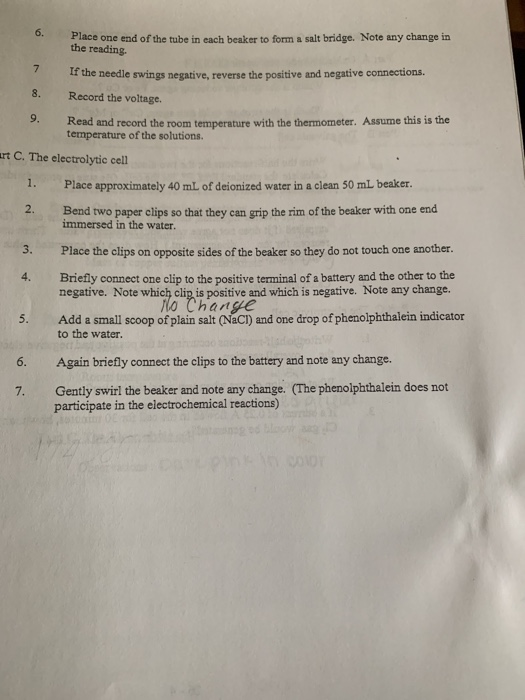
6. Place one end of the tube in each beaker to form a salt bridge. Note any change in the reading. 7 8. Record the voltage. 9. Read and record the room temperature with the thermometer. Assume this is the If the needle swings negative, reverse the positive and negative connections. temperature of the solutions. rt C. The electrolytic cell 1. Place approximately 40 mL of deionized water in a clean 50 mL beaker. 2. Bend two paper clips so that they can grip the rim of the beaker with one end 3. Place the clips on opposite sides of the beaker so they do not touch one another. 4. Briefly connect one clip to the positive terminal of a battery and the other to the 5. Add a small scoop of plain salt (NaCI) and one drop of phenolphthalein indicator 6. Again briefly connect the clips to the battery and note any change. immersed in the water. negative. Note which clip is positive and which is negative. Note any change. lo Changge to the water. Gently swirl the beaker and note any change. (The phenolphthalein does not participate in the electrochemical reactions) 7.
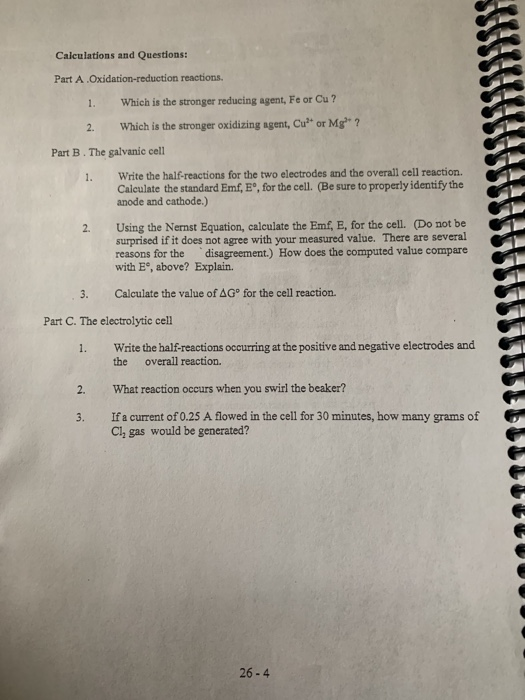
Calculations and Questions: Part A. Oxidation-reduction reactions. 1. Which is the stronger reducing agent, Fe or Cu ? 2. Which is the stronger oxidizing agent, Cu" or Mg" Part B. The galvanic cell 1. Write the half-reactions for the two electrodes and the overall cell reaction. Caleulate the standard Emf, Eo, for the cell. (Be sure to properly identify the anode and cathode.) 2. Using the Nernst Equation, calculate the Emf, E, for the cell. (Do not be surprised if it does not agree with your measured value. There are several reasons for the disagreement.) How does the computed value compare with Ee, above? Explain. 3. Calculate the value of AGo for the cell reaction. Part C. The electrolytic cell 1. Write the half-reactions occurring at the positive and negative electrodes and the overall reaction. What reaction occurs when you swirl the beaker? 2. 3. If a current of 0.25 A flowed in the cell for 30 minutes, how many grams of Clh gas would be generated? 26-4
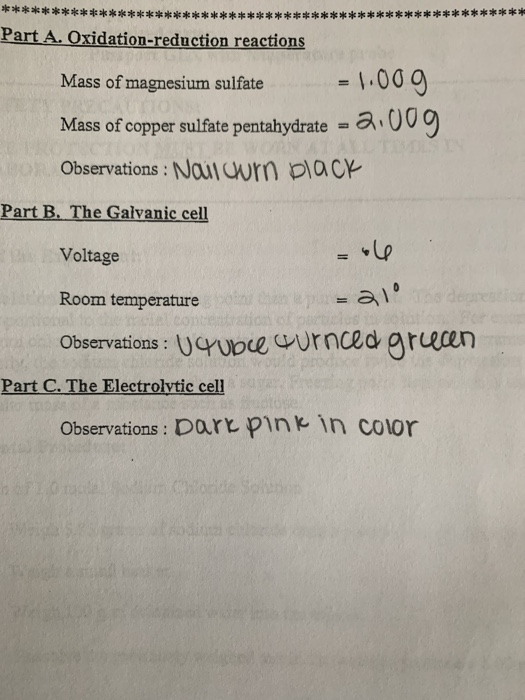
Part A. Oxidation-reduction reactions - .009 -a 009 Mass of magnesium sulfate Mass of copper sulfate pentahydrate Observations: Part B. The Galvanic cell Voltage Lp Room temperature Observations: Uguoe vurnced gruen Part C. The Electrolytic cel Observations:
Homework Answers

Add Answer to:
EXPERIMENT: 26 ELECTROCHEMISTRY: GALVANIC AND ELECTROLYTIC CELLS Materials Required : 50 mL beake...
can someone help me write the half reactions for part A and B. 2. Electrolytic Cells...
 can someone help me write the half reactions for part A and
B.
2. Electrolytic Cells A. In a small beaker, mix 1 mL of 0.1 M sodium iodide solution, 9 mL of water, 1 mL of fresh starch solution, and two drops of phenolphthalein indicator. Lead wires from a dry cell or storage battery into this solution and observe the region around each wire (9). Write half- reaction equations for the reactions (10). What would happen if the reaction...
can someone help me write the half reactions for part A and
B.
2. Electrolytic Cells A. In a small beaker, mix 1 mL of 0.1 M sodium iodide solution, 9 mL of water, 1 mL of fresh starch solution, and two drops of phenolphthalein indicator. Lead wires from a dry cell or storage battery into this solution and observe the region around each wire (9). Write half- reaction equations for the reactions (10). What would happen if the reaction...
Prelab Activity: Electrochemical Cells To determine the solubility product of copper(II) carbonate, CuCO3 , a concentration...
 Prelab Activity:
Electrochemical Cells
To determine the solubility product of copper(II) carbonate,
CuCO3 , a concentration cell as described on pages 71-72
of the lab handout is constructed. The temperature of the Galvanic
cell is measured to be 22.5°C, and the cell potential 282 mV (0.282
V). Using this data and Equation 8 in the lab manual, calculate the
Ksp for CuCO3 and report your answer with
three significant digits.
For the Galvanic cell you will construct in PART B,...
Prelab Activity:
Electrochemical Cells
To determine the solubility product of copper(II) carbonate,
CuCO3 , a concentration cell as described on pages 71-72
of the lab handout is constructed. The temperature of the Galvanic
cell is measured to be 22.5°C, and the cell potential 282 mV (0.282
V). Using this data and Equation 8 in the lab manual, calculate the
Ksp for CuCO3 and report your answer with
three significant digits.
For the Galvanic cell you will construct in PART B,...
need help with the calculatiobs the bottom picture is what i got performing the experiment C....
 need help with the calculatiobs the bottom picture is what i
got performing the experiment
C. Concentration Cells If both cell compartments contain copper metal and copper sulfate, the standard potential is 0.000 V and the Nernst equation becomes: Ercan = 0.000 volts (com dilute) volts Prepare a new cell, which has the beaker with 40 ml of 0.10 M CuSO. (from Part B) and 40 mL 0.0010 M Cuso. (from Part B) in an adjacent second one. Place copper...
need help with the calculatiobs the bottom picture is what i
got performing the experiment
C. Concentration Cells If both cell compartments contain copper metal and copper sulfate, the standard potential is 0.000 V and the Nernst equation becomes: Ercan = 0.000 volts (com dilute) volts Prepare a new cell, which has the beaker with 40 ml of 0.10 M CuSO. (from Part B) and 40 mL 0.0010 M Cuso. (from Part B) in an adjacent second one. Place copper...
1 Reaction C: Copper(II) Hydroxide to Copper(IT) Oxide Observations: The solntich goes from a light blue...
 1 Reaction C: Copper(II) Hydroxide to Copper(IT) Oxide Observations: The solntich goes from a light blue to a dark blue. when heated the solution turns to a green/black color. Balanced Molecular Equation: Balanced Net lonie Equation: Reaction D: Copper(IT) Oxide to Copper(II) Sulfate Observations: "The back sond is dissolved in the acid. This creates a light blue / Clear solurich Balanced Molecular Equation: Balanced Net Ionic Equation: Reaction E: Copper(II) Sulfate to Copper Metal (and Dissolution of excess Mg) Observations:...
Is #3 correct? "Sn(s)/Sn+2(aq) // Cu+2(aq)/Cu(s)" Also, I need help with #4 and #5. Thanks! (will...
 Is #3 correct? "Sn(s)/Sn+2(aq) // Cu+2(aq)/Cu(s)"
Also, I need help with #4 and #5.
Thanks! (will rate!)
Section A. Constructing a Small-Scale Electrochemical Cell Objective To construct a small-scale electrochemical cell using a redox system, to measure the cell potential and derive thermodynamic quantities. Procedures 1. Connect the red and black alligator clips to the multimeter to read voltage. Set up the multimeter to read DC (direct current) voltage using the tab at the top. 2. Cut the filter paper...
Is #3 correct? "Sn(s)/Sn+2(aq) // Cu+2(aq)/Cu(s)"
Also, I need help with #4 and #5.
Thanks! (will rate!)
Section A. Constructing a Small-Scale Electrochemical Cell Objective To construct a small-scale electrochemical cell using a redox system, to measure the cell potential and derive thermodynamic quantities. Procedures 1. Connect the red and black alligator clips to the multimeter to read voltage. Set up the multimeter to read DC (direct current) voltage using the tab at the top. 2. Cut the filter paper...
Chemical Reactions & Equations System 1: Reaction of Sodium Metal with Water Observations: solution start to...
Chemical Reactions & Equations System 1: Reaction of Sodium Metal with Water Observations: solution start to produce vapor and eventually catches fire Reaction Type: Balanced Equation: (Na with H2O) Reaction in words: The hydrogen gas produced in the reaction can ignite in the presence of oxygen gas in the air. If you observed flames above, it was likely due to this reaction Reaction Type: Balanced Equation: (hydrogen gas with oxygen gas): System 2: Combustion Reactions of Methane (CH4) and Cellulose...
Procedure 1. Obtain a power supply and two cables that have alligator clips at one end....
Procedure 1. Obtain a power supply and two cables that have alligator clips at one end. Also obtain two small pieces of insulated copper wire (approximately six inches, with a small amount of exposed wire at each end). 2. Completely Fill a 50 mL buret with 1 M sulfuric acid (to the top, not just the 0 mL mark). 3. Add 150 mL of 1 M sulfuric acid to a medium-sized beaker (250-400 mL). 4. Take a piece of insulated...
Chemistry Laboratory Manual 2017 Revision 3) Get a medium test tube and place about 2 ml...
 Chemistry Laboratory Manual 2017 Revision 3) Get a medium test tube and place about 2 ml of hydrochloric acid into it. Now add a piece of magnesium metal and notice what happens over time Evidence of a shemical reaction white bubbles Balanced chemical equation: Balanced lonie equation: Balanced net ionic equation: 4) Demonstration: Your instructor will demonstrate the reaction that takes place between lithium metal and water. The demonstration will include a test of the resulting solution with universal indicator...
Page 1 and 2 are instructions. Please help me solve K for page 3 and page...
 Page 1 and 2 are instructions. Please help me solve K for page 3
and page 4 and please check the other work on Page 3.
Thanyou very much. Will Rate!
CHM 112 Electrochemical Cells and Thermodynamics Section A. Constructing a Small-Scale Electrochemical Cell Woodbridge Campus Objective To construct a small-scale electrochemical cell using a redox system, to measure the cell potential and derive thermodynamic quantities. Procedures 1. Connect the red and black alligator clips to the multimeter to read...
Page 1 and 2 are instructions. Please help me solve K for page 3
and page 4 and please check the other work on Page 3.
Thanyou very much. Will Rate!
CHM 112 Electrochemical Cells and Thermodynamics Section A. Constructing a Small-Scale Electrochemical Cell Woodbridge Campus Objective To construct a small-scale electrochemical cell using a redox system, to measure the cell potential and derive thermodynamic quantities. Procedures 1. Connect the red and black alligator clips to the multimeter to read...
1. Add hydrochloric acid (HCl) to magnesium metal in a test tube. Observations: &
1. Add hydrochloric acid (HCl) to magnesium metal in a test tube. Observations: Reactants: Products: Chemical Equation: 2. Add calcium nitrate to sodium carbonate in a test tube. Observations: Reactants: Products: Chemical Equation: 3. Add iron (III) nitrate to sodium hydroxide in a test tube. Observations: Reactants: Products: Chemical Equation: 4. Add copper (II) nitrate to ammonium hydroxide in a test tube. For writing the equation, the Roman numeral indicates the charge of copper. Caution: ammonium hydroxide produces very pungent...
 can someone help me write the half reactions for part A and
B.
2. Electrolytic Cells A. In a small beaker, mix 1 mL of 0.1 M sodium iodide solution, 9 mL of water, 1 mL of fresh starch solution, and two drops of phenolphthalein indicator. Lead wires from a dry cell or storage battery into this solution and observe the region around each wire (9). Write half- reaction equations for the reactions (10). What would happen if the reaction...
can someone help me write the half reactions for part A and
B.
2. Electrolytic Cells A. In a small beaker, mix 1 mL of 0.1 M sodium iodide solution, 9 mL of water, 1 mL of fresh starch solution, and two drops of phenolphthalein indicator. Lead wires from a dry cell or storage battery into this solution and observe the region around each wire (9). Write half- reaction equations for the reactions (10). What would happen if the reaction...
 Prelab Activity:
Electrochemical Cells
To determine the solubility product of copper(II) carbonate,
CuCO3 , a concentration cell as described on pages 71-72
of the lab handout is constructed. The temperature of the Galvanic
cell is measured to be 22.5°C, and the cell potential 282 mV (0.282
V). Using this data and Equation 8 in the lab manual, calculate the
Ksp for CuCO3 and report your answer with
three significant digits.
For the Galvanic cell you will construct in PART B,...
Prelab Activity:
Electrochemical Cells
To determine the solubility product of copper(II) carbonate,
CuCO3 , a concentration cell as described on pages 71-72
of the lab handout is constructed. The temperature of the Galvanic
cell is measured to be 22.5°C, and the cell potential 282 mV (0.282
V). Using this data and Equation 8 in the lab manual, calculate the
Ksp for CuCO3 and report your answer with
three significant digits.
For the Galvanic cell you will construct in PART B,...
 need help with the calculatiobs the bottom picture is what i
got performing the experiment
C. Concentration Cells If both cell compartments contain copper metal and copper sulfate, the standard potential is 0.000 V and the Nernst equation becomes: Ercan = 0.000 volts (com dilute) volts Prepare a new cell, which has the beaker with 40 ml of 0.10 M CuSO. (from Part B) and 40 mL 0.0010 M Cuso. (from Part B) in an adjacent second one. Place copper...
need help with the calculatiobs the bottom picture is what i
got performing the experiment
C. Concentration Cells If both cell compartments contain copper metal and copper sulfate, the standard potential is 0.000 V and the Nernst equation becomes: Ercan = 0.000 volts (com dilute) volts Prepare a new cell, which has the beaker with 40 ml of 0.10 M CuSO. (from Part B) and 40 mL 0.0010 M Cuso. (from Part B) in an adjacent second one. Place copper...
 1 Reaction C: Copper(II) Hydroxide to Copper(IT) Oxide Observations: The solntich goes from a light blue to a dark blue. when heated the solution turns to a green/black color. Balanced Molecular Equation: Balanced Net lonie Equation: Reaction D: Copper(IT) Oxide to Copper(II) Sulfate Observations: "The back sond is dissolved in the acid. This creates a light blue / Clear solurich Balanced Molecular Equation: Balanced Net Ionic Equation: Reaction E: Copper(II) Sulfate to Copper Metal (and Dissolution of excess Mg) Observations:...
 Is #3 correct? "Sn(s)/Sn+2(aq) // Cu+2(aq)/Cu(s)"
Also, I need help with #4 and #5.
Thanks! (will rate!)
Section A. Constructing a Small-Scale Electrochemical Cell Objective To construct a small-scale electrochemical cell using a redox system, to measure the cell potential and derive thermodynamic quantities. Procedures 1. Connect the red and black alligator clips to the multimeter to read voltage. Set up the multimeter to read DC (direct current) voltage using the tab at the top. 2. Cut the filter paper...
Is #3 correct? "Sn(s)/Sn+2(aq) // Cu+2(aq)/Cu(s)"
Also, I need help with #4 and #5.
Thanks! (will rate!)
Section A. Constructing a Small-Scale Electrochemical Cell Objective To construct a small-scale electrochemical cell using a redox system, to measure the cell potential and derive thermodynamic quantities. Procedures 1. Connect the red and black alligator clips to the multimeter to read voltage. Set up the multimeter to read DC (direct current) voltage using the tab at the top. 2. Cut the filter paper...
 Chemistry Laboratory Manual 2017 Revision 3) Get a medium test tube and place about 2 ml of hydrochloric acid into it. Now add a piece of magnesium metal and notice what happens over time Evidence of a shemical reaction white bubbles Balanced chemical equation: Balanced lonie equation: Balanced net ionic equation: 4) Demonstration: Your instructor will demonstrate the reaction that takes place between lithium metal and water. The demonstration will include a test of the resulting solution with universal indicator...
 Page 1 and 2 are instructions. Please help me solve K for page 3
and page 4 and please check the other work on Page 3.
Thanyou very much. Will Rate!
CHM 112 Electrochemical Cells and Thermodynamics Section A. Constructing a Small-Scale Electrochemical Cell Woodbridge Campus Objective To construct a small-scale electrochemical cell using a redox system, to measure the cell potential and derive thermodynamic quantities. Procedures 1. Connect the red and black alligator clips to the multimeter to read...
Page 1 and 2 are instructions. Please help me solve K for page 3
and page 4 and please check the other work on Page 3.
Thanyou very much. Will Rate!
CHM 112 Electrochemical Cells and Thermodynamics Section A. Constructing a Small-Scale Electrochemical Cell Woodbridge Campus Objective To construct a small-scale electrochemical cell using a redox system, to measure the cell potential and derive thermodynamic quantities. Procedures 1. Connect the red and black alligator clips to the multimeter to read...
Most questions answered within 3 hours.
-
Where is the error in this code sequence?
String s1 = "Hello";
String s2 = "ello";...
asked 10 months ago -
Financial data for Joel de Paris, Inc., for last year
follow:
Joel de Paris, Inc.
Balance...
asked 10 months ago -
Consider this reaction:
Al2(SO4)3 (aq)+ BaCl3
(aq) Al2Cl6 (aq)- +
3BaSO4(s) . What is the...
asked 10 months ago -
Suppose that Savneet is considering increasing her
recent random sample from 20 car rentals to 40...
asked 10 months ago -
Trucks arrive at an unloading terminal at an average rate of 120
per hour.
Trucks arrive...
asked 10 months ago -
Why are methanol and ethanol completely soluble in water while
octanol is not very little soluble....
asked 10 months ago -
A facilities manager at a university reads in a research report
that the mean amount of...
asked 10 months ago -
When the CuSO4 is rehydrated by adding water to the anhydrous
compound, is this an endothermic...
asked 10 months ago -
A ray of sunlight is passing from diamond into crown glass; the
angle of incidence is...
asked 10 months ago -
A block of mass 0.249 kg is placed on top of a light, vertical
spring of...
asked 10 months ago -
how do the kidneys compensate in the presences of acidosis
a) trigger hyperventilate
b) reserve acid...
asked 10 months ago -
Question 501 pts
The rental rate of capital to the firm increases. Which of the
following...
asked 10 months ago