
Homework Answers
Add Answer to:
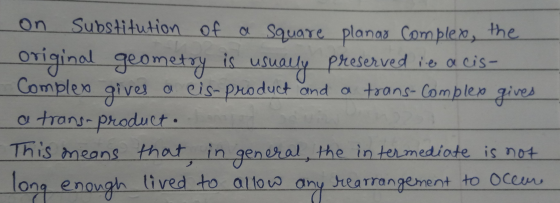
5. Why are intermediates rarely detected in substitution reactions of square planar complexes?
8. Given what you know about substitution reactions of square planar complexes, explain what would happen in the re...
 8. Given what you know about substitution reactions of square planar complexes, explain what would happen in the reaction (Pt(NH3)4]2+ + Cl → Pt(NH3)3CIJ* + NH3 if the entering group were changed from Cl to Br. How would the rate be affected? Write the mechanism for the reaction (be sure to designate a rate determining step) and draw a reaction coordinate diagram.
Copper(I) complexes tend to be tetrahedral rather than octahedral or square planar. Why is this the...
Copper(I) complexes tend to be tetrahedral rather than octahedral or square planar. Why is this the case? Explain your reasoning.
5) (20 Pts) a) Ni(II) tends to form a variety of complexes w square-planar geometries, while Pd(I...
 show cft diagram
5) (20 Pts) a) Ni(II) tends to form a variety of complexes w square-planar geometries, while Pd(IID) and PtII) form predominately square-planar complexes, explain using crystal field theory. b) Another striking difference between these three metals is that the NiIV) oxidation state is very rare, while Pd(IV) is more common and Pt(IV) is very common, explain. Show the CFT diagrams for full credit. ith octahedral, tetrahedral and
5) (20 Pts) a) Ni(II) tends to form a variety...
show cft diagram
5) (20 Pts) a) Ni(II) tends to form a variety of complexes w square-planar geometries, while Pd(IID) and PtII) form predominately square-planar complexes, explain using crystal field theory. b) Another striking difference between these three metals is that the NiIV) oxidation state is very rare, while Pd(IV) is more common and Pt(IV) is very common, explain. Show the CFT diagrams for full credit. ith octahedral, tetrahedral and
5) (20 Pts) a) Ni(II) tends to form a variety...
Group 10 M(II) complexes are often four-coordinate. For Pd and Pt, these molecules are square planar...
Group 10 M(II) complexes are often four-coordinate. For Pd and Pt, these molecules are square planar (with few exceptions). However, for Ni(II), tetrahedral complexes are common. Give at least one plausible explanation for this observation.
Rank the 3 complexes (A, B, C) according to their largest Δ. Three square planar Pt complexes are shown below: (A) [Pt(...
 Rank the 3 complexes (A, B, C) according to their largest Δ.
Three square planar Pt complexes are shown below: (A) [Pt(NH3)4](C1O4)2, (B) Naz[Pt(CN)4], and (C) [Pt(bpy)2](C104)2. H3N2. INH Pt H3N NH3
Rank the 3 complexes (A, B, C) according to their largest Δ.
Three square planar Pt complexes are shown below: (A) [Pt(NH3)4](C1O4)2, (B) Naz[Pt(CN)4], and (C) [Pt(bpy)2](C104)2. H3N2. INH Pt H3N NH3
3. For the following trans effect substitution reactions, predict the square planar products [labelled (a) through...
 3. For the following trans effect substitution reactions, predict the square planar products [labelled (a) through ()]. Reminder: the complete list of trans effect ligands can be found in your textbook (Miessler, Tarr, Fischer). Be sure to indicate the arrangement of ligands by using words or pictures. (10 marks) (i) [PtC14]2-+ NO2 + (a) (a) + NH3 + (b) (ii) [PtCl3NH3] + NO2 → (c) (c) + NO2 → (d) [PtCl(NH3)3]* + NO2 → (e) (iii) (e) + NO2 →...
Draw structures for the following square planar and octahedral complexes and identify, using appropriate schematics, whether...
Draw structures for the following square planar and octahedral complexes and identify, using appropriate schematics, whether coordination or optical isomerism can exist for each complex: [PdCl2(NH3)2] [Pt(NH3)4]2+ [Ru(2,2´-bipyridine)3]2+ [CoCl3(NH3)3]
Draw structures for the following square planar and octahedral complexes and identify, using appropriate schematics, whether...
Draw structures for the following square planar and octahedral complexes and identify, using appropriate schematics, whether coordination or optical isomerism can exist for each complex: [PdCl2(NH3)2] [Pt(NH3)4]2+ [Ru(2,2´-bipyridine)3]2+ [CoCl3(NH3)3]
Inroganic Chemistry. 2 and 3 please 2. Suggest a reason why PdCl is square planar while...
 Inroganic Chemistry. 2 and 3 please
2. Suggest a reason why PdCl is square planar while NiCl is tetrahedral 3. Nearly all Cr(ll) complexes are made by starting with Crill) species. A favorite starting material is the chromous acetate. What is unusual about chromous acetate?
Inroganic Chemistry. 2 and 3 please
2. Suggest a reason why PdCl is square planar while NiCl is tetrahedral 3. Nearly all Cr(ll) complexes are made by starting with Crill) species. A favorite starting material is the chromous acetate. What is unusual about chromous acetate?
Which of the following complexes exhibit geometrical but not optical isomerism? I. Ni(NH3)2Cl2 (square planar) II....
Which of the following complexes exhibit geometrical but not optical isomerism? I. Ni(NH3)2Cl2 (square planar) II. [Rh(en)3]2+ III. [CoCl2Br I and III II III II and III I, II and III I I and II
 8. Given what you know about substitution reactions of square planar complexes, explain what would happen in the reaction (Pt(NH3)4]2+ + Cl → Pt(NH3)3CIJ* + NH3 if the entering group were changed from Cl to Br. How would the rate be affected? Write the mechanism for the reaction (be sure to designate a rate determining step) and draw a reaction coordinate diagram.
 show cft diagram
5) (20 Pts) a) Ni(II) tends to form a variety of complexes w square-planar geometries, while Pd(IID) and PtII) form predominately square-planar complexes, explain using crystal field theory. b) Another striking difference between these three metals is that the NiIV) oxidation state is very rare, while Pd(IV) is more common and Pt(IV) is very common, explain. Show the CFT diagrams for full credit. ith octahedral, tetrahedral and
5) (20 Pts) a) Ni(II) tends to form a variety...
show cft diagram
5) (20 Pts) a) Ni(II) tends to form a variety of complexes w square-planar geometries, while Pd(IID) and PtII) form predominately square-planar complexes, explain using crystal field theory. b) Another striking difference between these three metals is that the NiIV) oxidation state is very rare, while Pd(IV) is more common and Pt(IV) is very common, explain. Show the CFT diagrams for full credit. ith octahedral, tetrahedral and
5) (20 Pts) a) Ni(II) tends to form a variety...
 Rank the 3 complexes (A, B, C) according to their largest Δ.
Three square planar Pt complexes are shown below: (A) [Pt(NH3)4](C1O4)2, (B) Naz[Pt(CN)4], and (C) [Pt(bpy)2](C104)2. H3N2. INH Pt H3N NH3
Rank the 3 complexes (A, B, C) according to their largest Δ.
Three square planar Pt complexes are shown below: (A) [Pt(NH3)4](C1O4)2, (B) Naz[Pt(CN)4], and (C) [Pt(bpy)2](C104)2. H3N2. INH Pt H3N NH3
 3. For the following trans effect substitution reactions, predict the square planar products [labelled (a) through ()]. Reminder: the complete list of trans effect ligands can be found in your textbook (Miessler, Tarr, Fischer). Be sure to indicate the arrangement of ligands by using words or pictures. (10 marks) (i) [PtC14]2-+ NO2 + (a) (a) + NH3 + (b) (ii) [PtCl3NH3] + NO2 → (c) (c) + NO2 → (d) [PtCl(NH3)3]* + NO2 → (e) (iii) (e) + NO2 →...
 Inroganic Chemistry. 2 and 3 please
2. Suggest a reason why PdCl is square planar while NiCl is tetrahedral 3. Nearly all Cr(ll) complexes are made by starting with Crill) species. A favorite starting material is the chromous acetate. What is unusual about chromous acetate?
Inroganic Chemistry. 2 and 3 please
2. Suggest a reason why PdCl is square planar while NiCl is tetrahedral 3. Nearly all Cr(ll) complexes are made by starting with Crill) species. A favorite starting material is the chromous acetate. What is unusual about chromous acetate?
Most questions answered within 3 hours.
-
Where is the error in this code sequence?
String s1 = "Hello";
String s2 = "ello";...
asked 10 months ago -
Financial data for Joel de Paris, Inc., for last year
follow:
Joel de Paris, Inc.
Balance...
asked 10 months ago -
Consider this reaction:
Al2(SO4)3 (aq)+ BaCl3
(aq) Al2Cl6 (aq)- +
3BaSO4(s) . What is the...
asked 10 months ago -
Suppose that Savneet is considering increasing her
recent random sample from 20 car rentals to 40...
asked 10 months ago -
Trucks arrive at an unloading terminal at an average rate of 120
per hour.
Trucks arrive...
asked 10 months ago -
Why are methanol and ethanol completely soluble in water while
octanol is not very little soluble....
asked 10 months ago -
A facilities manager at a university reads in a research report
that the mean amount of...
asked 10 months ago -
When the CuSO4 is rehydrated by adding water to the anhydrous
compound, is this an endothermic...
asked 10 months ago -
A ray of sunlight is passing from diamond into crown glass; the
angle of incidence is...
asked 10 months ago -
A block of mass 0.249 kg is placed on top of a light, vertical
spring of...
asked 10 months ago -
how do the kidneys compensate in the presences of acidosis
a) trigger hyperventilate
b) reserve acid...
asked 10 months ago -
Question 501 pts
The rental rate of capital to the firm increases. Which of the
following...
asked 10 months ago