
Homework Answers
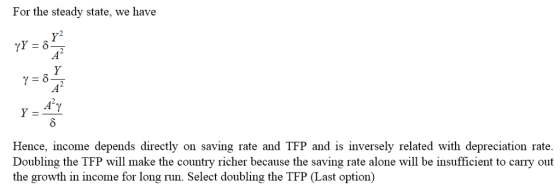
Select the last option (Doubling TFP)
Add Answer to:
We know that a country reaches a steady state when investment equals depreciation. This means Consider...
2. Suppose we know the following about Countries 1 and 2: Country l's production function is...
 2. Suppose we know the following about Countries 1 and 2: Country l's production function is yı = A (k)", Country 2's production function is y2 = A2(k)", where y = output per capita, k = kapital per capita, A = productivity factor, and A1 > 12. At steady state kz > ki, where kj, ki, are steady state kapital per capita of Countries 2 and 1, respectively. Given the above information, what can we conclude about Country 2's output...
1. Consider a country that is initially in steady state. Suppose the saving rate increases. Moreover,...
1. Consider a country that is initially in steady state. Suppose the saving rate increases. Moreover, the population growth rate increases by 1% but the capital depreciation rate falls by 1%. According to the Solow–Swan model, the per capita capital stock increases, and the country moves to a new, higher steady state level of per capita income. Answer true, false, or uncertain. Please briefly explain your answer. 2. Consider the country of Solow, which is described by the Solow–Swan model....
An economy (country A) has a Cobb-Douglas production function: Y = K^0.4 (LE) ^0.6 The economy...
An economy (country A) has a Cobb-Douglas production function: Y = K^0.4 (LE) ^0.6 The economy has a saving rate of 48 percent, a depreciation rate of 2 percent, a rate of population growth of 1 percent, and a rate of labor-augmenting technological change of 3 percent. Assume there is a second economy (country B) with everything identical to country A except for the rate of population growth, which is 2 percent. Assume both countries start a k = 0,...
Consider the Solow growth model with the following production function where y is output. K is ca...
 A and B only
Consider the Solow growth model with the following production function where y is output. K is capital, s is the productivity and is labor. Assume that 0 < α < 1 Further, suppose that labor grows at a constant rate n. That is. 1 + n. Also, assume that capital depreciates at rate d and that gross investment in capital is fraction s of output. a Letting k-N, obtain the law of motion for capital accumulation...
A and B only
Consider the Solow growth model with the following production function where y is output. K is capital, s is the productivity and is labor. Assume that 0 < α < 1 Further, suppose that labor grows at a constant rate n. That is. 1 + n. Also, assume that capital depreciates at rate d and that gross investment in capital is fraction s of output. a Letting k-N, obtain the law of motion for capital accumulation...
pls solve parts f,g,h Suppose Country X's initial capital per effective worker (K/AN) ratio is 16,...
 pls solve parts f,g,h
Suppose Country X's initial capital per effective worker (K/AN) ratio is 16, while Country Z's initial capital per effective worker (KAN) ountries have the same production function: F(K, A,N) = 10K, 5(AN)05 (a) Derive the output per effective worker. The evolution of the capital stock is given by K +1 = (1 - 6)K, + I, where is the depreciation rate. (b) Derive and show that in the long-run growth model, the steady state capital per...
pls solve parts f,g,h
Suppose Country X's initial capital per effective worker (K/AN) ratio is 16, while Country Z's initial capital per effective worker (KAN) ountries have the same production function: F(K, A,N) = 10K, 5(AN)05 (a) Derive the output per effective worker. The evolution of the capital stock is given by K +1 = (1 - 6)K, + I, where is the depreciation rate. (b) Derive and show that in the long-run growth model, the steady state capital per...
1. Imagine that you are hired by the president of the country of Bogatya as an...
 1. Imagine that you are hired by the president of the country of Bogatya as an economic adviser. Currently the country is enjoying a constant but comfortably high standard of living. However, the neighboring country of the Republic of Orania is extremely poor. a. Your initial analysis of the economic data from the region leads you to discover that Bogatya has a much higher level of total factor productivity (A) than Orania but otherwise the two countries seem very similar...
1. Consider the simple version of the Solow Growth Model discussed in class summarized by these...
 1. Consider the simple version of the Solow Growth Model discussed in class summarized by these four equations: Consumers save a fraction s of output: 1 = sy Capital grows as follows: K' = 1 + (1 - 8)K Firms use capital to make output: Y = AK 0.3 There is no government or trade: Y = C+/ where Y is GDP, / is investment, C is consumption, s is the savings rate, K is the capital stock this year,...
Consider a cylindrical capacitor like that shown in Fig. 24.6. Let d = rb − ra...
 Consider a cylindrical capacitor like that shown in Fig. 24.6. Let d = rb − ra be the spacing between the inner and outer conductors. (a) Let the radii of the two conductors be only slightly different, so that d << ra. Show that the result derived in Example 24.4 (Section 24.1) for the capacitance of a cylindrical capacitor then reduces to Eq. (24.2), the equation for the capacitance of a parallel-plate capacitor, with A being the surface area of...
I need Summary of this Paper i dont need long summary i need What methodology they used , what is the purpose of this...
 I need Summary of this Paper i dont need long summary i need
What methodology they used , what is the purpose of this paper and
some conclusions and contributes of this paper. I need this for my
Finishing Project so i need this ASAP please ( IN 1-2-3 HOURS
PLEASE !!!)
SPECIAL ARTICLES tole of Monetary Policy C Rangarajan What should be the objectives of monetary policy? Does the objective of price stability conflict with the goal of achieving...
I need Summary of this Paper i dont need long summary i need
What methodology they used , what is the purpose of this paper and
some conclusions and contributes of this paper. I need this for my
Finishing Project so i need this ASAP please ( IN 1-2-3 HOURS
PLEASE !!!)
SPECIAL ARTICLES tole of Monetary Policy C Rangarajan What should be the objectives of monetary policy? Does the objective of price stability conflict with the goal of achieving...
 2. Suppose we know the following about Countries 1 and 2: Country l's production function is yı = A (k)", Country 2's production function is y2 = A2(k)", where y = output per capita, k = kapital per capita, A = productivity factor, and A1 > 12. At steady state kz > ki, where kj, ki, are steady state kapital per capita of Countries 2 and 1, respectively. Given the above information, what can we conclude about Country 2's output...
 A and B only
Consider the Solow growth model with the following production function where y is output. K is capital, s is the productivity and is labor. Assume that 0 < α < 1 Further, suppose that labor grows at a constant rate n. That is. 1 + n. Also, assume that capital depreciates at rate d and that gross investment in capital is fraction s of output. a Letting k-N, obtain the law of motion for capital accumulation...
A and B only
Consider the Solow growth model with the following production function where y is output. K is capital, s is the productivity and is labor. Assume that 0 < α < 1 Further, suppose that labor grows at a constant rate n. That is. 1 + n. Also, assume that capital depreciates at rate d and that gross investment in capital is fraction s of output. a Letting k-N, obtain the law of motion for capital accumulation...
 pls solve parts f,g,h
Suppose Country X's initial capital per effective worker (K/AN) ratio is 16, while Country Z's initial capital per effective worker (KAN) ountries have the same production function: F(K, A,N) = 10K, 5(AN)05 (a) Derive the output per effective worker. The evolution of the capital stock is given by K +1 = (1 - 6)K, + I, where is the depreciation rate. (b) Derive and show that in the long-run growth model, the steady state capital per...
pls solve parts f,g,h
Suppose Country X's initial capital per effective worker (K/AN) ratio is 16, while Country Z's initial capital per effective worker (KAN) ountries have the same production function: F(K, A,N) = 10K, 5(AN)05 (a) Derive the output per effective worker. The evolution of the capital stock is given by K +1 = (1 - 6)K, + I, where is the depreciation rate. (b) Derive and show that in the long-run growth model, the steady state capital per...
 1. Imagine that you are hired by the president of the country of Bogatya as an economic adviser. Currently the country is enjoying a constant but comfortably high standard of living. However, the neighboring country of the Republic of Orania is extremely poor. a. Your initial analysis of the economic data from the region leads you to discover that Bogatya has a much higher level of total factor productivity (A) than Orania but otherwise the two countries seem very similar...
 1. Consider the simple version of the Solow Growth Model discussed in class summarized by these four equations: Consumers save a fraction s of output: 1 = sy Capital grows as follows: K' = 1 + (1 - 8)K Firms use capital to make output: Y = AK 0.3 There is no government or trade: Y = C+/ where Y is GDP, / is investment, C is consumption, s is the savings rate, K is the capital stock this year,...
 Consider a cylindrical capacitor like that shown in Fig. 24.6. Let d = rb − ra be the spacing between the inner and outer conductors. (a) Let the radii of the two conductors be only slightly different, so that d << ra. Show that the result derived in Example 24.4 (Section 24.1) for the capacitance of a cylindrical capacitor then reduces to Eq. (24.2), the equation for the capacitance of a parallel-plate capacitor, with A being the surface area of...
 I need Summary of this Paper i dont need long summary i need
What methodology they used , what is the purpose of this paper and
some conclusions and contributes of this paper. I need this for my
Finishing Project so i need this ASAP please ( IN 1-2-3 HOURS
PLEASE !!!)
SPECIAL ARTICLES tole of Monetary Policy C Rangarajan What should be the objectives of monetary policy? Does the objective of price stability conflict with the goal of achieving...
I need Summary of this Paper i dont need long summary i need
What methodology they used , what is the purpose of this paper and
some conclusions and contributes of this paper. I need this for my
Finishing Project so i need this ASAP please ( IN 1-2-3 HOURS
PLEASE !!!)
SPECIAL ARTICLES tole of Monetary Policy C Rangarajan What should be the objectives of monetary policy? Does the objective of price stability conflict with the goal of achieving...
Most questions answered within 3 hours.
-
Where is the error in this code sequence?
String s1 = "Hello";
String s2 = "ello";...
asked 10 months ago -
Financial data for Joel de Paris, Inc., for last year
follow:
Joel de Paris, Inc.
Balance...
asked 10 months ago -
Consider this reaction:
Al2(SO4)3 (aq)+ BaCl3
(aq) Al2Cl6 (aq)- +
3BaSO4(s) . What is the...
asked 10 months ago -
Suppose that Savneet is considering increasing her
recent random sample from 20 car rentals to 40...
asked 10 months ago -
Trucks arrive at an unloading terminal at an average rate of 120
per hour.
Trucks arrive...
asked 10 months ago -
Why are methanol and ethanol completely soluble in water while
octanol is not very little soluble....
asked 10 months ago -
A facilities manager at a university reads in a research report
that the mean amount of...
asked 10 months ago -
When the CuSO4 is rehydrated by adding water to the anhydrous
compound, is this an endothermic...
asked 10 months ago -
A ray of sunlight is passing from diamond into crown glass; the
angle of incidence is...
asked 10 months ago -
A block of mass 0.249 kg is placed on top of a light, vertical
spring of...
asked 10 months ago -
how do the kidneys compensate in the presences of acidosis
a) trigger hyperventilate
b) reserve acid...
asked 10 months ago -
Question 501 pts
The rental rate of capital to the firm increases. Which of the
following...
asked 10 months ago