
Homework Answers

Add Answer to:
10-78 A centrifuge of moment of inertia 2.25 x 10² kg.m' rotating at 2.50 X 10...
A centrifuge rotor rotating at 9200 rpm is shut off and is eventually brought uniformly to...
A centrifuge rotor rotating at 9200 rpm is shut off and is eventually brought uniformly to rest by a frictional torque of 2.45 m⋅N. a) If the mass of the rotor is 3.23 kg and it can be approximated as a solid cylinder of radius 0.0950 m , through how many revolutions will the rotor turn before coming to rest? b) How long will it take?
A centrifuge rotor rotating at 9500 rpm is shut off and is eventually brought uniformly to...
A centrifuge rotor rotating at 9500 rpm is shut off and is eventually brought uniformly to rest by a frictional torque of 1.66 m⋅N . a). If the mass of the rotor is 3.42 kg and it can be approximated as a solid cylinder of radius 0.0720 m , through how many revolutions will the rotor turn before coming to rest? b). How long will it take?
part A A centrifuge rotor rotating at 9600 rpm is shut off and is eventually brought...
part A A centrifuge rotor rotating at 9600 rpm is shut off and is eventually brought uniformly to rest by a frictional torque of 2.46 m⋅N . Part A Part complete If the mass of the rotor is 4.40 kg and it can be approximated as a solid cylinder of radius 0.0740 m , through how many revolutions will the rotor turn before coming to rest? part B How long will it take?
A centrifuge rotor rotating at 9500 rpm is shut off and is eventually brought uniformly to...
A centrifuge rotor rotating at 9500 rpm is shut off and is eventually brought uniformly to rest by a frictional torque of 1.93 m⋅N . If the mass of the rotor is 4.69 kg and it can be approximated as a solid cylinder of radius 0.0600 m , through how many revolutions will the rotor turn before coming to rest? How long will it take? Express your answer to three significant figures and include the appropriate units.
40. (II) Calculate the moment of inertia of the array of point objects shown in Fig. 10-53 about (a) the vertica...
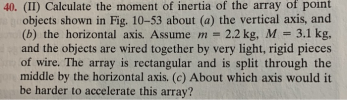 40. (II) Calculate the moment of inertia of the array of point objects shown in Fig. 10-53 about (a) the vertical axis, and (b) the horizontal axis. Assume m = 2.2 kg, M = 3.1 kg, and the objects are wired together by very light, rigid pieces of wire. The array is rectangular and is split through the middle by the horizontal axis. (c) About which axis would it be harder to accelerate this array? 3. (II) A centrifuge rotor...
K Home Work 8 Problem 8.44 9 of 10 > Part A Constants A centrifuge rotor...
 K Home Work 8 Problem 8.44 9 of 10 > Part A Constants A centrifuge rotor rotating at 9800 rpm is shut off and is eventually brought uniformly to rest by a frictional torque of 2.12 m N If the mass of the rotor is 3.43 kg and it can be approximated as a solid cylinder of radius 0.0950 m, through how many revolutions will the rotor turn before coming to rest? Express your answer to three significant figures. revolutions...
A counterclockwise torque is suddenly applied to a rotating shaft with a moment of inertia of...
A counterclockwise torque is suddenly applied to a rotating shaft with a moment of inertia of 5 kg•m2 . The shaft was initially at rest (zero speed). If the applied torque causes the shaft to rotate at a constant angular acceleration of 1.5 rad/s2 , considering zero viscous damping: a) Calculate the applied torque. b) Calculate the angular speed of the shaft after 5 seconds in radians per second. c) Express the speed in revolutions per minute.
A uniform solid disc, whose moment of inertia is unknown, is rotating at an angular velocity...
A uniform solid disc, whose moment of inertia is unknown, is rotating at an angular velocity of 500 rpm. Later it falls on another solid disc that is at rest and that its moment of inertia is of 2.50 kg * m2. The final speed with which both rotate is 170 rpm. Determine the moment of inertia of the disc.
a- A wheel with moment of inertia 0.05 kgm2 rotates about a fixed axis. Its kinetic...
a- A wheel with moment of inertia 0.05 kgm2 rotates about a fixed axis. Its kinetic energy is 1,503 J. What is ts angular speed ω in s-1? Enter an integer. b- A centrifuge starts from rest. Its angular acceleration α is constant for 20 s. Its final angular speed is ω = 160 revolutions per second. What is its angular acceleration α in units of s-2? Enter a number with one digit behind the decimal point c- A centrifuge...
A centrifuge rotor has a moment of inertia of 4.28×10⁻² kg⋅m2 .How much energy is required...
A centrifuge rotor has a moment of inertia of 4.28×10⁻² kg⋅m2 .How much energy is required to bring it from rest to 5520 rpm ?
 40. (II) Calculate the moment of inertia of the array of point objects shown in Fig. 10-53 about (a) the vertical axis, and (b) the horizontal axis. Assume m = 2.2 kg, M = 3.1 kg, and the objects are wired together by very light, rigid pieces of wire. The array is rectangular and is split through the middle by the horizontal axis. (c) About which axis would it be harder to accelerate this array? 3. (II) A centrifuge rotor...
 K Home Work 8 Problem 8.44 9 of 10 > Part A Constants A centrifuge rotor rotating at 9800 rpm is shut off and is eventually brought uniformly to rest by a frictional torque of 2.12 m N If the mass of the rotor is 3.43 kg and it can be approximated as a solid cylinder of radius 0.0950 m, through how many revolutions will the rotor turn before coming to rest? Express your answer to three significant figures. revolutions...
Most questions answered within 3 hours.
-
Where is the error in this code sequence?
String s1 = "Hello";
String s2 = "ello";...
asked 11 months ago -
Financial data for Joel de Paris, Inc., for last year
follow:
Joel de Paris, Inc.
Balance...
asked 11 months ago -
Consider this reaction:
Al2(SO4)3 (aq)+ BaCl3
(aq) Al2Cl6 (aq)- +
3BaSO4(s) . What is the...
asked 11 months ago -
Suppose that Savneet is considering increasing her
recent random sample from 20 car rentals to 40...
asked 11 months ago -
Trucks arrive at an unloading terminal at an average rate of 120
per hour.
Trucks arrive...
asked 11 months ago -
Why are methanol and ethanol completely soluble in water while
octanol is not very little soluble....
asked 11 months ago -
A facilities manager at a university reads in a research report
that the mean amount of...
asked 11 months ago -
When the CuSO4 is rehydrated by adding water to the anhydrous
compound, is this an endothermic...
asked 11 months ago -
A ray of sunlight is passing from diamond into crown glass; the
angle of incidence is...
asked 11 months ago -
A block of mass 0.249 kg is placed on top of a light, vertical
spring of...
asked 11 months ago -
how do the kidneys compensate in the presences of acidosis
a) trigger hyperventilate
b) reserve acid...
asked 11 months ago -
Question 501 pts
The rental rate of capital to the firm increases. Which of the
following...
asked 11 months ago