
Homework Answers
5. The localisation mechanism of 18F - NaF is by uptake in Hydroxyapatite crystals.
C. The mechanism of skeletal uptake of 18F-NaF is based on ion exchange. Bone hardness is due to a crystalline matrix of calcium and phosphate known as hydroxyapatite, which is composed of many different positive and negative ions. Bone. 18F ions exchange with hydroxyl ions (OH–) on the surface of the hydroxyapatite to form fluoroapatite. This exchange occurs at a rapid rate. However, the actual incorporation of 18F ions into the crystalline matrix of bone may take days or weeks.
Uptake of 18F-NaF is a function of osseous blood flow and reflects bone remodeling, and the uptake indicates osteoblastic activity by identifying reactive changes in the underlying affected bone. Abnormal areas of increased 18F-NaF uptake depicted on PET/CT images indicate osteolytic and osteoblastic processes. The rate-limiting step in the passing of 18F ions from blood to bone is thought to be blood flow. Differences in regional blood flow will demonstrate a nonuniform pattern of uptake. Mechanisms leading to increased uptake are not limited to neoplastic processes and include any process of bone remodeling. Normal physiologic uptake in adults is generally uniform.
6. The primary source of energy for the heart is from Fatty Acids.
C. Unlike skeletal muscles, Heart functions almost exclusively aerobically and has virtually no glycogen reserves. The heart can use a variety of substrates to oxidatively regenerate ATP depending upon availability. However, main source of energy for cardiac muscles are fatty acids (60-70%). Lactate can also be used, and becomes a very important substrate during exercise. The heart can also utilize amino acids and ketones instead of fatty acids. Ketone bodies (like acetoacetate) are particularly important in diabetic acidosis. During ischemia and hypoxia, the coronary circulation is unable to deliver metabolic substrates to the heart to support aerobic metabolism. Under these conditions, the heart is able to utilize glycogen (a storage form of carbohydrate) temporarily as a substrate for anaerobic production of ATP and the formation of lactic acid. However, the amount of ATP that the heart is able to produce by this pathway is very small compared to the amount of ATP that can be produced via aerobic metabolism. Furthermore, the heart has a limited supply of glycogen, which is rapidly depleted under severely hypoxic conditions.
7. 11C-Choline is used for imaging all of the following except Breast.
D. 11C-Choline is used in PET imaging studies. Radionuclide is 11C with a Half-life 20.4 minutes. 11C-choline distributes mainly to the pancreas, kidneys, liver, spleen, brain, prostate and colon. Following intravenous administration, 11C-choline undergoes metabolism resulting in the detection of 11C-betaine as the major metabolite in blood.
8. 18F-FDOPA is used to evaluate Parkinson's disease.
B. 18F-FDOPA is used to evaluate Dopamine receptors in the brain (Parkinson’s disease is characterized by loss of dopaminergic neurons in the brain). It is also used in the evaluation of Amino acid (AA) transporters as a diagnostic marker for many benign and malignant tumors and overexpression of DOPA decarboxylase which is a characteristic feature of neuroendocrine tumors. Here the radionuclide is 18F.
9. The answer is 18F-FMISO.
A. PET hypoxia imaging utilizes radiopharmaceuticals compounds that identify regions of tumor hypoxia. The most commonly used radiopharmaceutical to detect hypoxia is 18F-fluoromisonidazole (FMISO). When FMISO diffuses into cells, it is first reduced by nitroreductase to a radical form. Under hypoxic conditions, these radicals will bind to intracellular macromolecules and accumulate inside the cell. Positive accumulation of FMISO is proportional to the extent of hypoxia, with high FMISO uptake indicative of a low tissue O2 concentration.
10. The correct answer is 14N.
B. 15O is commonly produced by deuteron bombardment of a nitrogen gas target via the 14N (d,n) 15O reaction. The short-lived isotope 15O is a clinically important radionuclide for positron emission tomography (PET). 15O is used for metabolic oxygen consumption measurements, 15O-CO is used for lung perfusion and blood distribution measurements, and 15OH2O is used for measuring regional cerebral blood flow.
Add Answer to:
5. The localization mechanism of "F-sodium fluoride is by uptake A. via nucleophilic substitution B. within...
hich radionuclides are possible radioactive contaminants in the eluent of an Rb generator? A. 8Sr and...
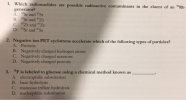 hich radionuclides are possible radioactive contaminants in the eluent of an Rb generator? A. 8Sr and 8SSr B. 8Sr and Zr C. 8Zr and 85Zr D. 8Sr and Sr 2. Negative ion PET cyclotrons accelerate which of the following types of particles? A. Protons B. Negatively charged hydrogen atoms C. Negatively charged neutrons D. Negatively charged protons 3. F is labeled to glucose using a chemical method known as A. electrophilic substitution B. base hydrolysis C. mannose triflate hydrolysis D....
1. Which of the following is not considered a nutrient a Vitamin B. Water c.Carbohydrate (d)...
 1. Which of the following is not considered a nutrient a Vitamin B. Water c.Carbohydrate (d) Alcohol e Mineral 2. For which of the following causes of death does a person's diet play a part? a. Lung disease (6) Cancer Chronic lower respiratory diseases d. Infections of the blood e AIDS 3. Researchers repeatedly report that people who consume a variety of foods such as fruits, vegetables, legumes, nuts, and whole grains have reduced risks of which of the following...
 hich radionuclides are possible radioactive contaminants in the eluent of an Rb generator? A. 8Sr and 8SSr B. 8Sr and Zr C. 8Zr and 85Zr D. 8Sr and Sr 2. Negative ion PET cyclotrons accelerate which of the following types of particles? A. Protons B. Negatively charged hydrogen atoms C. Negatively charged neutrons D. Negatively charged protons 3. F is labeled to glucose using a chemical method known as A. electrophilic substitution B. base hydrolysis C. mannose triflate hydrolysis D....
 1. Which of the following is not considered a nutrient a Vitamin B. Water c.Carbohydrate (d) Alcohol e Mineral 2. For which of the following causes of death does a person's diet play a part? a. Lung disease (6) Cancer Chronic lower respiratory diseases d. Infections of the blood e AIDS 3. Researchers repeatedly report that people who consume a variety of foods such as fruits, vegetables, legumes, nuts, and whole grains have reduced risks of which of the following...
Most questions answered within 3 hours.
-
Where is the error in this code sequence?
String s1 = "Hello";
String s2 = "ello";...
asked 11 months ago -
Financial data for Joel de Paris, Inc., for last year
follow:
Joel de Paris, Inc.
Balance...
asked 11 months ago -
Consider this reaction:
Al2(SO4)3 (aq)+ BaCl3
(aq) Al2Cl6 (aq)- +
3BaSO4(s) . What is the...
asked 11 months ago -
Suppose that Savneet is considering increasing her
recent random sample from 20 car rentals to 40...
asked 11 months ago -
Trucks arrive at an unloading terminal at an average rate of 120
per hour.
Trucks arrive...
asked 11 months ago -
Why are methanol and ethanol completely soluble in water while
octanol is not very little soluble....
asked 11 months ago -
A facilities manager at a university reads in a research report
that the mean amount of...
asked 11 months ago -
When the CuSO4 is rehydrated by adding water to the anhydrous
compound, is this an endothermic...
asked 11 months ago -
A ray of sunlight is passing from diamond into crown glass; the
angle of incidence is...
asked 11 months ago -
A block of mass 0.249 kg is placed on top of a light, vertical
spring of...
asked 11 months ago -
how do the kidneys compensate in the presences of acidosis
a) trigger hyperventilate
b) reserve acid...
asked 11 months ago -
Question 501 pts
The rental rate of capital to the firm increases. Which of the
following...
asked 11 months ago