![2. Draw the structure formula for the complexes [Co(NH3)s(ONO)]Cl2 and [Co(NH3)-(NO)]CI.](http://img.homeworklib.com/questions/8fa63020-72df-11ea-95d1-0f3ab27dacf6.png?x-oss-process=image/resize,w_560)
Homework Answers
![[LOLNH₂), (ONO)] Qq structure. [co (NH3), (NO)] ₂ structure / Vu thuco 2 ceo NR2 NH NH₂](http://img.homeworklib.com/questions/901935e0-72df-11ea-a357-f7b9b6b27b0a.png?x-oss-process=image/resize,w_560)
Add Answer to:
Inorganic Chemistry
2. Draw the structure formula for the complexes [Co(NH3)s(ONO)]Cl2 and [Co(NH3)-(NO)]CI.
In my inorganic chemistry lab we synthesized [Co(NH3)4CO3]NO3. 1. Draw the structure of the [Co(NH3)4CO3]+ complex...
In my inorganic chemistry lab we synthesized [Co(NH3)4CO3]NO3. 1. Draw the structure of the [Co(NH3)4CO3]+ complex and identify the symmetry point group. 9. Which ions satisfy the primary and secondary valence? 10. How many electrons are around the central metal? Does it satisfy the 18 electron rule? Is it stable?
inorganic chemistry 10) Determine the electron count and oxidation states of the following complexes: COCOR PM.,,,CI,...
 inorganic chemistry
10) Determine the electron count and oxidation states of the following complexes: COCOR PM.,,,CI, UP Lp-cp- R2 co co R2 d) O-PR2 e) [Fe(bpy)3]3+ f) TpRe(dppe)(CO) -Ni-H VO OC "CO O-PR2
inorganic chemistry
10) Determine the electron count and oxidation states of the following complexes: COCOR PM.,,,CI, UP Lp-cp- R2 co co R2 d) O-PR2 e) [Fe(bpy)3]3+ f) TpRe(dppe)(CO) -Ni-H VO OC "CO O-PR2
inorganic chemistry 10) Determine the electron count and oxidation states of the following complexes: COCOR PM.,,,CI,...
 inorganic chemistry
10) Determine the electron count and oxidation states of the following complexes: COCOR PM.,,,CI, UP Lp-cp- R2 co co R2 d) O-PR2 e) [Fe(bpy)3]3+ f) TpRe(dppe)(CO) -Ni-H VO OC "CO O-PR2
inorganic chemistry
10) Determine the electron count and oxidation states of the following complexes: COCOR PM.,,,CI, UP Lp-cp- R2 co co R2 d) O-PR2 e) [Fe(bpy)3]3+ f) TpRe(dppe)(CO) -Ni-H VO OC "CO O-PR2
Inorganic Chemistry 3. What is the oxidation state and coordination number of the central cobalt in...
 Inorganic Chemistry
3. What is the oxidation state and coordination number of the central cobalt in each of the prepared complexes? What is the geometry of each one? A [Co (NH₂), CI] Cla B) [Co (NH) (ONO)] C12 C) [c ( H) (No)] Cla
Inorganic Chemistry
3. What is the oxidation state and coordination number of the central cobalt in each of the prepared complexes? What is the geometry of each one? A [Co (NH₂), CI] Cla B) [Co (NH) (ONO)] C12 C) [c ( H) (No)] Cla
What is the name of the following inorganic complexes a. [Pt(NH3)3C13] b. [Co(NH3)2(H20)2Cl2] c. [Re(dien)Br2Cl] d....
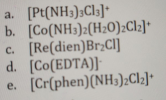 What is the name of the following inorganic
complexes
a. [Pt(NH3)3C13] b. [Co(NH3)2(H20)2Cl2] c. [Re(dien)Br2Cl] d. [Co(EDTA)] e. [Cr(phen) (NH3)2C12]*
What is the name of the following inorganic
complexes
a. [Pt(NH3)3C13] b. [Co(NH3)2(H20)2Cl2] c. [Re(dien)Br2Cl] d. [Co(EDTA)] e. [Cr(phen) (NH3)2C12]*
inorganic chemistry 10) Determine the electron count and oxidation states of the following complexes: R2 co...
 inorganic chemistry
10) Determine the electron count and oxidation states of the following complexes: R2 co co R2 P RECOCIDO RZ O-PR2 e) [Fe(bpy)3]3+ f) TpReadppe)(CO) - Ni-H Μο ICO co O-PR2
inorganic chemistry
10) Determine the electron count and oxidation states of the following complexes: R2 co co R2 P RECOCIDO RZ O-PR2 e) [Fe(bpy)3]3+ f) TpReadppe)(CO) - Ni-H Μο ICO co O-PR2
inorganic chemistry 10) Determine the electron count and oxidation states of the following complexes: R2 co co R2 P...
 inorganic chemistry
10) Determine the electron count and oxidation states of the following complexes: R2 co co R2 P RECOCIDO RZ O-PR2 e) [Fe(bpy)3]3+ f) TpReadppe)(CO) - Ni-H Μο ICO co O-PR2
inorganic chemistry
10) Determine the electron count and oxidation states of the following complexes: R2 co co R2 P RECOCIDO RZ O-PR2 e) [Fe(bpy)3]3+ f) TpReadppe)(CO) - Ni-H Μο ICO co O-PR2
For each of the following complexes, draw the molecular structure and determine the effective ato...
 please do answer all the questions below. thank you
For each of the following complexes, draw the molecular structure and determine the effective atomic numbers. (i) Na[Fe(CN)s(NH3)3l (i) [Cr(H2O)2(NH3)2(en)]Cl (ii) [Co(o-phen)2(NHs)(NCS))CI (iv) (n3-C3Hs)Co(CO)2] (v) [Fe(diphos)(CO)sl in which diphos Ph2PCH2CH2PPh2 and Ph CsHs (10 marks) (i)/ The K for Fe(OH)4]2-is found to be higher than that found in (5 marks) Zn(OH)4]2-and [Cr(OHM. Explain . Cho and coworkers used the following ligand to react with cobalt. Predict how this ligand would bind...
please do answer all the questions below. thank you
For each of the following complexes, draw the molecular structure and determine the effective atomic numbers. (i) Na[Fe(CN)s(NH3)3l (i) [Cr(H2O)2(NH3)2(en)]Cl (ii) [Co(o-phen)2(NHs)(NCS))CI (iv) (n3-C3Hs)Co(CO)2] (v) [Fe(diphos)(CO)sl in which diphos Ph2PCH2CH2PPh2 and Ph CsHs (10 marks) (i)/ The K for Fe(OH)4]2-is found to be higher than that found in (5 marks) Zn(OH)4]2-and [Cr(OHM. Explain . Cho and coworkers used the following ligand to react with cobalt. Predict how this ligand would bind...
4. (2 points) The absorbance maxima observed for the following octahedral cobalt complexes ([Co(NH)* max [Co(NH3)3Cl]...
 4. (2 points) The absorbance maxima observed for the following octahedral cobalt complexes ([Co(NH)* max [Co(NH3)3Cl] nmax = 680 nm) can be identified with transitions involving d-electrons. = 470 nm, [Co(NH);CI]2* Amax = 560 nm, [Co(NH),Cl2]* max = 630 nm, and What can be said about the trend observed in these complexes with relation to their crystal field splitting energies? Rank from LOWEST to HIGHEST splitting energies. а. b. Given the complexes above and the trend in absorbance maxima for...
The two isomers are: [Co(NH3)5ONO]Cl2 and [Co(NH3)5NO2]Cl2. 1. Draw Lewis structures for both isomers, making sure...
The two isomers are: [Co(NH3)5ONO]Cl2 and [Co(NH3)5NO2]Cl2. 1. Draw Lewis structures for both isomers, making sure to highlight what the difference between them is, and what the charge on cobalt is. (Note: In your drawing, you don't have to draw the entire structure and all the bonds within each ammonia ligand (the N-H bonds), but you should for the NO2. It should be clear what atom from each ligand binds to the cobalt ion). 2. Which isomer do you expect...
 inorganic chemistry
10) Determine the electron count and oxidation states of the following complexes: COCOR PM.,,,CI, UP Lp-cp- R2 co co R2 d) O-PR2 e) [Fe(bpy)3]3+ f) TpRe(dppe)(CO) -Ni-H VO OC "CO O-PR2
inorganic chemistry
10) Determine the electron count and oxidation states of the following complexes: COCOR PM.,,,CI, UP Lp-cp- R2 co co R2 d) O-PR2 e) [Fe(bpy)3]3+ f) TpRe(dppe)(CO) -Ni-H VO OC "CO O-PR2
 inorganic chemistry
10) Determine the electron count and oxidation states of the following complexes: COCOR PM.,,,CI, UP Lp-cp- R2 co co R2 d) O-PR2 e) [Fe(bpy)3]3+ f) TpRe(dppe)(CO) -Ni-H VO OC "CO O-PR2
inorganic chemistry
10) Determine the electron count and oxidation states of the following complexes: COCOR PM.,,,CI, UP Lp-cp- R2 co co R2 d) O-PR2 e) [Fe(bpy)3]3+ f) TpRe(dppe)(CO) -Ni-H VO OC "CO O-PR2
 Inorganic Chemistry
3. What is the oxidation state and coordination number of the central cobalt in each of the prepared complexes? What is the geometry of each one? A [Co (NH₂), CI] Cla B) [Co (NH) (ONO)] C12 C) [c ( H) (No)] Cla
Inorganic Chemistry
3. What is the oxidation state and coordination number of the central cobalt in each of the prepared complexes? What is the geometry of each one? A [Co (NH₂), CI] Cla B) [Co (NH) (ONO)] C12 C) [c ( H) (No)] Cla
 What is the name of the following inorganic
complexes
a. [Pt(NH3)3C13] b. [Co(NH3)2(H20)2Cl2] c. [Re(dien)Br2Cl] d. [Co(EDTA)] e. [Cr(phen) (NH3)2C12]*
What is the name of the following inorganic
complexes
a. [Pt(NH3)3C13] b. [Co(NH3)2(H20)2Cl2] c. [Re(dien)Br2Cl] d. [Co(EDTA)] e. [Cr(phen) (NH3)2C12]*
 inorganic chemistry
10) Determine the electron count and oxidation states of the following complexes: R2 co co R2 P RECOCIDO RZ O-PR2 e) [Fe(bpy)3]3+ f) TpReadppe)(CO) - Ni-H Μο ICO co O-PR2
inorganic chemistry
10) Determine the electron count and oxidation states of the following complexes: R2 co co R2 P RECOCIDO RZ O-PR2 e) [Fe(bpy)3]3+ f) TpReadppe)(CO) - Ni-H Μο ICO co O-PR2
 inorganic chemistry
10) Determine the electron count and oxidation states of the following complexes: R2 co co R2 P RECOCIDO RZ O-PR2 e) [Fe(bpy)3]3+ f) TpReadppe)(CO) - Ni-H Μο ICO co O-PR2
inorganic chemistry
10) Determine the electron count and oxidation states of the following complexes: R2 co co R2 P RECOCIDO RZ O-PR2 e) [Fe(bpy)3]3+ f) TpReadppe)(CO) - Ni-H Μο ICO co O-PR2
 please do answer all the questions below. thank you
For each of the following complexes, draw the molecular structure and determine the effective atomic numbers. (i) Na[Fe(CN)s(NH3)3l (i) [Cr(H2O)2(NH3)2(en)]Cl (ii) [Co(o-phen)2(NHs)(NCS))CI (iv) (n3-C3Hs)Co(CO)2] (v) [Fe(diphos)(CO)sl in which diphos Ph2PCH2CH2PPh2 and Ph CsHs (10 marks) (i)/ The K for Fe(OH)4]2-is found to be higher than that found in (5 marks) Zn(OH)4]2-and [Cr(OHM. Explain . Cho and coworkers used the following ligand to react with cobalt. Predict how this ligand would bind...
please do answer all the questions below. thank you
For each of the following complexes, draw the molecular structure and determine the effective atomic numbers. (i) Na[Fe(CN)s(NH3)3l (i) [Cr(H2O)2(NH3)2(en)]Cl (ii) [Co(o-phen)2(NHs)(NCS))CI (iv) (n3-C3Hs)Co(CO)2] (v) [Fe(diphos)(CO)sl in which diphos Ph2PCH2CH2PPh2 and Ph CsHs (10 marks) (i)/ The K for Fe(OH)4]2-is found to be higher than that found in (5 marks) Zn(OH)4]2-and [Cr(OHM. Explain . Cho and coworkers used the following ligand to react with cobalt. Predict how this ligand would bind...
 4. (2 points) The absorbance maxima observed for the following octahedral cobalt complexes ([Co(NH)* max [Co(NH3)3Cl] nmax = 680 nm) can be identified with transitions involving d-electrons. = 470 nm, [Co(NH);CI]2* Amax = 560 nm, [Co(NH),Cl2]* max = 630 nm, and What can be said about the trend observed in these complexes with relation to their crystal field splitting energies? Rank from LOWEST to HIGHEST splitting energies. а. b. Given the complexes above and the trend in absorbance maxima for...
Most questions answered within 3 hours.
-
Where is the error in this code sequence?
String s1 = "Hello";
String s2 = "ello";...
asked 10 months ago -
Financial data for Joel de Paris, Inc., for last year
follow:
Joel de Paris, Inc.
Balance...
asked 10 months ago -
Consider this reaction:
Al2(SO4)3 (aq)+ BaCl3
(aq) Al2Cl6 (aq)- +
3BaSO4(s) . What is the...
asked 10 months ago -
Suppose that Savneet is considering increasing her
recent random sample from 20 car rentals to 40...
asked 10 months ago -
Trucks arrive at an unloading terminal at an average rate of 120
per hour.
Trucks arrive...
asked 10 months ago -
Why are methanol and ethanol completely soluble in water while
octanol is not very little soluble....
asked 10 months ago -
A facilities manager at a university reads in a research report
that the mean amount of...
asked 10 months ago -
When the CuSO4 is rehydrated by adding water to the anhydrous
compound, is this an endothermic...
asked 10 months ago -
A ray of sunlight is passing from diamond into crown glass; the
angle of incidence is...
asked 10 months ago -
A block of mass 0.249 kg is placed on top of a light, vertical
spring of...
asked 10 months ago -
how do the kidneys compensate in the presences of acidosis
a) trigger hyperventilate
b) reserve acid...
asked 10 months ago -
Question 501 pts
The rental rate of capital to the firm increases. Which of the
following...
asked 10 months ago