In my inorganic chemistry lab we synthesized [Co(NH3)4CO3]NO3. 1. Draw the structure of the [Co(NH3)4CO3]+ complex...
In my inorganic chemistry lab we synthesized
[Co(NH3)4CO3]NO3.
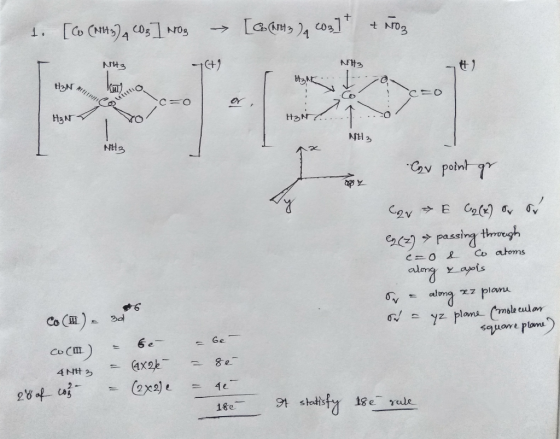
1. Draw the structure of the [Co(NH3)4CO3]+ complex and identify the symmetry point group.
9. Which ions satisfy the primary and secondary valence?
10. How many electrons are around the central metal? Does it satisfy the 18 electron rule? Is it stable?
Homework Answers
primary valency was satisfied by requested number of anions or negatively charged ions that is groups being present inside and/ or outside the coordination sphere
and secondary valency indicate the capacity of the metal ion to accommodate certain number of groups around itself in the first year of attraction that is within the square bracket....therefore primary valency is now be created with oxidation state of the central metal and secondary valency with the coordination number of the metal......
In the complex the carbonate ion inside the coordination sphere has -2 charge and the nitrate nitrate ion outside the coordination sphere has -1 charge. These two negatively charged ions that is a total of -3 charged balances the the the +3 charge of the central metal Cobalt.....
the secondary valency that is the coordination number of the metal is 6 and is satisfied by 4 neutral ammonia ligand and that is coordinated to the metal giving two electron to the metal centre each and the carbonate ion is coordinated by its two oxygen atoms of its three oxygen atoms satisfies remaining two coordination sites of the central metal by simple sigma bond and acting as two electron donors( each oxygen atom)....
Add Answer to:
In my inorganic chemistry lab we synthesized
[Co(NH3)4CO3]NO3.
1. Draw the structure of the [Co(NH3)4CO3]+ complex...
Inorganic Chemistry 2. Draw the structure formula for the complexes [Co(NH3)s(ONO)]Cl2 and [Co(NH3)-(NO)]CI.
 Inorganic Chemistry
2. Draw the structure formula for the complexes [Co(NH3)s(ONO)]Cl2 and [Co(NH3)-(NO)]CI.
Inorganic Chemistry
2. Draw the structure formula for the complexes [Co(NH3)s(ONO)]Cl2 and [Co(NH3)-(NO)]CI.
State the point group symmetry for Mn(acac), [Co(bpy)3](PF6)2, and [Cu(bpy)2](PF6)2 (ignoring the counter anion structure) and...
State the point group symmetry for Mn(acac), [Co(bpy)3](PF6)2, and [Cu(bpy)2](PF6)2 (ignoring the counter anion structure) and illustrate (using an energy level diagram like that used in the lecture) the appropriate valence d electronic configuration (e.g. t2gxegy for Oh and ex t2y for Td) for all investigated metal ions. This schematic of the crystal field splitting diagram for each complex should illustrate the correct distribution of electrons between each orbital level in each case inclusive of any predicted Jahn-Teller distortion.
1. Draw these straightforward Lewis structures for these compounds and ions. CO2 HCCH H20 NO2 NH3...
 1. Draw these straightforward Lewis structures for these compounds and ions. CO2 HCCH H20 NO2 NH3 NO3 NH4+ PCI: H2CO CC14 The shape of molecules is determined primarily by the number of groupings ("electron domains") around the central atom. For the structures above there, are: Two electron domains around the central atom in CO2, HCCH Three electron domains around the central atom in H2CO, NO3-, NO2 Four electron domains around the central atom in NH3, NH4+, H20, PC13, CC14 2....
CHEMISTRY 171: PROBLEM SET #6 (11/8/19) Due: Monday, November 18, 2019 1. How could you tell the difference between...
 CHEMISTRY 171: PROBLEM SET #6 (11/8/19) Due: Monday, November 18, 2019 1. How could you tell the difference between a. A crystal of cubic zirconia and a diamond b. A synthetic ruby and a natural ruby 2. Give the chemical formula for a. cubic zirconia b. sapphire c. emerald 3. Describe the structure of white, red and black phosphorus. What happens when white or red phosphorus is exposed to air? Why did it take 10 years to determine that ducks...
Pre-Lab Exercise 2-3 Chemical Bonding One of the more challenging concepts to grasp in chemistry is...
 Pre-Lab Exercise 2-3 Chemical Bonding One of the more challenging concepts to grasp in chemistry is chemical bonding, a topic that pops up again and again in A&P: We revisit it in cytology, the nervous system, blood, respiration, and digestion-to name just a few First let's do some basics. Use your textbook and this unit to answer the following questions 1. Do metals donate or accept electrons? What do they become after they donate/accept electrons? 2. Do nonmetals donate or...
please I need help with this Х Lab 11.pdf Lab 11.pdf INTRODUCTION The chemical and physical...
 please I need help with this
Х Lab 11.pdf Lab 11.pdf INTRODUCTION The chemical and physical properties of substances are influenced by the way in which valence electrons are distributed and by the three-dimensional shape of the molecule or ion. X- ray and neutron diffraction, infrared, Raman and microwave absorption spectroscopy, as well as dipole moment measurements, are used to ascertain the three-dimensional structure of a substance. Thus, techniques are available which can identify the geometry of substances Results of...
please I need help with this
Х Lab 11.pdf Lab 11.pdf INTRODUCTION The chemical and physical properties of substances are influenced by the way in which valence electrons are distributed and by the three-dimensional shape of the molecule or ion. X- ray and neutron diffraction, infrared, Raman and microwave absorption spectroscopy, as well as dipole moment measurements, are used to ascertain the three-dimensional structure of a substance. Thus, techniques are available which can identify the geometry of substances Results of...
For my chemistry class, we are to create an experimental plan using these guidelines. I would lik...
 For my chemistry class, we are to create an experimental plan
using these guidelines. I would like help with what the
experimental plan should look like, maybe general direction about
what techniques we should use and what values/results we should be
trying to find. Thank you!!
You and your lab partner have been awarded a contract from the U. S. Office of Naval Research (ONR) to identify two secret additives in a radar-reflective coating for nuclear submarines in the Russian...
For my chemistry class, we are to create an experimental plan
using these guidelines. I would like help with what the
experimental plan should look like, maybe general direction about
what techniques we should use and what values/results we should be
trying to find. Thank you!!
You and your lab partner have been awarded a contract from the U. S. Office of Naval Research (ONR) to identify two secret additives in a radar-reflective coating for nuclear submarines in the Russian...
please I need help with the data sheet INTRODUCTION The chemical and physical properties of substances...
 please I need help with the data sheet
INTRODUCTION The chemical and physical properties of substances are influenced by the way in which valence electrons are distributed and by the three-dimensional shape of the molecule or ion. X- ray and neutron diffraction, infrared, Raman and microwave absorption spectroscopy, as well as dipole moment measurements are used to ascertain the three-dimensional structure of a substance. Thus, techniques are available which can identify the geometry of substances. Results of these measurements generally...
please I need help with the data sheet
INTRODUCTION The chemical and physical properties of substances are influenced by the way in which valence electrons are distributed and by the three-dimensional shape of the molecule or ion. X- ray and neutron diffraction, infrared, Raman and microwave absorption spectroscopy, as well as dipole moment measurements are used to ascertain the three-dimensional structure of a substance. Thus, techniques are available which can identify the geometry of substances. Results of these measurements generally...
What are the instruments that have been utilized for the review article discussions? ` 1. Introduction...
 What are the instruments that have been utilized for the
review article discussions?
`
1. Introduction In recent years, nanoclays have been the object of particular interest for many scientists and researchers in chemistry, physics, engineering and biology due to their excellent properties as well as their sustain- ability [1-3]. For instance, they represent the starting point to the de velopment of smart materials for drug delivery (4-9), food packaging [10-12), environmental remediation and wastewater treatment [13], cultural heritage [14–17and...
What are the instruments that have been utilized for the
review article discussions?
`
1. Introduction In recent years, nanoclays have been the object of particular interest for many scientists and researchers in chemistry, physics, engineering and biology due to their excellent properties as well as their sustain- ability [1-3]. For instance, they represent the starting point to the de velopment of smart materials for drug delivery (4-9), food packaging [10-12), environmental remediation and wastewater treatment [13], cultural heritage [14–17and...
 Inorganic Chemistry
2. Draw the structure formula for the complexes [Co(NH3)s(ONO)]Cl2 and [Co(NH3)-(NO)]CI.
Inorganic Chemistry
2. Draw the structure formula for the complexes [Co(NH3)s(ONO)]Cl2 and [Co(NH3)-(NO)]CI.
 1. Draw these straightforward Lewis structures for these compounds and ions. CO2 HCCH H20 NO2 NH3 NO3 NH4+ PCI: H2CO CC14 The shape of molecules is determined primarily by the number of groupings ("electron domains") around the central atom. For the structures above there, are: Two electron domains around the central atom in CO2, HCCH Three electron domains around the central atom in H2CO, NO3-, NO2 Four electron domains around the central atom in NH3, NH4+, H20, PC13, CC14 2....
 CHEMISTRY 171: PROBLEM SET #6 (11/8/19) Due: Monday, November 18, 2019 1. How could you tell the difference between a. A crystal of cubic zirconia and a diamond b. A synthetic ruby and a natural ruby 2. Give the chemical formula for a. cubic zirconia b. sapphire c. emerald 3. Describe the structure of white, red and black phosphorus. What happens when white or red phosphorus is exposed to air? Why did it take 10 years to determine that ducks...
 Pre-Lab Exercise 2-3 Chemical Bonding One of the more challenging concepts to grasp in chemistry is chemical bonding, a topic that pops up again and again in A&P: We revisit it in cytology, the nervous system, blood, respiration, and digestion-to name just a few First let's do some basics. Use your textbook and this unit to answer the following questions 1. Do metals donate or accept electrons? What do they become after they donate/accept electrons? 2. Do nonmetals donate or...
 please I need help with this
Х Lab 11.pdf Lab 11.pdf INTRODUCTION The chemical and physical properties of substances are influenced by the way in which valence electrons are distributed and by the three-dimensional shape of the molecule or ion. X- ray and neutron diffraction, infrared, Raman and microwave absorption spectroscopy, as well as dipole moment measurements, are used to ascertain the three-dimensional structure of a substance. Thus, techniques are available which can identify the geometry of substances Results of...
please I need help with this
Х Lab 11.pdf Lab 11.pdf INTRODUCTION The chemical and physical properties of substances are influenced by the way in which valence electrons are distributed and by the three-dimensional shape of the molecule or ion. X- ray and neutron diffraction, infrared, Raman and microwave absorption spectroscopy, as well as dipole moment measurements, are used to ascertain the three-dimensional structure of a substance. Thus, techniques are available which can identify the geometry of substances Results of...
 For my chemistry class, we are to create an experimental plan
using these guidelines. I would like help with what the
experimental plan should look like, maybe general direction about
what techniques we should use and what values/results we should be
trying to find. Thank you!!
You and your lab partner have been awarded a contract from the U. S. Office of Naval Research (ONR) to identify two secret additives in a radar-reflective coating for nuclear submarines in the Russian...
For my chemistry class, we are to create an experimental plan
using these guidelines. I would like help with what the
experimental plan should look like, maybe general direction about
what techniques we should use and what values/results we should be
trying to find. Thank you!!
You and your lab partner have been awarded a contract from the U. S. Office of Naval Research (ONR) to identify two secret additives in a radar-reflective coating for nuclear submarines in the Russian...
 please I need help with the data sheet
INTRODUCTION The chemical and physical properties of substances are influenced by the way in which valence electrons are distributed and by the three-dimensional shape of the molecule or ion. X- ray and neutron diffraction, infrared, Raman and microwave absorption spectroscopy, as well as dipole moment measurements are used to ascertain the three-dimensional structure of a substance. Thus, techniques are available which can identify the geometry of substances. Results of these measurements generally...
please I need help with the data sheet
INTRODUCTION The chemical and physical properties of substances are influenced by the way in which valence electrons are distributed and by the three-dimensional shape of the molecule or ion. X- ray and neutron diffraction, infrared, Raman and microwave absorption spectroscopy, as well as dipole moment measurements are used to ascertain the three-dimensional structure of a substance. Thus, techniques are available which can identify the geometry of substances. Results of these measurements generally...
 What are the instruments that have been utilized for the
review article discussions?
`
1. Introduction In recent years, nanoclays have been the object of particular interest for many scientists and researchers in chemistry, physics, engineering and biology due to their excellent properties as well as their sustain- ability [1-3]. For instance, they represent the starting point to the de velopment of smart materials for drug delivery (4-9), food packaging [10-12), environmental remediation and wastewater treatment [13], cultural heritage [14–17and...
What are the instruments that have been utilized for the
review article discussions?
`
1. Introduction In recent years, nanoclays have been the object of particular interest for many scientists and researchers in chemistry, physics, engineering and biology due to their excellent properties as well as their sustain- ability [1-3]. For instance, they represent the starting point to the de velopment of smart materials for drug delivery (4-9), food packaging [10-12), environmental remediation and wastewater treatment [13], cultural heritage [14–17and...
Most questions answered within 3 hours.
-
Where is the error in this code sequence?
String s1 = "Hello";
String s2 = "ello";...
asked 11 months ago -
Financial data for Joel de Paris, Inc., for last year
follow:
Joel de Paris, Inc.
Balance...
asked 11 months ago -
Consider this reaction:
Al2(SO4)3 (aq)+ BaCl3
(aq) Al2Cl6 (aq)- +
3BaSO4(s) . What is the...
asked 11 months ago -
Suppose that Savneet is considering increasing her
recent random sample from 20 car rentals to 40...
asked 11 months ago -
Trucks arrive at an unloading terminal at an average rate of 120
per hour.
Trucks arrive...
asked 11 months ago -
Why are methanol and ethanol completely soluble in water while
octanol is not very little soluble....
asked 11 months ago -
A facilities manager at a university reads in a research report
that the mean amount of...
asked 11 months ago -
When the CuSO4 is rehydrated by adding water to the anhydrous
compound, is this an endothermic...
asked 11 months ago -
A ray of sunlight is passing from diamond into crown glass; the
angle of incidence is...
asked 11 months ago -
A block of mass 0.249 kg is placed on top of a light, vertical
spring of...
asked 11 months ago -
how do the kidneys compensate in the presences of acidosis
a) trigger hyperventilate
b) reserve acid...
asked 11 months ago -
Question 501 pts
The rental rate of capital to the firm increases. Which of the
following...
asked 11 months ago