
Homework Answers
consider the motion from A to B
vA = speed at A = 2.8 m/s
vB = speed at B = ?
hA = height at A = 0 m
hB = height at B = 22 cm = 0.22 m
m = mass of the marble
using conservation of energy between A and B
Total energy at A = Total energy at B
kinetic energy at A + potential energy at A = kinetic energy at B + potential energy at B
(0.5) m vA2 + m g hA = (0.5) m vB2 + m g hB
(0.5) vA2 + g hA = (0.5) vB2 + g hB
(0.5) (2.8)2 + (9.8) (0) = (0.5) vB2 + (9.8) (0.22)
vB = 1.88 m/s
consider the motion from A to C
vA = speed at A = 2.8 m/s
vC = speed at C = ?
hA = height at A = 0 m
hC = height at C = 17 cm = 0.17 m
m = mass of the marble
using conservation of energy between A and C
Total energy at A = Total energy at C
kinetic energy at A + potential energy at A = kinetic energy at C + potential energy at C
(0.5) m vA2 + m g hA = (0.5) m vC2 + m g hC
(0.5) vA2 + g hA = (0.5) vC2 + g hC
(0.5) (2.8)2 + (9.8) (0) = (0.5) vC2 + (9.8) (0.17)
vC = 2.12 m/s
Add Answer to:
A marble rolls on the track shown in the figure below, with hs-22 cm and hc17...
A marble rolls on the track shown in the figure below, with hB = 24 cm...
 A marble rolls on the track shown
in the figure below, with hB = 24 cm and hC = 12 cm. If the marble
has a speed of 2.0 m/s at point A, what is its speed at points B
and C?
Velocity at point B _______ m/s
Velocity at point C________ m/s
A marble rolls on the track shown
in the figure below, with hB = 24 cm and hC = 12 cm. If the marble
has a speed of 2.0 m/s at point A, what is its speed at points B
and C?
Velocity at point B _______ m/s
Velocity at point C________ m/s
Please answer the following My Not -2 points A marble rolls on the track shown in...
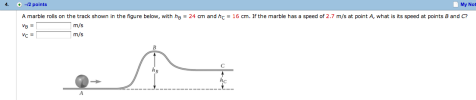 Please answer the following
My Not -2 points A marble rolls on the track shown in the figure below, with h 24 cm and h 16 cm. If the marble has a speed of 2.7 m/s at point A, what is its speed at points B and C? m/s VB m/s
Please answer the following
My Not -2 points A marble rolls on the track shown in the figure below, with h 24 cm and h 16 cm. If the marble has a speed of 2.7 m/s at point A, what is its speed at points B and C? m/s VB m/s
100 cm H. A child rolls a marble on a bent track that is 100 cm...
 100 cm H. A child rolls a marble on a bent track that is 100 cm long as shown in the figure. We use x to represent the position of the marble along the track. The child gives the marble some initial speed at x0 m and t 0 s and then watches it roll to x100 cm, where it turns around, eventually returning to x 0 m with the same speed with which the child released it. On the...
A marble of mass m and radius r rolls along the looped rough track of the...
 A marble of mass m and radius r rolls along
the looped rough track of the figure.(Figure 1) Ignore frictional
losses.
Part A
What is the minimum value of the vertical height h that
the marble must drop if it is to reach the highest point of the
loop without leaving the track? Assume r?R.
Express your answer in terms of R.
Part B
What is the minimum value of the vertical height h that
the marble must drop if...
A marble of mass m and radius r rolls along
the looped rough track of the figure.(Figure 1) Ignore frictional
losses.
Part A
What is the minimum value of the vertical height h that
the marble must drop if it is to reach the highest point of the
loop without leaving the track? Assume r?R.
Express your answer in terms of R.
Part B
What is the minimum value of the vertical height h that
the marble must drop if...
Review Part A The marble rolls down the track and around a loop-the- loop of radius...
 Review Part A The marble rolls down the track and around a loop-the- loop of radius R. The marble has mass m and radius r.(Figure) What minimum height h must the track have for the marble to make it around the loop-the-loop without falling off? Express your answer in terms of the variables R and r hmin Request Answer Submit < Return to Assignment Provide Feedback Figure 〈 1011 〉 Mass m, radius r
In an amusement park, a car rolls on a track as shown below. Find the speed...
 In an amusement park, a car rolls on a track as shown below.
Find the speed (in m/s) of the car at A, B, and C. Note that the
work done by the rolling friction is zero since the point at which
the rolling friction acts on the tires is momentarily at rest and
therefore has a zero displacement.
Va = ? m/s
Vb = ? m/s
Vc = ? m/s
Thanks!
v=0 84 m 74 m 37 m
In an amusement park, a car rolls on a track as shown below.
Find the speed (in m/s) of the car at A, B, and C. Note that the
work done by the rolling friction is zero since the point at which
the rolling friction acts on the tires is momentarily at rest and
therefore has a zero displacement.
Va = ? m/s
Vb = ? m/s
Vc = ? m/s
Thanks!
v=0 84 m 74 m 37 m
please help A marble rolls off a tabletop 1.3 m high and hits the floor at...
 please help
A marble rolls off a tabletop 1.3 m high and hits the floor at a point 2.2 m away from the table's edge in the horizontal direction (a) How long (in s) is the marble in the air? (b) What is the speed of the marble (in m/s) when it leaves the table's edge? m/s (c) What is its speed (in m/s) when it hits the floor?
please help
A marble rolls off a tabletop 1.3 m high and hits the floor at a point 2.2 m away from the table's edge in the horizontal direction (a) How long (in s) is the marble in the air? (b) What is the speed of the marble (in m/s) when it leaves the table's edge? m/s (c) What is its speed (in m/s) when it hits the floor?
In an amusement park, a car rolls on a track as shown below. Find the speed...
 In an amusement park, a car rolls on a track as shown below. Find the speed in /s) of the rolling friction acts on the tires momentarily trest and therefore has a rere displacement AB, and C. Note that the work done by the rolling friction is rare since the point at which the
A marble rolls around with no friction in a circular loop that has a radius of...
A marble rolls around with no friction in a circular loop that has a radius of 40 cm. At the bottom of the loop, the speed is 7 m/s. A. Calculate the marble's centripetal acceleration and the angular speed when the marble is at the bottom of the loop. B. Using conservation of energy, determine the speed of the marble at the top of the loop. C. Calculate the magnitude of the centripetal acceleration and the angular speed of the...
A ball rolls without slipping down the track as shown in the figure below, starting from...
A ball rolls without slipping down the track as shown in the figure below, starting from rest at a height h1 = 24 m as shown. The ball is traveling horizontally when it leaves the bottom of the track, which has a height h2 = 9.5 m. Find where the ball hits the ground; that is, find L.
 A marble rolls on the track shown
in the figure below, with hB = 24 cm and hC = 12 cm. If the marble
has a speed of 2.0 m/s at point A, what is its speed at points B
and C?
Velocity at point B _______ m/s
Velocity at point C________ m/s
A marble rolls on the track shown
in the figure below, with hB = 24 cm and hC = 12 cm. If the marble
has a speed of 2.0 m/s at point A, what is its speed at points B
and C?
Velocity at point B _______ m/s
Velocity at point C________ m/s
 Please answer the following
My Not -2 points A marble rolls on the track shown in the figure below, with h 24 cm and h 16 cm. If the marble has a speed of 2.7 m/s at point A, what is its speed at points B and C? m/s VB m/s
Please answer the following
My Not -2 points A marble rolls on the track shown in the figure below, with h 24 cm and h 16 cm. If the marble has a speed of 2.7 m/s at point A, what is its speed at points B and C? m/s VB m/s
 100 cm H. A child rolls a marble on a bent track that is 100 cm long as shown in the figure. We use x to represent the position of the marble along the track. The child gives the marble some initial speed at x0 m and t 0 s and then watches it roll to x100 cm, where it turns around, eventually returning to x 0 m with the same speed with which the child released it. On the...
 A marble of mass m and radius r rolls along
the looped rough track of the figure.(Figure 1) Ignore frictional
losses.
Part A
What is the minimum value of the vertical height h that
the marble must drop if it is to reach the highest point of the
loop without leaving the track? Assume r?R.
Express your answer in terms of R.
Part B
What is the minimum value of the vertical height h that
the marble must drop if...
A marble of mass m and radius r rolls along
the looped rough track of the figure.(Figure 1) Ignore frictional
losses.
Part A
What is the minimum value of the vertical height h that
the marble must drop if it is to reach the highest point of the
loop without leaving the track? Assume r?R.
Express your answer in terms of R.
Part B
What is the minimum value of the vertical height h that
the marble must drop if...
 Review Part A The marble rolls down the track and around a loop-the- loop of radius R. The marble has mass m and radius r.(Figure) What minimum height h must the track have for the marble to make it around the loop-the-loop without falling off? Express your answer in terms of the variables R and r hmin Request Answer Submit < Return to Assignment Provide Feedback Figure 〈 1011 〉 Mass m, radius r
 In an amusement park, a car rolls on a track as shown below.
Find the speed (in m/s) of the car at A, B, and C. Note that the
work done by the rolling friction is zero since the point at which
the rolling friction acts on the tires is momentarily at rest and
therefore has a zero displacement.
Va = ? m/s
Vb = ? m/s
Vc = ? m/s
Thanks!
v=0 84 m 74 m 37 m
In an amusement park, a car rolls on a track as shown below.
Find the speed (in m/s) of the car at A, B, and C. Note that the
work done by the rolling friction is zero since the point at which
the rolling friction acts on the tires is momentarily at rest and
therefore has a zero displacement.
Va = ? m/s
Vb = ? m/s
Vc = ? m/s
Thanks!
v=0 84 m 74 m 37 m
 please help
A marble rolls off a tabletop 1.3 m high and hits the floor at a point 2.2 m away from the table's edge in the horizontal direction (a) How long (in s) is the marble in the air? (b) What is the speed of the marble (in m/s) when it leaves the table's edge? m/s (c) What is its speed (in m/s) when it hits the floor?
please help
A marble rolls off a tabletop 1.3 m high and hits the floor at a point 2.2 m away from the table's edge in the horizontal direction (a) How long (in s) is the marble in the air? (b) What is the speed of the marble (in m/s) when it leaves the table's edge? m/s (c) What is its speed (in m/s) when it hits the floor?
 In an amusement park, a car rolls on a track as shown below. Find the speed in /s) of the rolling friction acts on the tires momentarily trest and therefore has a rere displacement AB, and C. Note that the work done by the rolling friction is rare since the point at which the
Most questions answered within 3 hours.
-
Where is the error in this code sequence?
String s1 = "Hello";
String s2 = "ello";...
asked 10 months ago -
Financial data for Joel de Paris, Inc., for last year
follow:
Joel de Paris, Inc.
Balance...
asked 10 months ago -
Consider this reaction:
Al2(SO4)3 (aq)+ BaCl3
(aq) Al2Cl6 (aq)- +
3BaSO4(s) . What is the...
asked 10 months ago -
Suppose that Savneet is considering increasing her
recent random sample from 20 car rentals to 40...
asked 10 months ago -
Trucks arrive at an unloading terminal at an average rate of 120
per hour.
Trucks arrive...
asked 10 months ago -
Why are methanol and ethanol completely soluble in water while
octanol is not very little soluble....
asked 10 months ago -
A facilities manager at a university reads in a research report
that the mean amount of...
asked 10 months ago -
When the CuSO4 is rehydrated by adding water to the anhydrous
compound, is this an endothermic...
asked 10 months ago -
A ray of sunlight is passing from diamond into crown glass; the
angle of incidence is...
asked 10 months ago -
A block of mass 0.249 kg is placed on top of a light, vertical
spring of...
asked 10 months ago -
how do the kidneys compensate in the presences of acidosis
a) trigger hyperventilate
b) reserve acid...
asked 10 months ago -
Question 501 pts
The rental rate of capital to the firm increases. Which of the
following...
asked 10 months ago