Homework Answers
Add Answer to:
0.5
is just an arbitrary point value assigned to the problem
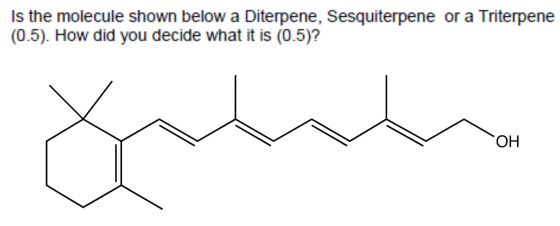
Is the molecule shown below...
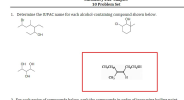
Just answer the circled molecule! 10 Problem Set Determine the IUPAC name for each alcohol-containing compound...
 Just answer the circled molecule!
10 Problem Set Determine the IUPAC name for each alcohol-containing compound shown below 1. он Cl он OH OH H2CH SH он CH
Just answer the circled molecule!
10 Problem Set Determine the IUPAC name for each alcohol-containing compound shown below 1. он Cl он OH OH H2CH SH он CH
Determine the point group of the molecule shown below. Make sure to rotate the molecule to...
 Determine the point group of the molecule shown below. Make sure to rotate the molecule to see all of it (Your answer should have the correct formatting for point groups, e.g, C4v) Tools Click in the window to rotate the molecule. Do not click on any of the atoms in the molecule.
3. The questions below refer to the cyclic peptide shown below. HO H. -ΝΗ HN OH...
 3. The questions below refer to the cyclic peptide shown below. HO H. -ΝΗ HN OH HN -NH ot SH Me a. This peptide is made from how many amino acids? (single number on the line) b. How many potential diastereomers are possible for this molecule? (single number) c. Starting at the glycine residue, draw the linear, Fmoc-protected form of the peptide shown above. Make sure you are drawing the correct stereochemistry! Do not use any abbreviations. Draw out the...
2. Draw the major resonance contributors of the molecule shown below. Then indicate the hybridization about...
 2. Draw the major resonance contributors of the molecule shown below. Then indicate the hybridization about each atom. Once you have assigned hybridization, draw the molecular orbital picture of the molecule in the space below. (10 points) i I
Modify the structure of the molecule shown below to result in a stronger acid and modify...
 Modify the structure of the molecule shown below to result in a stronger acid and modify the structure to result in a weaker acid OH structure of weaker acid structure of stronger acid Draw the major product that results from each set of reactions below. Make certain to indicate stereochemistry if appropriate. If there is no reaction at any point, write "no reaction" as your answer. 2) NaBH4 3) H,0 EIOH heat CsH02 IR 1740 cm1 0 O LDA 3)...
7. What is the empirical formula of the molecule shown below? .OH HO Si- oH HO-Si...
 7. What is the empirical formula of the molecule shown below? .OH HO Si- oH HO-Si HO : OS OH HO:
Show how the molecule shown below can be synthesized via a Mannich reaction. Draw the neutral...
 Show
how the molecule shown below can be synthesized via a Mannich
reaction. Draw the neutral components required. The starting
materials contain four carbon atoms or fewer.
Show how the molecule shown below can be synthesized via a Mannich reaction. Draw the neutral components required. The starting materials contain four carbon atoms or fewer. 1.HCI 2. OH
Show
how the molecule shown below can be synthesized via a Mannich
reaction. Draw the neutral components required. The starting
materials contain four carbon atoms or fewer.
Show how the molecule shown below can be synthesized via a Mannich reaction. Draw the neutral components required. The starting materials contain four carbon atoms or fewer. 1.HCI 2. OH
The molecule shown below is chlorogenic acid, a component of coffee beans. When the ester linkages...
 The molecule shown below is chlorogenic acid, a component of coffee beans. When the ester linkages in this acid break to form two different acid products. What are the products? coffee beans are roasted, structures of these acid OH Our textbook shows examples of radiolabeling experiments in the hydrolysis of labeled esters, but actually leaves out one of the most significant radiolabeling examples! If you had an ester labeled as shown below, what would the products of base-promoted hydrolysis be?...
The triprotic form of the amino acid glutamic acid is shown below, along with the pK,...
 The triprotic form of the amino acid glutamic acid is shown below, along with the pK, value for each ionizable site. B 9.7 l A 2.2 +H3N— C—C—OH c= 0 OH C 4.3 In the monoprotic form of the molecule, is each of the sites (labeled A, B, and C) protonated or unprotonated? site A:( site B: site C: The triprotic form of the amino acid arginine is shown below, along with the pK, value for each ionizable site. B...
6. Four part problem, all about the molecule shown in part a.) a.) Name the following...
 6. Four part problem, all about the molecule shown in part a.) a.) Name the following molecule. OH b.) The alcohol could be converted into which of the functional groups below, using a reaction we have covered in this course (i.e., in one step)? Circle all correct answers. i.) carboxylic acid ii.) alkene iii.) ether iv.) ester v.) aldehyde vi.) epoxide vii.) ketone viii.) acetal c.) How many signals would be seen in the 'C NMR spectrum of the alcohol...
 Just answer the circled molecule!
10 Problem Set Determine the IUPAC name for each alcohol-containing compound shown below 1. он Cl он OH OH H2CH SH он CH
Just answer the circled molecule!
10 Problem Set Determine the IUPAC name for each alcohol-containing compound shown below 1. он Cl он OH OH H2CH SH он CH
 Determine the point group of the molecule shown below. Make sure to rotate the molecule to see all of it (Your answer should have the correct formatting for point groups, e.g, C4v) Tools Click in the window to rotate the molecule. Do not click on any of the atoms in the molecule.
 3. The questions below refer to the cyclic peptide shown below. HO H. -ΝΗ HN OH HN -NH ot SH Me a. This peptide is made from how many amino acids? (single number on the line) b. How many potential diastereomers are possible for this molecule? (single number) c. Starting at the glycine residue, draw the linear, Fmoc-protected form of the peptide shown above. Make sure you are drawing the correct stereochemistry! Do not use any abbreviations. Draw out the...
 2. Draw the major resonance contributors of the molecule shown below. Then indicate the hybridization about each atom. Once you have assigned hybridization, draw the molecular orbital picture of the molecule in the space below. (10 points) i I
 Modify the structure of the molecule shown below to result in a stronger acid and modify the structure to result in a weaker acid OH structure of weaker acid structure of stronger acid Draw the major product that results from each set of reactions below. Make certain to indicate stereochemistry if appropriate. If there is no reaction at any point, write "no reaction" as your answer. 2) NaBH4 3) H,0 EIOH heat CsH02 IR 1740 cm1 0 O LDA 3)...
 7. What is the empirical formula of the molecule shown below? .OH HO Si- oH HO-Si HO : OS OH HO:
 Show
how the molecule shown below can be synthesized via a Mannich
reaction. Draw the neutral components required. The starting
materials contain four carbon atoms or fewer.
Show how the molecule shown below can be synthesized via a Mannich reaction. Draw the neutral components required. The starting materials contain four carbon atoms or fewer. 1.HCI 2. OH
Show
how the molecule shown below can be synthesized via a Mannich
reaction. Draw the neutral components required. The starting
materials contain four carbon atoms or fewer.
Show how the molecule shown below can be synthesized via a Mannich reaction. Draw the neutral components required. The starting materials contain four carbon atoms or fewer. 1.HCI 2. OH
 The molecule shown below is chlorogenic acid, a component of coffee beans. When the ester linkages in this acid break to form two different acid products. What are the products? coffee beans are roasted, structures of these acid OH Our textbook shows examples of radiolabeling experiments in the hydrolysis of labeled esters, but actually leaves out one of the most significant radiolabeling examples! If you had an ester labeled as shown below, what would the products of base-promoted hydrolysis be?...
 The triprotic form of the amino acid glutamic acid is shown below, along with the pK, value for each ionizable site. B 9.7 l A 2.2 +H3N— C—C—OH c= 0 OH C 4.3 In the monoprotic form of the molecule, is each of the sites (labeled A, B, and C) protonated or unprotonated? site A:( site B: site C: The triprotic form of the amino acid arginine is shown below, along with the pK, value for each ionizable site. B...
 6. Four part problem, all about the molecule shown in part a.) a.) Name the following molecule. OH b.) The alcohol could be converted into which of the functional groups below, using a reaction we have covered in this course (i.e., in one step)? Circle all correct answers. i.) carboxylic acid ii.) alkene iii.) ether iv.) ester v.) aldehyde vi.) epoxide vii.) ketone viii.) acetal c.) How many signals would be seen in the 'C NMR spectrum of the alcohol...
Most questions answered within 3 hours.
-
Where is the error in this code sequence?
String s1 = "Hello";
String s2 = "ello";...
asked 10 months ago -
Financial data for Joel de Paris, Inc., for last year
follow:
Joel de Paris, Inc.
Balance...
asked 10 months ago -
Consider this reaction:
Al2(SO4)3 (aq)+ BaCl3
(aq) Al2Cl6 (aq)- +
3BaSO4(s) . What is the...
asked 10 months ago -
Suppose that Savneet is considering increasing her
recent random sample from 20 car rentals to 40...
asked 10 months ago -
Trucks arrive at an unloading terminal at an average rate of 120
per hour.
Trucks arrive...
asked 10 months ago -
Why are methanol and ethanol completely soluble in water while
octanol is not very little soluble....
asked 10 months ago -
A facilities manager at a university reads in a research report
that the mean amount of...
asked 10 months ago -
When the CuSO4 is rehydrated by adding water to the anhydrous
compound, is this an endothermic...
asked 10 months ago -
A ray of sunlight is passing from diamond into crown glass; the
angle of incidence is...
asked 10 months ago -
A block of mass 0.249 kg is placed on top of a light, vertical
spring of...
asked 10 months ago -
how do the kidneys compensate in the presences of acidosis
a) trigger hyperventilate
b) reserve acid...
asked 10 months ago -
Question 501 pts
The rental rate of capital to the firm increases. Which of the
following...
asked 10 months ago