A cylindrical glass with a radius of 4 cm and a height of 20 cm is...
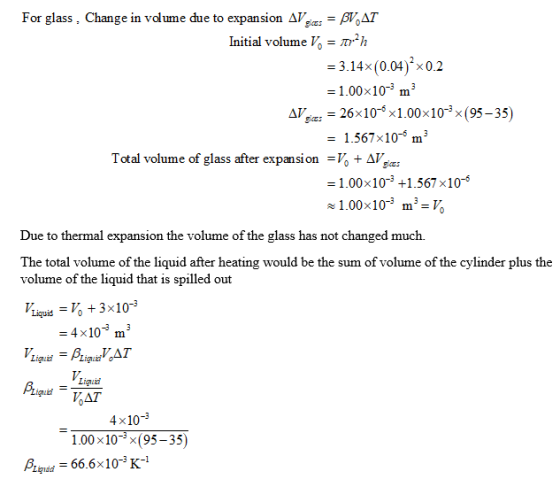
A cylindrical glass with a radius of 4 cm and a height of 20 cm is filled with an unknown liquid at a temperature of 35 oC. The liquid is then heated to 95 oC and 3 x10⁻³ m3 of liquid spills out. What is the coefficient of volumetric expansion for this liquid? (βglass = 26 x 10-6 (Co)-1)
Homework Answers
Add Answer to:
A cylindrical glass with a radius of 4 cm and a height of 20 cm
is...
An cylindrical opaque drinking glass has a diameter 5.4 cm and height h, as shown in...
 An cylindrical opaque drinking glass has a diameter 5.4 cm and height h, as shown in the figure. An observer's eye is placed as shown (the observer is just barely looking over the rim of the glass). When empty, the observer can just barely see the edge of the bottom of the glass. When filled (with a transparent liquid with an index of refraction of 1.36) to the brim, the observer can just barely see the center of the bottom...
A 1200-mL (cm3) cylindrical glass beaker is filled to the brim with ethyl alcohol at a...
A 1200-mL (cm3) cylindrical glass beaker is filled to the brim with ethyl alcohol at a temperature of 20.00°C. The temperature drops to 8°C. The thermal expansion coefficient ? for the ethyl alcohol is 1100×10-6 (1/°C). C) Find the (i) change of volume and the (ii) new volume of the ethyl alcohol. D) The diameter of the beaker is 10 cm. Find the final height of the ethyl alcohol
1. A round-bottomed boiling flask is used to heat 320 ml of blood (1 litre =...
1. A round-bottomed boiling flask is used to heat 320 ml of blood (1 litre = 1 x 10⁻³ m3) from 36 oC to 82 oC. The flask can be assumed to be a sphere of radius r = 5 cm which features a cylindrical neck with an inner diameter d = 3 cm. a) A rubber bung is used to close off the flask, creating a column of air with a height h = 6 cm inside the neck....
A cylindrical pitcher has a radius of 5.00 cm. When filled to a height of 20.0...
A cylindrical pitcher has a radius of 5.00 cm. When filled to a height of 20.0 cm, it holds 1.68 kg of milk. What is the density of the milk? a) 1.13 g/cm^3 b) 0.85 g/cm^3 c) 0.78 g/cm^3 d) 1.00 g/cm^3 e) 1.07 g/cm^3
A copper tube with an inner diameter of 7.46 cm at room temperature (20'C) is to be tension fitted with a glass marble of diameter 7.47 cm. To which temperature must the 100.00-cm long copper...
 A copper tube with an inner diameter of 7.46 cm at room temperature (20'C) is to be tension fitted with a glass marble of diameter 7.47 cm. To which temperature must the 100.00-cm long copper tube be heated to be able to accommodate the marble? The linear expansion coeficient of copper is 17x 10() , for glass you can assume the expansion coefficient to be zero.(4) 1. -1 2. Initially, the tube is open at both ends. When you blow...
A fluid of constant density (p) at 40 °F (T) is flowing into an initially empty cylindrical tank of radius 10 ft. The cy...
A fluid of constant density (p) at 40 °F (T) is flowing into an initially empty cylindrical tank of radius 10 ft. The cylindrical vešsel is jacketed and heated with saturated steam (T) at 212 °F.The steam jacket does not cover either the top or bottom of the tank. The heat capacity of liquid (Cp liquid is near to that of water. The vessel is well stirred and the heat resistance of the jacket is negligible as are the heat...
Wine bottles are never completely filled: a small volume of air is left in the glass...
Wine bottles are never completely filled: a small volume of air is left in the glass bottle's cylindrically shaped neck (inner diameter d = 18.5 mm) to allow for wine's fairly large coefficient of thermal expansion. The distance H between the surface of the liquid contents and the bottom of the cork is called the "headspace height"(Figure 1), and is typically H = 1.5 cm for a 750-mL bottle filled at 20 ∘C. Due to its alcoholic content, wine's coefficient...
Wine bottles are never completely filled: a small volume of air is left in the glass...
 Wine bottles are never completely filled: a small volume of air
is left in the glass bottle's cylindrically shaped neck (inner
diameter d = 18.5 mm) to allow for wine's fairly large
coefficient of thermal expansion. The distance H between
the surface of the liquid contents and the bottom of the cork is
called the "headspace height"(Figure 1), and is typically
H = 1.5 cm for a 750-mL bottle filled at 20 ∘C. Due to its
alcoholic content, wine's coefficient...
Wine bottles are never completely filled: a small volume of air
is left in the glass bottle's cylindrically shaped neck (inner
diameter d = 18.5 mm) to allow for wine's fairly large
coefficient of thermal expansion. The distance H between
the surface of the liquid contents and the bottom of the cork is
called the "headspace height"(Figure 1), and is typically
H = 1.5 cm for a 750-mL bottle filled at 20 ∘C. Due to its
alcoholic content, wine's coefficient...
A long slender solid cylindrical rod made of copper is 2 cm in diameter. It is...
A long slender solid cylindrical rod made of copper is 2 cm in diameter. It is taken out of a liquid nitrogen bath at 77 K and exposed to a stream of warm air at a temperature of 50 C. Neglect internal temperature gradients find the time taken by the rod to heat up to a temperature of 10 C if the surface heat transfer coefficient is 20 W/m^2K. For copper, take k=330 W/mK and ?=95*10^-6 m^2/s.
Liver sausages assume cylindrical 2.5 cm diameter 20 cm long, originally at 20 C, are to...
Liver sausages assume cylindrical 2.5 cm diameter 20 cm long, originally at 20 C, are to be processed in an autoclave kept at 115C, and we want every part of the sausage to reach 105. Estimate the lowest temperature of the sausage after 3 hours in the autoclave. cp=3338 J/kg-K, k=o.483 W/m-K. The density of a sausage is 1050kg/m3. Assume total heat transfer coefficient of 7.5 W/m2-K.
 An cylindrical opaque drinking glass has a diameter 5.4 cm and height h, as shown in the figure. An observer's eye is placed as shown (the observer is just barely looking over the rim of the glass). When empty, the observer can just barely see the edge of the bottom of the glass. When filled (with a transparent liquid with an index of refraction of 1.36) to the brim, the observer can just barely see the center of the bottom...
 A copper tube with an inner diameter of 7.46 cm at room temperature (20'C) is to be tension fitted with a glass marble of diameter 7.47 cm. To which temperature must the 100.00-cm long copper tube be heated to be able to accommodate the marble? The linear expansion coeficient of copper is 17x 10() , for glass you can assume the expansion coefficient to be zero.(4) 1. -1 2. Initially, the tube is open at both ends. When you blow...
 Wine bottles are never completely filled: a small volume of air
is left in the glass bottle's cylindrically shaped neck (inner
diameter d = 18.5 mm) to allow for wine's fairly large
coefficient of thermal expansion. The distance H between
the surface of the liquid contents and the bottom of the cork is
called the "headspace height"(Figure 1), and is typically
H = 1.5 cm for a 750-mL bottle filled at 20 ∘C. Due to its
alcoholic content, wine's coefficient...
Wine bottles are never completely filled: a small volume of air
is left in the glass bottle's cylindrically shaped neck (inner
diameter d = 18.5 mm) to allow for wine's fairly large
coefficient of thermal expansion. The distance H between
the surface of the liquid contents and the bottom of the cork is
called the "headspace height"(Figure 1), and is typically
H = 1.5 cm for a 750-mL bottle filled at 20 ∘C. Due to its
alcoholic content, wine's coefficient...
Most questions answered within 3 hours.
-
Where is the error in this code sequence?
String s1 = "Hello";
String s2 = "ello";...
asked 11 months ago -
Financial data for Joel de Paris, Inc., for last year
follow:
Joel de Paris, Inc.
Balance...
asked 11 months ago -
Consider this reaction:
Al2(SO4)3 (aq)+ BaCl3
(aq) Al2Cl6 (aq)- +
3BaSO4(s) . What is the...
asked 11 months ago -
Suppose that Savneet is considering increasing her
recent random sample from 20 car rentals to 40...
asked 11 months ago -
Trucks arrive at an unloading terminal at an average rate of 120
per hour.
Trucks arrive...
asked 11 months ago -
Why are methanol and ethanol completely soluble in water while
octanol is not very little soluble....
asked 11 months ago -
A facilities manager at a university reads in a research report
that the mean amount of...
asked 11 months ago -
When the CuSO4 is rehydrated by adding water to the anhydrous
compound, is this an endothermic...
asked 11 months ago -
A ray of sunlight is passing from diamond into crown glass; the
angle of incidence is...
asked 11 months ago -
A block of mass 0.249 kg is placed on top of a light, vertical
spring of...
asked 11 months ago -
how do the kidneys compensate in the presences of acidosis
a) trigger hyperventilate
b) reserve acid...
asked 11 months ago -
Question 501 pts
The rental rate of capital to the firm increases. Which of the
following...
asked 11 months ago