Wine bottles are never completely filled: a small volume of air is left in the glass...
Wine bottles are never completely filled: a small volume of air is left in the glass bottle's cylindrically shaped neck (inner diameter d = 18.5 mm) to allow for wine's fairly large coefficient of thermal expansion. The distance H between the surface of the liquid contents and the bottom of the cork is called the "headspace height"(Figure 1), and is typically H = 1.5 cm for a 750-mL bottle filled at 20 ∘C. Due to its alcoholic content, wine's coefficient of volume expansion is about double that of water; in comparison, the thermal expansion of glass can be neglected.
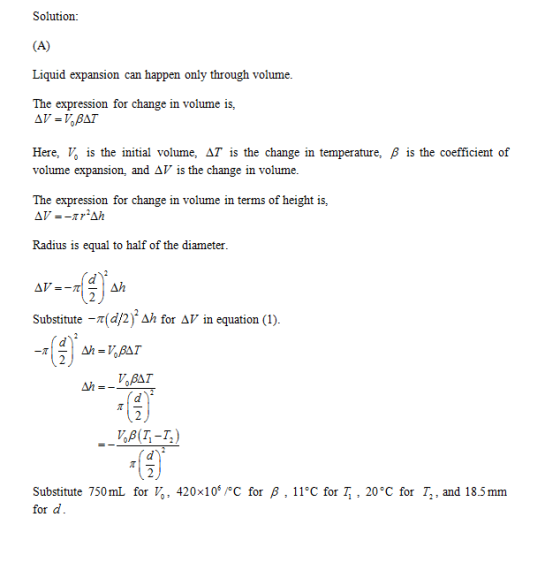
A) Estimate H if the bottle is kept at 11 ∘C.
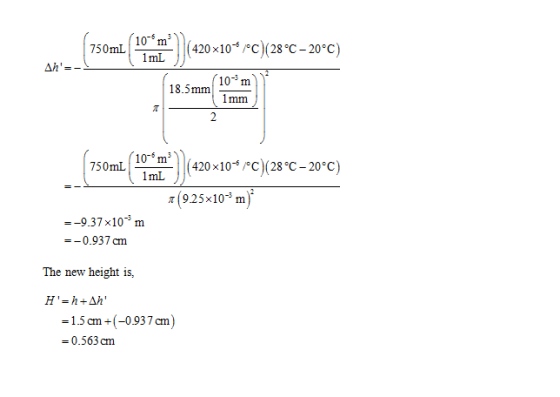
B) Estimate H if the bottle is kept at 28 ∘C.
Homework Answers

Add Answer to:
Wine bottles are never completely filled: a small volume of air
is left in the glass...
Wine bottles are never completely filled: a small volume of air is left in the glass...
 Wine bottles are never completely filled: a small volume of air
is left in the glass bottle's cylindrically shaped neck (inner
diameter d = 18.5 mm) to allow for wine's fairly large
coefficient of thermal expansion. The distance H between
the surface of the liquid contents and the bottom of the cork is
called the "headspace height"(Figure 1), and is typically
H = 1.5 cm for a 750-mL bottle filled at 20 ∘C. Due to its
alcoholic content, wine's coefficient...
Wine bottles are never completely filled: a small volume of air
is left in the glass bottle's cylindrically shaped neck (inner
diameter d = 18.5 mm) to allow for wine's fairly large
coefficient of thermal expansion. The distance H between
the surface of the liquid contents and the bottom of the cork is
called the "headspace height"(Figure 1), and is typically
H = 1.5 cm for a 750-mL bottle filled at 20 ∘C. Due to its
alcoholic content, wine's coefficient...
Constants| Periodic Table Part A Wine bottles are never completely filled: a small volume of air...
 Constants| Periodic Table Part A Wine bottles are never completely filled: a small volume of air is left in the glass bottle's cylindrically shaped neck (inner diameter d 18.5 mm) to allow for wine's fairly large coefficient of thermal expansion. The distance H between the surface of the liquid contents and the bottom of the cork is called the "headspace height (Figure 1), and is typically H 1.5 cm for a 750-m bottle filled at 20 °C. Due to its...
Estimate H if the bottle is kept at 13 °C Wine bottles are never completely filled:...
 Estimate H if the bottle is kept at 13 °C Wine bottles are never completely filled: a small volume of air is left in the glass bottle's cylindrically shaped neck (inner diameter d- 18.5 mm) to allow for wine's fairly large coefficient of thermal expansion. The distance H between the surface of the liquid contents and the bottom of the cork is called the "headspace height (Figure 1), and is typically H 1.5 cm for a 750-mL bottle filled at...
Physics and Chemistry Department - Dr. Masoud PH2031-C Test#1 Name Spring-20 4/7/20 Q5) A- A glass...
 Physics and Chemistry Department - Dr. Masoud PH2031-C Test#1 Name Spring-20 4/7/20 Q5) A- A glass bottle is filled with water up to a distance H from the top. The cylindrically shaped neck has an inner diameter of d-2 cm. H= 12 cm when the volume of water inside the bottle is 200-mL at 20°C. a) Calculate H if the bottle kept at 80°C (ignore the thermal expansion of the glass) b) Repeat part (a) if you take the thermal...
A glass flask whose volume is 1000.29 cm3 at 0.0∘C is completely filled with mercury at...
A glass flask whose volume is 1000.29 cm3 at 0.0∘C is completely filled with mercury at this temperature. When flask and mercury are warmed to 55.4 ∘C, 8.98 cm3 of mercury overflow. Compute the coefficient of volume expansion of the glass. (The coefficient of volume expansion of the mercury is 18×10−5K−1.)
A glass flask whose volume is 1000.42 cm° at 0.0° C is completely filled with mercury...
 A glass flask whose volume is 1000.42 cm° at 0.0° C is completely filled with mercury at this temperature. When flask and mercury are warmed to 55.6° C, 8.68 cm3 of mercury overflow. Part A For related problem-solving tips and strategies, you may want to view a Video Tutor Solution of Expansion of mercury. Compute the coefficient of volume expansion of the glass. (The coefficient of volume expansion of the mercury is 18 x 10 K) Express your answer in...
A glass flask whose volume is 1000.42 cm at 0.0°C is completely filled with mercury at...
 A glass flask whose volume is 1000.42 cm at 0.0°C is completely filled with mercury at this temperature. When flask and mercury are warmed to 55.6°C, 8.68 cm of mercury overflow. - Part A For related problem-solving tips and strategies, you may want to view a Video Tutor Solution of Expansion of mercury. Compute the coefficient of volume expansion of the glass. (The coefficient of volume expansion of the mercury is 18 x 10-5 K-?.). Express your answer in inverse...
A glass flask whose volume is 1000 cm3 at a temperature of 0 ∘C is completely filled with mercury at the same temperatur...
A glass flask whose volume is 1000 cm3 at a temperature of 0 ∘C is completely filled with mercury at the same temperature. When the flask and mercury are warmed together to a temperature of 52.0 ∘C , a volume of 8.50 cm3 of mercury overflows the flask. 1. If the coefficient of volume expansion of mercury is βHg = 1.80×10⁻⁴ /K , compute β glass, the coefficient of volume expansion of the glass. Express your answer in inverse kelvins.
11. (10 pts) A glass beaker with volume 1 liter is completely filled with water at...
 11. (10 pts) A glass beaker with volume 1 liter is completely filled with water at 20°C. How much water will spill out of the glass beaker when the temperature is raised to 90°C? Use the table below if needed (α and β are the coefficients of linear expansion and volume expansion, respectively. Approximate Coefficients of Thermal Expansion at 20oC a (10-"/oc) 23 12 Material Aluminum Concrete Diamond Glass Stainless Steel Water B (10°/oc) 69 36 3 27 51 207...
 Wine bottles are never completely filled: a small volume of air
is left in the glass bottle's cylindrically shaped neck (inner
diameter d = 18.5 mm) to allow for wine's fairly large
coefficient of thermal expansion. The distance H between
the surface of the liquid contents and the bottom of the cork is
called the "headspace height"(Figure 1), and is typically
H = 1.5 cm for a 750-mL bottle filled at 20 ∘C. Due to its
alcoholic content, wine's coefficient...
Wine bottles are never completely filled: a small volume of air
is left in the glass bottle's cylindrically shaped neck (inner
diameter d = 18.5 mm) to allow for wine's fairly large
coefficient of thermal expansion. The distance H between
the surface of the liquid contents and the bottom of the cork is
called the "headspace height"(Figure 1), and is typically
H = 1.5 cm for a 750-mL bottle filled at 20 ∘C. Due to its
alcoholic content, wine's coefficient...
 Constants| Periodic Table Part A Wine bottles are never completely filled: a small volume of air is left in the glass bottle's cylindrically shaped neck (inner diameter d 18.5 mm) to allow for wine's fairly large coefficient of thermal expansion. The distance H between the surface of the liquid contents and the bottom of the cork is called the "headspace height (Figure 1), and is typically H 1.5 cm for a 750-m bottle filled at 20 °C. Due to its...
 Estimate H if the bottle is kept at 13 °C Wine bottles are never completely filled: a small volume of air is left in the glass bottle's cylindrically shaped neck (inner diameter d- 18.5 mm) to allow for wine's fairly large coefficient of thermal expansion. The distance H between the surface of the liquid contents and the bottom of the cork is called the "headspace height (Figure 1), and is typically H 1.5 cm for a 750-mL bottle filled at...
 Physics and Chemistry Department - Dr. Masoud PH2031-C Test#1 Name Spring-20 4/7/20 Q5) A- A glass bottle is filled with water up to a distance H from the top. The cylindrically shaped neck has an inner diameter of d-2 cm. H= 12 cm when the volume of water inside the bottle is 200-mL at 20°C. a) Calculate H if the bottle kept at 80°C (ignore the thermal expansion of the glass) b) Repeat part (a) if you take the thermal...
 A glass flask whose volume is 1000.42 cm° at 0.0° C is completely filled with mercury at this temperature. When flask and mercury are warmed to 55.6° C, 8.68 cm3 of mercury overflow. Part A For related problem-solving tips and strategies, you may want to view a Video Tutor Solution of Expansion of mercury. Compute the coefficient of volume expansion of the glass. (The coefficient of volume expansion of the mercury is 18 x 10 K) Express your answer in...
 A glass flask whose volume is 1000.42 cm at 0.0°C is completely filled with mercury at this temperature. When flask and mercury are warmed to 55.6°C, 8.68 cm of mercury overflow. - Part A For related problem-solving tips and strategies, you may want to view a Video Tutor Solution of Expansion of mercury. Compute the coefficient of volume expansion of the glass. (The coefficient of volume expansion of the mercury is 18 x 10-5 K-?.). Express your answer in inverse...
 11. (10 pts) A glass beaker with volume 1 liter is completely filled with water at 20°C. How much water will spill out of the glass beaker when the temperature is raised to 90°C? Use the table below if needed (α and β are the coefficients of linear expansion and volume expansion, respectively. Approximate Coefficients of Thermal Expansion at 20oC a (10-"/oc) 23 12 Material Aluminum Concrete Diamond Glass Stainless Steel Water B (10°/oc) 69 36 3 27 51 207...
Most questions answered within 3 hours.
-
Where is the error in this code sequence?
String s1 = "Hello";
String s2 = "ello";...
asked 10 months ago -
Financial data for Joel de Paris, Inc., for last year
follow:
Joel de Paris, Inc.
Balance...
asked 10 months ago -
Consider this reaction:
Al2(SO4)3 (aq)+ BaCl3
(aq) Al2Cl6 (aq)- +
3BaSO4(s) . What is the...
asked 10 months ago -
Suppose that Savneet is considering increasing her
recent random sample from 20 car rentals to 40...
asked 10 months ago -
Trucks arrive at an unloading terminal at an average rate of 120
per hour.
Trucks arrive...
asked 10 months ago -
Why are methanol and ethanol completely soluble in water while
octanol is not very little soluble....
asked 10 months ago -
A facilities manager at a university reads in a research report
that the mean amount of...
asked 10 months ago -
When the CuSO4 is rehydrated by adding water to the anhydrous
compound, is this an endothermic...
asked 10 months ago -
A ray of sunlight is passing from diamond into crown glass; the
angle of incidence is...
asked 10 months ago -
A block of mass 0.249 kg is placed on top of a light, vertical
spring of...
asked 10 months ago -
how do the kidneys compensate in the presences of acidosis
a) trigger hyperventilate
b) reserve acid...
asked 10 months ago -
Question 501 pts
The rental rate of capital to the firm increases. Which of the
following...
asked 10 months ago