When I use arbitrary numbers for the payoff function for Player 2, I get 2 NEPS, but am not certain about this approach.
Homework Answers
Consider the game with two players “Player 1” and “Player 2”. Now, “P1” have two strategies “UP” and “DOWN” and “P2” have two strategies “LEFT” and “RIGHT”. Now, we have given that “P1’s” payoff function is such that for any combination of the player’s chosen strategies, “P1” always receive payoff equal to “0” and “P2’s” payoff function is such that no two combination of the player’s chosen strategies ever give “P2” the same payoff, => the payoff matrix is given by.

Now, if “P1” choses “UP” then “P2” will chose either “LEFT” or “RIGHT” depending on “a” or “b” which one is greater. Similarly, if “P1” choses “DOWN” then “P2” will chose either “LEFT” or “RIGHT” depending on “c” or “d” which one is greater and “P1” will always get “0”, => is completely independent of any strategies. SO, there are exactly “2 pure strategy NE”
So, here “2nd” be the correct answer.
Add Answer to:
When I use arbitrary numbers for the payoff function for Player
2, I get 2 NEPS,...
QUESTION 8 Consider a game with two players, players and player 2. Player 1's strategies are...
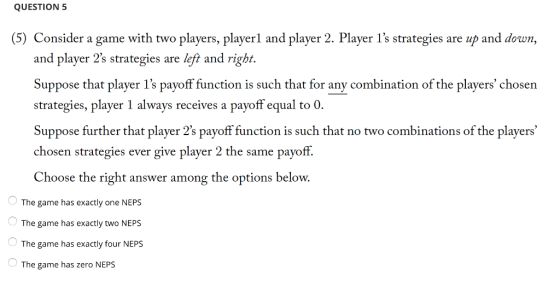
 QUESTION 8 Consider a game with two players, players and player 2. Player 1's strategies are up and down, and player 2's strategies are left and right. Suppose that player 1's payoff function is such that for any combination of the players chosen strategies, player 1 always receives a payoff equal to 0. Suppose further that player 2's payoff function is such that no two combinations of the players' chosen strategies ever give player 2 the same payoff Choose the...
The following simultaneous-move game is with two players. The payoff of player i=1,2 is ui(si,sj)=si(1-si+1asj), where...
The following simultaneous-move game is with two players. The payoff of player i=1,2 is ui(si,sj)=si(1-si+1asj), where is is a strategy of player i and sj is a strategy of player j. a is between 0 and 1. strategies are non-negative real numbers. What is the best response function of player i and equilibrium strategy?
2. Suppose you know the following about a particular two-player game: S1- A, B, C], S2...
 2. Suppose you know the following about a particular two-player game: S1- A, B, C], S2 (X, Y, Z], uI(A, X) 6, u1(A, Y) 0, and u1(A, Z)-0. In addition, suppose you know that the game has a mixed-strategy Nash equilibrium in which (a) the players select each of their strategies with posi- tive probability, (b) player 1's expected payoff in equilibrium is 4, and (c) player 2's expected payoff in equilibrium is 6. Do you have enough infor- mation...
4. (a) (10%) A player has three information sets in the game tree. He has four...
 4. (a) (10%) A player has three information sets in the game tree. He has four choices in his first information set, four in his second and three in his third. How many strategies does he have in the strategic form? Circle one: (i) 11, (ii) 28 (iii) 48 (iv) 18. (b) (10%) Is it true that the following game is a Prisoners' Dilemma? Explain which features of a Prisoners' Dilemma hold and which do not. (Remember each player must...
Consider the following two-period repeated game. The stage game is the following: payoff S H C...
Consider the following two-period repeated game. The stage game is the following: payoff S H C S 3,3 0,1 0,0 H 1,0 1,1 6,0 C 0,0 0,6 5,5 (a) Find all pure-strategy Nash equilibria if the stage game is played only once. (b) Now consider the two-period game. Suppose the discount factor δ = 1 for both players. Find a subgame perfect equilibrium in which each player receives a total payoff of at least 8. (c) For what other values...
Every time I have plugged in the values, I keep getting only 1 NEPS. I have...
 Every time I have plugged in the values, I keep getting only 1
NEPS. I have done the math twice.
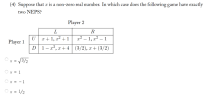
4) Suppose that r is a non-zero real number. In which case does the following game have exactly two NEPS? Player 2 Player 1
Every time I have plugged in the values, I keep getting only 1
NEPS. I have done the math twice.
4) Suppose that r is a non-zero real number. In which case does the following game have exactly two NEPS? Player 2 Player 1
The following matrix gives the payoff for Player 1 and Player 2 with R and L...
The following matrix gives the payoff for Player 1 and Player 2 with R and L strategies. Assume that they determine their strategies simultaneously and independently. Player 2 R L R (5, 4) (-1, -1) Player 1 L (-1, -1) (2, 2) (a) Does Player 1 have a dominant strategy? Why or why not? What is its dominant strategy, if existing? (b) Does Player 2 have a dominant strategy? Why or why not? What is its dominant strategy, if existing?...
5. Consider the payoff matrix below, which shows two players each with three strategies. Player 2...
 5. Consider the payoff matrix below, which shows two players each with three strategies. Player 2 A2 B2 C2 A1 20, 22 24, 20 25, 24 B1 23,26 21,24 22, 23 C1 19, 25 23,17 26,26 Player1 STUDENT NUMBER: SECTION: Page 11 of 12 pages Find all Nash equilibria in pure strategies for this simultaneous choice, one play game. Explain your reasoning. a) b) Draw the game in extended form and solve assuming sequential choice, with player 2 choosing first.
Use the following payoff matrix for a one-shot game to answer the accompanying questions. Player 2...
Use the following payoff matrix for a one-shot game to answer the accompanying questions. Player 2 Strategy X Y Player 1 A 48, 48 -60, 8 B 8, -60 32, 32 a. Determine the Nash equilibrium outcomes that arise if the players make decisions independently, simultaneously, and without any communication. Instructions: In order to receive full credit, you must make a selection for each option. For correct answer(s), click the box once to place a check mark. For incorrect answer(s),...
QUESTION 5 Player III PlayerII Player lI Player i A 11,1 444 A 3,3,0 3,1,7 B...
 QUESTION 5 Player III PlayerII Player lI Player i A 11,1 444 A 3,3,0 3,1,7 B 118 31A Player I B 7,5,7 -1,6,3 Consider the stage game above and suppose it is repeated twice without discounting. Consider all possible SPNE in pure strategies for the twice repeated game. The highest payoff Player 1 can get in a SPNE is The highest payoff Player 2 can get in a SPNE is . Finally, the highest payoff Player 3 can get in...
 QUESTION 8 Consider a game with two players, players and player 2. Player 1's strategies are up and down, and player 2's strategies are left and right. Suppose that player 1's payoff function is such that for any combination of the players chosen strategies, player 1 always receives a payoff equal to 0. Suppose further that player 2's payoff function is such that no two combinations of the players' chosen strategies ever give player 2 the same payoff Choose the...
 2. Suppose you know the following about a particular two-player game: S1- A, B, C], S2 (X, Y, Z], uI(A, X) 6, u1(A, Y) 0, and u1(A, Z)-0. In addition, suppose you know that the game has a mixed-strategy Nash equilibrium in which (a) the players select each of their strategies with posi- tive probability, (b) player 1's expected payoff in equilibrium is 4, and (c) player 2's expected payoff in equilibrium is 6. Do you have enough infor- mation...
 4. (a) (10%) A player has three information sets in the game tree. He has four choices in his first information set, four in his second and three in his third. How many strategies does he have in the strategic form? Circle one: (i) 11, (ii) 28 (iii) 48 (iv) 18. (b) (10%) Is it true that the following game is a Prisoners' Dilemma? Explain which features of a Prisoners' Dilemma hold and which do not. (Remember each player must...
 Every time I have plugged in the values, I keep getting only 1
NEPS. I have done the math twice.
4) Suppose that r is a non-zero real number. In which case does the following game have exactly two NEPS? Player 2 Player 1
Every time I have plugged in the values, I keep getting only 1
NEPS. I have done the math twice.
4) Suppose that r is a non-zero real number. In which case does the following game have exactly two NEPS? Player 2 Player 1
 5. Consider the payoff matrix below, which shows two players each with three strategies. Player 2 A2 B2 C2 A1 20, 22 24, 20 25, 24 B1 23,26 21,24 22, 23 C1 19, 25 23,17 26,26 Player1 STUDENT NUMBER: SECTION: Page 11 of 12 pages Find all Nash equilibria in pure strategies for this simultaneous choice, one play game. Explain your reasoning. a) b) Draw the game in extended form and solve assuming sequential choice, with player 2 choosing first.
 QUESTION 5 Player III PlayerII Player lI Player i A 11,1 444 A 3,3,0 3,1,7 B 118 31A Player I B 7,5,7 -1,6,3 Consider the stage game above and suppose it is repeated twice without discounting. Consider all possible SPNE in pure strategies for the twice repeated game. The highest payoff Player 1 can get in a SPNE is The highest payoff Player 2 can get in a SPNE is . Finally, the highest payoff Player 3 can get in...
Most questions answered within 3 hours.
-
Where is the error in this code sequence?
String s1 = "Hello";
String s2 = "ello";...
asked 10 months ago -
Financial data for Joel de Paris, Inc., for last year
follow:
Joel de Paris, Inc.
Balance...
asked 10 months ago -
Consider this reaction:
Al2(SO4)3 (aq)+ BaCl3
(aq) Al2Cl6 (aq)- +
3BaSO4(s) . What is the...
asked 10 months ago -
Suppose that Savneet is considering increasing her
recent random sample from 20 car rentals to 40...
asked 10 months ago -
Trucks arrive at an unloading terminal at an average rate of 120
per hour.
Trucks arrive...
asked 10 months ago -
Why are methanol and ethanol completely soluble in water while
octanol is not very little soluble....
asked 10 months ago -
A facilities manager at a university reads in a research report
that the mean amount of...
asked 10 months ago -
When the CuSO4 is rehydrated by adding water to the anhydrous
compound, is this an endothermic...
asked 10 months ago -
A ray of sunlight is passing from diamond into crown glass; the
angle of incidence is...
asked 10 months ago -
A block of mass 0.249 kg is placed on top of a light, vertical
spring of...
asked 10 months ago -
how do the kidneys compensate in the presences of acidosis
a) trigger hyperventilate
b) reserve acid...
asked 10 months ago -
Question 501 pts
The rental rate of capital to the firm increases. Which of the
following...
asked 10 months ago