
Homework Answers
2N2O5 ---> 4NO2 +O2
given
K= 6.5 x10^-3 S-1
initial concentration , Ao;; [N2O50] = 2.00 M
time taken = 2500 s
final concentration, A;; [N2O5]= ??
Use the formula for 1st order kinetics
A= Aoe^-kt
A= 2 M e^[-6.5 x10^-3*2500 s]
= 1.753 x10^-7 M
thus final concentration of N2O5 =1.753 x10^-7 M
*****************
CH3CHO +--> CH4 + CO
given
K= 6.5 x10^-3 S-1
initial concentration , Ao = 2.00 M
time taken = 2500 s
final concentration, A= ??
For 2nd order reaction ,integrated form of rate law,
1/A = kt + 1/Ao
=6.5 x10^-3 S-1*2500 s + 1/3
= 16.25 +0.33 =17.0833
A = 1/17.083= 0.05853 M
thus final concentration of CH3CHO = 0.05853 M
Thus after 2500 s ,CH3CHO will remain more than N2O5
******************
Add Answer to:
#1 please
sactions and kinetic 6.50 x 10's INOCHOD. = 3.00 M 1. (30 pts) Kinetics...
1A. 2NO(g) + 2H2(g) → N2(g) + 2H2O (g) EXPERIMENT [NO]0 [H2]0 Initial rate (M/s) 1...
1A. 2NO(g) + 2H2(g) → N2(g) + 2H2O (g) EXPERIMENT [NO]0 [H2]0 Initial rate (M/s) 1 0.200 0.122 0.0313 2 0.400 0.122 0.1250 3 0.200 0.244 0.0625 Using the information above, find the order of each reactant and then find the rate constant. 1B. The decomposition of dinitrogen pentoxide happens by the following: 2N2O5 (g) → 4NO2(g) + O2(g) Calculate the average rate (M/s) of decomposition given: Time [N2O5] 10 minutes 1.238 x 10⁻² 20 minutes 0.926 x 10⁻² If...
1. The following chemical reaction: A → products shows first order kinetics with respect to A;...
1. The following chemical reaction: A → products shows first order kinetics with respect to A; rate = k[A]. Assume k = 10.09 x 10⁻⁴ s-1 . If the initial concentration of A was 0.82 mol L-1 and then decreased to 0.11 mol L-1 , how much time elapsed in minutes? 2. Consider the following balanced chemical equation: H2O2 (aq) + 3 I-(aq) + 2 H+(aq) → I3- (aq) + 2 H2O (l) In the first 62.9 seconds of the...
please show all work 1. Consider the following kinetic data, collected at 25.0°C, for the reaction...
 please show all work
1. Consider the following kinetic data, collected at 25.0°C, for the reaction 2 NO(g+ Cl2 → 2NOCI Experiment INOJ (M) 0.0300 0.0150 0.0150 ICI (M) 0.0100 0.0100 0.0400 Rate (M/s) 3.4 x 10 8.5 x 10 3.4 x 10 a. What is the reaction order with respect to NO? b. What is the reaction order with respect to CIZ? c. What is the overall reaction order? d. Determine the value of the rate constant, k (round...
please show all work
1. Consider the following kinetic data, collected at 25.0°C, for the reaction 2 NO(g+ Cl2 → 2NOCI Experiment INOJ (M) 0.0300 0.0150 0.0150 ICI (M) 0.0100 0.0100 0.0400 Rate (M/s) 3.4 x 10 8.5 x 10 3.4 x 10 a. What is the reaction order with respect to NO? b. What is the reaction order with respect to CIZ? c. What is the overall reaction order? d. Determine the value of the rate constant, k (round...
1. Consider the following kinetic data, collected at 25.0°C, for the reaction 2 NO(g+ Cl2 →...
 1. Consider the following kinetic data, collected at 25.0°C, for the reaction 2 NO(g+ Cl2 → 2NOCI Experiment INOJ (M) 0.0300 0.0150 0.0150 ICI (M) 0.0100 0.0100 0.0400 Rate (M/s) 3.4 x 10 8.5 x 10 3.4 x 10 a. What is the reaction order with respect to NO? b. What is the reaction order with respect to CIZ? c. What is the overall reaction order? d. Determine the value of the rate constant, k (round to 2 sig figs).
1. Consider the following kinetic data, collected at 25.0°C, for the reaction 2 NO. + Cl2...
 1. Consider the following kinetic data, collected at 25.0°C, for the reaction 2 NO. + Cl2 → 2NOCI Experiment INOJM) 0.0300 0.0150 0.0150 [CI] (M) 0.0100 0.0100 0.0400 Rate (M/s) 3.4 x 10 8.5 x 10⁻⁵ 3.4 x 10+ الدنيا a. What is the reaction order with respect to NO? b. What is the reaction order with respect to CIL? c. What is the overall reaction order? d. Determine the value of the rate constant, k (round to 2 sig...
Calculate the rate constant k (in M^-1 s^-1) using the information in the reaction and Table...
 Calculate the rate constant k (in M^-1 s^-1) using the information
in the reaction and Table 14.2.
ΝΗ, 4 (aq) + NO 2 (aq) →N + 2H2O 2 (8) A) 2.7 x 10*m's' B) 1.0 x 10-ºm's' C) 5.4 x 10m's' D) 2.7 x 10 M's! TABLE 14.2. Rate Data for the Reaction of Ammonium and Nitrite lons in Water at 25 °C + Experiment Number Initial NH, Concentration (M) Initial NO2 Concentration (M) انا فية طالية 0.0100 0.0200 0.0400...
Calculate the rate constant k (in M^-1 s^-1) using the information
in the reaction and Table 14.2.
ΝΗ, 4 (aq) + NO 2 (aq) →N + 2H2O 2 (8) A) 2.7 x 10*m's' B) 1.0 x 10-ºm's' C) 5.4 x 10m's' D) 2.7 x 10 M's! TABLE 14.2. Rate Data for the Reaction of Ammonium and Nitrite lons in Water at 25 °C + Experiment Number Initial NH, Concentration (M) Initial NO2 Concentration (M) انا فية طالية 0.0100 0.0200 0.0400...
help! 1 , 2 and extra credit! please answer all. 1. You study the following reaction...
 help! 1 , 2 and extra credit! please answer all.
1. You study the following reaction in a series of experiments: (CH),COH(aq) + HCl(aq) à (CH),CCl(aq) +H,0(1) At 100.C you obtained the following data: Experiment (CH.COH., MHCIL. M Initial Rate, M's 100 0.100 5.0 x 10 0.100 10 x 10 300 6.200 10x10 0.300 0.100 1.5 x 10 0.00 Please do the following: a. Write the rate law for the reaction. b. Indicate the order of the reaction with respect...
help! 1 , 2 and extra credit! please answer all.
1. You study the following reaction in a series of experiments: (CH),COH(aq) + HCl(aq) à (CH),CCl(aq) +H,0(1) At 100.C you obtained the following data: Experiment (CH.COH., MHCIL. M Initial Rate, M's 100 0.100 5.0 x 10 0.100 10 x 10 300 6.200 10x10 0.300 0.100 1.5 x 10 0.00 Please do the following: a. Write the rate law for the reaction. b. Indicate the order of the reaction with respect...
D18 Kinetics Review Sheets 8 H*(aq) + 4 Cl(aq) + MnO4 (aq) - 2 Cl(g) +...
 D18 Kinetics Review Sheets 8 H*(aq) + 4 Cl(aq) + MnO4 (aq) - 2 Cl(g) + Mn(aq) + 4H2O(l) 1. Cl2 (9) can be generated in the laboratory by reacting potassium permanganate with an acidified solution of sodium chloride. The net-ionic equation for the reaction is given above. a. A 25.00 mL sample of 0.250 M NaCl reacts completely with excess KMnO.(aq). The Cl(a) produced is dried and stored in a sealed container. At 22°C the pressure of the Cl2(g)...
a certain first-order reaction has a rate constant of 3.00×10⁻² s−1 at 23 ∘c. what is...
a certain first-order reaction has a rate constant of 3.00×10⁻² s−1 at 23 ∘c. what is the value of k at 67 degrees celsius if Ea= 86 kJ/mol
1 S = 1 x 10-13 sectomie R= 8.314 J molt K M =8.314 Nm molt...
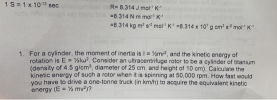 1 S = 1 x 10-13 sectomie R= 8.314 J molt K M =8.314 Nm molt K1 =8.314 kg m? s? mol K-=8.314 x 10'g cm? s? molt k? 1. For a cylinder, the moment of inertia is I = Vmr?, and the kinetic energy of rotation is E = Vlwa. Consider an ultracentrifuge rotor to be a cylinder of titanium (density of 4.5 g/cm, diameter of 25 cm, and height of 10 cm). Calculate the kinetic energy of such...
 please show all work
1. Consider the following kinetic data, collected at 25.0°C, for the reaction 2 NO(g+ Cl2 → 2NOCI Experiment INOJ (M) 0.0300 0.0150 0.0150 ICI (M) 0.0100 0.0100 0.0400 Rate (M/s) 3.4 x 10 8.5 x 10 3.4 x 10 a. What is the reaction order with respect to NO? b. What is the reaction order with respect to CIZ? c. What is the overall reaction order? d. Determine the value of the rate constant, k (round...
please show all work
1. Consider the following kinetic data, collected at 25.0°C, for the reaction 2 NO(g+ Cl2 → 2NOCI Experiment INOJ (M) 0.0300 0.0150 0.0150 ICI (M) 0.0100 0.0100 0.0400 Rate (M/s) 3.4 x 10 8.5 x 10 3.4 x 10 a. What is the reaction order with respect to NO? b. What is the reaction order with respect to CIZ? c. What is the overall reaction order? d. Determine the value of the rate constant, k (round...
 1. Consider the following kinetic data, collected at 25.0°C, for the reaction 2 NO(g+ Cl2 → 2NOCI Experiment INOJ (M) 0.0300 0.0150 0.0150 ICI (M) 0.0100 0.0100 0.0400 Rate (M/s) 3.4 x 10 8.5 x 10 3.4 x 10 a. What is the reaction order with respect to NO? b. What is the reaction order with respect to CIZ? c. What is the overall reaction order? d. Determine the value of the rate constant, k (round to 2 sig figs).
 1. Consider the following kinetic data, collected at 25.0°C, for the reaction 2 NO. + Cl2 → 2NOCI Experiment INOJM) 0.0300 0.0150 0.0150 [CI] (M) 0.0100 0.0100 0.0400 Rate (M/s) 3.4 x 10 8.5 x 10⁻⁵ 3.4 x 10+ الدنيا a. What is the reaction order with respect to NO? b. What is the reaction order with respect to CIL? c. What is the overall reaction order? d. Determine the value of the rate constant, k (round to 2 sig...
 Calculate the rate constant k (in M^-1 s^-1) using the information
in the reaction and Table 14.2.
ΝΗ, 4 (aq) + NO 2 (aq) →N + 2H2O 2 (8) A) 2.7 x 10*m's' B) 1.0 x 10-ºm's' C) 5.4 x 10m's' D) 2.7 x 10 M's! TABLE 14.2. Rate Data for the Reaction of Ammonium and Nitrite lons in Water at 25 °C + Experiment Number Initial NH, Concentration (M) Initial NO2 Concentration (M) انا فية طالية 0.0100 0.0200 0.0400...
Calculate the rate constant k (in M^-1 s^-1) using the information
in the reaction and Table 14.2.
ΝΗ, 4 (aq) + NO 2 (aq) →N + 2H2O 2 (8) A) 2.7 x 10*m's' B) 1.0 x 10-ºm's' C) 5.4 x 10m's' D) 2.7 x 10 M's! TABLE 14.2. Rate Data for the Reaction of Ammonium and Nitrite lons in Water at 25 °C + Experiment Number Initial NH, Concentration (M) Initial NO2 Concentration (M) انا فية طالية 0.0100 0.0200 0.0400...
 help! 1 , 2 and extra credit! please answer all.
1. You study the following reaction in a series of experiments: (CH),COH(aq) + HCl(aq) à (CH),CCl(aq) +H,0(1) At 100.C you obtained the following data: Experiment (CH.COH., MHCIL. M Initial Rate, M's 100 0.100 5.0 x 10 0.100 10 x 10 300 6.200 10x10 0.300 0.100 1.5 x 10 0.00 Please do the following: a. Write the rate law for the reaction. b. Indicate the order of the reaction with respect...
help! 1 , 2 and extra credit! please answer all.
1. You study the following reaction in a series of experiments: (CH),COH(aq) + HCl(aq) à (CH),CCl(aq) +H,0(1) At 100.C you obtained the following data: Experiment (CH.COH., MHCIL. M Initial Rate, M's 100 0.100 5.0 x 10 0.100 10 x 10 300 6.200 10x10 0.300 0.100 1.5 x 10 0.00 Please do the following: a. Write the rate law for the reaction. b. Indicate the order of the reaction with respect...
 D18 Kinetics Review Sheets 8 H*(aq) + 4 Cl(aq) + MnO4 (aq) - 2 Cl(g) + Mn(aq) + 4H2O(l) 1. Cl2 (9) can be generated in the laboratory by reacting potassium permanganate with an acidified solution of sodium chloride. The net-ionic equation for the reaction is given above. a. A 25.00 mL sample of 0.250 M NaCl reacts completely with excess KMnO.(aq). The Cl(a) produced is dried and stored in a sealed container. At 22°C the pressure of the Cl2(g)...
 1 S = 1 x 10-13 sectomie R= 8.314 J molt K M =8.314 Nm molt K1 =8.314 kg m? s? mol K-=8.314 x 10'g cm? s? molt k? 1. For a cylinder, the moment of inertia is I = Vmr?, and the kinetic energy of rotation is E = Vlwa. Consider an ultracentrifuge rotor to be a cylinder of titanium (density of 4.5 g/cm, diameter of 25 cm, and height of 10 cm). Calculate the kinetic energy of such...
Most questions answered within 3 hours.
-
Where is the error in this code sequence?
String s1 = "Hello";
String s2 = "ello";...
asked 11 months ago -
Financial data for Joel de Paris, Inc., for last year
follow:
Joel de Paris, Inc.
Balance...
asked 11 months ago -
Consider this reaction:
Al2(SO4)3 (aq)+ BaCl3
(aq) Al2Cl6 (aq)- +
3BaSO4(s) . What is the...
asked 11 months ago -
Suppose that Savneet is considering increasing her
recent random sample from 20 car rentals to 40...
asked 11 months ago -
Trucks arrive at an unloading terminal at an average rate of 120
per hour.
Trucks arrive...
asked 11 months ago -
Why are methanol and ethanol completely soluble in water while
octanol is not very little soluble....
asked 11 months ago -
A facilities manager at a university reads in a research report
that the mean amount of...
asked 11 months ago -
When the CuSO4 is rehydrated by adding water to the anhydrous
compound, is this an endothermic...
asked 11 months ago -
A ray of sunlight is passing from diamond into crown glass; the
angle of incidence is...
asked 11 months ago -
A block of mass 0.249 kg is placed on top of a light, vertical
spring of...
asked 11 months ago -
how do the kidneys compensate in the presences of acidosis
a) trigger hyperventilate
b) reserve acid...
asked 11 months ago -
Question 501 pts
The rental rate of capital to the firm increases. Which of the
following...
asked 11 months ago