

Homework Answers
Add Answer to:
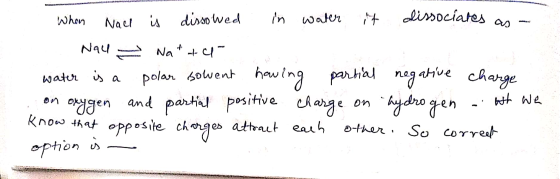
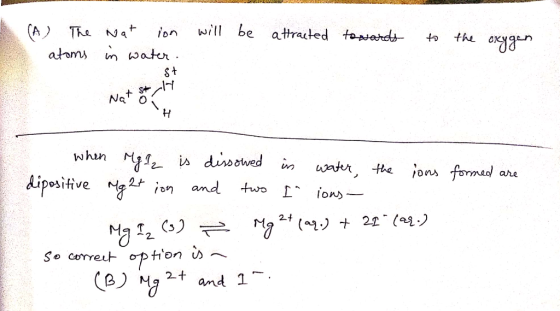
When NaCl dissolves in water A) the Nation will be attracted to the oxygen atom in...
5) When KCl dissolves in water A) the Clions are attracted to dissolved K+ ions. B) the Clions are attracted to the...
 5) When KCl dissolves in water A) the Clions are attracted to dissolved K+ ions. B) the Clions are attracted to the partially negative oxygen atoms of the water molecule. C) the K+ ions are attracted to Clions on the KCl crystal. D) the Kions are attracted to the partially negative oxygen atoms of the water molecule. E) the Kions are attracted to the partially positive hydrogen atoms of the water molecule. 6) in water, a substance that partially ionizes...
When KCl dissolves in water Multiple Choice A. the Cl- ions are attracted to the partially...
When KCl dissolves in water Multiple Choice A. the Cl- ions are attracted to the partially negative oxygen atoms of the water molecules B. the K+ ions are attracted to the partially negative oxygen atoms of the water molecules C. the K+ ions are attracted to the partially positive hydrogen atoms of the water molecules. D. the Cl- ions are attracted to dissolved K+ ions
19 When NaCl dissolves in water, aqueous Na+ and Clions result. The force of attraction that...
 19 When NaCl dissolves in water, aqueous Na+ and Clions result. The force of attraction that exists between Na+ and H2O is called a(n) _ interaction. (A) Hydrogen Bonding (B) Dipole-dipole forces (C) London Dispersion/Van der Waals Forces . Ion-Dipole 20 Which of the following is true if a molecule possesses hydrogen bonding? (A) the molecule will be an ionic crystal lattice structure where there are strong electrostatic (B) the molecule will have a hydrogen bonded directly to an N,...
When a 5.12-g sample of solid sodium nitrate dissolves in 31.1 g of water in a...
 When a 5.12-g sample of solid sodium nitrate dissolves in 31.1 g
of water in a coffee-cup calorimeter (see above figure) the
temperature falls from 25.00 oC to 16.37 oC.
Calculate H in kJ/mol NaNO3 for the solution
process.
NaNO3(s)
Na+(aq) + NO3-(aq)
The specific heat of water is 4.18 J/g-K.
We were unable to transcribe this imageWe were unable to transcribe this imagethermometer stirrer coffee cups containing reaction mixture When a 5.12-g sample of solid sodium nitrate dissolves in...
When a 5.12-g sample of solid sodium nitrate dissolves in 31.1 g
of water in a coffee-cup calorimeter (see above figure) the
temperature falls from 25.00 oC to 16.37 oC.
Calculate H in kJ/mol NaNO3 for the solution
process.
NaNO3(s)
Na+(aq) + NO3-(aq)
The specific heat of water is 4.18 J/g-K.
We were unable to transcribe this imageWe were unable to transcribe this imagethermometer stirrer coffee cups containing reaction mixture When a 5.12-g sample of solid sodium nitrate dissolves in...
1) A hydrogen bond is A) an attraction between a hydrogen atom attached to N, O, or F and an N, O, or Fatom on anot...
 1) A hydrogen bond is A) an attraction between a hydrogen atom attached to N, O, or F and an N, O, or Fatom on anothe molecule. B) a covalent bond between H and O. c) an ionic bond between H and another atom. D) a bond that is stronger than a covalent bond. E) the polar O-H bond in water. 2) Which of the following molecules can form hydrogen bonds? A) CH4 B) NaH C) NH3 D) BH3 E)...
When sodium chloride dissolves in water, the ions dissociate: NaCl (s) --> Na+ (aq) + ...
When sodium chloride dissolves in water, the ions dissociate: NaCl (s) --> Na+ (aq) + Cl- (aq) Write ionic equations, similar to the one above, that describe how NaNO3 and NaCH3COO each dissociate as they dissolve in water. Include heat as a reactant or product in each equation.
When sodium chloride dissolves in water, the ions dissociate: NaCl (s) Na+ (aq) + Cl-...
When sodium chloride dissolves in water, the ions dissociate: NaCl (s) Na+ (aq) + Cl- (aq) What is the sign of the change in Gibbs free energy (DG) for each process in the forward direction?
When sodium chloride dissolves in water, the ions dissociate: NaCl (s) à Na+ (aq) + Cl-...
When sodium chloride dissolves in water, the ions dissociate: NaCl (s) à Na+ (aq) + Cl- (aq) Write ionic equations, similar to the one above, that describe how NaNO3 and NaCH3COO each dissociate as they dissolve in water. Include heat as a reactant or product in each equation
A particle moving in the x-y plane is attracted toward the origin by force . Calculate...
 A particle moving in the x-y plane is attracted toward
the origin by force
. Calculate work done when the particle moves from A to B and then
C. Use the Cartesian variable method for this
problem.
We were unable to transcribe this imageB (2a a) A(0.a) C( 20)
A particle moving in the x-y plane is attracted toward
the origin by force
. Calculate work done when the particle moves from A to B and then
C. Use the Cartesian variable method for this
problem.
We were unable to transcribe this imageB (2a a) A(0.a) C( 20)
Predict which intermolecular forces contribute the most to the dissolution of NaCl in water?
NaCl is an ionic solid. The Na+ and Cl− ions in NaCl are bonded through an electrostatic force of attraction commonly known as the ionic bond. Water is a polar solvent. The oxygen atom, being more electronegative, attracts the electron cloud toward itself. As the electron cloud is pulled by the oxygen atom, it carries a partial negative charge, and the hydrogen atoms carry a partial positive charge. This partial separation of charges in the water molecule makes it polar....
 5) When KCl dissolves in water A) the Clions are attracted to dissolved K+ ions. B) the Clions are attracted to the partially negative oxygen atoms of the water molecule. C) the K+ ions are attracted to Clions on the KCl crystal. D) the Kions are attracted to the partially negative oxygen atoms of the water molecule. E) the Kions are attracted to the partially positive hydrogen atoms of the water molecule. 6) in water, a substance that partially ionizes...
 19 When NaCl dissolves in water, aqueous Na+ and Clions result. The force of attraction that exists between Na+ and H2O is called a(n) _ interaction. (A) Hydrogen Bonding (B) Dipole-dipole forces (C) London Dispersion/Van der Waals Forces . Ion-Dipole 20 Which of the following is true if a molecule possesses hydrogen bonding? (A) the molecule will be an ionic crystal lattice structure where there are strong electrostatic (B) the molecule will have a hydrogen bonded directly to an N,...
 When a 5.12-g sample of solid sodium nitrate dissolves in 31.1 g
of water in a coffee-cup calorimeter (see above figure) the
temperature falls from 25.00 oC to 16.37 oC.
Calculate H in kJ/mol NaNO3 for the solution
process.
NaNO3(s)
Na+(aq) + NO3-(aq)
The specific heat of water is 4.18 J/g-K.
We were unable to transcribe this imageWe were unable to transcribe this imagethermometer stirrer coffee cups containing reaction mixture When a 5.12-g sample of solid sodium nitrate dissolves in...
When a 5.12-g sample of solid sodium nitrate dissolves in 31.1 g
of water in a coffee-cup calorimeter (see above figure) the
temperature falls from 25.00 oC to 16.37 oC.
Calculate H in kJ/mol NaNO3 for the solution
process.
NaNO3(s)
Na+(aq) + NO3-(aq)
The specific heat of water is 4.18 J/g-K.
We were unable to transcribe this imageWe were unable to transcribe this imagethermometer stirrer coffee cups containing reaction mixture When a 5.12-g sample of solid sodium nitrate dissolves in...
 1) A hydrogen bond is A) an attraction between a hydrogen atom attached to N, O, or F and an N, O, or Fatom on anothe molecule. B) a covalent bond between H and O. c) an ionic bond between H and another atom. D) a bond that is stronger than a covalent bond. E) the polar O-H bond in water. 2) Which of the following molecules can form hydrogen bonds? A) CH4 B) NaH C) NH3 D) BH3 E)...
 A particle moving in the x-y plane is attracted toward
the origin by force
. Calculate work done when the particle moves from A to B and then
C. Use the Cartesian variable method for this
problem.
We were unable to transcribe this imageB (2a a) A(0.a) C( 20)
A particle moving in the x-y plane is attracted toward
the origin by force
. Calculate work done when the particle moves from A to B and then
C. Use the Cartesian variable method for this
problem.
We were unable to transcribe this imageB (2a a) A(0.a) C( 20)
Most questions answered within 3 hours.
-
Where is the error in this code sequence?
String s1 = "Hello";
String s2 = "ello";...
asked 10 months ago -
Financial data for Joel de Paris, Inc., for last year
follow:
Joel de Paris, Inc.
Balance...
asked 10 months ago -
Consider this reaction:
Al2(SO4)3 (aq)+ BaCl3
(aq) Al2Cl6 (aq)- +
3BaSO4(s) . What is the...
asked 10 months ago -
Suppose that Savneet is considering increasing her
recent random sample from 20 car rentals to 40...
asked 10 months ago -
Trucks arrive at an unloading terminal at an average rate of 120
per hour.
Trucks arrive...
asked 10 months ago -
Why are methanol and ethanol completely soluble in water while
octanol is not very little soluble....
asked 10 months ago -
A facilities manager at a university reads in a research report
that the mean amount of...
asked 10 months ago -
When the CuSO4 is rehydrated by adding water to the anhydrous
compound, is this an endothermic...
asked 10 months ago -
A ray of sunlight is passing from diamond into crown glass; the
angle of incidence is...
asked 10 months ago -
A block of mass 0.249 kg is placed on top of a light, vertical
spring of...
asked 10 months ago -
how do the kidneys compensate in the presences of acidosis
a) trigger hyperventilate
b) reserve acid...
asked 10 months ago -
Question 501 pts
The rental rate of capital to the firm increases. Which of the
following...
asked 10 months ago