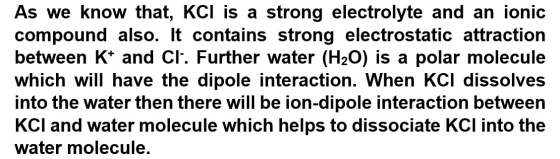
When KCl dissolves in water Multiple Choice A. the Cl- ions are attracted to the partially...
When KCl dissolves in water
Multiple Choice
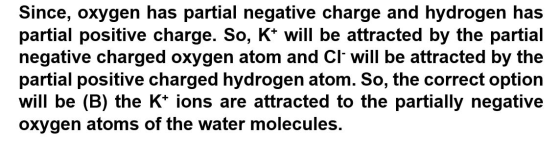
A. the Cl- ions are attracted to the partially negative oxygen atoms of the water molecules
B. the K+ ions are attracted to the partially negative oxygen atoms of the water molecules
C. the K+ ions are attracted to the partially positive hydrogen atoms of the water molecules.
D. the Cl- ions are attracted to dissolved K+ ions
Homework Answers
Add Answer to:
When KCl dissolves in water
Multiple Choice
A. the Cl- ions are attracted to the partially...
5) When KCl dissolves in water A) the Clions are attracted to dissolved K+ ions. B) the Clions are attracted to the...
 5) When KCl dissolves in water A) the Clions are attracted to dissolved K+ ions. B) the Clions are attracted to the partially negative oxygen atoms of the water molecule. C) the K+ ions are attracted to Clions on the KCl crystal. D) the Kions are attracted to the partially negative oxygen atoms of the water molecule. E) the Kions are attracted to the partially positive hydrogen atoms of the water molecule. 6) in water, a substance that partially ionizes...
1) A hydrogen bond is A) an attraction between a hydrogen atom attached to N, O, or F and an N, O, or Fatom on anot...
 1) A hydrogen bond is A) an attraction between a hydrogen atom attached to N, O, or F and an N, O, or Fatom on anothe molecule. B) a covalent bond between H and O. c) an ionic bond between H and another atom. D) a bond that is stronger than a covalent bond. E) the polar O-H bond in water. 2) Which of the following molecules can form hydrogen bonds? A) CH4 B) NaH C) NH3 D) BH3 E)...
When NaCl dissolves in water A) the Nation will be attracted to the oxygen atom in...
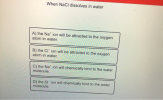 When NaCl dissolves in water A) the Nation will be attracted to the oxygen atom in water. B) the Cl" ion will be attracted to the oxygen atom in water. C) the Na'ion will chemically bind to the water molecule. D) the Cl" ion will chemically bind to the water molecule. We were unable to transcribe this image
When Caßrqundergoes dissociation and hydration in water, CaBr does not dissociate because it is insoluble in...
 When Caßrqundergoes dissociation and hydration in water, CaBr does not dissociate because it is insoluble in water. the bromide ions are attracted to the oxygen atoms of the water molecules. the bromide ions are attracted to the hydrogen atoms of the water molecules. the bromide ions are not attracted to any portion of the water molecules.
4. Complete the diagram below to show calcium and chloride ions being surrounded by water when CaCl2 dissolves and...
 4. Complete the diagram below to show calcium and chloride ions being surrounded by water when CaCl2 dissolves and dissociates. Include at least 3 water molecules around each ion. Ca2 Cl Cl
4. Complete the diagram below to show calcium and chloride ions being surrounded by water when CaCl2 dissolves and dissociates. Include at least 3 water molecules around each ion. Ca2 Cl Cl
4. Complete the diagram below to show calcium and chloride ions being surrounded by water when CaCl2 dissolves and dissociates. Include at least 3 water molecules around each ion. Ca2 Cl Cl
When sodium chloride dissolves in water, the ions dissociate: NaCl (s) Na+ (aq) + Cl-...
When sodium chloride dissolves in water, the ions dissociate: NaCl (s) Na+ (aq) + Cl- (aq) What is the sign of the change in Gibbs free energy (DG) for each process in the forward direction?
When sodium chloride dissolves in water, the ions dissociate: NaCl (s) à Na+ (aq) + Cl-...
When sodium chloride dissolves in water, the ions dissociate: NaCl (s) à Na+ (aq) + Cl- (aq) Write ionic equations, similar to the one above, that describe how NaNO3 and NaCH3COO each dissociate as they dissolve in water. Include heat as a reactant or product in each equation
When a salt like sodium chloride dissolves in water
When a salt like sodium chloride dissolves in water, the anion (-) will be surrounded by _______ partially postivive oxygens nothing partially positive hydrogens partially negative oxygens partially negative hydrogens
When an ionic compound dissolves in water. O A the hydrogen end of water molecules surround...
 When an ionic compound dissolves in water. O A the hydrogen end of water molecules surround the cations OB. none of these are correct O C. the oxygen end of water molecules surround both the anions and the cations OD. the oxygen end of water molecules surround the cations E. the oxygen end of water molecules surround the anions QUESTION 15 When added to water, which of the following would produce a base? MgCl2 Mgo BaCl2 All would produce bases....
When sodium chloride dissolves in water, the ions dissociate: NaCl (s) --> Na+ (aq) + Cl-...
When sodium chloride dissolves in water, the ions dissociate: NaCl (s) --> Na+ (aq) + Cl- (aq) Consider the equation, DG = DH - TDS. For each dissolving process, substitute the signs of DG and DH into the equation and predict the possible sign(s) for the entropy (DS). Explain why you chose this sign(s). Does the sign for entropy change seem to make sense? Explain.
 5) When KCl dissolves in water A) the Clions are attracted to dissolved K+ ions. B) the Clions are attracted to the partially negative oxygen atoms of the water molecule. C) the K+ ions are attracted to Clions on the KCl crystal. D) the Kions are attracted to the partially negative oxygen atoms of the water molecule. E) the Kions are attracted to the partially positive hydrogen atoms of the water molecule. 6) in water, a substance that partially ionizes...
 1) A hydrogen bond is A) an attraction between a hydrogen atom attached to N, O, or F and an N, O, or Fatom on anothe molecule. B) a covalent bond between H and O. c) an ionic bond between H and another atom. D) a bond that is stronger than a covalent bond. E) the polar O-H bond in water. 2) Which of the following molecules can form hydrogen bonds? A) CH4 B) NaH C) NH3 D) BH3 E)...
 When NaCl dissolves in water A) the Nation will be attracted to the oxygen atom in water. B) the Cl" ion will be attracted to the oxygen atom in water. C) the Na'ion will chemically bind to the water molecule. D) the Cl" ion will chemically bind to the water molecule. We were unable to transcribe this image
 When Caßrqundergoes dissociation and hydration in water, CaBr does not dissociate because it is insoluble in water. the bromide ions are attracted to the oxygen atoms of the water molecules. the bromide ions are attracted to the hydrogen atoms of the water molecules. the bromide ions are not attracted to any portion of the water molecules.
 4. Complete the diagram below to show calcium and chloride ions being surrounded by water when CaCl2 dissolves and dissociates. Include at least 3 water molecules around each ion. Ca2 Cl Cl
4. Complete the diagram below to show calcium and chloride ions being surrounded by water when CaCl2 dissolves and dissociates. Include at least 3 water molecules around each ion. Ca2 Cl Cl
4. Complete the diagram below to show calcium and chloride ions being surrounded by water when CaCl2 dissolves and dissociates. Include at least 3 water molecules around each ion. Ca2 Cl Cl
 When an ionic compound dissolves in water. O A the hydrogen end of water molecules surround the cations OB. none of these are correct O C. the oxygen end of water molecules surround both the anions and the cations OD. the oxygen end of water molecules surround the cations E. the oxygen end of water molecules surround the anions QUESTION 15 When added to water, which of the following would produce a base? MgCl2 Mgo BaCl2 All would produce bases....
Most questions answered within 3 hours.
-
Where is the error in this code sequence?
String s1 = "Hello";
String s2 = "ello";...
asked 10 months ago -
Financial data for Joel de Paris, Inc., for last year
follow:
Joel de Paris, Inc.
Balance...
asked 10 months ago -
Consider this reaction:
Al2(SO4)3 (aq)+ BaCl3
(aq) Al2Cl6 (aq)- +
3BaSO4(s) . What is the...
asked 10 months ago -
Suppose that Savneet is considering increasing her
recent random sample from 20 car rentals to 40...
asked 10 months ago -
Trucks arrive at an unloading terminal at an average rate of 120
per hour.
Trucks arrive...
asked 10 months ago -
Why are methanol and ethanol completely soluble in water while
octanol is not very little soluble....
asked 10 months ago -
A facilities manager at a university reads in a research report
that the mean amount of...
asked 10 months ago -
When the CuSO4 is rehydrated by adding water to the anhydrous
compound, is this an endothermic...
asked 10 months ago -
A ray of sunlight is passing from diamond into crown glass; the
angle of incidence is...
asked 10 months ago -
A block of mass 0.249 kg is placed on top of a light, vertical
spring of...
asked 10 months ago -
how do the kidneys compensate in the presences of acidosis
a) trigger hyperventilate
b) reserve acid...
asked 10 months ago -
Question 501 pts
The rental rate of capital to the firm increases. Which of the
following...
asked 10 months ago