
Homework Answers
Add Answer to:
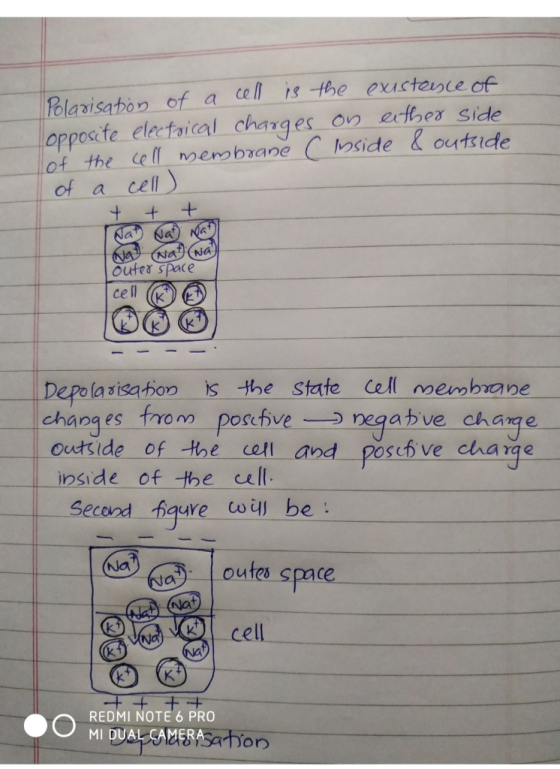
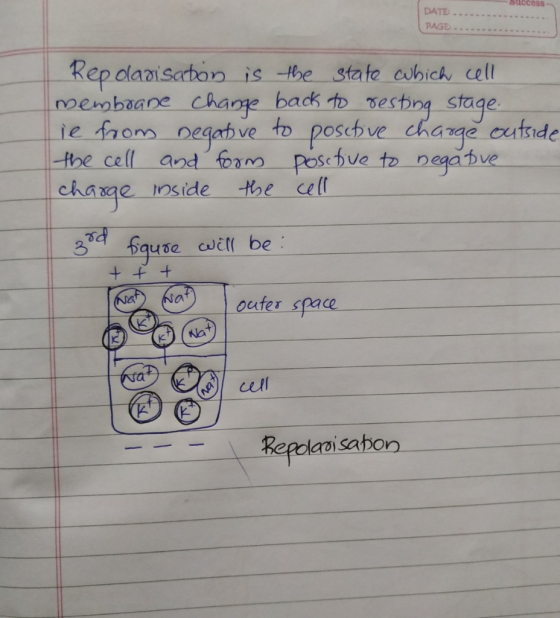
Label the cell below as it moves through the process of depolarization repolarization. Include the ions...
In its resting state, the membrane surrounding a neuron is permeable to potassium ions but only...
 In its resting state, the membrane surrounding a neuron is
permeable to potassium ions but only slightly permeable to sodium
ions. Thus, positive K ions can flow through the membrane in an
attempt to equalize K concentration, but Na ions cannot as quickly.
This leads to an excess of Na ions outside of the cell. If the
space outside the cell is defined as zero electric potential, then
the electric potential of the interior of the cell is negative.
This...
In its resting state, the membrane surrounding a neuron is
permeable to potassium ions but only slightly permeable to sodium
ions. Thus, positive K ions can flow through the membrane in an
attempt to equalize K concentration, but Na ions cannot as quickly.
This leads to an excess of Na ions outside of the cell. If the
space outside the cell is defined as zero electric potential, then
the electric potential of the interior of the cell is negative.
This...
Question 1. The following questions are based on the information below, from a mutated nerve cell...
Question 1. The following questions are based on the information below, from a mutated nerve cell in the brain: I nterstitial fluid intracellular fluid Na+ 5mM 180mM K+ 15mM 100mM Ca2+ 300mM 6mM Cl- 105mM 15mM 1) Calculate the equilibrium potentials for each ion. 2) From those values, predict the transport mechanism for each ion. 3) Which two ions are involved in establishing the resting potential? 4) Of those two ions, which has the greater permeability? 5) Which ion is...
Use what you know about the physiology of neurons to answer the following questions. Treat each of these questions as u...
 Use what you know about the physiology of neurons to answer the following questions. Treat each of these questions as unrelated to each other. a. Imagine that a mutation makes Na* leak channels just as common as K' leak channels. Explain the effect of this mutation on the resting potential of this neuron. 3. b. The intracellular:extracellular ratio of K' ions is normally 150:4mM. Imagine that you decrease that ratio to 150: 20mM. Describe the subsequent effect on the resting...
3. Label each of the parts of a neuron below. Include the axon, axon terminal, dend...
 3. Label each of the parts of a neuron below. Include the axon, axon terminal, dend on below. Include the axon, axon terminal, dendrite, cell body, myelin sheath, and nucleus. bul 4. Which portion of the neuron receives incoming signals? Which part conducts signals away from the cell body? 5. Compare the function of sensory neurons, motor neurons, and interneurons 6. Label depolarization, hyperpolarization, peak action potential, resting potential, Na/K ATP pump. +30 Membrane potential (mv) Time 8. What are...
I NEED ANSWERED ASAP!!! First, draw a cell with 6 chromosomes as it moves through the...
I NEED ANSWERED ASAP!!! First, draw a cell with 6 chromosomes as it moves through the phases of meiosis. Explain what nondisjunction is. Draw and copy a picture of your drawing of your cell with 6 chromosomes to start with as it goes through the phases of meiosis with nondisjunction occurring in one chromosomes pair in meiosis I. Be sure to label the phases and indicate how many chromosomes each resulting cell will have. Label the monosomies vs. trisomies. EXTRA...
I NEED ANSWERED ASAP!!! First, draw a cell with 6 chromosomes as it moves through the phases of meiosis. Explain what nondisjunction is. Draw and copy a picture of your drawing of your cell with 6 c...
I NEED ANSWERED ASAP!!! First, draw a cell with 6 chromosomes as it moves through the phases of meiosis. Explain what nondisjunction is. Draw and copy a picture of your drawing of your cell with 6 chromosomes to start with as it goes through the phases of meiosis with nondisjunction occurring in one chromosomes pair in meiosis I. Be sure to label the phases and indicate how many chromosomes each resulting cell will have. Label the monosomies vs. trisomies. EXTRA...
Lo 10: Electrochemical Gradient The difference in voltage across the membrane is called the __________________________________. The...
Lo 10: Electrochemical Gradient The difference in voltage across the membrane is called the __________________________________. The inside of a normal cell is ___________________ (+/-); while the outside is ___________(+/-). The resting membrane potential of a neuron is ___________mV. Diagram the relative ratios of Ca++, Na+ and K+ in a cell under resting conditions. Draw an arrow for each of the molecules indicating which direction would be passive transport (into or out of the cell). For each of the following sentences, fill in...
2. Consider the voltaic cell illustrated below, constructed by coupling a Ni/Ni half-cell with an Ag/Ag* half-cell a...
 2. Consider the voltaic cell illustrated below, constructed by coupling a Ni/Ni half-cell with an Ag/Ag* half-cell and allowing them to react spontaneously. Refer to the table of reduction potentials and write the half-reaction that occurs at each electrode (nickel and silver). Then combine the half-reactions into the overall reaction. a. Calculate the standard cell potential. b. Annotate the diagram below. First, randomly label one electrode as Ag and one as Ni. Then identify which is the anode and which...
Neurons are electrically excitable cells in the nervous system that function to process and transmit information...
 Neurons are electrically excitable cells in the nervous system that function to process and transmit information from one part the body to another, through specialized connections called synapses. The signaling process is partly electrical and partly chemical. In vertebrate animals, neurons are the core components of the brain, spinal cord and peripheral nerves. Neurons carry messages in the form of electrical signals called nerve impulses or action potentials. An action potential occurs when the resting membrane potential at a specific...
Please answer the following questions for numbers 7-9. If you are not sure please write it...
 Please answer the following questions for numbers 7-9. If you
are not sure please write it next to the problem number. I am a
little confused with these. I will rate good!
. If the membrane shown in the beakers below is only permeable to Na", and the beaker on the left epresents the initial state, which of the following will occur over time? Na A, a. Na will diffuse to the left side of the membrane, causing a net...
Please answer the following questions for numbers 7-9. If you
are not sure please write it next to the problem number. I am a
little confused with these. I will rate good!
. If the membrane shown in the beakers below is only permeable to Na", and the beaker on the left epresents the initial state, which of the following will occur over time? Na A, a. Na will diffuse to the left side of the membrane, causing a net...
 In its resting state, the membrane surrounding a neuron is
permeable to potassium ions but only slightly permeable to sodium
ions. Thus, positive K ions can flow through the membrane in an
attempt to equalize K concentration, but Na ions cannot as quickly.
This leads to an excess of Na ions outside of the cell. If the
space outside the cell is defined as zero electric potential, then
the electric potential of the interior of the cell is negative.
This...
In its resting state, the membrane surrounding a neuron is
permeable to potassium ions but only slightly permeable to sodium
ions. Thus, positive K ions can flow through the membrane in an
attempt to equalize K concentration, but Na ions cannot as quickly.
This leads to an excess of Na ions outside of the cell. If the
space outside the cell is defined as zero electric potential, then
the electric potential of the interior of the cell is negative.
This...
 Use what you know about the physiology of neurons to answer the following questions. Treat each of these questions as unrelated to each other. a. Imagine that a mutation makes Na* leak channels just as common as K' leak channels. Explain the effect of this mutation on the resting potential of this neuron. 3. b. The intracellular:extracellular ratio of K' ions is normally 150:4mM. Imagine that you decrease that ratio to 150: 20mM. Describe the subsequent effect on the resting...
 3. Label each of the parts of a neuron below. Include the axon, axon terminal, dend on below. Include the axon, axon terminal, dendrite, cell body, myelin sheath, and nucleus. bul 4. Which portion of the neuron receives incoming signals? Which part conducts signals away from the cell body? 5. Compare the function of sensory neurons, motor neurons, and interneurons 6. Label depolarization, hyperpolarization, peak action potential, resting potential, Na/K ATP pump. +30 Membrane potential (mv) Time 8. What are...
 2. Consider the voltaic cell illustrated below, constructed by coupling a Ni/Ni half-cell with an Ag/Ag* half-cell and allowing them to react spontaneously. Refer to the table of reduction potentials and write the half-reaction that occurs at each electrode (nickel and silver). Then combine the half-reactions into the overall reaction. a. Calculate the standard cell potential. b. Annotate the diagram below. First, randomly label one electrode as Ag and one as Ni. Then identify which is the anode and which...
 Neurons are electrically excitable cells in the nervous system that function to process and transmit information from one part the body to another, through specialized connections called synapses. The signaling process is partly electrical and partly chemical. In vertebrate animals, neurons are the core components of the brain, spinal cord and peripheral nerves. Neurons carry messages in the form of electrical signals called nerve impulses or action potentials. An action potential occurs when the resting membrane potential at a specific...
 Please answer the following questions for numbers 7-9. If you
are not sure please write it next to the problem number. I am a
little confused with these. I will rate good!
. If the membrane shown in the beakers below is only permeable to Na", and the beaker on the left epresents the initial state, which of the following will occur over time? Na A, a. Na will diffuse to the left side of the membrane, causing a net...
Please answer the following questions for numbers 7-9. If you
are not sure please write it next to the problem number. I am a
little confused with these. I will rate good!
. If the membrane shown in the beakers below is only permeable to Na", and the beaker on the left epresents the initial state, which of the following will occur over time? Na A, a. Na will diffuse to the left side of the membrane, causing a net...
Most questions answered within 3 hours.
-
Where is the error in this code sequence?
String s1 = "Hello";
String s2 = "ello";...
asked 10 months ago -
Financial data for Joel de Paris, Inc., for last year
follow:
Joel de Paris, Inc.
Balance...
asked 10 months ago -
Consider this reaction:
Al2(SO4)3 (aq)+ BaCl3
(aq) Al2Cl6 (aq)- +
3BaSO4(s) . What is the...
asked 10 months ago -
Suppose that Savneet is considering increasing her
recent random sample from 20 car rentals to 40...
asked 10 months ago -
Trucks arrive at an unloading terminal at an average rate of 120
per hour.
Trucks arrive...
asked 10 months ago -
Why are methanol and ethanol completely soluble in water while
octanol is not very little soluble....
asked 10 months ago -
A facilities manager at a university reads in a research report
that the mean amount of...
asked 10 months ago -
When the CuSO4 is rehydrated by adding water to the anhydrous
compound, is this an endothermic...
asked 10 months ago -
A ray of sunlight is passing from diamond into crown glass; the
angle of incidence is...
asked 10 months ago -
A block of mass 0.249 kg is placed on top of a light, vertical
spring of...
asked 10 months ago -
how do the kidneys compensate in the presences of acidosis
a) trigger hyperventilate
b) reserve acid...
asked 10 months ago -
Question 501 pts
The rental rate of capital to the firm increases. Which of the
following...
asked 10 months ago