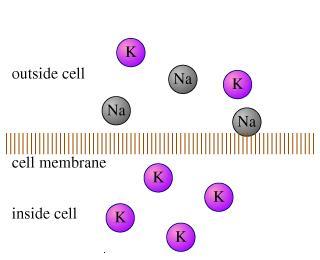
In its resting state, the membrane surrounding a neuron is
permeable to potassium ions but only slightly permeable to sodium
ions. Thus, positive K ions can flow through the membrane in an
attempt to equalize K concentration, but Na ions cannot as quickly.
This leads to an excess of Na ions outside of the cell. If the
space outside the cell is defined as zero electric potential, then
the electric potential of the interior of the cell is negative.
This resting potential is typically about  80
80  . A schematic of this situation
is shown in the figure:
. A schematic of this situation
is shown in the figure:
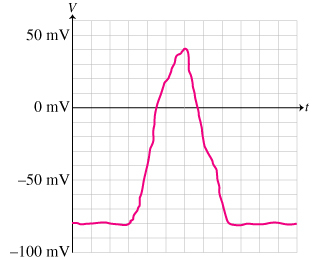
In response to an electrical stimulus, certain channels in
the membrane can become permeable to Na ions. Due to the
concentration gradient, Na ions rush into the cell and the interior
of the cell reaches an electric potential of about
40 . This process is
termed depolarization. In response to
depolarization, the membrane again becomes less permeable to Na
ions, and the K ions flow out of the interior of the cell through
channels established by the positive electric potential inside of
the cell. This then reestablishing the resting potential. This is
termed repolarization. Only a small
percentage of the available Na and K ions participate in each
depolarization/repolarization cycle, so the cell can respond to
many stimuli in succession without depleting its "stock" of
available Na and K ions. A graph of an electric potential inside a
cell vs. time is shown in the next figure (Intro 2
figure) for a single depolarization/repolarization
cycle.
|

|
|
Homework Answers
Because it does not have electric potential outside of the cell membrane.
U=qV=eV
B) -80meV
C) +80meV
D)+40meV
Add Answer to:
In its resting state, the membrane surrounding a neuron is
permeable to potassium ions but only...
With respect to the membrane potential which of the following is NOT true? A. In resting...
With respect to the membrane potential which of the following is NOT true? A. In resting cells, the membrane potential is negative because sodium ions are less permeable than potassium ions. B. The resting potential of the nerve cell depends on voltage gated potassium channels C. While chloride is much more permeable than sodium, it adds relatively little to the negative membrane potential. D. The concentration of chloride inside/outside the cell is the reciprocal of the potassium concentration of the...
Correct answer is 51.1 mV 4. Magnitude of the revereal potential oreated by nerve cell discharge....
 Correct answer is 51.1 mV
4. Magnitude of the revereal potential oreated by nerve cell discharge. A nerve cell (resting potential 75 mv: inside negative) fires when some stimulus affects the nerve cell membrane and causes it to suddenly become highly permeable to Na ions. Depolarization occurs as Na ions rush inside the cell. At the height of this process, enough Na ions are inside the cell to actually make the interior positively charged relative to the exterior; that is,...
Correct answer is 51.1 mV
4. Magnitude of the revereal potential oreated by nerve cell discharge. A nerve cell (resting potential 75 mv: inside negative) fires when some stimulus affects the nerve cell membrane and causes it to suddenly become highly permeable to Na ions. Depolarization occurs as Na ions rush inside the cell. At the height of this process, enough Na ions are inside the cell to actually make the interior positively charged relative to the exterior; that is,...
Potassium ions (K+) move across a 7.0-nm- thick cell membrane from the inside to the outside....
Potassium ions (K+) move across a 7.0-nm- thick cell membrane from the inside to the outside. The potential inside the cell is −80.0 mV, and the potential outside is zero. What is the change in the electrical potential energy Δ? electric of the potassium ions as they move across the membrane?
A model cell contains the intracellular ions Na+, K+, Cl-, and An- (impermeant anions) and the...
A model cell contains the intracellular ions Na+, K+, Cl-, and An- (impermeant anions) and the extracellular ions Na+, K+, and Cl-. The concentration (activities) of [Na+]o=125 mmol l-1, [K+]o = 5 mmol l-1, whereas [An-]i = 123 mmol l-1, [K+]i= 112 mmol l-1. Assume the membrane is permeable to Na+, K+, and Cl-. [ The subscripts i and o refer to inside and outside, respectively]. The relative permeabilities for the ions are pNa/pK=0.02, pCl/pK=0.1 a) What are the values...
Potassium ions (K+)(K+) move across a 9.0-nm-9.0-nm-thick cell membrane from the inside to the outside. The...
Potassium ions (K+)(K+) move across a 9.0-nm-9.0-nm-thick cell membrane from the inside to the outside. The potential inside the cell is −60.0 mV,−60.0 mV, and the potential outside is zero. What is the change in the electrical potential energy Δ? electricΔU electric of the potassium ions as they move across the membrane? Δ? electric = ... J?
Under certain circumstances, potassium ions in a cell will move across the cell membrane from the...
 Under certain circumstances, potassium ions in a cell will move
across the cell membrane from the inside to the outside. The
potential inside the cell is -75.5mV and the potential outside he
cell is zero. What is the change in the electrical potential energy
of a single potassium ion as it moves across the membrane ?
orries TxLakehead University-PHYS 1N Net iscms/mod/ficn/view.php?id 429903 Jump to... Winter19-MACKAY > Activities and Due Dates > HW: Electric Potential re: ResourcesGive Up Feedback Attempt...
Under certain circumstances, potassium ions in a cell will move
across the cell membrane from the inside to the outside. The
potential inside the cell is -75.5mV and the potential outside he
cell is zero. What is the change in the electrical potential energy
of a single potassium ion as it moves across the membrane ?
orries TxLakehead University-PHYS 1N Net iscms/mod/ficn/view.php?id 429903 Jump to... Winter19-MACKAY > Activities and Due Dates > HW: Electric Potential re: ResourcesGive Up Feedback Attempt...
2. Explain how the resting membrane potential of a neuron is established by a. Listing the...
 2. Explain how the resting membrane potential of a neuron is established by a. Listing the important ions/molecules that contribute to the establishment of the membrane potential (there are 4) Describing which direction the ions/molecules flow (if at all; in or out of the cell?) Telling me which one of the ions/molecules is the MOST important for establishing the resting membrane potential and WHY b. c. Explaining how this ONE important ion/molecule flows through the membrane by describing the opposing...
0 Attempt 1 of 22> Potassium ions (K) move across a 9.0-nm-thick cell membrane from the...
 0 Attempt 1 of 22> Potassium ions (K) move across a 9.0-nm-thick cell membrane from the inside to the outside. The potential inside the cell is -70.0 mV, and the potential outside is zero. What is the change in the electrical potential energy AU of the potassium ions as they move across the membrane? AUelectric =1 1.214 ×10⁻²⁰
What is a resting potential? Is it positive or negative? The resting potential is mainly due...
What is a resting potential? Is it positive or negative? The resting potential is mainly due to the main _____-charged large molecules stuck inside the neuron. The Na+/K+ pump pushes Na+ _____ of the cell and K+ ____ of the cell (in or out for each ion) Where is K+ concentrated, inside or outside of the neuron? Where is Na+ concentrated, inside or outside of the neuron? The action potential starts with an rise in membrane voltage. This is due...
What is the main function of the sodium potassium pump in the neuron? a. Establish concentration...
What is the main function of the sodium potassium pump in the neuron? a. Establish concentration gradients for sodium and potassium ions. b. Depolarize the membrane to threshold. c. Make the inside of the cell more negative than the outside. d. Make the inside of the cell more positive than the outside. e. Pump ions down their concentration gradients during an action potential. A patient of yours has been poisoned by a toxin which prevents fast repolarization of the membrane...
 Correct answer is 51.1 mV
4. Magnitude of the revereal potential oreated by nerve cell discharge. A nerve cell (resting potential 75 mv: inside negative) fires when some stimulus affects the nerve cell membrane and causes it to suddenly become highly permeable to Na ions. Depolarization occurs as Na ions rush inside the cell. At the height of this process, enough Na ions are inside the cell to actually make the interior positively charged relative to the exterior; that is,...
Correct answer is 51.1 mV
4. Magnitude of the revereal potential oreated by nerve cell discharge. A nerve cell (resting potential 75 mv: inside negative) fires when some stimulus affects the nerve cell membrane and causes it to suddenly become highly permeable to Na ions. Depolarization occurs as Na ions rush inside the cell. At the height of this process, enough Na ions are inside the cell to actually make the interior positively charged relative to the exterior; that is,...
 Under certain circumstances, potassium ions in a cell will move
across the cell membrane from the inside to the outside. The
potential inside the cell is -75.5mV and the potential outside he
cell is zero. What is the change in the electrical potential energy
of a single potassium ion as it moves across the membrane ?
orries TxLakehead University-PHYS 1N Net iscms/mod/ficn/view.php?id 429903 Jump to... Winter19-MACKAY > Activities and Due Dates > HW: Electric Potential re: ResourcesGive Up Feedback Attempt...
Under certain circumstances, potassium ions in a cell will move
across the cell membrane from the inside to the outside. The
potential inside the cell is -75.5mV and the potential outside he
cell is zero. What is the change in the electrical potential energy
of a single potassium ion as it moves across the membrane ?
orries TxLakehead University-PHYS 1N Net iscms/mod/ficn/view.php?id 429903 Jump to... Winter19-MACKAY > Activities and Due Dates > HW: Electric Potential re: ResourcesGive Up Feedback Attempt...
 2. Explain how the resting membrane potential of a neuron is established by a. Listing the important ions/molecules that contribute to the establishment of the membrane potential (there are 4) Describing which direction the ions/molecules flow (if at all; in or out of the cell?) Telling me which one of the ions/molecules is the MOST important for establishing the resting membrane potential and WHY b. c. Explaining how this ONE important ion/molecule flows through the membrane by describing the opposing...
 0 Attempt 1 of 22> Potassium ions (K) move across a 9.0-nm-thick cell membrane from the inside to the outside. The potential inside the cell is -70.0 mV, and the potential outside is zero. What is the change in the electrical potential energy AU of the potassium ions as they move across the membrane? AUelectric =1 1.214 ×10⁻²⁰
Most questions answered within 3 hours.
-
Where is the error in this code sequence?
String s1 = "Hello";
String s2 = "ello";...
asked 10 months ago -
Financial data for Joel de Paris, Inc., for last year
follow:
Joel de Paris, Inc.
Balance...
asked 10 months ago -
Consider this reaction:
Al2(SO4)3 (aq)+ BaCl3
(aq) Al2Cl6 (aq)- +
3BaSO4(s) . What is the...
asked 10 months ago -
Suppose that Savneet is considering increasing her
recent random sample from 20 car rentals to 40...
asked 10 months ago -
Trucks arrive at an unloading terminal at an average rate of 120
per hour.
Trucks arrive...
asked 10 months ago -
Why are methanol and ethanol completely soluble in water while
octanol is not very little soluble....
asked 10 months ago -
A facilities manager at a university reads in a research report
that the mean amount of...
asked 10 months ago -
When the CuSO4 is rehydrated by adding water to the anhydrous
compound, is this an endothermic...
asked 10 months ago -
A ray of sunlight is passing from diamond into crown glass; the
angle of incidence is...
asked 10 months ago -
A block of mass 0.249 kg is placed on top of a light, vertical
spring of...
asked 10 months ago -
how do the kidneys compensate in the presences of acidosis
a) trigger hyperventilate
b) reserve acid...
asked 10 months ago -
Question 501 pts
The rental rate of capital to the firm increases. Which of the
following...
asked 10 months ago