
Homework Answers
ANS-The standard enthalpy of formation for an element in its standard state is ZERO. Elements in their standard state are not formed, they just are. CORRECT ANS- Ni(s) because only Ni present in the element state. that's why it is right option [ THANK YOU VERY MUCH,HOPE THIS WILL HELP YOU.GOOD LUCK]
Add Answer to:
in the reaction below, change of H =0 for
problem istry er Keys iClicker Question •...
DITU U11 U1 18. In the reaction below, AHf is zero for Ni (s) + 200...
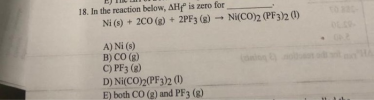 DITU U11 U1 18. In the reaction below, AHf is zero for Ni (s) + 200 (g) + 2PF3 (g) → Ni(CO)2 (PF3)2 (1) A) Ni (s) B) CO (8) C) PF3 (g) D) Ni(CO)2(PF3)2 (1) E) both CO (g) and PF3 (g)
QUESTION 9 If two reactions are coupled, then 2. A product of one reaction is a...
 QUESTION 9 If two reactions are coupled, then 2. A product of one reaction is a reactant of the other, and the overall process is product-favored. b. A product of one reaction is a reactant of the other, and the overall process is reactant-favored C. The heat released from an exothermic reaction is used in an endothermic reaction. The Gibbs free energy released from a product-favored reaction is released to the surroundings. causing an increase in entropy for a second...
Determine the amount of heat involved in a chemical change using. Hess's Law Question 2C(s) +...
 Determine the amount of heat involved in a chemical change using. Hess's Law Question 2C(s) + 0,(g) + 2 CO(g) AH = -222 kJ 2 H, (g) + O2(g) + 2H2O(g) AH = -484 kJ H,0(1) H2O(g) AH = +44 kJ Use the thermochemical data above to calculate the change in enthalpy for the reaction below. H,0(1) + C(s) + CO(g) +H, () . Your answer should have three significant figures. Provide your answer below: Activity Details You have viewed...
in 19 The following reaction takes place at 120°C-H 0(1) - H 0(g) Which of the...
 in 19 The following reaction takes place at 120°C-H 0(1) - H 0(g) Which of the following must be true? AH = 44.0 kJ mol AS = 0.119 kJ mol K ered ed out of Ein Select one: a. The reaction is spontaneous Flag question b. The reaction is not spontaneous CAG=0 d. AGO e. Two of these Finish attempt. Time left 3:13:19 e lp @ NI Wololol **** 2x Cy BN м.
FOUAL ERAME ethe a Akd 30) The transtion of a chemical from the Sgid phe to...
 FOUAL ERAME ethe a Akd 30) The transtion of a chemical from the Sgid phe to the sollid phase is ealled b) meting ublimation d) vaporization e)condensation 51) For the chemical species in the resction below, A- for 2Ce () H ( PF, ()-2HCo(PF () a) Co (s) b) H. (в) c) PF (g) d) HCo(PF) (1) e) both Co(s) and H: (g) 52) The value of Ar for the reaction below is-144 Jimol. Determine the reaction energy (J) whem...
The standard enthalpy change for the following reaction is - 52.3 kJ at 298 K. C2H4(g)...
 The standard enthalpy change for the following reaction is - 52.3 kJ at 298 K. C2H4(g) — 2 C(s.graphite) + 2 H2(g) AH° = -52.3 kJ What is the standard enthalpy change for this reaction at 298 K? 2 C(s,graphite) + 2 H2(g) — C2H4(9) LLUCU The standard enthalpy change for the following reaction is -240 kJ at 298 K. Ni(s) + 1/2 O2(g) → Nio(s) AH° = -240 kJ What is the standard enthalpy change for the reaction at...
26. The internal energy can be increased by a) transferring heat from the surroundings to the...
 26. The internal energy can be increased by a) transferring heat from the surroundings to the ystem (b) transferring heat from the system to the surroundings c) doing work on the system A) a only B)b only C) c only D) a and c E) b and e 27. For the species in the reaction below, AHf is zero for 2Co (s) + H2 (3)+ 8PF3 () 2HCo(PF3)4) A) Co (s) B) H2 (3) C) PF3 (8) 1D) HCo(PF3)40 E)...
(9) A spontaneous process has the change of free energy (a) AG > 0 (b) AG <0 (c) AG = 0 (d) AH >0 and AS &...
 (9) A spontaneous process has the change of free energy (a) AG > 0 (b) AG <0 (c) AG = 0 (d) AH >0 and AS <0 (10) A chemical reaction has AH = 10 kJ, AS = 50 J/K at temperature T = 300 K, the reaction AG = (a) 5000 (b)-5000 (c) 10000 (d) 50 (11) For reaction : Ag (s) + 1/2 Cl2 (g) = Agt (aq) + CI+ (aq), the standard free energy of formation: AGE"...
43) The value of for the reaction below is -790 kJ. The enthalpy change accompanying the...
 43) The value of
for the reaction below is -790 kJ. The enthalpy change accompanying
the reaction of 0.95 g of S is __________ kJ. 2S(s) + 3O2 (g) à
2SO3(g)
A) 23
B) -23
C) -12
D) 12
E) -790
AH
43) The value of
for the reaction below is -790 kJ. The enthalpy change accompanying
the reaction of 0.95 g of S is __________ kJ. 2S(s) + 3O2 (g) à
2SO3(g)
A) 23
B) -23
C) -12
D) 12
E) -790
AH
4. For which of the following reactions is AH° of the reaction equal to AH, of...
 4. For which of the following reactions is AH° of the reaction equal to AH, of the product? (a) CO (9) + 0.5 O2 (g) (b) Al(s) + 3 CI (g)- (c) Ni (s) + O2 (g) (d) 12 (g) + 3 F2 (g) CO2 (9) AICI: (s) NiO2 (s) 2 IF3 (9)
 DITU U11 U1 18. In the reaction below, AHf is zero for Ni (s) + 200 (g) + 2PF3 (g) → Ni(CO)2 (PF3)2 (1) A) Ni (s) B) CO (8) C) PF3 (g) D) Ni(CO)2(PF3)2 (1) E) both CO (g) and PF3 (g)
 QUESTION 9 If two reactions are coupled, then 2. A product of one reaction is a reactant of the other, and the overall process is product-favored. b. A product of one reaction is a reactant of the other, and the overall process is reactant-favored C. The heat released from an exothermic reaction is used in an endothermic reaction. The Gibbs free energy released from a product-favored reaction is released to the surroundings. causing an increase in entropy for a second...
 Determine the amount of heat involved in a chemical change using. Hess's Law Question 2C(s) + 0,(g) + 2 CO(g) AH = -222 kJ 2 H, (g) + O2(g) + 2H2O(g) AH = -484 kJ H,0(1) H2O(g) AH = +44 kJ Use the thermochemical data above to calculate the change in enthalpy for the reaction below. H,0(1) + C(s) + CO(g) +H, () . Your answer should have three significant figures. Provide your answer below: Activity Details You have viewed...
 in 19 The following reaction takes place at 120°C-H 0(1) - H 0(g) Which of the following must be true? AH = 44.0 kJ mol AS = 0.119 kJ mol K ered ed out of Ein Select one: a. The reaction is spontaneous Flag question b. The reaction is not spontaneous CAG=0 d. AGO e. Two of these Finish attempt. Time left 3:13:19 e lp @ NI Wololol **** 2x Cy BN м.
 FOUAL ERAME ethe a Akd 30) The transtion of a chemical from the Sgid phe to the sollid phase is ealled b) meting ublimation d) vaporization e)condensation 51) For the chemical species in the resction below, A- for 2Ce () H ( PF, ()-2HCo(PF () a) Co (s) b) H. (в) c) PF (g) d) HCo(PF) (1) e) both Co(s) and H: (g) 52) The value of Ar for the reaction below is-144 Jimol. Determine the reaction energy (J) whem...
 The standard enthalpy change for the following reaction is - 52.3 kJ at 298 K. C2H4(g) — 2 C(s.graphite) + 2 H2(g) AH° = -52.3 kJ What is the standard enthalpy change for this reaction at 298 K? 2 C(s,graphite) + 2 H2(g) — C2H4(9) LLUCU The standard enthalpy change for the following reaction is -240 kJ at 298 K. Ni(s) + 1/2 O2(g) → Nio(s) AH° = -240 kJ What is the standard enthalpy change for the reaction at...
 26. The internal energy can be increased by a) transferring heat from the surroundings to the ystem (b) transferring heat from the system to the surroundings c) doing work on the system A) a only B)b only C) c only D) a and c E) b and e 27. For the species in the reaction below, AHf is zero for 2Co (s) + H2 (3)+ 8PF3 () 2HCo(PF3)4) A) Co (s) B) H2 (3) C) PF3 (8) 1D) HCo(PF3)40 E)...
 (9) A spontaneous process has the change of free energy (a) AG > 0 (b) AG <0 (c) AG = 0 (d) AH >0 and AS <0 (10) A chemical reaction has AH = 10 kJ, AS = 50 J/K at temperature T = 300 K, the reaction AG = (a) 5000 (b)-5000 (c) 10000 (d) 50 (11) For reaction : Ag (s) + 1/2 Cl2 (g) = Agt (aq) + CI+ (aq), the standard free energy of formation: AGE"...
 43) The value of
for the reaction below is -790 kJ. The enthalpy change accompanying
the reaction of 0.95 g of S is __________ kJ. 2S(s) + 3O2 (g) à
2SO3(g)
A) 23
B) -23
C) -12
D) 12
E) -790
AH
43) The value of
for the reaction below is -790 kJ. The enthalpy change accompanying
the reaction of 0.95 g of S is __________ kJ. 2S(s) + 3O2 (g) à
2SO3(g)
A) 23
B) -23
C) -12
D) 12
E) -790
AH
 4. For which of the following reactions is AH° of the reaction equal to AH, of the product? (a) CO (9) + 0.5 O2 (g) (b) Al(s) + 3 CI (g)- (c) Ni (s) + O2 (g) (d) 12 (g) + 3 F2 (g) CO2 (9) AICI: (s) NiO2 (s) 2 IF3 (9)
Most questions answered within 3 hours.
-
Where is the error in this code sequence?
String s1 = "Hello";
String s2 = "ello";...
asked 11 months ago -
Financial data for Joel de Paris, Inc., for last year
follow:
Joel de Paris, Inc.
Balance...
asked 11 months ago -
Consider this reaction:
Al2(SO4)3 (aq)+ BaCl3
(aq) Al2Cl6 (aq)- +
3BaSO4(s) . What is the...
asked 11 months ago -
Suppose that Savneet is considering increasing her
recent random sample from 20 car rentals to 40...
asked 11 months ago -
Trucks arrive at an unloading terminal at an average rate of 120
per hour.
Trucks arrive...
asked 11 months ago -
Why are methanol and ethanol completely soluble in water while
octanol is not very little soluble....
asked 11 months ago -
A facilities manager at a university reads in a research report
that the mean amount of...
asked 11 months ago -
When the CuSO4 is rehydrated by adding water to the anhydrous
compound, is this an endothermic...
asked 11 months ago -
A ray of sunlight is passing from diamond into crown glass; the
angle of incidence is...
asked 11 months ago -
A block of mass 0.249 kg is placed on top of a light, vertical
spring of...
asked 11 months ago -
how do the kidneys compensate in the presences of acidosis
a) trigger hyperventilate
b) reserve acid...
asked 11 months ago -
Question 501 pts
The rental rate of capital to the firm increases. Which of the
following...
asked 11 months ago