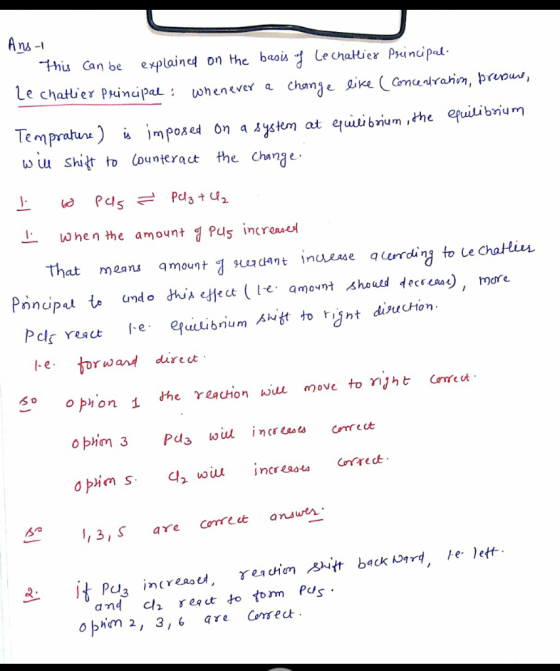
QUESTION 1 In the reaction: PCl5 <----> PCl3 + Cl2 When the amount of PCl5 is...
QUESTION 1
- In the reaction: PCl5 <----> PCl3 + Cl2 When the amount
of PCl5 is increased, which of the following will occur? Check all
that apply, deductions for incorrect choices.
1. the reaction will move to the right
2. The reaction will move to the left
3. PCl3 will increase
4. PCl3 will decrease
5. Cl2 will increase
6. Cl2 will decrease
QUESTION 2
- In the reaction: PCl5 <----> PCl3 + Cl2 When the amount
of PCl3 is increased, which of the following will occur? Check all
that apply, deductions for incorrect choices.
1. the reaction will move to the right
2. The reaction will move to the left
3. PCl5 will increase
4. PCl5 will decrease
5. Cl2 will increase
6. Cl2 will decrease
- In the reaction of phosphorous pentachloride: PCl5 <---->
PCl3 + Cl2 When the amount of Cl2 is increased, which of the
following will occur? Check all that apply, deductions for
incorrect choices.
1. the reaction will move to the right
2. The reaction will move to the left
3. PCl5 will increase
4. PCl5 will decrease
5. PCl3 will increase
6. PCl3 will decrease
QUESTION 4
- In the reaction: CO2 + H2O <----> H+ + HCO3- When the
amount of hydrogen ion in your blood increases, which of the
following will occur? Check all that apply, deductions for
incorrect choices.
1. the reaction will move to the right
2. The reaction will move to the left
3. Carbon dioxide will increase
4. Carbon dioxide will decrease
5. Bicarbonate ion will increase
6. Bicarbonate ion will decrease
QUESTION 5
- In the reaction: CO2 + H2O <----> HCO3- + H+ When you
hold your breath, which of the following will occur. Check all that
apply, deductions for incorrect choices.
1. the reaction will move to the right
2. The reaction will move to the left
3. Carbon dioxide will increase
4. Carbon dioxide will decrease
5. Bicarbonate ion will increase
6. Bicarbonate ion will decrease
7. Hydrogen ion will increase
8. Hydrogen ion will decrease
- In the reaction: CO2 + H2O <----> H+ + HCO3- When the
amount of hydrogen ion in your blood decreases, which of the
following will occur? Check all that apply, deductions for
incorrect choices.
1. the reaction will move to the right
2. The reaction will move to the left
3. Carbon dioxide will increase
4. Carbon dioxide will decrease
5. Bicarbonate ion will increase
6. Bicarbonate ion will decrease
Homework Answers
Add Answer to:
QUESTION 1
In the reaction: PCl5 <----> PCl3 + Cl2 When the amount
of PCl5 is...
For the reaction PCl3 + Cl2 --> (reversible) PCl5 + heat What will happen to the...
For the reaction PCl3 + Cl2 --> (reversible) PCl5 + heat What will happen to the amount of PCl5 created if heat is removed? What symbol is missing in the following nuclear equation: 2311Na + 21H --> __?__ + 11H HELP!!! Can't get these questions right!
1. Consider the following reaction where Kc = 1.20×10⁻²at 500 K: PCl5(g) ------ PCl3(g) + Cl2(g)...
1. Consider the following reaction where Kc = 1.20×10⁻²at 500 K: PCl5(g) ------ PCl3(g) + Cl2(g) A reaction mixture was found to contain 0.136 moles of PCl5(g), 2.47×10⁻²moles ofPCl3(g), and 4.45×10⁻²moles of Cl2(g), in a 1.00 liter container. Indicate True (T) or False (F) for each of the following: ___TF 1. In order to reach equilibrium PCl5(g) must be produced . ___TF 2. In order to reach equilibrium Kc must decrease . ___TF 3. In order to reach equilibrium PCl3must...
PCl5 decompose into PCl3 and Cl2 when heated. A 0.72-mol sample of PCl5 is put into...
PCl5 decompose into PCl3 and Cl2 when heated. A 0.72-mol sample of PCl5 is put into a 1.00-L vessel and heated. At equilibrium, the vessel contains 0.40 mol of PCl3(g) and 0.40 mol of Cl2(g). Calculate the value of the equilibrium constant for the decomposition this decomposition reaction at this temperature.
Phosphorus pentachloride decomposes at higher temperatures. PCl5(g) ⇄ PCl3(g) + Cl2(g) An equilibrium mixture at some...
Phosphorus pentachloride decomposes at higher temperatures. PCl5(g) ⇄ PCl3(g) + Cl2(g) An equilibrium mixture at some temperature consists of 5.93 g PCl5, 208.23 g/mol 4.86 g PCl3, 137.33 g/mol 3.59 g Cl2, 70.91 g/mol in a 1.00-L flask. If you add 1.31 g of Cl2, how will the equilibrium be affected and what will the concentration of PCl5 be when equilibrium is reestablished? _shift left _shift right _no shift will occur [PCl5] =? mol/L
Phosphorus pentachloride decomposes at higher temperatures. PCl5(g) ⇄ PCl3(g) + Cl2(g) An equilibrium mixture at some...
Phosphorus pentachloride decomposes at higher temperatures. PCl5(g) ⇄ PCl3(g) + Cl2(g) An equilibrium mixture at some temperature consists of 4.48 g PCl5, 208.23 g/mol 4.86 g PCl3, 137.33 g/mol 3.59 g Cl2, 70.91 g/mol in a 1.00-L flask. If you add 1.31 g of Cl2, how will the equilibrium be affected and what will the concentration of PCl5 be when equilibrium is reestablished? shift left shift right no shift will occur [PCl5] = mol/L
5. For the reaction: PCl5(g) ⇌ PCl3(g) + Cl2(g), what will happen when the temperature is...
5. For the reaction: PCl5(g) ⇌ PCl3(g) + Cl2(g), what will happen when the temperature is increased? (Hint: Do you think a decomposition reaction is endothermic or exothermic?)
Consider the following reaction. PCl3 (g) + Cl2 (g) PCl5 (g) + Energy At 25 °C...
Consider the following reaction. PCl3 (g) + Cl2 (g) PCl5 (g) + Energy At 25 °C in a rigid closed container, certain amounts of PCl3 (g) and Cl2 (g) are mixed and allowed to reach above equilibrium. The following statements are mentioned as reasons to increase number of moles of PCl5 (g) in equilibrium. A - reduce the volume of the container at a constant temperature. B - increase the temperature at a constant volume. C - addition of a...
The equilibrium constant Kp for the reaction PCl5(g) <---> PCl3(g) + Cl2(g) is 1.15 at 25...
The equilibrium constant Kp for the reaction PCl5(g) <---> PCl3(g) + Cl2(g) is 1.15 at 25 degrees Celsius. The reaction starts with a mixture of 0.177 atm PCl5, 0.223 atm PCl3, and 0.111 atm Cl2. When this mixture comes to equilibrium at 25 degrees Celsius, what are the equilibrium pressures of each component?
When the reaction below reached equilibrium the following concentrations were measured [PCl5]=6.2x10^-5 , [PCl3]= 3.1x10^-2 ,...
When the reaction below reached equilibrium the following concentrations were measured [PCl5]=6.2x10^-5 , [PCl3]= 3.1x10^-2 , [Cl2]= 7.6x10^-2 What is the value of Kc for this reaction? PCl3(g)+Cl2(g)<-->PCl5(g)
The equilibrium constant Kc for the reaction: PCl3(g) + Cl2(g) PCl5(g) is 490 at 230°C. If...
The equilibrium constant Kc for the reaction: PCl3(g) + Cl2(g) PCl5(g) is 490 at 230°C. If 0.70 mol of PCl3 is added to 0.70 mol of Cl2 in a 1.00-L reaction vessel at 230°C, what is the concentration of PCl3 when equilibrium has been established? (show work)
Most questions answered within 3 hours.
-
Where is the error in this code sequence?
String s1 = "Hello";
String s2 = "ello";...
asked 10 months ago -
Financial data for Joel de Paris, Inc., for last year
follow:
Joel de Paris, Inc.
Balance...
asked 10 months ago -
Consider this reaction:
Al2(SO4)3 (aq)+ BaCl3
(aq) Al2Cl6 (aq)- +
3BaSO4(s) . What is the...
asked 10 months ago -
Suppose that Savneet is considering increasing her
recent random sample from 20 car rentals to 40...
asked 10 months ago -
Trucks arrive at an unloading terminal at an average rate of 120
per hour.
Trucks arrive...
asked 10 months ago -
Why are methanol and ethanol completely soluble in water while
octanol is not very little soluble....
asked 10 months ago -
A facilities manager at a university reads in a research report
that the mean amount of...
asked 10 months ago -
When the CuSO4 is rehydrated by adding water to the anhydrous
compound, is this an endothermic...
asked 10 months ago -
A ray of sunlight is passing from diamond into crown glass; the
angle of incidence is...
asked 10 months ago -
A block of mass 0.249 kg is placed on top of a light, vertical
spring of...
asked 10 months ago -
how do the kidneys compensate in the presences of acidosis
a) trigger hyperventilate
b) reserve acid...
asked 10 months ago -
Question 501 pts
The rental rate of capital to the firm increases. Which of the
following...
asked 10 months ago