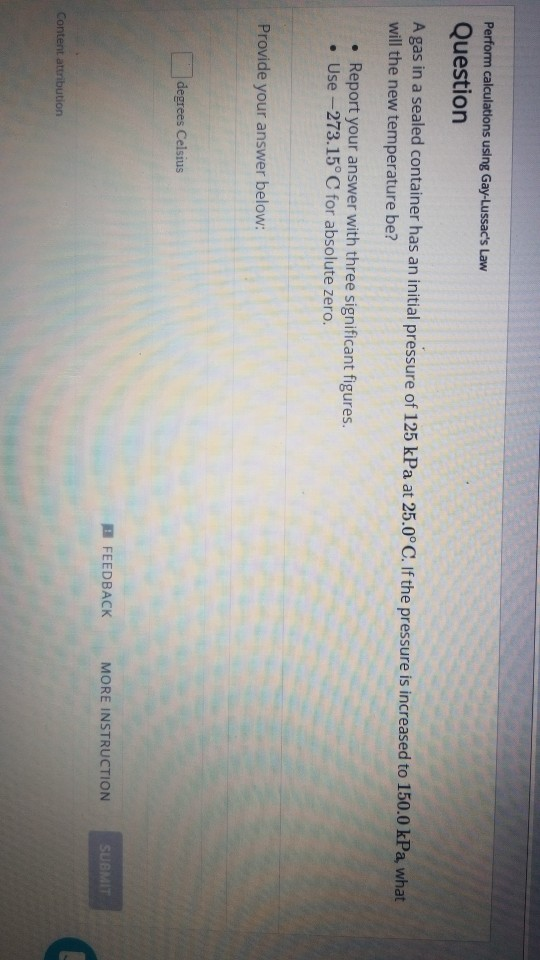
I guess in a sealed container has an initial pressure of 1 to 5KPA at 25゚C the pressures increased to 150゚ KPA what will the new temperature be a pottery answer with 3 significant figures use negative 27 3.15゚C for absolute zero
Homework Answers
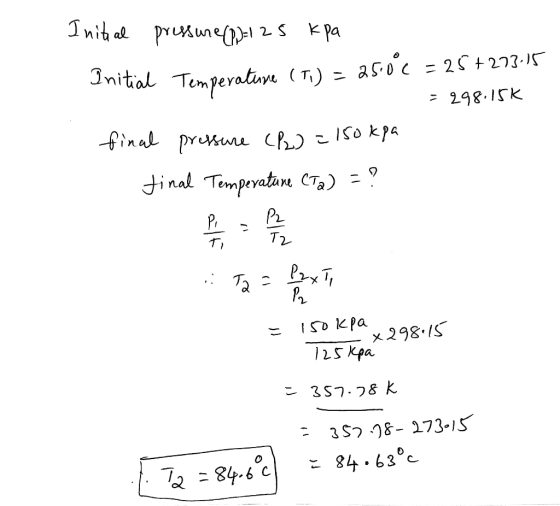
Add Answer to:
I guess in a
sealed container has an initial pressure of 1 to 5KPA at 25゚C...
Perform calculations using Gay-Lussac's Law Question A gas in a sealed container has an initial pressure...
 Perform calculations using Gay-Lussac's Law Question A gas in a sealed container has an initial pressure of 125 kPa at 25.0° C. If the pressure is increased to 150.0 kPa, what will the new temperature be? Report your answer with three significant figures. Use -273.15°C for absolute zero. Provide your answer below: degrees Celsius FEEDBACK MORE INSTRUCTION SUBMIT Content attribution
Perform calculations using Gay-Lussac's Law Question A gas in a sealed container has an initial pressure...
 Perform calculations using Gay-Lussac's Law Question A gas in a sealed container has an initial pressure of 125 kPa at 25.0°C. If the pressure is increased to 150.0 kPa, what will the new temperature be? • Report your answer with three significant figures. • Use -273.15°C for absolute zero. Provide your answer below:
gas had an initial pressure of 4.80 atm in a 5.50 L container. After transfering it...
 gas had an initial pressure of 4.80 atm in a 5.50 L container. After transfering it to a 9.60 L container, the gas was found to have a pressure of 2.10 atm and a temperature of 25.00 C. What was the initial temperature in degrees Celsius? A Report your answer to three significant figures Use +273.15'C for absolute zero.
Gay-Lussac's law states that the pressure of a gas is directly related to its absolute temperature
 Gay-Lussac's law states that the pressure of a gas is directly related to its absolute temperature, provided the volume and number of moles of the gas remain the same: (Figure 1) Part A A sample of ideal gas is in a sealed container. The pressure of the gas is 145 torr, and the temperature is 39 °C. If the temperature changes to 80 °C with no change in volume or amount of gas, what is the new pressure, P2, of the gas...
A fixed amount of ideal gas is held in a sealed container. The initial volume, pressure,...
A fixed amount of ideal gas is held in a sealed container. The initial volume, pressure, and temperature are [recall that 1L = 10−3 m3, and 1atm = 101,300Pa] V = 40 L P = 2.5 atm T = 400 K. (a) Compute the new temperature if the pressure is reduced to P = 1.0atm while the volume is held constant. (b) Compute the new volume if the temperature increases to 600K while the pressure is reduced to 2.0atm. (c)...
A sample of a gas is in a sealed container. The pressure of the gas is...
A sample of a gas is in a sealed container. The pressure of the gas is 645 torr , and the temperature is 36 ∘C . If the temperature changes to 66 ∘C with no change in volume or amount of gas, what is the new pressure, P2, of the gas inside the container? Express your answer with the appropriate units. Using the same sample of gas (P1 = 645 torr , T1 = 36 ∘C ), we wish to...
A sample of a gas is in a sealed container. The pressure of the gas is...
A sample of a gas is in a sealed container. The pressure of the gas is 475 torr , and the temperature is 12 ∘C . If the temperature changes to 84 ∘C with no change in volume or amount of gas, what is the new pressure, P2, of the gas inside the container Using the same sample of gas (P1 = 475 torr , T1 = 12 ∘C ), we wish to change the pressure to 4750 torr with...
Part A: A sample of a gas is in a sealed container. The pressure of the...
Part A: A sample of a gas is in a sealed container. The pressure of the gas is 705 torr , and the temperature is 37 ∘C . If the temperature changes to 88 ∘C with no change in volume or amount of gas, what is the new pressure, P2, of the gas inside the container? Part B: Using the same sample of gas (P1 = 705 torr , T1 = 37 ∘C ), we wish to change the pressure...
A sealed container full of 3 ??? of an ideal has an initial pressure of ?...
A sealed container full of 3 ??? of an ideal has an initial pressure of ? 0 and an initial temperature of 300 ?. A thermodynamic process causes the temperature to triple at the same time that 8600 ? of energy are transferred out of the gas as heat. What is the magnitude of energy transferred as work, |?|, during this process? (No chemical reaction occurs.) |?| = 13,837 ? |?| = 25,056 ? |?| = 31,037 ? |?| =...
PART A A sample of ideal gas is in a sealed container. The pressure of the...
PART A A sample of ideal gas is in a sealed container. The pressure of the gas is 445 torr , and the temperature is 26 ∘C . If the temperature changes to 98 ∘C with no change in volume or amount of gas, what is the new pressure, P2, of the gas inside the container? Express your answer with the appropriate units. PART B Using the same sample of gas (P1 = 445 torr , T1 = 26 ∘C...
 Perform calculations using Gay-Lussac's Law Question A gas in a sealed container has an initial pressure of 125 kPa at 25.0° C. If the pressure is increased to 150.0 kPa, what will the new temperature be? Report your answer with three significant figures. Use -273.15°C for absolute zero. Provide your answer below: degrees Celsius FEEDBACK MORE INSTRUCTION SUBMIT Content attribution
 Perform calculations using Gay-Lussac's Law Question A gas in a sealed container has an initial pressure of 125 kPa at 25.0°C. If the pressure is increased to 150.0 kPa, what will the new temperature be? • Report your answer with three significant figures. • Use -273.15°C for absolute zero. Provide your answer below:
 gas had an initial pressure of 4.80 atm in a 5.50 L container. After transfering it to a 9.60 L container, the gas was found to have a pressure of 2.10 atm and a temperature of 25.00 C. What was the initial temperature in degrees Celsius? A Report your answer to three significant figures Use +273.15'C for absolute zero.
 Gay-Lussac's law states that the pressure of a gas is directly related to its absolute temperature, provided the volume and number of moles of the gas remain the same: (Figure 1) Part A A sample of ideal gas is in a sealed container. The pressure of the gas is 145 torr, and the temperature is 39 °C. If the temperature changes to 80 °C with no change in volume or amount of gas, what is the new pressure, P2, of the gas...
Most questions answered within 3 hours.
-
Where is the error in this code sequence?
String s1 = "Hello";
String s2 = "ello";...
asked 10 months ago -
Financial data for Joel de Paris, Inc., for last year
follow:
Joel de Paris, Inc.
Balance...
asked 10 months ago -
Consider this reaction:
Al2(SO4)3 (aq)+ BaCl3
(aq) Al2Cl6 (aq)- +
3BaSO4(s) . What is the...
asked 10 months ago -
Suppose that Savneet is considering increasing her
recent random sample from 20 car rentals to 40...
asked 10 months ago -
Trucks arrive at an unloading terminal at an average rate of 120
per hour.
Trucks arrive...
asked 10 months ago -
Why are methanol and ethanol completely soluble in water while
octanol is not very little soluble....
asked 10 months ago -
A facilities manager at a university reads in a research report
that the mean amount of...
asked 10 months ago -
When the CuSO4 is rehydrated by adding water to the anhydrous
compound, is this an endothermic...
asked 10 months ago -
A ray of sunlight is passing from diamond into crown glass; the
angle of incidence is...
asked 10 months ago -
A block of mass 0.249 kg is placed on top of a light, vertical
spring of...
asked 10 months ago -
how do the kidneys compensate in the presences of acidosis
a) trigger hyperventilate
b) reserve acid...
asked 10 months ago -
Question 501 pts
The rental rate of capital to the firm increases. Which of the
following...
asked 10 months ago