A sealed container full of 3 ??? of an ideal has an initial pressure of ?...
A sealed container full of 3 ??? of an ideal has an initial pressure of ? 0
and an initial temperature of 300 ?. A thermodynamic process causes the temperature to triple at the same time that 8600 ? of
energy are transferred out of the gas as heat. What is the magnitude of energy transferred as work, |?|, during this process? (No chemical reaction occurs.)
-
|?| = 13,837 ?
-
|?| = 25,056 ?
-
|?| = 31,037 ?
-
|?| = 42,256 ?
-
None of the above
answer is #3, can you explain why/show the work
Homework Answers
Find the change in internal energy by using the difference in
temperature and use first law of thermodynamics to find the
required work done as shown below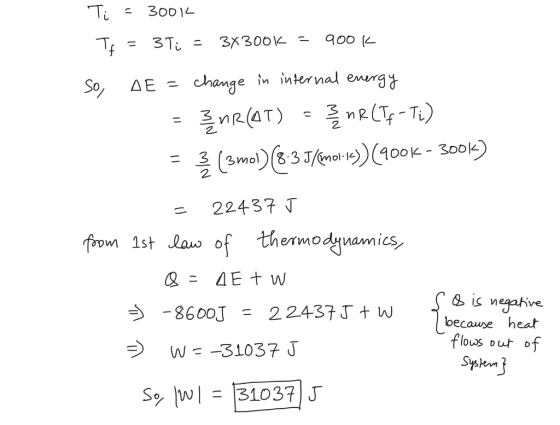
***********************************************************************************************
This concludes the answers. If there is any mistake or
omission, let me know in the comments immediately and I will fix
it....
Add Answer to:
A sealed container full of 3 ??? of an ideal has an initial
pressure of ?...
A sealed container holds 0.020 moles of ideal nitrogen (N2) gas at a pressure of 1.5...
A sealed container holds 0.020 moles of ideal nitrogen (N2) gas at a pressure of 1.5 atmospheres and a temperature of 290 K. The atomic mass of nitrogen is 14.0 g/mol. What is the approximate quantity of heat, transferred at constant volume, that raises the temperature of the gas to 300 K, in SI units?
A fixed amount of ideal gas is held in a sealed container. The initial volume, pressure,...
A fixed amount of ideal gas is held in a sealed container. The initial volume, pressure, and temperature are [recall that 1L = 10−3 m3, and 1atm = 101,300Pa] V = 40 L P = 2.5 atm T = 400 K. (a) Compute the new temperature if the pressure is reduced to P = 1.0atm while the volume is held constant. (b) Compute the new volume if the temperature increases to 600K while the pressure is reduced to 2.0atm. (c)...
A container holds 5 ??? of gas at a pressure of 150 ??? = 1.50 ×...
A container holds 5 ??? of gas at a pressure of 150 ??? = 1.50 × 10⁵ ?? and an initial temperature of280 ?. The gas expands to a final volume of 0.155 ?3 while the pressure and number of moles remain fixed (no chemical reaction takes place). The magnitude of work for this expansion is 11,620 ?. How much heat is transferred in this process, and is it entering or exiting the gas?
An ideal gas in a sealed container has an initial volume of 2.30 L. At constant...
 An ideal gas in a sealed container has an initial volume of 2.30 L. At constant pressure, it is cooled to 20.00 C, where its final volume is 1.75 L. What was the initial temperature?
An ideal gas in a sealed container has an initial volume of 2.70 L. At constant...
An ideal gas in a sealed container has an initial volume of 2.70 L. At constant pressure, it is cooled to 18.00 °C where its final volume is 1.75 L. What was the initial temperature?
An ideal gas in a sealed container has an initial volume of 2.45 L. At constant...
 An ideal gas in a sealed container has an initial volume of 2.45 L. At constant pressure, it is cooled to 25.00 °C, where its final volume is 1.75 L. What was the initial temperature?
A sample of ideal gas is in a sealed container. The pressure of the gas is...
A sample of ideal gas is in a sealed container. The pressure of the gas is 425 torr , and the temperature is 5 ∘C . If the temperature changes to 91 ∘C with no change in volume or amount of gas, what is the new pressure, P2, of the gas inside the container?
An ideal gas in a sealed container has an initial volume of 2.50 L. At constant...
An ideal gas in a sealed container has an initial volume of 2.50 L. At constant pressure, it is cooled to19.00 ∘C, where its final volume is 1.75 L. What was the initial temperature? ?1= ∘C
A sample of ideal gas is in a sealed container. The pressure of the gas is...
A sample of ideal gas is in a sealed container. The pressure of the gas is 515 torr , and the temperature is 36.4 ºC . If the temperature changes to 92 ºC with no change in volume or amount of gas, what is the new pressure of the gas inside the container? Report the pressure rounded to the nearest torr, without units.
A container of 3.1 mol of gas expands from 1.5 L to 2.5 L (1 L...
 A container of 3.1 mol of gas expands from 1.5 L to 2.5 L (1 L = 0.001 m3) while the pressure is kept constant. The gas is initially at a temperature of 280 K. What is the pressure of the gas? 4811034 Pa What is the final temperature of the gas? T 466 What is the magnitude of the change in internal energy of the gas, and is the internal energy increasing or decreasing? (Note that there is no...
 An ideal gas in a sealed container has an initial volume of 2.30 L. At constant pressure, it is cooled to 20.00 C, where its final volume is 1.75 L. What was the initial temperature?
 An ideal gas in a sealed container has an initial volume of 2.45 L. At constant pressure, it is cooled to 25.00 °C, where its final volume is 1.75 L. What was the initial temperature?
 A container of 3.1 mol of gas expands from 1.5 L to 2.5 L (1 L = 0.001 m3) while the pressure is kept constant. The gas is initially at a temperature of 280 K. What is the pressure of the gas? 4811034 Pa What is the final temperature of the gas? T 466 What is the magnitude of the change in internal energy of the gas, and is the internal energy increasing or decreasing? (Note that there is no...
Most questions answered within 3 hours.
-
Where is the error in this code sequence?
String s1 = "Hello";
String s2 = "ello";...
asked 11 months ago -
Financial data for Joel de Paris, Inc., for last year
follow:
Joel de Paris, Inc.
Balance...
asked 11 months ago -
Consider this reaction:
Al2(SO4)3 (aq)+ BaCl3
(aq) Al2Cl6 (aq)- +
3BaSO4(s) . What is the...
asked 11 months ago -
Suppose that Savneet is considering increasing her
recent random sample from 20 car rentals to 40...
asked 11 months ago -
Trucks arrive at an unloading terminal at an average rate of 120
per hour.
Trucks arrive...
asked 11 months ago -
Why are methanol and ethanol completely soluble in water while
octanol is not very little soluble....
asked 11 months ago -
A facilities manager at a university reads in a research report
that the mean amount of...
asked 11 months ago -
When the CuSO4 is rehydrated by adding water to the anhydrous
compound, is this an endothermic...
asked 11 months ago -
A ray of sunlight is passing from diamond into crown glass; the
angle of incidence is...
asked 11 months ago -
A block of mass 0.249 kg is placed on top of a light, vertical
spring of...
asked 11 months ago -
how do the kidneys compensate in the presences of acidosis
a) trigger hyperventilate
b) reserve acid...
asked 11 months ago -
Question 501 pts
The rental rate of capital to the firm increases. Which of the
following...
asked 11 months ago