
PART 2
The price in Japan is ___?
Homework Answers
Answer
P=MC/(1+(1/e))
P=price
MC=marginal cost
e=elastcity of demand
Price in United states is:
P=11/(1+(1/(-2.1)))
=21
Price in Japan is:
P=11/(1+(1/(-5.2)))
P=13.6190476
=13.62
the price in the US is $21.00 and the price in Japan is $13.62
Add Answer to:
PART 2
The price in Japan is ___?
A monopoly sells its good in the United...
A monopoly sells its good in the United States, where the elasticity of demand is negative...
A monopoly sells its good in the United States, where the elasticity of demand is negative −2, and in Japan, where the elasticity of demand is −5.4. Its marginal cost is 12. At what price does the monopoly sell its good in each country if resales are impossible? The price of the united states? The price of Japan? (Round your answer to the nearest penny.)
A monopoly sells its good in the United States, where the elasticity of demand is -2,...
A monopoly sells its good in the United States, where the elasticity of demand is -2, and in Japan, where the elasticity of demand is -5. Its marginal cost is $10. At what price does the monopoly sell its good in each country if resale is impossible?
A monopoly sells its good in the U.S. and Japanese markets. The American inverse demand function...
 A monopoly sells its good in the U.S. and Japanese markets. The American inverse demand function is Pa = 100 - Qa and the Japanese inverse demand function is Pj = 90 - 2Qj where both prices, Pa and pi, are measured in dollars. The firm's marginal cost of production is m = $15 in both countries. If the firm can prevent resales, what price will it charge in both markets? (Hint: The monopoly determines its optimal (monopoly) price in...
A monopoly sells its good in the U.S. and Japanese markets. The American inverse demand function...
A monopoly sells its good in the U.S. and Japanese markets. The American inverse demand function is: Pa=100-Qa and the Japanese inverse demand function is pj=90-2Qj where both prices, Pa and Pj, are measured in dollars. The firm's marginal cost of production is m = $25 in both countries. If the firm can prevent resales, what price will it charge in both markets? (Hint: The monopoly determines its optimal (monopoly) price in each country separately because customers cannot resell the...
Question 3) (30 points) A monopoly sells in two countries, and resales between the countries are...
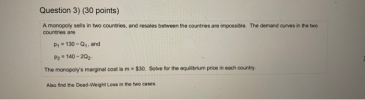 Question 3) (30 points) A monopoly sells in two countries, and resales between the countries are impossible. The demand curves in the two countries are P1 = 130 - Q. and P2 = 140 - 202 The monopoly's marginal cost is m = $30. Solve for the equilibrium price in each country. Also find the Dead-Weight Loss in the two cases.
If a monopoly charges $2.00 and its marginal cost of producing the good is $1.50, what...
If a monopoly charges $2.00 and its marginal cost of producing the good is $1.50, what explanation can be given about the elasticity of demand for the product? If a monopoly in another firm charges $2.00 and the marginal cost of producing the good is $1.00, what explanation can be given about the elasticity of demand for the product? What conclusion can be given about the mark-up of price over marginal cost and the elasticity of demand for the product?
Your firm is a monopoly supplier of a good. The inverse demand for your good (in...
Your firm is a monopoly supplier of a good. The inverse demand for your good (in dollars) is given by P=250−0.02Q . Your firm's cost function (in dollars) is C(Q)=400000+22Q+0.01Q2. Some of that cost comes from a critical part that you import from England that currently costs you $12.00 US for every unit of output that you produce. The current exchange rate is 1.20 $/£. How much profit (in $US) does your firm make? Round your answer to the nearest...
Distinguish between a price-discriminating monopoly and a single-price monopoly. A single-price monopoly is a firm that...
Distinguish between a price-discriminating monopoly and a single-price monopoly. A single-price monopoly is a firm that ______ each unit of its output ______. A. produces; at a constant cost B. must sell; at the same price as its competitors C. must sell; at the price regulated by the government D. must sell; for the same price to all its customers A price-discriminating monopoly _______. A. sells different units of a good or service for different prices B. is a firm...
A Japanese firm produces a particular model of vehicle in Japan and sells it in the...
A Japanese firm produces a particular model of vehicle in Japan and sells it in the United States. The production cost per vehicle is ¥800,000 and the vehicle is sold in the United States at a price of $10,000. Answer the questions below on the following assumptions: (1) there are no taxes in either country; (2) there are no transaction costs; (3) production cost does not change for the Japanese firm; and (4) the Japanese firm can exchange its dollar...
A monopoly sells in two countries . The demand curves in the two countries are p1...
A monopoly sells in two countries . The demand curves in the two countries are p1 = 12−q1, and p2 = 48−q2. The monopoly’s MC is $4. Now, suppose a long-running trade war between the two countries comes to an end, allowing resales between the two countries. The monopoly is now forced to charge the same price in both countries. The monopoly would have two options: (1) Sell at a price low enough (lower than 12), so that consumers from...
 A monopoly sells its good in the U.S. and Japanese markets. The American inverse demand function is Pa = 100 - Qa and the Japanese inverse demand function is Pj = 90 - 2Qj where both prices, Pa and pi, are measured in dollars. The firm's marginal cost of production is m = $15 in both countries. If the firm can prevent resales, what price will it charge in both markets? (Hint: The monopoly determines its optimal (monopoly) price in...
 Question 3) (30 points) A monopoly sells in two countries, and resales between the countries are impossible. The demand curves in the two countries are P1 = 130 - Q. and P2 = 140 - 202 The monopoly's marginal cost is m = $30. Solve for the equilibrium price in each country. Also find the Dead-Weight Loss in the two cases.
Most questions answered within 3 hours.
-
Where is the error in this code sequence?
String s1 = "Hello";
String s2 = "ello";...
asked 11 months ago -
Financial data for Joel de Paris, Inc., for last year
follow:
Joel de Paris, Inc.
Balance...
asked 11 months ago -
Consider this reaction:
Al2(SO4)3 (aq)+ BaCl3
(aq) Al2Cl6 (aq)- +
3BaSO4(s) . What is the...
asked 11 months ago -
Suppose that Savneet is considering increasing her
recent random sample from 20 car rentals to 40...
asked 11 months ago -
Trucks arrive at an unloading terminal at an average rate of 120
per hour.
Trucks arrive...
asked 11 months ago -
Why are methanol and ethanol completely soluble in water while
octanol is not very little soluble....
asked 11 months ago -
A facilities manager at a university reads in a research report
that the mean amount of...
asked 11 months ago -
When the CuSO4 is rehydrated by adding water to the anhydrous
compound, is this an endothermic...
asked 11 months ago -
A ray of sunlight is passing from diamond into crown glass; the
angle of incidence is...
asked 11 months ago -
A block of mass 0.249 kg is placed on top of a light, vertical
spring of...
asked 11 months ago -
how do the kidneys compensate in the presences of acidosis
a) trigger hyperventilate
b) reserve acid...
asked 11 months ago -
Question 501 pts
The rental rate of capital to the firm increases. Which of the
following...
asked 11 months ago