A monopoly sells its good in the United States, where the elasticity of demand is -2,...
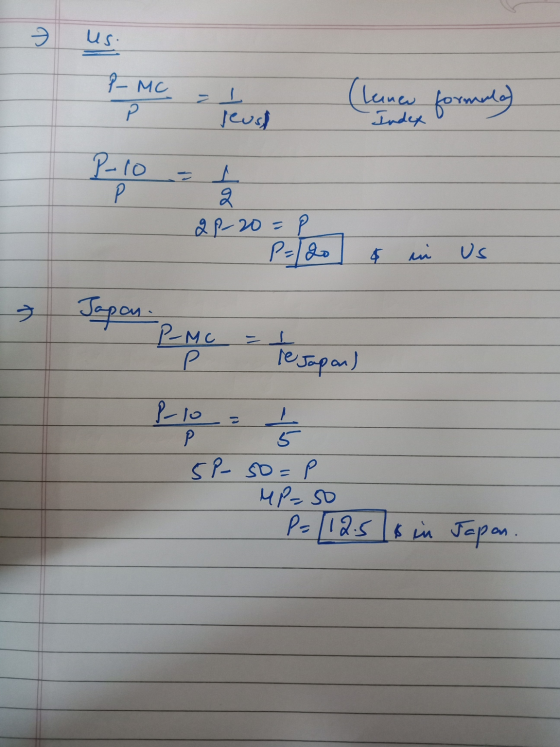
A monopoly sells its good in the United States, where the elasticity of demand is -2, and in Japan, where the elasticity of demand is -5. Its marginal cost is $10. At what price does the monopoly sell its good in each country if resale is impossible?
Homework Answers
Add Answer to:
A monopoly sells its good in the United States, where the
elasticity of demand is -2,...
A monopoly sells its good in the United States, where the elasticity of demand is negative...
A monopoly sells its good in the United States, where the elasticity of demand is negative −2, and in Japan, where the elasticity of demand is −5.4. Its marginal cost is 12. At what price does the monopoly sell its good in each country if resales are impossible? The price of the united states? The price of Japan? (Round your answer to the nearest penny.)
PART 2 The price in Japan is ___? A monopoly sells its good in the United...
 PART 2
The price in Japan is ___?
A monopoly sells its good in the United States, where the elasticity of demand is - 2.1, and in Japan, where the elasticity of demand is -5.2. Its marginal cost is $11. At what price does the monopoly sell its good in each country if resales are impossible? The price in the United States is $ . (Round your answer to the nearest penny.)
PART 2
The price in Japan is ___?
A monopoly sells its good in the United States, where the elasticity of demand is - 2.1, and in Japan, where the elasticity of demand is -5.2. Its marginal cost is $11. At what price does the monopoly sell its good in each country if resales are impossible? The price in the United States is $ . (Round your answer to the nearest penny.)
A monopoly sells its good in the U.S. and Japanese markets. The American inverse demand function...
A monopoly sells its good in the U.S. and Japanese markets. The American inverse demand function is: Pa=100-Qa and the Japanese inverse demand function is pj=90-2Qj where both prices, Pa and Pj, are measured in dollars. The firm's marginal cost of production is m = $25 in both countries. If the firm can prevent resales, what price will it charge in both markets? (Hint: The monopoly determines its optimal (monopoly) price in each country separately because customers cannot resell the...
A monopoly sells its good in the U.S. and Japanese markets. The American inverse demand function...
 A monopoly sells its good in the U.S. and Japanese markets. The American inverse demand function is Pa = 100 - Qa and the Japanese inverse demand function is Pj = 90 - 2Qj where both prices, Pa and pi, are measured in dollars. The firm's marginal cost of production is m = $15 in both countries. If the firm can prevent resales, what price will it charge in both markets? (Hint: The monopoly determines its optimal (monopoly) price in...
If a monopoly charges $2.00 and its marginal cost of producing the good is $1.50, what...
If a monopoly charges $2.00 and its marginal cost of producing the good is $1.50, what explanation can be given about the elasticity of demand for the product? If a monopoly in another firm charges $2.00 and the marginal cost of producing the good is $1.00, what explanation can be given about the elasticity of demand for the product? What conclusion can be given about the mark-up of price over marginal cost and the elasticity of demand for the product?
The manager of a local monopoly estimates that the elasticity of demand for its product is...
The manager of a local monopoly estimates that the elasticity of demand for its product is constant and equal to -3. The firm’s marginal cost is constant at $30 per unit. a. Express the firm’s marginal revenue as a function of its price. MR = ________ × P b. Determine the profit-maximizing price.
The manager of a local monopoly estimates that the elasticity of demand for its products is...
The manager of a local monopoly estimates that the elasticity of demand for its products is constant and equal to -3. The firm's marginal cost is constant at $35 per unit. a. express the firm's revenue as a function of its price MR= ???x P b. Determine the profit-maximizing price
The manager of a local monopoly estimates that the elasticity of demand for its product is...
The manager of a local monopoly estimates that the elasticity of demand for its product is constant and equal to -3. The firm’s marginal cost is constant at $30 per unit. a. Express the firm’s marginal revenue as a function of its price. Instruction: Enter your response rounded to two decimal places. MR = ___ × P
Suppose the own price elasticity of demand for good X is -2, its income elasticity is...
Suppose the own price elasticity of demand for good X is -2, its income elasticity is 3, its advertising elasticity is 4, and the cross-price elasticity of demand between it and good Y is -6. Determine how much the consumption of this good will change if for the following: A) The price of good X decreases by 5 percent. B) The price of good Y increases by 10 percent. C) Advertising decreases by 2 percent. D) Income increases by 3...
The manager of a local monopoly estimates that the elasticity of demand for its product is...
 The manager of a local monopoly estimates that the elasticity of demand for its product is constant and equal to -2. The firm's marginal cost is constant at $20 per unit. a. Express the firm's marginal revenue as a function of its price. Instruction: Enter your response rounded to two decimal places. MR = P b. Determine the profit-maximizing price. Instruction: Use the rounded value calculated above and round your response to two decimal places. $
 PART 2
The price in Japan is ___?
A monopoly sells its good in the United States, where the elasticity of demand is - 2.1, and in Japan, where the elasticity of demand is -5.2. Its marginal cost is $11. At what price does the monopoly sell its good in each country if resales are impossible? The price in the United States is $ . (Round your answer to the nearest penny.)
PART 2
The price in Japan is ___?
A monopoly sells its good in the United States, where the elasticity of demand is - 2.1, and in Japan, where the elasticity of demand is -5.2. Its marginal cost is $11. At what price does the monopoly sell its good in each country if resales are impossible? The price in the United States is $ . (Round your answer to the nearest penny.)
 A monopoly sells its good in the U.S. and Japanese markets. The American inverse demand function is Pa = 100 - Qa and the Japanese inverse demand function is Pj = 90 - 2Qj where both prices, Pa and pi, are measured in dollars. The firm's marginal cost of production is m = $15 in both countries. If the firm can prevent resales, what price will it charge in both markets? (Hint: The monopoly determines its optimal (monopoly) price in...
 The manager of a local monopoly estimates that the elasticity of demand for its product is constant and equal to -2. The firm's marginal cost is constant at $20 per unit. a. Express the firm's marginal revenue as a function of its price. Instruction: Enter your response rounded to two decimal places. MR = P b. Determine the profit-maximizing price. Instruction: Use the rounded value calculated above and round your response to two decimal places. $
Most questions answered within 3 hours.
-
Where is the error in this code sequence?
String s1 = "Hello";
String s2 = "ello";...
asked 11 months ago -
Financial data for Joel de Paris, Inc., for last year
follow:
Joel de Paris, Inc.
Balance...
asked 11 months ago -
Consider this reaction:
Al2(SO4)3 (aq)+ BaCl3
(aq) Al2Cl6 (aq)- +
3BaSO4(s) . What is the...
asked 11 months ago -
Suppose that Savneet is considering increasing her
recent random sample from 20 car rentals to 40...
asked 11 months ago -
Trucks arrive at an unloading terminal at an average rate of 120
per hour.
Trucks arrive...
asked 11 months ago -
Why are methanol and ethanol completely soluble in water while
octanol is not very little soluble....
asked 11 months ago -
A facilities manager at a university reads in a research report
that the mean amount of...
asked 11 months ago -
When the CuSO4 is rehydrated by adding water to the anhydrous
compound, is this an endothermic...
asked 11 months ago -
A ray of sunlight is passing from diamond into crown glass; the
angle of incidence is...
asked 11 months ago -
A block of mass 0.249 kg is placed on top of a light, vertical
spring of...
asked 11 months ago -
how do the kidneys compensate in the presences of acidosis
a) trigger hyperventilate
b) reserve acid...
asked 11 months ago -
Question 501 pts
The rental rate of capital to the firm increases. Which of the
following...
asked 11 months ago