
Homework Answers

Define 8 steps to assist with risk mitigation.
Define 8 steps to assist with risk mitigation.
Fill in the spaces in the table below. For steps 1, 4, 5, and 8, name...
 Fill in the spaces in the table below. For steps 1, 4, 5, and 8, name the correct substrates, enzyme, products, for all the other steps, name the enzyme and draw the missing structure.
7. (five marks) Outline the steps involved in making a CaCh solution in the lab. 8....
 7. (five marks) Outline the steps involved in making a CaCh solution in the lab. 8. (five marks) Outline the steps involved in making a diluted acid solution in the lab.
14. (12 pts) Show the mechanistic steps leading to the products below. 8-8 8 H2O +...
 14. (12 pts) Show the mechanistic steps leading to the products below. 8-8 8 H2O + + HF OH 15. (6 pts) Electrophilic addition to alkenes. A) Show the mechanism for the reaction below. CH3 CHs CCH-CH+ HCI Нс- НС CH2-CH C Cl B) Why does the Cl attach only to one of the two carbons in the C-C bond? (What is the reason behind the observed regiochemistry?)
8. (8 pts.) The following transformations can be done in two steps. Show the two reactions...
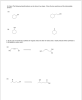 8. (8 pts.) The following transformations can be done in two steps. Show the two reactions and the intermediate product. 9. (6 pts.) Do one of the two synthesis for regular credit, the other for extra credit. Clearly indicate which synthesis is to be graded as extra credit.. 'Eno —
23. Label the diagram of a muscle. 3 8 2 24. List the 4 steps to cross-bridge cycling. 8:45P
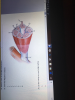 23. Label the diagram of a muscle. 3 8 2 24. List the 4 steps to cross-bridge cycling. 8:45P
Please help with the following question. List the 8 steps to accurate coding. Explain how following...
Please help with the following question. List the 8 steps to accurate coding. Explain how following these steps can help you develop accurate coding skills.
8. Many of the steps in the pathways described in this chapter are essentially irreversible (for...
 8. Many of the steps in the pathways described in this chapter are essentially irreversible (for A → BAG < 0). As a result, if the cell wants to carry out the reverse transformation, it must use a different pathway to go from B → A. For each of the enzymes on the left, pick the enzyme on the right that carries out the reverse transformation (not necessarily the reverse reaction). (4 marks) a) hexokinase b) fructose 1,6-bisphosphatase c) glycogen...
Convert the 16-bit word 10101100011010112 to octal (base 8) Please explain the steps!
Convert the 16-bit word 10101100011010112 to octal (base 8) Please explain the steps!
8. In more than two steps convert the aldehyde into the cyclic ester. two or more
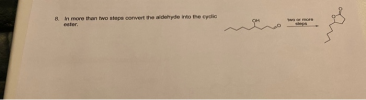 8. In more than two steps convert the aldehyde into the cyclic ester. two or more
 Fill in the spaces in the table below. For steps 1, 4, 5, and 8, name the correct substrates, enzyme, products, for all the other steps, name the enzyme and draw the missing structure.
 7. (five marks) Outline the steps involved in making a CaCh solution in the lab. 8. (five marks) Outline the steps involved in making a diluted acid solution in the lab.
 14. (12 pts) Show the mechanistic steps leading to the products below. 8-8 8 H2O + + HF OH 15. (6 pts) Electrophilic addition to alkenes. A) Show the mechanism for the reaction below. CH3 CHs CCH-CH+ HCI Нс- НС CH2-CH C Cl B) Why does the Cl attach only to one of the two carbons in the C-C bond? (What is the reason behind the observed regiochemistry?)
 8. (8 pts.) The following transformations can be done in two steps. Show the two reactions and the intermediate product. 9. (6 pts.) Do one of the two synthesis for regular credit, the other for extra credit. Clearly indicate which synthesis is to be graded as extra credit.. 'Eno —
 23. Label the diagram of a muscle. 3 8 2 24. List the 4 steps to cross-bridge cycling. 8:45P
 8. Many of the steps in the pathways described in this chapter are essentially irreversible (for A → BAG < 0). As a result, if the cell wants to carry out the reverse transformation, it must use a different pathway to go from B → A. For each of the enzymes on the left, pick the enzyme on the right that carries out the reverse transformation (not necessarily the reverse reaction). (4 marks) a) hexokinase b) fructose 1,6-bisphosphatase c) glycogen...
 8. In more than two steps convert the aldehyde into the cyclic ester. two or more
Most questions answered within 3 hours.
-
Where is the error in this code sequence?
String s1 = "Hello";
String s2 = "ello";...
asked 10 months ago -
Financial data for Joel de Paris, Inc., for last year
follow:
Joel de Paris, Inc.
Balance...
asked 10 months ago -
Consider this reaction:
Al2(SO4)3 (aq)+ BaCl3
(aq) Al2Cl6 (aq)- +
3BaSO4(s) . What is the...
asked 10 months ago -
Suppose that Savneet is considering increasing her
recent random sample from 20 car rentals to 40...
asked 10 months ago -
Trucks arrive at an unloading terminal at an average rate of 120
per hour.
Trucks arrive...
asked 10 months ago -
Why are methanol and ethanol completely soluble in water while
octanol is not very little soluble....
asked 10 months ago -
A facilities manager at a university reads in a research report
that the mean amount of...
asked 10 months ago -
When the CuSO4 is rehydrated by adding water to the anhydrous
compound, is this an endothermic...
asked 10 months ago -
A ray of sunlight is passing from diamond into crown glass; the
angle of incidence is...
asked 10 months ago -
A block of mass 0.249 kg is placed on top of a light, vertical
spring of...
asked 10 months ago -
how do the kidneys compensate in the presences of acidosis
a) trigger hyperventilate
b) reserve acid...
asked 10 months ago -
Question 501 pts
The rental rate of capital to the firm increases. Which of the
following...
asked 10 months ago