
Homework Answers
 Where Th
=Temperature of Hot source, Tc=Temperature of the cold
sink
Where Th
=Temperature of Hot source, Tc=Temperature of the cold
sink
Add Answer to:
Consider a Carnot cycle in which the working substance is 0.10 mol of perfect gas molecules,...
Physical Chemistry rating based in correction please Consider a Carnot cycle in which the working substance is 0.10...
 Physical Chemistry
rating based in correction please
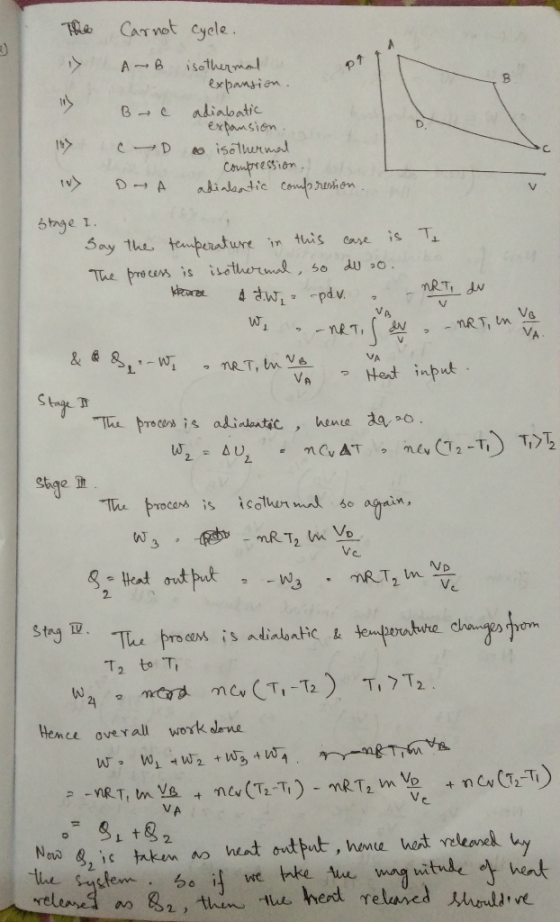
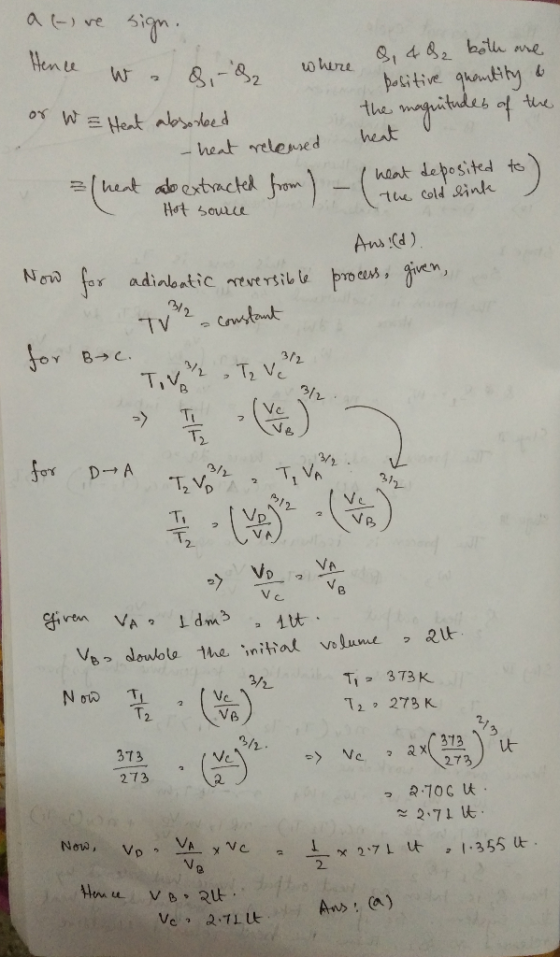
Consider a Carnot cycle in which the working substance is 0.10 mol of perfect gas molecules, the temperature of the hot source is 373 K, that of the cold sink is 273 K; the initial volume of gas is 1.00 dm', which doubles over the course of the first isothermal stage. For the reversible adiabatic stages it may be assumed that VT3/2 = constant. a) calculate the volume of the gas Vs and...
Physical Chemistry
rating based in correction please
Consider a Carnot cycle in which the working substance is 0.10 mol of perfect gas molecules, the temperature of the hot source is 373 K, that of the cold sink is 273 K; the initial volume of gas is 1.00 dm', which doubles over the course of the first isothermal stage. For the reversible adiabatic stages it may be assumed that VT3/2 = constant. a) calculate the volume of the gas Vs and...
The working substance of a certain Carnot engine is 1.80 mol of an ideal monatomic gas....
The working substance of a certain Carnot engine is 1.80 mol of an ideal monatomic gas. During the isothermal expansion portion of this engine's cycle, the volume of the gas doubles, while during the adiabatic expansion the volume increases by a factor of 5.7. The work output of the engine is 900 J in each cycle. Compute the temperatures of the two reservoirs between which this engine operates.
A diatomic gas describes a Carnot cycle in which, through an isothermal expansion process at 850...
A diatomic gas describes a Carnot cycle in which, through an isothermal expansion process at 850 K it passes from a pressure of 10 atm and a volume of 2 L at a pressure of 8 atm. Subsequently there is an adiabatic expansion and isothermal compression at a temperature of 310 K. Finally, in the adiabatic compression the initial point is reached at 10 atm of pressure and a volume of 2 L. Make a scheme of the process and...
A Carnot cycle is conducted using an ideal diatomic gas. Initially, the gas is at temperature...
A Carnot cycle is conducted using an ideal diatomic gas. Initially, the gas is at temperature 25C., pressure of 100KPa and volume of 0.01m3. The system is then compressed isothermally to a volume 0.002m3. From that point, the gas undergoes an adiabatic compression ( with gamma= 1.4), until the volume further reduces to 0.001m3. After that, the system goes an isothermal expansion process to a point where the pressure of the system is 263.8KPa. Then the system continues the cycle...
3. (20 pts) In the Carnot engine (refer to the figure in question 2), an ideal...
3. (20 pts) In the Carnot engine (refer to the figure in question 2), an ideal gas undergoes a cycle of isothermal expansion (A → B), adiabatic expansion (B → C), isothermal compression (C → D), and adiabatic compression (D → A). All processes are assumed to be reversible. The volumes at the points are given that 2VA=VB and VC=2VD. Th is 650 °C and Tc is 30 °C. (1) Calculate the amount of heat added to one mole gas...
A Carnot engine operates us ing 1.0 mol e of monoatomic ideal gas as a working...
A Carnot engine operates us ing 1.0 mol e of monoatomic ideal gas as a working s ubstance. In t he first step, the gas is place d in thermal contact with a heat reservoir and expands isothermally to 3 .0 times its initial volume. (a) If the internal energy o f the gas after this step is 6.25 k J , calculate the temperature of the heat reservoir ( T h ) . (b) C alculate the heat absorbed...
Help me do it. Problem 4. A Carnot cycle using 2 mol mono-atomic gas works between...
 Help me do it.
Problem 4. A Carnot cycle using 2 mol mono-atomic gas works between a hot reservoir Ti 400K and a cold reservoir T2 300K The 1-2 and 3-4 processes are isothermal The 2-3 and 4-1 processes are adiabatic. Given Vi 12 L, V2 -8 L a) (3 pts) Find Pi, P2, Ps, Ps, Vs, V4 b) (4 pts) What is the heat received by the gas during the 1-2 process? o (4 ptsy) What is the heat...
Help me do it.
Problem 4. A Carnot cycle using 2 mol mono-atomic gas works between a hot reservoir Ti 400K and a cold reservoir T2 300K The 1-2 and 3-4 processes are isothermal The 2-3 and 4-1 processes are adiabatic. Given Vi 12 L, V2 -8 L a) (3 pts) Find Pi, P2, Ps, Ps, Vs, V4 b) (4 pts) What is the heat received by the gas during the 1-2 process? o (4 ptsy) What is the heat...
An ideal gas (1.82 moles) undergoes the following reversible Carnot cycle. (1) An isothermal expansion at...
An ideal gas (1.82 moles) undergoes the following reversible Carnot cycle. (1) An isothermal expansion at Thot=850K from 3.20L to 20.40L. (2) An adiabatic expansion until the temperature falls to 298K. The system then undergoes (3) an isothermal compression and a subsequent (4) adiabatic compression until the initial state is reached. a. Calculate work and ΔS for each step in the cycle and its overall efficiency. b. Determine ΔH and ΔU for steps (1) and (2). c. Explain why ΔUcycle=...
An ideal gas is taken through a Carnot cycle. The isothermal expansion occurs at 290°C, and...
An ideal gas is taken through a Carnot cycle. The isothermal expansion occurs at 290°C, and the isothermal compression takes place at 50.0°C. The gas takes in 1.34 103 J of energy from the hot reservoir during the isothermal expansion. (a) Find the energy expelled to the cold reservoir in each cycle. J (b) Find the net work done by the gas in each cycle. J
Problem 8: Consider the reversible Carnot's cycle of an ideal monatomic gas in the cold cylinder...
 Problem 8: Consider the reversible Carnot's cycle of an ideal monatomic gas in the cold cylinder of 290 K corresponding to the isothermal compression step. Then the volume of the gas is further compressed by a factor of 7.5 in the adiabatic compression step. a) Find the temperature at the final step of the adiabatic compression. b) What is Thot for the isothermal expansion step? c) What is the maximum thermodynamic efficiency for this engine? d) How much would the...
 Physical Chemistry
rating based in correction please
Consider a Carnot cycle in which the working substance is 0.10 mol of perfect gas molecules, the temperature of the hot source is 373 K, that of the cold sink is 273 K; the initial volume of gas is 1.00 dm', which doubles over the course of the first isothermal stage. For the reversible adiabatic stages it may be assumed that VT3/2 = constant. a) calculate the volume of the gas Vs and...
Physical Chemistry
rating based in correction please
Consider a Carnot cycle in which the working substance is 0.10 mol of perfect gas molecules, the temperature of the hot source is 373 K, that of the cold sink is 273 K; the initial volume of gas is 1.00 dm', which doubles over the course of the first isothermal stage. For the reversible adiabatic stages it may be assumed that VT3/2 = constant. a) calculate the volume of the gas Vs and...
 Help me do it.
Problem 4. A Carnot cycle using 2 mol mono-atomic gas works between a hot reservoir Ti 400K and a cold reservoir T2 300K The 1-2 and 3-4 processes are isothermal The 2-3 and 4-1 processes are adiabatic. Given Vi 12 L, V2 -8 L a) (3 pts) Find Pi, P2, Ps, Ps, Vs, V4 b) (4 pts) What is the heat received by the gas during the 1-2 process? o (4 ptsy) What is the heat...
Help me do it.
Problem 4. A Carnot cycle using 2 mol mono-atomic gas works between a hot reservoir Ti 400K and a cold reservoir T2 300K The 1-2 and 3-4 processes are isothermal The 2-3 and 4-1 processes are adiabatic. Given Vi 12 L, V2 -8 L a) (3 pts) Find Pi, P2, Ps, Ps, Vs, V4 b) (4 pts) What is the heat received by the gas during the 1-2 process? o (4 ptsy) What is the heat...
 Problem 8: Consider the reversible Carnot's cycle of an ideal monatomic gas in the cold cylinder of 290 K corresponding to the isothermal compression step. Then the volume of the gas is further compressed by a factor of 7.5 in the adiabatic compression step. a) Find the temperature at the final step of the adiabatic compression. b) What is Thot for the isothermal expansion step? c) What is the maximum thermodynamic efficiency for this engine? d) How much would the...
Most questions answered within 3 hours.
-
Where is the error in this code sequence?
String s1 = "Hello";
String s2 = "ello";...
asked 10 months ago -
Financial data for Joel de Paris, Inc., for last year
follow:
Joel de Paris, Inc.
Balance...
asked 10 months ago -
Consider this reaction:
Al2(SO4)3 (aq)+ BaCl3
(aq) Al2Cl6 (aq)- +
3BaSO4(s) . What is the...
asked 10 months ago -
Suppose that Savneet is considering increasing her
recent random sample from 20 car rentals to 40...
asked 10 months ago -
Trucks arrive at an unloading terminal at an average rate of 120
per hour.
Trucks arrive...
asked 10 months ago -
Why are methanol and ethanol completely soluble in water while
octanol is not very little soluble....
asked 10 months ago -
A facilities manager at a university reads in a research report
that the mean amount of...
asked 10 months ago -
When the CuSO4 is rehydrated by adding water to the anhydrous
compound, is this an endothermic...
asked 10 months ago -
A ray of sunlight is passing from diamond into crown glass; the
angle of incidence is...
asked 10 months ago -
A block of mass 0.249 kg is placed on top of a light, vertical
spring of...
asked 10 months ago -
how do the kidneys compensate in the presences of acidosis
a) trigger hyperventilate
b) reserve acid...
asked 10 months ago -
Question 501 pts
The rental rate of capital to the firm increases. Which of the
following...
asked 10 months ago