![3. [4 points total] You are production engineer at a baking facility that produces glazes and fillings for all major doughnut](http://img.homeworklib.com/questions/4df83b30-7377-11ea-9b6e-1f6f75bebf42.png?x-oss-process=image/resize,w_560)

Homework Answers
Ans.a
The payback period can be calculated as follows:
Project A
| Year | Total Flow | Cumulative flow |
| 0 | -87750 | -87750 |
| 1 | 0 | -87750 |
| 2 | 2000 | -85750 |
| 3 | 5000 | -80750 |
| 4 | 5000 | -75750 |
| 5 | 12000 | -63750 |
| 6 | 18000 | -45750 |
| 7 | 24000 | -21750 |
| 8 | 46000 | 24250 |
| 9 | 60000 | 84250 |
| 10 | 80000 | 164250 |
Now to find out the payback period:
Step 1: We must pick the year in which the outflows have become positive. In other words, the year with the last negative outflow has to be selected. So, in this case, it will be year seven.
Step 2: Divide the total cumulative flow in the year in which the cash flows became positive by the total flow of the consecutive year.
So that is: 21750/46000 = 0.47
Step 3: Step 1 + Step 2 = The payback period is 7.47 years for project A.
Similarly for Project B,
| Year | Total Flow | Cumulative flow |
| 0 | -52500 | -52500 |
| 1 | 1000 | -51500 |
| 2 | 2000 | -49500 |
| 3 | 5000 | -44500 |
| 4 | 8000 | -36500 |
| 5 | 18000 | -18500 |
| 6 | 22000 | 3500 |
| 7 | 24000 | 27500 |
| 8 | 24000 | 51500 |
| 9 | 26000 | 77500 |
| 10 | 28000 | 105500 |
Now to find out the payback period:
Step 1: We must pick the year in which the outflows have become positive. In other words, the year with the last negative outflow has to be selected. So, in this case, it will be year five.
Step 2: Divide the total cumulative flow in the year in which the cash flows became positive by the total flow of the consecutive year.
So that is: 18500/22000 = 0.84
Step 3: Step 1 + Step 2 = The payback period is 5.84 years for project B.
Similarly for Project B,
| Year | Total Flow | Cumulative flow |
| 0 | -40000 | -40000 |
| 1 | 0 | -40000 |
| 2 | -5000 | -45000 |
| 3 | -5000 | -50000 |
| 4 | 10000 | -40000 |
| 5 | 10000 | -30000 |
| 6 | 14000 | -16000 |
| 7 | 14000 | -2000 |
| 8 | 24000 | 22000 |
| 9 | 24000 | 46000 |
| 10 | 30000 | 76000 |
Now to find out the payback period:
Step 1: We must pick the year in which the outflows have become positive. In other words, the year with the last negative outflow has to be selected. So, in this case, it will be year seven.
Step 2: Divide the total cumulative flow in the year in which the cash flows became positive by the total flow of the consecutive year.
So that is: 2000/24000 = 0.08
Step 3: Step 1 + Step 2 = The payback period is 7.08 years for project C.
Based on this approach, only Project B should be considered for installation and project A & project C should be eliminated.
Ans.b
Calculation of Discounted Payback Period
Project A
| Year | Total Flow | PV Factor @6% | DCF | Cumulative flow |
| 0 | -87750 | 1 | -87750 | -87750 |
| 1 | 0 | 0.943 | 0.00 | -87750.00 |
| 2 | 2000 | 0.890 | 1779.99 | -85970.01 |
| 3 | 5000 | 0.840 | 4198.10 | -81771.91 |
| 4 | 5000 | 0.792 | 3960.47 | -77811.44 |
| 5 | 12000 | 0.747 | 8967.10 | -68844.34 |
| 6 | 18000 | 0.705 | 12689.29 | -56155.05 |
| 7 | 24000 | 0.665 | 15961.37 | -40193.68 |
| 8 | 46000 | 0.627 | 28860.97 | -11332.71 |
| 9 | 60000 | 0.592 | 35513.91 | 24181.19 |
| 10 | 80000 | 0.558 | 44671.58 | 68852.78 |
Now to find out the payback period:
Step 1: We must pick the year in which the outflows have become positive. In other words, the year with the last negative outflow has to be selected. So, in this case, it will be year eight.
Step 2: Divide the total cumulative flow in the year in which the cash flows became positive by the total flow of the consecutive year.
So that is: 11332.71/33513.91 = 0.34
Step 3: Step 1 + Step 2 = The payback period is 8.34 years for project A.
Project B
| Year | Total Flow | PV Factor @6% | DCF | Cumulative flow |
| 0 | -52500 | 1 | -52500 | -52500 |
| 1 | 1000 | 0.943 | 943.40 | -51556.60 |
| 2 | 2000 | 0.890 | 1779.99 | -49776.61 |
| 3 | 5000 | 0.840 | 4198.10 | -45578.51 |
| 4 | 8000 | 0.792 | 6336.75 | -39241.77 |
| 5 | 18000 | 0.747 | 13450.65 | -25791.12 |
| 6 | 22000 | 0.705 | 15509.13 | -10281.99 |
| 7 | 24000 | 0.665 | 15961.37 | 5679.38 |
| 8 | 24000 | 0.627 | 15057.90 | 20737.28 |
| 9 | 26000 | 0.592 | 15389.36 | 36126.64 |
| 10 | 28000 | 0.558 | 15635.05 | 51761.70 |
Now to find out the payback period:
Step 1: We must pick the year in which the outflows have become positive. In other words, the year with the last negative outflow has to be selected. So, in this case, it will be year six.
Step 2: Divide the total cumulative flow in the year in which the cash flows became positive by the total flow of the consecutive year.
So that is: 10281.99/15961.37 = 0.64
Step 3: Step 1 + Step 2 = The payback period is 6.64 years for project B.
Project C
| Year | Total Flow | PV Factor @6% | DCF | Cumulative flow |
| 0 | -40000 | 1 | -40000 | -40000 |
| 1 | 0 | 0.943 | 0.00 | -40000.00 |
| 2 | -5000 | 0.890 | -4449.98 | -44449.98 |
| 3 | -5000 | 0.840 | -4198.10 | -48648.08 |
| 4 | 10000 | 0.792 | 7920.94 | -40727.14 |
| 5 | 10000 | 0.747 | 7472.58 | -33254.56 |
| 6 | 14000 | 0.705 | 9869.45 | -23385.11 |
| 7 | 14000 | 0.665 | 9310.80 | -14074.31 |
| 8 | 24000 | 0.627 | 15057.90 | 983.58 |
| 9 | 24000 | 0.592 | 14205.56 | 15189.15 |
| 10 | 30000 | 0.558 | 16751.84 | 31940.99 |
Now to find out the payback period:
Step 1: We must pick the year in which the outflows have become positive. In other words, the year with the last negative outflow has to be selected. So, in this case, it will be year seven.
Step 2: Divide the total cumulative flow in the year in which the cash flows became positive by the total flow of the consecutive year.
So that is: 14074.31/15057.9 = 0.93
Step 3: Step 1 + Step 2 = The payback period is 7.93 years for project C.
Based on this approach also, only Project B should be considered for installation and project A & project C should be eliminated
Add Answer to:
please show all work. no excel.
3. [4 points total] You are production engineer at a...
PLEASE SHOW ALL WORK 1. (35 points) You are considering the following two mutually exclusiveprojects. Both projects...
PLEASE SHOW ALL WORK 1. (35 points) You are considering the following two mutually exclusiveprojects. Both projects will be depreciated using straight-line depreciation to a zero book value over the life of the project. Neither project has any salvage value. Year Project(A) Project (B) 0 -$30,000 -$30,000 1 13,000 5,000 2 11,000 5,000 3 9,000 5,000 4 7,000 5,000 5 0 5,000 6 7 8 9 10 0 0 0 0 0 5,000 5,000 5,000 5,000 5,000 The required rate...
please help on the calculations for this problem pictured using excel and show excel calculations and...
 please help on the calculations for this problem
pictured using excel and show excel calculations and output used
also. thanks in advanced for your help!
The payback method helps firms establish and identify a maximum acceptatite payback period that helps in their capital budgeting decisions Consider the case of Cute Camel Woodcraft Company: Cute Camel Woodcraft Company is a small firm, and several of its managers are worried about how soon the firm will be able to recover its initial...
please help on the calculations for this problem
pictured using excel and show excel calculations and output used
also. thanks in advanced for your help!
The payback method helps firms establish and identify a maximum acceptatite payback period that helps in their capital budgeting decisions Consider the case of Cute Camel Woodcraft Company: Cute Camel Woodcraft Company is a small firm, and several of its managers are worried about how soon the firm will be able to recover its initial...
Please submit your work in an Excel file and show all of your calculations. No credit...
Please submit your work in an Excel file and show all of your calculations. No credit will be earned if you just provide a solution with the calculations to justify how you arrived at the solution. Project A has an initial net investment at time period zero of ($100,000), with $21,000 positive cash flows for the next 7 years. Project A has a cost of capital of 7% APR. Project B has an initial net investment at time period zero...
answer all of it please! * M * Dubowe *1-200 Sched x stock x Due Du...
 answer all of it please!
* M * Dubowe *1-200 Sched x stock x Due Du Moda Coc pe.com/static/nb/i/evoindeholdeploymentid=593714300856417127549094838EN97813379110035766275&srapshot13401298 « CENGAGE MINDTAP Quiz 10. Ch 11 - The Basics of Capital Budgeting Complete the following table and compute the project's conventional payback period. For full credit, complete the entire table. (Note: Round the Conventional payback period to two decal places. If your answer is negative, be sure you ) Year Year 1 $2.000.000 $3,000,000 Year 4.250.000 $1,250,000 $1,750,000 $3.000.000 Cumulative...
answer all of it please!
* M * Dubowe *1-200 Sched x stock x Due Du Moda Coc pe.com/static/nb/i/evoindeholdeploymentid=593714300856417127549094838EN97813379110035766275&srapshot13401298 « CENGAGE MINDTAP Quiz 10. Ch 11 - The Basics of Capital Budgeting Complete the following table and compute the project's conventional payback period. For full credit, complete the entire table. (Note: Round the Conventional payback period to two decal places. If your answer is negative, be sure you ) Year Year 1 $2.000.000 $3,000,000 Year 4.250.000 $1,250,000 $1,750,000 $3.000.000 Cumulative...
Please show all steps and calculations. Answers without steps and calculations will not receive full points....
 Please show all steps and calculations. Answers without steps and calculations will not receive full points. (1) A firm is considering an expansion project that will last three years. The project requires an immediate purchase of a new equipment that costs $900,000. The equipment will be fully depreciated using straight-line method over the next three years. The resale price of the equipment at the end of year three is estimated to be $200,000. The project will generate annual sales of...
Please do not work in excel and also please show your calculations. FastTrack Bikes, Inc. is...
Please do not work in excel and also please show your calculations. FastTrack Bikes, Inc. is thinking of developing a new composite road bike. Development will take six years and the cost is $200,000 per year. Once in production, the bike is expected to make $300,000 (after expenses) per year for 10 years. The cash inflows begin at the end of year 7. At FastTrack, there is a difference of opinion as to the "best" decision rule to use. The...
please explain! thank you 41 Capital Budgeting Exercises: Inree independent projects are under consideration for capital...
 please explain! thank you
41 Capital Budgeting Exercises: Inree independent projects are under consideration for capital budgeting purposes. Their respective initial investment, cost of capital, and cash flows are provided below. Use the following capital budgeting techniques to evaluate all three projects and indicate which project should be undertaken, assuming there is no budget constraint A. Payback period method Discounted payback period method Net present value method IRR method B. C. D. Project 1 Project 2 Project 3 Initial Investment...
please explain! thank you
41 Capital Budgeting Exercises: Inree independent projects are under consideration for capital budgeting purposes. Their respective initial investment, cost of capital, and cash flows are provided below. Use the following capital budgeting techniques to evaluate all three projects and indicate which project should be undertaken, assuming there is no budget constraint A. Payback period method Discounted payback period method Net present value method IRR method B. C. D. Project 1 Project 2 Project 3 Initial Investment...
Please show all work in an Excel spreadsheet, showing all calculations in each cell. 4. Mini...
 Please show all work in an Excel spreadsheet, showing all
calculations in each cell.
4. Mini Case Analysis: Aguilera Acoustics, Inc. (AAI), projects unit sales for a new seven octaye voice emulation implants as follows Unit Sales 108.000 127,000 115,000 98,000 84,000 Year Production of the implants will require S1,500,000 in net working capital to start and additional net working capital investments each year equal to 15 percent of the projected sales increase for the following year. Total fixed costs...
Please show all work in an Excel spreadsheet, showing all
calculations in each cell.
4. Mini Case Analysis: Aguilera Acoustics, Inc. (AAI), projects unit sales for a new seven octaye voice emulation implants as follows Unit Sales 108.000 127,000 115,000 98,000 84,000 Year Production of the implants will require S1,500,000 in net working capital to start and additional net working capital investments each year equal to 15 percent of the projected sales increase for the following year. Total fixed costs...
Please show all work in an Excel spreadsheet, showing all calculations in each cell. 3. CSM...
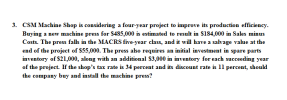 Please show all work in an Excel spreadsheet, showing all
calculations in each cell.
3. CSM Machine Shop is considering a four-year project to improve its production efficiency. Buying a new machine press for S485,000 is estimated to result in S184,000 in Sales minus Costs. The press falls in the MACRS five-year class, and it will have a salvage value at the end of the project of S55,000. The press also requires an initial investment in spare parts inventory of...
Please show all work in an Excel spreadsheet, showing all
calculations in each cell.
3. CSM Machine Shop is considering a four-year project to improve its production efficiency. Buying a new machine press for S485,000 is estimated to result in S184,000 in Sales minus Costs. The press falls in the MACRS five-year class, and it will have a salvage value at the end of the project of S55,000. The press also requires an initial investment in spare parts inventory of...
Remember to explain all your steps and to show all formulas you use before you put...
 Remember to explain all your steps and to show all formulas you
use before you put numbers into the equations.
-Write the formula, substitute the numbers into the formula, say
what is left to compute, compute
. Question 1 For question 1, use the following cash flows for projects A and B: A: (-$2,000, $500, $600, $700, $800) B: (-$2,000, $950, $850, $400, $300) AB. (1.1) Calculate the payback period for projects A and B. (1.2) If the discount rate...
Remember to explain all your steps and to show all formulas you
use before you put numbers into the equations.
-Write the formula, substitute the numbers into the formula, say
what is left to compute, compute
. Question 1 For question 1, use the following cash flows for projects A and B: A: (-$2,000, $500, $600, $700, $800) B: (-$2,000, $950, $850, $400, $300) AB. (1.1) Calculate the payback period for projects A and B. (1.2) If the discount rate...
 please help on the calculations for this problem
pictured using excel and show excel calculations and output used
also. thanks in advanced for your help!
The payback method helps firms establish and identify a maximum acceptatite payback period that helps in their capital budgeting decisions Consider the case of Cute Camel Woodcraft Company: Cute Camel Woodcraft Company is a small firm, and several of its managers are worried about how soon the firm will be able to recover its initial...
please help on the calculations for this problem
pictured using excel and show excel calculations and output used
also. thanks in advanced for your help!
The payback method helps firms establish and identify a maximum acceptatite payback period that helps in their capital budgeting decisions Consider the case of Cute Camel Woodcraft Company: Cute Camel Woodcraft Company is a small firm, and several of its managers are worried about how soon the firm will be able to recover its initial...
 answer all of it please!
* M * Dubowe *1-200 Sched x stock x Due Du Moda Coc pe.com/static/nb/i/evoindeholdeploymentid=593714300856417127549094838EN97813379110035766275&srapshot13401298 « CENGAGE MINDTAP Quiz 10. Ch 11 - The Basics of Capital Budgeting Complete the following table and compute the project's conventional payback period. For full credit, complete the entire table. (Note: Round the Conventional payback period to two decal places. If your answer is negative, be sure you ) Year Year 1 $2.000.000 $3,000,000 Year 4.250.000 $1,250,000 $1,750,000 $3.000.000 Cumulative...
answer all of it please!
* M * Dubowe *1-200 Sched x stock x Due Du Moda Coc pe.com/static/nb/i/evoindeholdeploymentid=593714300856417127549094838EN97813379110035766275&srapshot13401298 « CENGAGE MINDTAP Quiz 10. Ch 11 - The Basics of Capital Budgeting Complete the following table and compute the project's conventional payback period. For full credit, complete the entire table. (Note: Round the Conventional payback period to two decal places. If your answer is negative, be sure you ) Year Year 1 $2.000.000 $3,000,000 Year 4.250.000 $1,250,000 $1,750,000 $3.000.000 Cumulative...
 Please show all steps and calculations. Answers without steps and calculations will not receive full points. (1) A firm is considering an expansion project that will last three years. The project requires an immediate purchase of a new equipment that costs $900,000. The equipment will be fully depreciated using straight-line method over the next three years. The resale price of the equipment at the end of year three is estimated to be $200,000. The project will generate annual sales of...
 please explain! thank you
41 Capital Budgeting Exercises: Inree independent projects are under consideration for capital budgeting purposes. Their respective initial investment, cost of capital, and cash flows are provided below. Use the following capital budgeting techniques to evaluate all three projects and indicate which project should be undertaken, assuming there is no budget constraint A. Payback period method Discounted payback period method Net present value method IRR method B. C. D. Project 1 Project 2 Project 3 Initial Investment...
please explain! thank you
41 Capital Budgeting Exercises: Inree independent projects are under consideration for capital budgeting purposes. Their respective initial investment, cost of capital, and cash flows are provided below. Use the following capital budgeting techniques to evaluate all three projects and indicate which project should be undertaken, assuming there is no budget constraint A. Payback period method Discounted payback period method Net present value method IRR method B. C. D. Project 1 Project 2 Project 3 Initial Investment...
 Please show all work in an Excel spreadsheet, showing all
calculations in each cell.
4. Mini Case Analysis: Aguilera Acoustics, Inc. (AAI), projects unit sales for a new seven octaye voice emulation implants as follows Unit Sales 108.000 127,000 115,000 98,000 84,000 Year Production of the implants will require S1,500,000 in net working capital to start and additional net working capital investments each year equal to 15 percent of the projected sales increase for the following year. Total fixed costs...
Please show all work in an Excel spreadsheet, showing all
calculations in each cell.
4. Mini Case Analysis: Aguilera Acoustics, Inc. (AAI), projects unit sales for a new seven octaye voice emulation implants as follows Unit Sales 108.000 127,000 115,000 98,000 84,000 Year Production of the implants will require S1,500,000 in net working capital to start and additional net working capital investments each year equal to 15 percent of the projected sales increase for the following year. Total fixed costs...
 Please show all work in an Excel spreadsheet, showing all
calculations in each cell.
3. CSM Machine Shop is considering a four-year project to improve its production efficiency. Buying a new machine press for S485,000 is estimated to result in S184,000 in Sales minus Costs. The press falls in the MACRS five-year class, and it will have a salvage value at the end of the project of S55,000. The press also requires an initial investment in spare parts inventory of...
Please show all work in an Excel spreadsheet, showing all
calculations in each cell.
3. CSM Machine Shop is considering a four-year project to improve its production efficiency. Buying a new machine press for S485,000 is estimated to result in S184,000 in Sales minus Costs. The press falls in the MACRS five-year class, and it will have a salvage value at the end of the project of S55,000. The press also requires an initial investment in spare parts inventory of...
 Remember to explain all your steps and to show all formulas you
use before you put numbers into the equations.
-Write the formula, substitute the numbers into the formula, say
what is left to compute, compute
. Question 1 For question 1, use the following cash flows for projects A and B: A: (-$2,000, $500, $600, $700, $800) B: (-$2,000, $950, $850, $400, $300) AB. (1.1) Calculate the payback period for projects A and B. (1.2) If the discount rate...
Remember to explain all your steps and to show all formulas you
use before you put numbers into the equations.
-Write the formula, substitute the numbers into the formula, say
what is left to compute, compute
. Question 1 For question 1, use the following cash flows for projects A and B: A: (-$2,000, $500, $600, $700, $800) B: (-$2,000, $950, $850, $400, $300) AB. (1.1) Calculate the payback period for projects A and B. (1.2) If the discount rate...
Most questions answered within 3 hours.
-
Where is the error in this code sequence?
String s1 = "Hello";
String s2 = "ello";...
asked 10 months ago -
Financial data for Joel de Paris, Inc., for last year
follow:
Joel de Paris, Inc.
Balance...
asked 10 months ago -
Consider this reaction:
Al2(SO4)3 (aq)+ BaCl3
(aq) Al2Cl6 (aq)- +
3BaSO4(s) . What is the...
asked 10 months ago -
Suppose that Savneet is considering increasing her
recent random sample from 20 car rentals to 40...
asked 10 months ago -
Trucks arrive at an unloading terminal at an average rate of 120
per hour.
Trucks arrive...
asked 10 months ago -
Why are methanol and ethanol completely soluble in water while
octanol is not very little soluble....
asked 10 months ago -
A facilities manager at a university reads in a research report
that the mean amount of...
asked 10 months ago -
When the CuSO4 is rehydrated by adding water to the anhydrous
compound, is this an endothermic...
asked 10 months ago -
A ray of sunlight is passing from diamond into crown glass; the
angle of incidence is...
asked 10 months ago -
A block of mass 0.249 kg is placed on top of a light, vertical
spring of...
asked 10 months ago -
how do the kidneys compensate in the presences of acidosis
a) trigger hyperventilate
b) reserve acid...
asked 10 months ago -
Question 501 pts
The rental rate of capital to the firm increases. Which of the
following...
asked 10 months ago