
Homework Answers

Add Answer to:
3, and 4
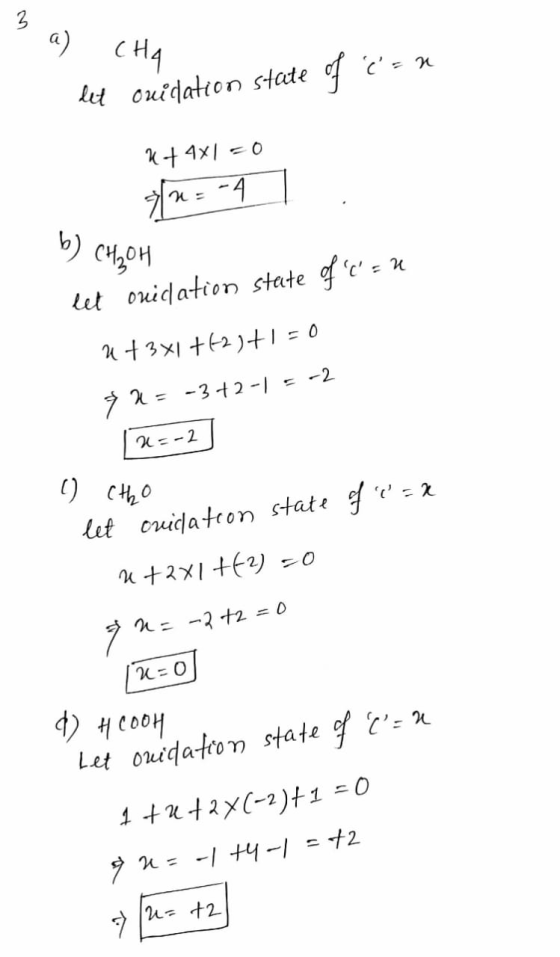
3. (10 pts) Jessica wants to find the oxidation states of carbon in...
Under certain circumstances, carbon dioxide, CO2(g), can be made to react with hydrogen gas, H2(g), to produce methane,...
Under certain circumstances, carbon dioxide, CO2(g), can be made to react with hydrogen gas, H2(g), to produce methane, CH4(g), and water vapor, H2O(g): CO2(g)+4H2(g)→CH4(g)+2H2O(g) How many moles of hydrogen gas would be needed to react with excess carbon dioxide to produce 53.6 moles of water vapor? Express your answer with the appropriate units. For example, write the unit moles as mol.
question 5, 6 5. (10 pts) Helena compares oxidation with reduction. Match each term with the...
 question 5, 6
5. (10 pts) Helena compares oxidation with reduction. Match each term with the correct definition a) Oxidation • Gain of oxygen • Gain of hydrogen b) Reduction • Loss of electron • Decrease in oxidation number • Gain of electron 6. Jasmine finds that the carbohydrate is one of the major sources of energy of our body. The combustion of the carbohydrate glucose produces carbon dioxide and water: C6H12O6 + O2 CO2 + H2O (unbalanced) a) (2...
question 5, 6
5. (10 pts) Helena compares oxidation with reduction. Match each term with the correct definition a) Oxidation • Gain of oxygen • Gain of hydrogen b) Reduction • Loss of electron • Decrease in oxidation number • Gain of electron 6. Jasmine finds that the carbohydrate is one of the major sources of energy of our body. The combustion of the carbohydrate glucose produces carbon dioxide and water: C6H12O6 + O2 CO2 + H2O (unbalanced) a) (2...
Question 8 10 pts Methane gas reacts with water vapor to produce a mixture of carbon...
 Question 8 10 pts Methane gas reacts with water vapor to produce a mixture of carbon monoxide and hydrogen, according to the balanced equation below. CH4(8) + H2O(g) → CO(g) + 3H2(8) AH® for the reaction is +206.1 kJ/mol, while ASⓇ is +215 J/Komol. At what temperature (in °C) does this reaction become spontaneous?
2. Determine the mole ratio for the following reaction: oxygen gas and carbon react to form...
 2. Determine the mole ratio for the following reaction: oxygen gas and carbon react to form carbon monoxide, CO. 3. Determine the number of moles of sodium hydroxide, NaOH, produced when 2 mol of sodium and 3 mol of water react to form sodium hydroxide and hydrogen gas, H2. 4. Calculate the mass of carbon monoxide, CO, that was needed to produce 78 g of methanol, CH2OH, by the following reaction: 2H2 + CO → CH3OH. 5. Demonstrate that the...
1) One hundred (100) ml of a 1.00 M solution of HCl is diluted with water...
 1) One hundred (100) ml of a 1.00 M solution of HCl is diluted with water to prepare a 0.200 M solution. What is the volume of the resulting 0.200 M solution? Or asked another way, to what volume must the original solution be diluted? (3 points) 2) Lithium hydroxide, LiOH, is used in spacecraft to absorb the carbon dioxide exhaled by astronauts. Given 1.3 kg of LiOH, how many kg of CO2 can be absorbed? (10 Pts. The reaction...
answer questions 1,2,3 DQuestion 1 2 pts Pentacarbonyliron (Fe(CO)s) reacts with phosophorous triflouride (PF3) and...
 answer questions 1,2,3
DQuestion 1 2 pts Pentacarbonyliron (Fe(CO)s) reacts with phosophorous triflouride (PF3) and hydrogen, releasing carbon monoxide according to the reaction below. If you combine 11.6 moles of Fe(CO)s. 81.6 moles of PF3, and 90 moles of H2, how many moles of Fe(CO)2(PF3)2(H2)2 are formed? Fe(CO)5 (s) + 2 PF3 (s) + 2 H2 (g)--Fe(CO)2(PF3)2(H2)2 (s) + 3 CO (g) uestion2 2 pts What is the percent yield of the following reaction if 23.4 grams of NH3 are...
answer questions 1,2,3
DQuestion 1 2 pts Pentacarbonyliron (Fe(CO)s) reacts with phosophorous triflouride (PF3) and hydrogen, releasing carbon monoxide according to the reaction below. If you combine 11.6 moles of Fe(CO)s. 81.6 moles of PF3, and 90 moles of H2, how many moles of Fe(CO)2(PF3)2(H2)2 are formed? Fe(CO)5 (s) + 2 PF3 (s) + 2 H2 (g)--Fe(CO)2(PF3)2(H2)2 (s) + 3 CO (g) uestion2 2 pts What is the percent yield of the following reaction if 23.4 grams of NH3 are...
Ethylene oxide is produced by the catalytic oxidation of ethylene: 2C2H4 + O2 → 2C2H4O An...
Ethylene oxide is produced by the catalytic oxidation of ethylene: 2C2H4 + O2 → 2C2H4O An undesired competing reaction is the combustion of ethylene: C2H4 + 3O2 → 2CO2 + 2H2O The feed to the reactor (not the fresh feed to the process) consists of 3.00 moles of ethylene per mole of oxygen. The single-pass conversion of ethylene to either ethylene oxide or carbon dioxide is 20.0%, and for every 100.0 moles of ethylene consumed in the reactor, 85.0 moles...
5. Determine the oxidation states of the elements in the compounds listed. None of the oxygen-containing...
 5. Determine the oxidation states of the elements in the compounds listed. None of the oxygen-containing compounds are peroxides or superoxides. (A) H,PO (В) AI(ОH), (C) SeO2 6. Complete and balance the following acid-base equations: (A) A solution of HCIO, is added to a solution of LiOH. (B) Aqueous H2SO4 reacts with NaOH 7. Write the molecular, total ionic, and net ionic equations for the following reactions: (А) Са(ОН), (аq) + НС-Н,О,(aq) — (B) H,PO,(aq) CaCl,(aq) - 8. Write the...
4. a.) Name the compounds in parts (a1) through (a4) and write the formulas for the...
4. a.) Name the compounds in parts (a1) through (a4) and write the formulas for the compounds in parts (a5) through (a8). (Enter your answer using the format copper(II) chloride for CuCl2.) a1.) HgO a2.) FeBr3 a3.) CoS a4.) Hg2O a5.) titanium(IV) chloride a6.) copper(I) chloride a7.) chromium(VI) sulfide a8.) niobium(V) oxide b.) What is the molar mass of potassium carbonate, K2CO3? _______ g/mol c.) Determine the number of molecules of hydrogen (H2) required to complete the following chemical equation....
6. 48.6 mL of a 0.100 M NaOH solution is needed to react with 20.0 mL...
 6. 48.6 mL of a 0.100 M NaOH solution is needed to react with 20.0 mL of an unknown concentration of HCl solution. What is the concentration of the HCl solution? 7. A colorless liquid has a composition of 84.1% carbon and 15.9% hydrogen by mass. Determine the empirical formula. Also, assuming the molar mass of this compound is 114.2 g/mol, determine the molecular formula of this compound. 8. What is the concentration of HCl in the final solution when...
 question 5, 6
5. (10 pts) Helena compares oxidation with reduction. Match each term with the correct definition a) Oxidation • Gain of oxygen • Gain of hydrogen b) Reduction • Loss of electron • Decrease in oxidation number • Gain of electron 6. Jasmine finds that the carbohydrate is one of the major sources of energy of our body. The combustion of the carbohydrate glucose produces carbon dioxide and water: C6H12O6 + O2 CO2 + H2O (unbalanced) a) (2...
question 5, 6
5. (10 pts) Helena compares oxidation with reduction. Match each term with the correct definition a) Oxidation • Gain of oxygen • Gain of hydrogen b) Reduction • Loss of electron • Decrease in oxidation number • Gain of electron 6. Jasmine finds that the carbohydrate is one of the major sources of energy of our body. The combustion of the carbohydrate glucose produces carbon dioxide and water: C6H12O6 + O2 CO2 + H2O (unbalanced) a) (2...
 Question 8 10 pts Methane gas reacts with water vapor to produce a mixture of carbon monoxide and hydrogen, according to the balanced equation below. CH4(8) + H2O(g) → CO(g) + 3H2(8) AH® for the reaction is +206.1 kJ/mol, while ASⓇ is +215 J/Komol. At what temperature (in °C) does this reaction become spontaneous?
 2. Determine the mole ratio for the following reaction: oxygen gas and carbon react to form carbon monoxide, CO. 3. Determine the number of moles of sodium hydroxide, NaOH, produced when 2 mol of sodium and 3 mol of water react to form sodium hydroxide and hydrogen gas, H2. 4. Calculate the mass of carbon monoxide, CO, that was needed to produce 78 g of methanol, CH2OH, by the following reaction: 2H2 + CO → CH3OH. 5. Demonstrate that the...
 1) One hundred (100) ml of a 1.00 M solution of HCl is diluted with water to prepare a 0.200 M solution. What is the volume of the resulting 0.200 M solution? Or asked another way, to what volume must the original solution be diluted? (3 points) 2) Lithium hydroxide, LiOH, is used in spacecraft to absorb the carbon dioxide exhaled by astronauts. Given 1.3 kg of LiOH, how many kg of CO2 can be absorbed? (10 Pts. The reaction...
 answer questions 1,2,3
DQuestion 1 2 pts Pentacarbonyliron (Fe(CO)s) reacts with phosophorous triflouride (PF3) and hydrogen, releasing carbon monoxide according to the reaction below. If you combine 11.6 moles of Fe(CO)s. 81.6 moles of PF3, and 90 moles of H2, how many moles of Fe(CO)2(PF3)2(H2)2 are formed? Fe(CO)5 (s) + 2 PF3 (s) + 2 H2 (g)--Fe(CO)2(PF3)2(H2)2 (s) + 3 CO (g) uestion2 2 pts What is the percent yield of the following reaction if 23.4 grams of NH3 are...
answer questions 1,2,3
DQuestion 1 2 pts Pentacarbonyliron (Fe(CO)s) reacts with phosophorous triflouride (PF3) and hydrogen, releasing carbon monoxide according to the reaction below. If you combine 11.6 moles of Fe(CO)s. 81.6 moles of PF3, and 90 moles of H2, how many moles of Fe(CO)2(PF3)2(H2)2 are formed? Fe(CO)5 (s) + 2 PF3 (s) + 2 H2 (g)--Fe(CO)2(PF3)2(H2)2 (s) + 3 CO (g) uestion2 2 pts What is the percent yield of the following reaction if 23.4 grams of NH3 are...
 5. Determine the oxidation states of the elements in the compounds listed. None of the oxygen-containing compounds are peroxides or superoxides. (A) H,PO (В) AI(ОH), (C) SeO2 6. Complete and balance the following acid-base equations: (A) A solution of HCIO, is added to a solution of LiOH. (B) Aqueous H2SO4 reacts with NaOH 7. Write the molecular, total ionic, and net ionic equations for the following reactions: (А) Са(ОН), (аq) + НС-Н,О,(aq) — (B) H,PO,(aq) CaCl,(aq) - 8. Write the...
 6. 48.6 mL of a 0.100 M NaOH solution is needed to react with 20.0 mL of an unknown concentration of HCl solution. What is the concentration of the HCl solution? 7. A colorless liquid has a composition of 84.1% carbon and 15.9% hydrogen by mass. Determine the empirical formula. Also, assuming the molar mass of this compound is 114.2 g/mol, determine the molecular formula of this compound. 8. What is the concentration of HCl in the final solution when...
Most questions answered within 3 hours.
-
Where is the error in this code sequence?
String s1 = "Hello";
String s2 = "ello";...
asked 11 months ago -
Financial data for Joel de Paris, Inc., for last year
follow:
Joel de Paris, Inc.
Balance...
asked 11 months ago -
Consider this reaction:
Al2(SO4)3 (aq)+ BaCl3
(aq) Al2Cl6 (aq)- +
3BaSO4(s) . What is the...
asked 11 months ago -
Suppose that Savneet is considering increasing her
recent random sample from 20 car rentals to 40...
asked 11 months ago -
Trucks arrive at an unloading terminal at an average rate of 120
per hour.
Trucks arrive...
asked 11 months ago -
Why are methanol and ethanol completely soluble in water while
octanol is not very little soluble....
asked 11 months ago -
A facilities manager at a university reads in a research report
that the mean amount of...
asked 11 months ago -
When the CuSO4 is rehydrated by adding water to the anhydrous
compound, is this an endothermic...
asked 11 months ago -
A ray of sunlight is passing from diamond into crown glass; the
angle of incidence is...
asked 11 months ago -
A block of mass 0.249 kg is placed on top of a light, vertical
spring of...
asked 11 months ago -
how do the kidneys compensate in the presences of acidosis
a) trigger hyperventilate
b) reserve acid...
asked 11 months ago -
Question 501 pts
The rental rate of capital to the firm increases. Which of the
following...
asked 11 months ago