1. The height of three peaks; A, B, and C obtained in a gas chromatogram are...
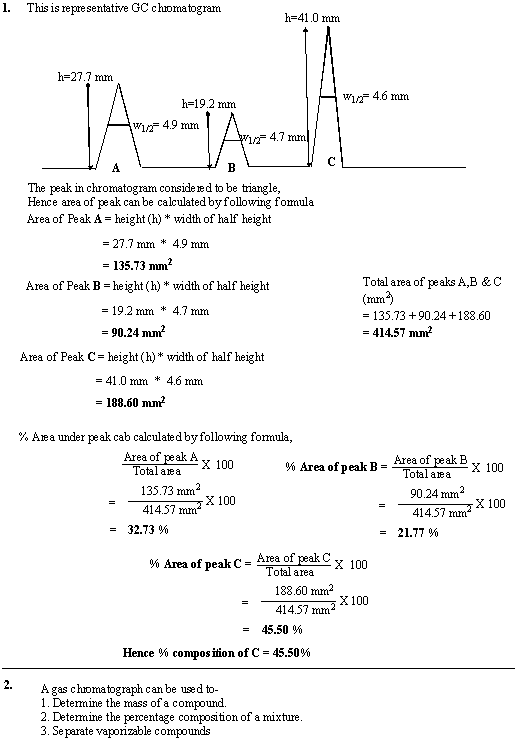
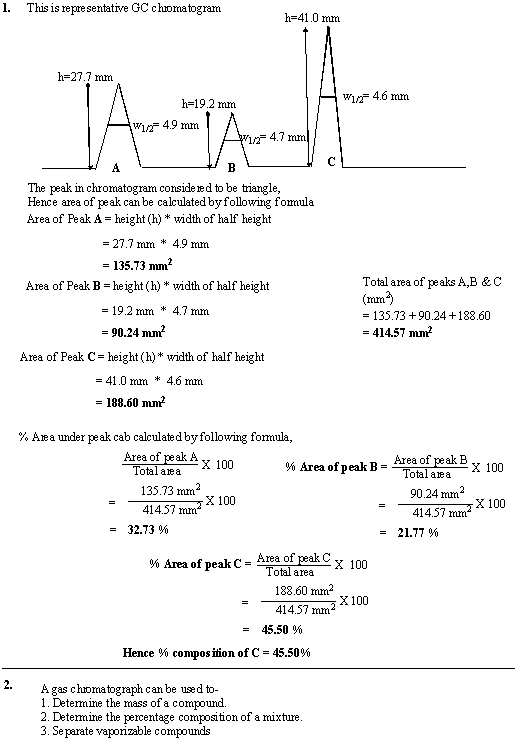
1. The height of three peaks; A, B, and C obtained in a gas chromatogram are 27.7 mm, 19.2 mm and 41.0 mm. The width of the peaks, at half height, are 4.9 mm, 4.7 mm and 4.6 mm, respectively. Calculate the percentage composition of C in the sample. Answer in : %
2. A gas chromatograph can be used to (more than one answer may be correct)
-determine the mass of a compound.
-determine the percentage composition of a mixture.
-purify large quantities of compounds.
-separate vaporizable compounds.
-separate nonvolatile compounds
Homework Answers
Add Answer to:
1. The height of three peaks; A,
B, and C obtained in a gas
chromatogram are...
1.Calculate the specific rotation, [α], if the observed rotation is -24°, the concentration is 31 g/100...
1.Calculate the specific rotation, [α], if the observed rotation is -24°, the concentration is 31 g/100 mL, and the cell length is 5 cm. Answer in :° mL/g/dm 2. The height of three peaks; A, B, and C obtained in a gas chromatogram are 27.7 mm, 19.2 mm and 41.0 mm. The width of the peaks, at half height, are 4.9 mm, 4.7 mm and 4.6 mm, respectively. Calculate the percentage composition of C in the sample. Answer in :...
1. The height of three peaks; A, B, and C obtained in a gas chromatogram are 27.7 mm, 19.2 mm and 41.0 mm. The width of...
1. The height of three peaks; A, B, and C obtained in a gas chromatogram are 27.7 mm, 19.2 mm and 41.0 mm. The width of the peaks, at half height, are 4.9 mm, 4.7 mm and 4.6 mm, respectively. 2.The optical purity of (+)-glucose in a mixture of (+) and (-)-glucose is 72%. What is the percentage of (+)-glucose in the sample? 3.Calculate the specific rotation, [α], if the observed rotation is -24°, the concentration is 0.4 g/mL, and...
You have obtained a gas chromatogram of a two component mixture of compounds A and B....
You have obtained a gas chromatogram of a two component mixture of compounds A and B. The height of peak A is 3.33 cm. and the width at half height is 1.61 cm. The height of peak B is 3.97 cm. and the width at half height is 1.11 cm. The percentage of a component in the mixture is proportional to peak area. Estimate peak areas by multiplying height by width at half height. What was the percentage of compound...
You have obtained a gas chromatogram of a two component mixture of compounds A and B....
You have obtained a gas chromatogram of a two component mixture of compounds A and B. The height of peak A is 3.42 cm. and the width at half height is 1.98 cm. The height of peak B is 3.58 cm. and the width at half height is 1.66 cm. The percentage of a component in the mixture is proportional to peak area. Estimate peak areas by multiplying height by width at half height. What was the percentage of compound...
You have obtained a gas chromatogram of a two component mixture of compounds A and B....
You have obtained a gas chromatogram of a two component mixture of compounds A and B. The height of peak A is 3.92 cm. and the width at half height is 1.77 cm. The height of peak B is 3.06 cm. and the width at half height is 1.65 cm. The percentage of a component in the mixture is proportional to peak area. Estimate peak areas by multiplying height by width at half height. What was the percentage of compound...
A mixture of two compounds (A and B) was separated by gas chromatography on a non-polar...
A mixture of two compounds (A and B) was separated by gas chromatography on a non-polar column. The chromatogram was recorded on a chart recorder that fed paper at a constant speed of 100 mm per minute, and a mark was made on the chart when the sample was injected. The first peak on the chromatogram corresponds to compound A, and that peak was observed at a distance of 5.42 cm from the sample injection point, and it had a...
5. Using the GC mentioned in question 4 and the values listed on the chromatogram for...
 5. Using the GC mentioned in question 4 and the values listed on the chromatogram for the height and width (at half height) of each peak, calculate the percent composition for each product (A, B and C). Be sure to show your work. (8 points) 6. The products corresponding to each peak on the GC are the ortho, meta, and para isomers of the nitrated product shown in the scheme for reaction 1. These isomers were isolated, and a proton...
c) Using your answers to question 5 and 6a, what percent of the mixture obtained in...
 c) Using your answers to question 5 and 6a, what percent of the
mixture obtained in reaction 1 is the ortho isomer?
d) What percent of the mixture obtained in reaction 1 is the
meta isomer?
e) What percent of the mixture obtained in reaction 1 is the
para isomer?
f) Could we have used Mass Spectrometry after the GC analysis
(GC-MS) to identify which peak on the GC was which isomer? Why or
why not?
g) Could we have...
c) Using your answers to question 5 and 6a, what percent of the
mixture obtained in reaction 1 is the ortho isomer?
d) What percent of the mixture obtained in reaction 1 is the
meta isomer?
e) What percent of the mixture obtained in reaction 1 is the
para isomer?
f) Could we have used Mass Spectrometry after the GC analysis
(GC-MS) to identify which peak on the GC was which isomer? Why or
why not?
g) Could we have...
NEED HELP WITH B) C) D) E) F) and G) that apply to the spectra below....
 NEED HELP WITH B) C) D) E) F) and G) that apply to the
spectra below.
OTHER ANSWERS ARE THERE TO SUPPLEMENT
Thank you!
5. Using the GC mentioned in question 4 and the values listed on
the chromatogram for the height and width (at half height) of each
peak, calculate the percent composition for each product (A, B and
C). Be sure to show your work.
Area of peak A = 125 x 8 =
1000mm2
Area of peak...
NEED HELP WITH B) C) D) E) F) and G) that apply to the
spectra below.
OTHER ANSWERS ARE THERE TO SUPPLEMENT
Thank you!
5. Using the GC mentioned in question 4 and the values listed on
the chromatogram for the height and width (at half height) of each
peak, calculate the percent composition for each product (A, B and
C). Be sure to show your work.
Area of peak A = 125 x 8 =
1000mm2
Area of peak...
Separating a Mixture, Recrystallization, pre-lab assignment could you also explain why you chose that substance for...
 Separating a Mixture, Recrystallization, pre-lab
assignment
could you also explain why you chose that substance for the empty
spaces and question marks
EXPERIMENT 4 Pre-Lab Assignment Separating a Mixture, Recrystalliration Name Date 1. Complete the following flowchart which shows how to separate a mixture of sand, sodium chloride and acetanilide. Notice that after a separation process (a down arrow) the filtered solids are shown on the left and the filtrate (the liquid) is shown on the right. The terminal step...
Separating a Mixture, Recrystallization, pre-lab
assignment
could you also explain why you chose that substance for the empty
spaces and question marks
EXPERIMENT 4 Pre-Lab Assignment Separating a Mixture, Recrystalliration Name Date 1. Complete the following flowchart which shows how to separate a mixture of sand, sodium chloride and acetanilide. Notice that after a separation process (a down arrow) the filtered solids are shown on the left and the filtrate (the liquid) is shown on the right. The terminal step...
 5. Using the GC mentioned in question 4 and the values listed on the chromatogram for the height and width (at half height) of each peak, calculate the percent composition for each product (A, B and C). Be sure to show your work. (8 points) 6. The products corresponding to each peak on the GC are the ortho, meta, and para isomers of the nitrated product shown in the scheme for reaction 1. These isomers were isolated, and a proton...
 c) Using your answers to question 5 and 6a, what percent of the
mixture obtained in reaction 1 is the ortho isomer?
d) What percent of the mixture obtained in reaction 1 is the
meta isomer?
e) What percent of the mixture obtained in reaction 1 is the
para isomer?
f) Could we have used Mass Spectrometry after the GC analysis
(GC-MS) to identify which peak on the GC was which isomer? Why or
why not?
g) Could we have...
c) Using your answers to question 5 and 6a, what percent of the
mixture obtained in reaction 1 is the ortho isomer?
d) What percent of the mixture obtained in reaction 1 is the
meta isomer?
e) What percent of the mixture obtained in reaction 1 is the
para isomer?
f) Could we have used Mass Spectrometry after the GC analysis
(GC-MS) to identify which peak on the GC was which isomer? Why or
why not?
g) Could we have...
 NEED HELP WITH B) C) D) E) F) and G) that apply to the
spectra below.
OTHER ANSWERS ARE THERE TO SUPPLEMENT
Thank you!
5. Using the GC mentioned in question 4 and the values listed on
the chromatogram for the height and width (at half height) of each
peak, calculate the percent composition for each product (A, B and
C). Be sure to show your work.
Area of peak A = 125 x 8 =
1000mm2
Area of peak...
NEED HELP WITH B) C) D) E) F) and G) that apply to the
spectra below.
OTHER ANSWERS ARE THERE TO SUPPLEMENT
Thank you!
5. Using the GC mentioned in question 4 and the values listed on
the chromatogram for the height and width (at half height) of each
peak, calculate the percent composition for each product (A, B and
C). Be sure to show your work.
Area of peak A = 125 x 8 =
1000mm2
Area of peak...
 Separating a Mixture, Recrystallization, pre-lab
assignment
could you also explain why you chose that substance for the empty
spaces and question marks
EXPERIMENT 4 Pre-Lab Assignment Separating a Mixture, Recrystalliration Name Date 1. Complete the following flowchart which shows how to separate a mixture of sand, sodium chloride and acetanilide. Notice that after a separation process (a down arrow) the filtered solids are shown on the left and the filtrate (the liquid) is shown on the right. The terminal step...
Separating a Mixture, Recrystallization, pre-lab
assignment
could you also explain why you chose that substance for the empty
spaces and question marks
EXPERIMENT 4 Pre-Lab Assignment Separating a Mixture, Recrystalliration Name Date 1. Complete the following flowchart which shows how to separate a mixture of sand, sodium chloride and acetanilide. Notice that after a separation process (a down arrow) the filtered solids are shown on the left and the filtrate (the liquid) is shown on the right. The terminal step...
Most questions answered within 3 hours.
-
Where is the error in this code sequence?
String s1 = "Hello";
String s2 = "ello";...
asked 11 months ago -
Financial data for Joel de Paris, Inc., for last year
follow:
Joel de Paris, Inc.
Balance...
asked 11 months ago -
Consider this reaction:
Al2(SO4)3 (aq)+ BaCl3
(aq) Al2Cl6 (aq)- +
3BaSO4(s) . What is the...
asked 11 months ago -
Suppose that Savneet is considering increasing her
recent random sample from 20 car rentals to 40...
asked 11 months ago -
Trucks arrive at an unloading terminal at an average rate of 120
per hour.
Trucks arrive...
asked 11 months ago -
Why are methanol and ethanol completely soluble in water while
octanol is not very little soluble....
asked 11 months ago -
A facilities manager at a university reads in a research report
that the mean amount of...
asked 11 months ago -
When the CuSO4 is rehydrated by adding water to the anhydrous
compound, is this an endothermic...
asked 11 months ago -
A ray of sunlight is passing from diamond into crown glass; the
angle of incidence is...
asked 11 months ago -
A block of mass 0.249 kg is placed on top of a light, vertical
spring of...
asked 11 months ago -
how do the kidneys compensate in the presences of acidosis
a) trigger hyperventilate
b) reserve acid...
asked 11 months ago -
Question 501 pts
The rental rate of capital to the firm increases. Which of the
following...
asked 11 months ago