
Homework Answers
Add Answer to:
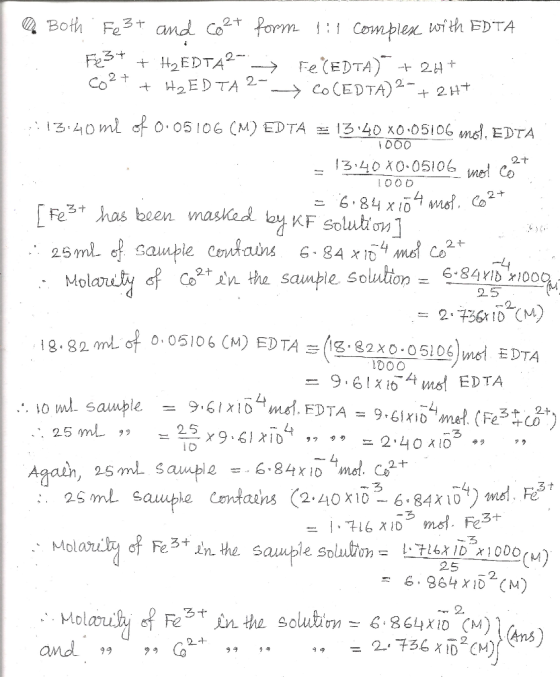
10.6 10.00 mL of a sample of a solution containing Feand Co are added to 100...
10.7 10.00 mL of a solution of Hg2+ and 25.00 mL of 0.04516 M EDTA are...
 10.7 10.00 mL of a solution of Hg2+ and 25.00 mL of 0.04516 M EDTA are added to 100 mL of pH 10 buffer. The resulting solution is titrated with 21.77 mL of 0.02385 M Mg2+ solution. What was the molarity of the Hg2+ solution? Report the answer with the correct number of significant figures.
6. (8) A 50.0 mL sample of hard water containing Ca2 was titrated with 0.0500 M...
 6. (8) A 50.0 mL sample of hard water containing Ca2 was titrated with 0.0500 M EDTA standard solution at pH 10 and with Eriochrome Black T indicator. The endpoint was reached when 11.35 mL of EDTA was added a) (6) Calculate the concentration of Ca* in the unknown sample in moles per liter (M). b) (2) What is the pCa of the solution?
4. 50.0 mL of 0.00200 M Ca2 solution buffer at pH 10.0 is titrated with 0.00200 M EDTA. At equivalence point (i.e. 50.0 mL EDTA has been added), what is the equilibrium concentration of Ca2, [Ca2...
 4. 50.0 mL of 0.00200 M Ca2 solution buffer at pH 10.0 is titrated with 0.00200 M EDTA. At equivalence point (i.e. 50.0 mL EDTA has been added), what is the equilibrium concentration of Ca2, [Ca2], and what is the pCa? The formation constant of CaY, Kaa 5.0 x 10¹⁰, and α4 of EDTA at pH 10.0 is 0.35
4. 50.0 mL of 0.00200 M Ca2 solution buffer at pH 10.0 is titrated with 0.00200 M EDTA. At equivalence point...
4. 50.0 mL of 0.00200 M Ca2 solution buffer at pH 10.0 is titrated with 0.00200 M EDTA. At equivalence point (i.e. 50.0 mL EDTA has been added), what is the equilibrium concentration of Ca2, [Ca2], and what is the pCa? The formation constant of CaY, Kaa 5.0 x 10¹⁰, and α4 of EDTA at pH 10.0 is 0.35
4. 50.0 mL of 0.00200 M Ca2 solution buffer at pH 10.0 is titrated with 0.00200 M EDTA. At equivalence point...
A 25.0 mL aliquot of 0.0440 M EDTA was added to a 49.0 mL solution containing...
A 25.0 mL aliquot of 0.0440 M EDTA was added to a 49.0 mL solution containing an unknown concentration of V3+. All of the V3+ present in the solution formed a complex with EDTA, leaving an excess of EDTA in solution. This solution was back-titrated with a 0.0340 M Ga3+ solution until all of the EDTA reacted, requiring 11.0 mL of the Ga3+ solution. What was the original concentration of the V3+ solution?
A 24.34 mL aliquot of a Pb2 solution, containing excess Pb2+, was added to 11.50 mL...
 A 24.34 mL aliquot of a Pb2 solution, containing excess Pb2+, was added to 11.50 mL of a 2,3-dimercapto-1-propanol (BAL) solution of unknown concentration, forming the 1:1 Pb2+-BAL complex. The excess Pb2+ was titrated with 0.0157 M EDTA, requiring 9.88 mL to reach the equivalence point. Separately, 39.89 mL of the EDTA solution was required to titrate 32.75 mL of the Pb2+ solution. Calculate the BAL concentration, in molarity, of the original 11.50 mL solution concentration:
A 20.21 mL aliquot of a Pb2+ solution, containing excess Pb2+, was added to 11.50 mL...
A 20.21 mL aliquot of a Pb2+ solution, containing excess Pb2+, was added to 11.50 mL of a 2,3-dimercapto-1-propanol (BAL) solution of unknown concentration, forming the 1:1 Pb2+ –BAL complex. The excess Pb2+ was titrated with 0.0136 M EDTA, requiring 8.21 mL to reach the equivalence point. Separately, 40.35 mL of the EDTA solution was required to titrate 31.75 mL of the Pb2+ solution. Calculate the BAL concentration, in molarity, of the original 11.50 mL solution.
16. Exactly 25.00 ml of 0.0685 M HClO4 solution is placed in a flask and titrated...
16. Exactly 25.00 ml of 0.0685 M HClO4 solution is placed in a flask and titrated with standardized 0.050M NaOH. A. Determine the endpoint of the titration B. Determine the pH of the solution after the following amounts of NaOH are added to the acid solution: a.) Initially, 0.00 ml NaOH. b.) 5.00 ml c.) 15.00 ml d.) 25.00 ml e.) 34.00 ml f.) At the endpoint of the titration g.)...
A 1.000-mL aliquot of a solution containing Cu and Ni2 is treated with 25.00 mL of...
 A 1.000-mL aliquot of a solution containing Cu and Ni2 is treated with 25.00 mL of a 0.05182 MEDTA solution. The solution is then back titrated with 0.02198 M Zn2 solution at a pH of 5. A volume of 21.82 mL of the Zn2 solution was needed to reach the xylenol orange end point. A 2.000-mL aliquot of the Cu and Ni2 solution is fed through an ion-exchange column that retains Ni2. The Cu2 that passed through the column is...
A 25.00 mL metal solution containing 0.025M Cu+, 0.050M Ag+, and 0.045M Pb²+ is titrated with 0.05000 M ETDA @ pH = 7
12. A 25.00 mL metal solution containing 0.025M Cu+, 0.050M Ag+, and 0.045M Pb²+ is titrated with 0.05000 M ETDA @ pH = 7. What is the equivalence volume of EDTA? 13. Which metal from question 12 binds strongest to EDTA at pH = 7?
10. Assume you are carrying out the titration of 50 mL of a 0.025 M solution...
10. Assume you are carrying out the titration of 50 mL of a 0.025 M solution of acetic acid with 0.1023 M NaOH. Acetic acid has a Ka of 1.8 × 10⁻⁵ . (a) Calculate the pH of the solution at V = 0, V = 0.3Veq, V = Veq, and V = 1.2Veq. (Veq is the equivalence point volume) (b) If a phenolphthalein indicator was used in this titration, where would the apparent endpoint occur? Assume the apparent endpoint...
 10.7 10.00 mL of a solution of Hg2+ and 25.00 mL of 0.04516 M EDTA are added to 100 mL of pH 10 buffer. The resulting solution is titrated with 21.77 mL of 0.02385 M Mg2+ solution. What was the molarity of the Hg2+ solution? Report the answer with the correct number of significant figures.
 6. (8) A 50.0 mL sample of hard water containing Ca2 was titrated with 0.0500 M EDTA standard solution at pH 10 and with Eriochrome Black T indicator. The endpoint was reached when 11.35 mL of EDTA was added a) (6) Calculate the concentration of Ca* in the unknown sample in moles per liter (M). b) (2) What is the pCa of the solution?
 4. 50.0 mL of 0.00200 M Ca2 solution buffer at pH 10.0 is titrated with 0.00200 M EDTA. At equivalence point (i.e. 50.0 mL EDTA has been added), what is the equilibrium concentration of Ca2, [Ca2], and what is the pCa? The formation constant of CaY, Kaa 5.0 x 10¹⁰, and α4 of EDTA at pH 10.0 is 0.35
4. 50.0 mL of 0.00200 M Ca2 solution buffer at pH 10.0 is titrated with 0.00200 M EDTA. At equivalence point...
4. 50.0 mL of 0.00200 M Ca2 solution buffer at pH 10.0 is titrated with 0.00200 M EDTA. At equivalence point (i.e. 50.0 mL EDTA has been added), what is the equilibrium concentration of Ca2, [Ca2], and what is the pCa? The formation constant of CaY, Kaa 5.0 x 10¹⁰, and α4 of EDTA at pH 10.0 is 0.35
4. 50.0 mL of 0.00200 M Ca2 solution buffer at pH 10.0 is titrated with 0.00200 M EDTA. At equivalence point...
 A 24.34 mL aliquot of a Pb2 solution, containing excess Pb2+, was added to 11.50 mL of a 2,3-dimercapto-1-propanol (BAL) solution of unknown concentration, forming the 1:1 Pb2+-BAL complex. The excess Pb2+ was titrated with 0.0157 M EDTA, requiring 9.88 mL to reach the equivalence point. Separately, 39.89 mL of the EDTA solution was required to titrate 32.75 mL of the Pb2+ solution. Calculate the BAL concentration, in molarity, of the original 11.50 mL solution concentration:
 A 1.000-mL aliquot of a solution containing Cu and Ni2 is treated with 25.00 mL of a 0.05182 MEDTA solution. The solution is then back titrated with 0.02198 M Zn2 solution at a pH of 5. A volume of 21.82 mL of the Zn2 solution was needed to reach the xylenol orange end point. A 2.000-mL aliquot of the Cu and Ni2 solution is fed through an ion-exchange column that retains Ni2. The Cu2 that passed through the column is...
Most questions answered within 3 hours.
-
Where is the error in this code sequence?
String s1 = "Hello";
String s2 = "ello";...
asked 11 months ago -
Financial data for Joel de Paris, Inc., for last year
follow:
Joel de Paris, Inc.
Balance...
asked 11 months ago -
Consider this reaction:
Al2(SO4)3 (aq)+ BaCl3
(aq) Al2Cl6 (aq)- +
3BaSO4(s) . What is the...
asked 11 months ago -
Suppose that Savneet is considering increasing her
recent random sample from 20 car rentals to 40...
asked 11 months ago -
Trucks arrive at an unloading terminal at an average rate of 120
per hour.
Trucks arrive...
asked 11 months ago -
Why are methanol and ethanol completely soluble in water while
octanol is not very little soluble....
asked 11 months ago -
A facilities manager at a university reads in a research report
that the mean amount of...
asked 11 months ago -
When the CuSO4 is rehydrated by adding water to the anhydrous
compound, is this an endothermic...
asked 11 months ago -
A ray of sunlight is passing from diamond into crown glass; the
angle of incidence is...
asked 11 months ago -
A block of mass 0.249 kg is placed on top of a light, vertical
spring of...
asked 11 months ago -
how do the kidneys compensate in the presences of acidosis
a) trigger hyperventilate
b) reserve acid...
asked 11 months ago -
Question 501 pts
The rental rate of capital to the firm increases. Which of the
following...
asked 11 months ago