
Homework Answers
Add Answer to:
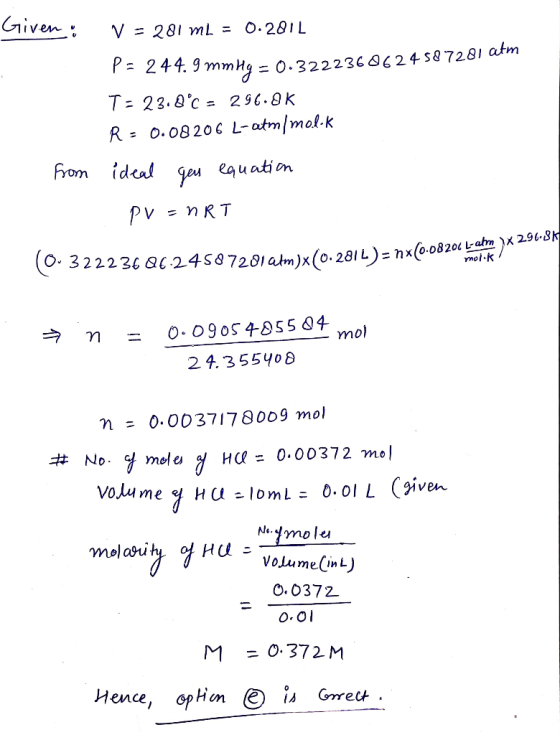
Calculate the molarity of HCl in solution using the ideal gas law if the pressure generated...
Ideal gas law problem Ideal gas law problem H_2 Molarity = 0.025 M Volume = 2.00...
 Ideal gas law problem
 H_2 Molarity = 0.025 M Volume = 2.00 L Temperature = 341 K Calculate the pressure?
Ideal gas law problem
Ideal gas law problem H_2 Molarity = 0.025 M Volume = 2.00 L Temperature = 341 K Calculate the pressure?
Can someone help me fill out this chart in this experiment "Antacid using ideal gas law"...
 Can someone help me fill out this chart in this experiment
"Antacid using ideal gas law"
btw. the mass of sample is the NaHCO3
thank you!!
Atmospheric pressure, mmHg 755. 1mmitg Temperature of H,0.C zle 22.0°C Vapor pressure of H,O at this temperature 19.8 mm Hg Calculated pressure of Co, in the system, mmHg 735.3 mmity Balanced reaction of NaHCO, and HCl (see Pre-Laboratory Question 4a) = Na HCO3 laq) + HCl(aq) – NACI Cagit CO2(g) + H2Oles Trial 1...
Can someone help me fill out this chart in this experiment
"Antacid using ideal gas law"
btw. the mass of sample is the NaHCO3
thank you!!
Atmospheric pressure, mmHg 755. 1mmitg Temperature of H,0.C zle 22.0°C Vapor pressure of H,O at this temperature 19.8 mm Hg Calculated pressure of Co, in the system, mmHg 735.3 mmity Balanced reaction of NaHCO, and HCl (see Pre-Laboratory Question 4a) = Na HCO3 laq) + HCl(aq) – NACI Cagit CO2(g) + H2Oles Trial 1...
Using the ideal gas law equation, calculate the grams of NH3 that can be produced when 4.50...
Using the ideal gas law equation, calculate the grams of NH3 that can be produced when 4.50 L of NO2 react at a temperature of 435 ∘C and a pressure of 735 mmHg . How many liters of H2 gas at STP can be produced from the reaction of 1.60 g of Al with excess HCl? 2Al(s)+6HCl(aq)→2AlCl3(aq)+3H2(g) How many liters of oxygen gas at STP are needed to react completely with 9.8 g of magnesium?
Please answer the whole page. Ideal Gas Law PV = nRT Gas Laws Formulas Combined Gas Law (P1)(V1) Ti (P2)(V2) Tz = Dalto...
 Please answer the whole page.
Ideal Gas Law PV = nRT Gas Laws Formulas Combined Gas Law (P1)(V1) Ti (P2)(V2) Tz = Dalton's Law of Partial Pressures P = P, +P+P, + ...etc. K="C + 273 3. A 5.0 L sample of gas has a pressure of 1200 torr. What is the new pressure if the temperature is changed from 220 K to 440 K and the volume increased to 20.0 L ? 4. A 10.0 mL sample of gas...
Please answer the whole page.
Ideal Gas Law PV = nRT Gas Laws Formulas Combined Gas Law (P1)(V1) Ti (P2)(V2) Tz = Dalton's Law of Partial Pressures P = P, +P+P, + ...etc. K="C + 273 3. A 5.0 L sample of gas has a pressure of 1200 torr. What is the new pressure if the temperature is changed from 220 K to 440 K and the volume increased to 20.0 L ? 4. A 10.0 mL sample of gas...
3. Using the ideal gas law determine the pressure, in atmosphere that a 40 gram sample...
 3. Using the ideal gas law determine the pressure, in atmosphere that a 40 gram sample of Os exerts at 127' and in a volume of 2.47L 6. Pressure is a. defined as the mass that an object exerts when at rest b. measured in Newtons c. defined as the force per unit area d. defined as the number of moles of substance divided by the mass of the substance e. measured in grams the number of moles in a...
3. Using the ideal gas law determine the pressure, in atmospheres, that a 48.0 gram sample of O: exerts at 127 C an...
 3. Using the ideal gas law determine the pressure, in atmospheres, that a 48.0 gram sample of O: exerts at 127 C and in a volume of 2.47L P- atm 6. Pressure is a. defined as the mass that an object exerts when at rest b. measured in Newtons c. defined as the force per unit area d. defined as the number of moles of substance divided by the mass of the substance e. measured in grams 7. If temperature...
need help with #1 a-c Post-laboratory Assignment (page 1 of 5) Excel Spreadsheet: Part A Use...
 need help with #1 a-c
Post-laboratory Assignment (page 1 of 5) Excel Spreadsheet: Part A Use Excel to generate a spreadsheet with the following information. Column A Enter the measured masses of sodium carbonate from data page 1 B Using stoichiometry, calculate the theoretical number of moles of CO, that can be produced from each reactant entry. C Using the ideal gas law, measured volume, and temperature, calculate the theoretical pressure of CO2(g) that can be produced from the theoretical...
need help with #1 a-c
Post-laboratory Assignment (page 1 of 5) Excel Spreadsheet: Part A Use Excel to generate a spreadsheet with the following information. Column A Enter the measured masses of sodium carbonate from data page 1 B Using stoichiometry, calculate the theoretical number of moles of CO, that can be produced from each reactant entry. C Using the ideal gas law, measured volume, and temperature, calculate the theoretical pressure of CO2(g) that can be produced from the theoretical...
plz help asap Excel Spreadsheet: Part A: Use Excel to generate a spreadsheet with the following information. Co...
 plz help asap
Excel Spreadsheet: Part A: Use Excel to generate a spreadsheet with the following information. Column A Enter the measured masses of sodium carbonate from data page #1 в Using stoichiometry, calculate the theoretical number of moles of CO2 that can be produced from each reactant entry. C Using the ideal gas law, measured volume, and temperature, calculate the theoretical pressure of CO2(g) that can be produced from the theoretical moles of CO2(8) D Actual measured pressures of...
plz help asap
Excel Spreadsheet: Part A: Use Excel to generate a spreadsheet with the following information. Column A Enter the measured masses of sodium carbonate from data page #1 в Using stoichiometry, calculate the theoretical number of moles of CO2 that can be produced from each reactant entry. C Using the ideal gas law, measured volume, and temperature, calculate the theoretical pressure of CO2(g) that can be produced from the theoretical moles of CO2(8) D Actual measured pressures of...
Station 2: Calculations with the Ideal Gas Law A Station Letter: A student reacted a strip...
 Station 2: Calculations with the Ideal Gas Law A Station Letter: A student reacted a strip of magnesium metal with 4.00 mL of 4.0 M hydrochloric acid and collected the hydrogen gas produced using the experimental setup you see at the station. Unfortunately, the student forgot to record the mass of the metal before they reacted it with acid. Determine the mass of the magnesium metal the student used in the experiment. For this experiment assume the pressure of the...
A sealed flask contains 100.0 mL H2O under 10.0 atm of total gas pressure. The gases...
A sealed flask contains 100.0 mL H2O under 10.0 atm of total gas pressure. The gases above the water are N2 (5.1 atm), H2 (2.1 atm), and O2 (2.8 atm). If the mass of dissolved oxygen is 11.5 mg, what is the Henry’s law constant of O2? a. 1.14 x10⁻² M/atm b. 1.28 x10⁻³ M/atm c. 4.11 x10⁻² M/atm d. 3.59 x10⁻⁴ M/atm e. 1.78 x10⁻⁴ M/atm (answer is B) how do you solve?
 Ideal gas law problem
 H_2 Molarity = 0.025 M Volume = 2.00 L Temperature = 341 K Calculate the pressure?
Ideal gas law problem
Ideal gas law problem H_2 Molarity = 0.025 M Volume = 2.00 L Temperature = 341 K Calculate the pressure?
 Can someone help me fill out this chart in this experiment
"Antacid using ideal gas law"
btw. the mass of sample is the NaHCO3
thank you!!
Atmospheric pressure, mmHg 755. 1mmitg Temperature of H,0.C zle 22.0°C Vapor pressure of H,O at this temperature 19.8 mm Hg Calculated pressure of Co, in the system, mmHg 735.3 mmity Balanced reaction of NaHCO, and HCl (see Pre-Laboratory Question 4a) = Na HCO3 laq) + HCl(aq) – NACI Cagit CO2(g) + H2Oles Trial 1...
Can someone help me fill out this chart in this experiment
"Antacid using ideal gas law"
btw. the mass of sample is the NaHCO3
thank you!!
Atmospheric pressure, mmHg 755. 1mmitg Temperature of H,0.C zle 22.0°C Vapor pressure of H,O at this temperature 19.8 mm Hg Calculated pressure of Co, in the system, mmHg 735.3 mmity Balanced reaction of NaHCO, and HCl (see Pre-Laboratory Question 4a) = Na HCO3 laq) + HCl(aq) – NACI Cagit CO2(g) + H2Oles Trial 1...
 Please answer the whole page.
Ideal Gas Law PV = nRT Gas Laws Formulas Combined Gas Law (P1)(V1) Ti (P2)(V2) Tz = Dalton's Law of Partial Pressures P = P, +P+P, + ...etc. K="C + 273 3. A 5.0 L sample of gas has a pressure of 1200 torr. What is the new pressure if the temperature is changed from 220 K to 440 K and the volume increased to 20.0 L ? 4. A 10.0 mL sample of gas...
Please answer the whole page.
Ideal Gas Law PV = nRT Gas Laws Formulas Combined Gas Law (P1)(V1) Ti (P2)(V2) Tz = Dalton's Law of Partial Pressures P = P, +P+P, + ...etc. K="C + 273 3. A 5.0 L sample of gas has a pressure of 1200 torr. What is the new pressure if the temperature is changed from 220 K to 440 K and the volume increased to 20.0 L ? 4. A 10.0 mL sample of gas...
 3. Using the ideal gas law determine the pressure, in atmosphere that a 40 gram sample of Os exerts at 127' and in a volume of 2.47L 6. Pressure is a. defined as the mass that an object exerts when at rest b. measured in Newtons c. defined as the force per unit area d. defined as the number of moles of substance divided by the mass of the substance e. measured in grams the number of moles in a...
 3. Using the ideal gas law determine the pressure, in atmospheres, that a 48.0 gram sample of O: exerts at 127 C and in a volume of 2.47L P- atm 6. Pressure is a. defined as the mass that an object exerts when at rest b. measured in Newtons c. defined as the force per unit area d. defined as the number of moles of substance divided by the mass of the substance e. measured in grams 7. If temperature...
 need help with #1 a-c
Post-laboratory Assignment (page 1 of 5) Excel Spreadsheet: Part A Use Excel to generate a spreadsheet with the following information. Column A Enter the measured masses of sodium carbonate from data page 1 B Using stoichiometry, calculate the theoretical number of moles of CO, that can be produced from each reactant entry. C Using the ideal gas law, measured volume, and temperature, calculate the theoretical pressure of CO2(g) that can be produced from the theoretical...
need help with #1 a-c
Post-laboratory Assignment (page 1 of 5) Excel Spreadsheet: Part A Use Excel to generate a spreadsheet with the following information. Column A Enter the measured masses of sodium carbonate from data page 1 B Using stoichiometry, calculate the theoretical number of moles of CO, that can be produced from each reactant entry. C Using the ideal gas law, measured volume, and temperature, calculate the theoretical pressure of CO2(g) that can be produced from the theoretical...
 plz help asap
Excel Spreadsheet: Part A: Use Excel to generate a spreadsheet with the following information. Column A Enter the measured masses of sodium carbonate from data page #1 в Using stoichiometry, calculate the theoretical number of moles of CO2 that can be produced from each reactant entry. C Using the ideal gas law, measured volume, and temperature, calculate the theoretical pressure of CO2(g) that can be produced from the theoretical moles of CO2(8) D Actual measured pressures of...
plz help asap
Excel Spreadsheet: Part A: Use Excel to generate a spreadsheet with the following information. Column A Enter the measured masses of sodium carbonate from data page #1 в Using stoichiometry, calculate the theoretical number of moles of CO2 that can be produced from each reactant entry. C Using the ideal gas law, measured volume, and temperature, calculate the theoretical pressure of CO2(g) that can be produced from the theoretical moles of CO2(8) D Actual measured pressures of...
 Station 2: Calculations with the Ideal Gas Law A Station Letter: A student reacted a strip of magnesium metal with 4.00 mL of 4.0 M hydrochloric acid and collected the hydrogen gas produced using the experimental setup you see at the station. Unfortunately, the student forgot to record the mass of the metal before they reacted it with acid. Determine the mass of the magnesium metal the student used in the experiment. For this experiment assume the pressure of the...
Most questions answered within 3 hours.
-
Where is the error in this code sequence?
String s1 = "Hello";
String s2 = "ello";...
asked 10 months ago -
Financial data for Joel de Paris, Inc., for last year
follow:
Joel de Paris, Inc.
Balance...
asked 10 months ago -
Consider this reaction:
Al2(SO4)3 (aq)+ BaCl3
(aq) Al2Cl6 (aq)- +
3BaSO4(s) . What is the...
asked 10 months ago -
Suppose that Savneet is considering increasing her
recent random sample from 20 car rentals to 40...
asked 10 months ago -
Trucks arrive at an unloading terminal at an average rate of 120
per hour.
Trucks arrive...
asked 10 months ago -
Why are methanol and ethanol completely soluble in water while
octanol is not very little soluble....
asked 10 months ago -
A facilities manager at a university reads in a research report
that the mean amount of...
asked 10 months ago -
When the CuSO4 is rehydrated by adding water to the anhydrous
compound, is this an endothermic...
asked 10 months ago -
A ray of sunlight is passing from diamond into crown glass; the
angle of incidence is...
asked 10 months ago -
A block of mass 0.249 kg is placed on top of a light, vertical
spring of...
asked 10 months ago -
how do the kidneys compensate in the presences of acidosis
a) trigger hyperventilate
b) reserve acid...
asked 10 months ago -
Question 501 pts
The rental rate of capital to the firm increases. Which of the
following...
asked 10 months ago