![5. Stoe-Geary preferences and Ramsey economy] Consider the standard Ramsey model of a closed economy, except that the representative house- holds instantaneous utility function (felicity function) takes on the following Stone-Geary form, so that preferences are no n-homothetic u(c) 1-6 where č0 represents the subsistence level of per capita consumption. Suppose that the production function has the Cobb-Douglas form, and assume that theres no technological progress e. Does the modification of the felicity function affect the steady-state values of k and c? Explain.](http://img.homeworklib.com/questions/418f9620-73ab-11ea-ada5-555300a5d2dc.png?x-oss-process=image/resize,w_560)
Homework Answers
STONE–GEARY UTILITY FUNCTION IN RAMSEY ECONOMY:
A utility function is a functional representation of consumer preferences. To make utility functions easy to use we often also assume some extra characteristics: non-satisfaction, convexity, and same preference. We use utility functions to derive demand curve, by opting the mix of goods that maximises utility subject to a budget constraint. In economics, the utility function measures the welfare or satisfaction of a consumer as a function of consumption of real goods such as food, clothing and composite goods rather than nominal goods measured in nominal terms. Utility function is widely used in the rational choice theory to analyze human behavior. Utility is measured in units called utils.
To assume the utility function, economists generally make assumptions about preferences for various goods. A simple example, in certain situations, oats and cornflakes considered to be perfect substitutes for each other, and the appropriate utility function must reflect such preferences with a utility form of u(o, c) = o +c, where "u" denotes the utility function and "o" and "c" denote oats and cornflakes. A person who consumes 1 dollar of oats and no cornflakes derives a utility of 1 util. Utility functions are often expressed as U(x1,x2,x3…) which means that U, our utility, is a function of the quantities of x1, x2 and so on. The utility functions grows with quantity. The Stone–Geary utility function was first derived by Roy C. Geary, in a comment on earlier work by Lawrence Klein and Herman Rubin. Richard Stone was the first to estimate the Linear Expenditure System.
The Stone–Geary utility function takes the form
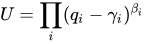
where 


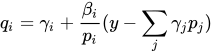
where 

Most growth models assume homothetic preferences (and quite often Cobb-Douglas model). Homotheticity means in cross-sections, the rich & the poor consume goods in the same proportions. With Cobb-Douglas, each sector accounts for a fixed share of the total expenditure.
Consider the standard Ramsey model of a closed economy, except that the representative house-holds instantaneous utility function (felicity function) takes on the following Stone-Geary form, so that preferences are non-homothetic.
Using Stone-Geary Function
The Stone-Geary function is often used to model problems involving subsistence levels of consumption. In these cases, a certain minimal level of some good has to be consumed, irrespective of its price or the consumer’s income. The Stone-Geary uses the natural log function to model utility. The sum of all the proportions of the goods consumed must equal 1. In the problem above, the subsistence levels of A and B are α and β. The term I is income, and pk {k=a,b} are the prices of A and B. A sequence of {Kt , Yt , Ct , It , Wt , RK,t} ∞ t=0 for a given sequence of {Lt , At} ∞ t=0 and an initial capital stock K0, such that (i) the representative household maximizes its utility taking the time path of factor prices {Wt , RK,t} ∞ t=0 as given; (ii) firms maximize profits taking the time path of factor prices as given; (iii) factor prices are such that all markets clear.
The Lagrangean and the First-Order conditions are:
Lagrange function (normalizing L0): L = X∞ t=0 β˜t C˜ 1−θ t 1 − θ + λt (1 − δ)K˜ t + Wt + RK,tK˜ t − C˜ t− −(1 + n)K˜ t+1
First order conditions (FOCs): ∂LL ∂C˜ t = 0 =⇒ C˜ −θ t = λt
∂LL ∂K˜ t+1 = 0 =⇒ βλ˜ t+1 (1 − δ + RK,t+1)) = (1 + n)λt
implying C˜ t+1 C˜ t !θ = β˜ RK,t+1 + 1 − δ (1 + n)
Using the definition of β˜ and rewriting in intensive form: ct+1 ct θ = β RK,t+1 + 1 − δ (1 + g) θ
For consumption per capita, using also the definition of the interest rate rt : C˜ t+1 C˜ t !θ = ct+1At+1 ctAt θ = β (1 + rt+1)
For θ > 0: C˜ t+1 > C˜ t ⇐⇒ 1 + rt+1 > β−1
Interpretation: For (per capita) consumption to grow the (market) interest rate must exceed households’ rate of time preference
Interpretation: It is optimal for households to postpone consumption (i.e. save in the current period and consume more in the next period) if the related utility loss is more than offset by the rate of return on savings.
The higher θ the less responsive consumption to changes in the interest rate. In other words: The higher θ the stronger the consumption smoothing motive (the lower intertemporal substitution).
In additionally, separable utility functions, any deviation from CES would give us non-homothetic preferences.
Suppose that the utility function, U:RJ R, is
quasi-concave, increasing, and separable then, it is homothetic.
Stone-Geary is highly tractable, because the marginal propensity to
consume for all goods is independent of the income, which allows
for aggregation across households. However, this same feature of
Stone-Geary makes it also highly restrictive: Income distribution
across households has no effects on the aggregate demand. The
average propensity to consume each good is either monotonically
increasing (luxury), monotonically decreasing (a necessity), or
constant for all income levels, making it ill-suited for capturing
the rich patterns of structural change. Asymptotically homothetic,
suggesting that non-homotheticity is merely a transitional
problem.
Consider a closed economy without exogenous technology and population growth, where firms produce a generic good Yt with the production function Yt = F (Kt , L) = K α t L 1−α , 0 < α < 1,
where Kt is aggregate capital and L is the number of workers in the economy. The law of motion for aggregate capital is given by Kt+1 = (1 − δ) Kt + It , K0 > 0,
where It denotes aggregate investment, and 0 < δ < 1 the depreciation rate. For simplicity, let aggregate labor supply (population) be equal to one, L = 1, such that consumption per worker, ct , is the same as aggregate consumption, Ct = ct = ctL.
the Ramsey growth model where household utility is maximized ∞ ∑ t=0 β tu (Ct), such that aggregate investment (savings) is endogenous It = Yt − Ct.
Thus in this model markets are competitive, thus input factors Kt and L are paid their marginal products.
The Lagrangian reads L = ∞ ∑ t=0 β tu (Ct) + λt [K α t + (1 − δ) Kt − Ct − Kt+1],
with associated optimality conditions 0 = ∂L ∂Ct = β tu 0 (Ct) − λt 0 = ∂L ∂Kt+1 = −λt + λt+1 h αK α−1 t+1 + (1 − δ) i 0 = ∂L ∂λt = K α t + (1 − δ) Kt − Ct − Kt+1.
Eliminating the Lagrange multiplier the second optimality condition can be written as u 0 (Ct) = βu 0 (Ct+1) h αK α−1 t+1 + (1 − δ) i
Thus the optimality conditions can be summarized as u 0 (Ct) u 0(Ct+1) = β h 1 + α(Kt+1) α−1 − δ i Kt+1 − Kt = K α t − δKt − Ct.
Suppose that the production function has the Cobb-Douglas form, and assume that theres no technological progress e. Does the modification of the felicity function affect the steady-state values of k and c.
The equilibrium dynamics of the model at any time t can be characterized by 3 equations:
ct+1 ct θ = β f 0 (kt+1) + 1 − δ (1 + g) θ
kt+1 kt = 1 − δ (1 + g)(1 + n) + 1 (1 + g)(1 + n) f (kt) − ct kt
and
lim t→∞ kt+1Y t s=1 (1 + n)(1 + g) f 0(kt+1) + 1 − δ ! = 0
At t = 0 capital is fixed. For given initial k0 and c0, equations above describe the future evolution of these variables: kt and ct. In the steady state equilibrium kt and ct must be constant.
Using above equations, the long-run solution to the Ramsey model:
f 0 (k ∗ ) = (1 + g) θ β − 1 + δ
c ∗ = f (k ∗ ) − (n + g + δ + ng)k ∗
Transversally, the condition written in the steady-state: lim t→∞ k ∗ (1 + n)(1 + g) f 0(k ∗) + 1 − δ t = 0
This implies: f 0 (k ∗ ) > n + g + δ + ng
Since fn(k) < 0 for any k > 0
fn(k ∗ ) > f 0 (kG ) =⇒ k ∗ < kG
Equivalently, we can show that the steady-state savings rate s ∗ falls short of the savings rate consistent with the golden rule:
the steady-state savings rate is: s ∗ = 1 − c ∗ f (k ∗) = (n + g + δ + ng) k ∗ f (k ∗)
Using above: s ∗ < f 0 (k ∗ ) k ∗ f (k ∗) = α(k ∗ )
Since households are impatient (β < 1) and smooth consumption (θ > 0, relevant if g > 0). Higher β implies more patient consumers. If β goes up, f 0 (k ∗ ) goes down, which means that k ∗ goes up The ct+1 = ct locus on the (k, c) chart shifts right Steady-state consumption goes up Intuition: if households are more patient, they save more, which brings them closer to the standard golden rule.
For simplicity consider a model without labor or technology growth max:
ct,kt+1,yt U0 = X∞ t=0 β t u(ct) subject to yt = f (kt) and ct + kt+1 = yt + (1 − δ)kt
L = X∞ t=0 β t u(ct) − X∞ t=0 λt [ct + kt+1 − f (kt) − (1 − δ)kt ]
FOC: ct : β t uc,t = λt kt+1 : −λt + λt+1 f 0 (kt+1) + 1 − δ = 0 TVC (imposed) : lim t→∞ λtkt+1 = 0
The optimal alocation is given by uc,t βuc,t+1 = f 0 (kt+1) + 1 − δ TVC : lim t→∞ β t uc,tkt+1 = 0 yt = f (kt) ct + kt+1 = yt − (1 − δ)kt
Use zero profit condition: kt+1 = (1 − δ) kt + yt − ct
Note that uc,t+1 uc,t = β(1 + rt+1) so that Y t s=1 1 1 + rs = βuc,1 uc,0 βuc,2 uc,1 · · · βuc,t uc,t−1 = β tuc,t uc,0.
Hence TVC condition is equivalent to lim t→∞ β t uc,tkt+1 = 0
Thus Ramsey economy reflects two fundamental welfare theorems. First welfare theorem: every competitive equilibrium is efficient. 2 Second welfare theorem: any efficient allocation can be supported as a competitive equilibrium (possibly with lump-sum transfers). In modern economies governments are big players G Y is 40-50% (once all government expenditure is accounted for) Some problems worth analysing: difference/ similarity between tax and debt financing of gov. expenditure reaction of economy to government shocks (spending, taxes).
In the Ramsey model Ricardian equivalence holds: Government plans sustainable - initial debt plus net present value of expenditures equals net present value of revenues T0 + X∞ t=1 Tt Rt = (1 + r0)B0 + G0 + X∞ t=1 Gt Rt where Rt ≡ Y t i=1 (1 + ri).
Household lifetime budget (with government) C0 + X∞ t=1 Ct Rt = (1 + r0)K0 + (1 + r0)B0 + W0L0 + X∞ t=1 WtLt Rt − T0 − X∞ t=1 Tt Rt.
Thus Steady state: f 0 (k ∗ ) = (1 + g) θ − β β(1 − τk ) + δ c ∗ = f (k ∗ ) − (n + g + δ + ng)k ∗ − g ∗
Thus permanent increase in government expenditure (financed with lump-sum taxes), temporary increase in government expenditure (financed with lump-sum taxes) and permanent increase in capital tax.
Add Answer to:
5. Stoe-Geary preferences and Ramsey economy] Consider the standard Ramsey model of a closed economy, except...
5. Stoe-Geary preferences and Ramsey economy] Consider the standard Ramsey model of a closed economy, except...
 5. Stoe-Geary preferences and Ramsey economy] Consider the standard Ramsey model of a closed economy, except that the representative house- hold's instantaneous utility function (felicity function) takes on the following Stone-Geary form, so that preferences are no n-homothetic u(c) 1-6 where č0 represents the subsistence level of per capita consumption. Suppose that the production function has the Cobb-Douglas form, and assume that there's no technological progress a. What is the intertemporal elasticity of substitution for the new form of the...
5. Stoe-Geary preferences and Ramsey economy] Consider the standard Ramsey model of a closed economy, except...
 5. Stoe-Geary preferences and Ramsey economy] Consider the standard Ramsey model of a closed economy, except that the representative house- hold's instantaneous utility function (felicity function) takes on the following Stone-Geary form, so that preferences are no n-homothetic u(c) 1-6 where č0 represents the subsistence level of per capita consumption. Suppose that the production function has the Cobb-Douglas form, and assume that there's no technological progress a. What is the intertemporal elasticity of substitution for the new form of the...
. Consider the following one-sector, closed, representative household economy. The production technology is given by the...
 . Consider the following one-sector, closed, representative household economy. The production technology is given by the Cobb-Douglas production function where Y(t) is the output, K(t) is the capital stock, Lit) is the labor input, all at time t, 0 < a < and A(t) is the technology level at time t. Technological progress is at positive rate g. Let δ denote the depreciation rate for capital. This production function displays constant returns to scale in both K and L, hence...
. Consider the following one-sector, closed, representative household economy. The production technology is given by the...
 . Consider the following one-sector, closed, representative household economy. The production technology is given by the Cobb-Douglas production function where Y(t) is the output, K(t) is the capital stock, Lit) is the labor input, all at time t, 0 < a < and A(t) is the technology level at time t. Technological progress is at positive rate g. Let δ denote the depreciation rate for capital. This production function displays constant returns to scale in both K and L, hence...
5. Under the assumptions of Solow's growth model, assume the economy is in a steady state....
 5. Under the assumptions of Solow's growth model, assume the economy is in a steady state. How will the steady-state levels of output and consumption per capita change in response to the following events: (a) A large part of the capital stock disappears - is "blown up", as in a war. (This is what happens in most wars, though wars kill people too.) (b) A huge refugee wave (as we see currently flowing from Syria): the population goes up (instantly)...
Consider a closed (no trade) economy "I" with a fixed labor force equal to 1000 and...
Consider a closed (no trade) economy "I" with a fixed labor force equal to 1000 and a fixed capital stock equal to 100 (L=1000, K=100). There is a representative firm with a Cobb-Douglas production function that rents capital and hires labor to produce. Assume that TFP parameter equals one (A=1) , we have Y=K^1/3 L^2/3. Markets are competitive. 1. graph the following: plot output per capita on the Y axis and capital per capita on the x axis. and show...
Consider a closed economy operating according to the Classical model. The production function is: Y =...
 Consider a closed economy operating according to the Classical
model. The production function is: Y = 40K^0:75L^0:25
Problem 1- Use the following information o answer questions 24 29 Consider a closed economy operating acoording to the Classical model. The production function is: 40K0.75し0.25 where K and L are the capital and labor used in the production of output Y The consumption and investment functions are: C 100 +0.8(Y-T) 1 = 1,450-20r where T is the amount of taxes and r...
Consider a closed economy operating according to the Classical
model. The production function is: Y = 40K^0:75L^0:25
Problem 1- Use the following information o answer questions 24 29 Consider a closed economy operating acoording to the Classical model. The production function is: 40K0.75し0.25 where K and L are the capital and labor used in the production of output Y The consumption and investment functions are: C 100 +0.8(Y-T) 1 = 1,450-20r where T is the amount of taxes and r...
Consider an exchange economy with two consumers, A and B, who can consume only two goods....
Consider an exchange economy with two consumers, A and B, who can consume only two goods. Suppose consumers’ preferences are represented by a Cobb- Douglas utility function of the form u(x1i,x2i) = x1ix2i (here i is for consumer A or B) for a consumption bundle of two goods (x1i,x2i). The consumers have endowments eA = (e1A;e2A) = (4;1) and eB = (e1B;e2B) = (1;4). The price of good 1 is p1 and the price of good 2 is p2. You...
1. (45 points) Consider the closed-economy one-period macroeconomic model developed in class. The...
1. (45 points) Consider the closed-economy one-period macroeconomic model developed in class. The consumer is endowed with h units of time, and chooses consumption C and leisure ` to maximize U = log(C) + θlog(`), subject to the budget constraint C = wNs + π. Production is described by Y = zNd . Government spending G is financed with a proportional revenue tax (tax rate τ ) on the firm. (a) (10) Find the firm’s optimal demand for labor Nd...
Just 5-8 1 Analytics of the Solow Model In the Solow economy, people consume a good...
 Just 5-8
1 Analytics of the Solow Model In the Solow economy, people consume a good that firms produce with technology Y (which we assume to be constant) and f is a Cobb-Douglas production function Af (K, L), where A is TFP f(K, L) KL-a Here K is the stock of capital, which depreciates at rate δ E (0, 1) per period, and L is the labor force, which grows exogenously at rate n > 0. Here employment is always...
Just 5-8
1 Analytics of the Solow Model In the Solow economy, people consume a good that firms produce with technology Y (which we assume to be constant) and f is a Cobb-Douglas production function Af (K, L), where A is TFP f(K, L) KL-a Here K is the stock of capital, which depreciates at rate δ E (0, 1) per period, and L is the labor force, which grows exogenously at rate n > 0. Here employment is always...
 5. Stoe-Geary preferences and Ramsey economy] Consider the standard Ramsey model of a closed economy, except that the representative house- hold's instantaneous utility function (felicity function) takes on the following Stone-Geary form, so that preferences are no n-homothetic u(c) 1-6 where č0 represents the subsistence level of per capita consumption. Suppose that the production function has the Cobb-Douglas form, and assume that there's no technological progress a. What is the intertemporal elasticity of substitution for the new form of the...
 5. Stoe-Geary preferences and Ramsey economy] Consider the standard Ramsey model of a closed economy, except that the representative house- hold's instantaneous utility function (felicity function) takes on the following Stone-Geary form, so that preferences are no n-homothetic u(c) 1-6 where č0 represents the subsistence level of per capita consumption. Suppose that the production function has the Cobb-Douglas form, and assume that there's no technological progress a. What is the intertemporal elasticity of substitution for the new form of the...
 . Consider the following one-sector, closed, representative household economy. The production technology is given by the Cobb-Douglas production function where Y(t) is the output, K(t) is the capital stock, Lit) is the labor input, all at time t, 0 < a < and A(t) is the technology level at time t. Technological progress is at positive rate g. Let δ denote the depreciation rate for capital. This production function displays constant returns to scale in both K and L, hence...
 . Consider the following one-sector, closed, representative household economy. The production technology is given by the Cobb-Douglas production function where Y(t) is the output, K(t) is the capital stock, Lit) is the labor input, all at time t, 0 < a < and A(t) is the technology level at time t. Technological progress is at positive rate g. Let δ denote the depreciation rate for capital. This production function displays constant returns to scale in both K and L, hence...
 5. Under the assumptions of Solow's growth model, assume the economy is in a steady state. How will the steady-state levels of output and consumption per capita change in response to the following events: (a) A large part of the capital stock disappears - is "blown up", as in a war. (This is what happens in most wars, though wars kill people too.) (b) A huge refugee wave (as we see currently flowing from Syria): the population goes up (instantly)...
 Consider a closed economy operating according to the Classical
model. The production function is: Y = 40K^0:75L^0:25
Problem 1- Use the following information o answer questions 24 29 Consider a closed economy operating acoording to the Classical model. The production function is: 40K0.75し0.25 where K and L are the capital and labor used in the production of output Y The consumption and investment functions are: C 100 +0.8(Y-T) 1 = 1,450-20r where T is the amount of taxes and r...
Consider a closed economy operating according to the Classical
model. The production function is: Y = 40K^0:75L^0:25
Problem 1- Use the following information o answer questions 24 29 Consider a closed economy operating acoording to the Classical model. The production function is: 40K0.75し0.25 where K and L are the capital and labor used in the production of output Y The consumption and investment functions are: C 100 +0.8(Y-T) 1 = 1,450-20r where T is the amount of taxes and r...
 Just 5-8
1 Analytics of the Solow Model In the Solow economy, people consume a good that firms produce with technology Y (which we assume to be constant) and f is a Cobb-Douglas production function Af (K, L), where A is TFP f(K, L) KL-a Here K is the stock of capital, which depreciates at rate δ E (0, 1) per period, and L is the labor force, which grows exogenously at rate n > 0. Here employment is always...
Just 5-8
1 Analytics of the Solow Model In the Solow economy, people consume a good that firms produce with technology Y (which we assume to be constant) and f is a Cobb-Douglas production function Af (K, L), where A is TFP f(K, L) KL-a Here K is the stock of capital, which depreciates at rate δ E (0, 1) per period, and L is the labor force, which grows exogenously at rate n > 0. Here employment is always...
Most questions answered within 3 hours.
-
Where is the error in this code sequence?
String s1 = "Hello";
String s2 = "ello";...
asked 11 months ago -
Financial data for Joel de Paris, Inc., for last year
follow:
Joel de Paris, Inc.
Balance...
asked 11 months ago -
Consider this reaction:
Al2(SO4)3 (aq)+ BaCl3
(aq) Al2Cl6 (aq)- +
3BaSO4(s) . What is the...
asked 11 months ago -
Suppose that Savneet is considering increasing her
recent random sample from 20 car rentals to 40...
asked 11 months ago -
Trucks arrive at an unloading terminal at an average rate of 120
per hour.
Trucks arrive...
asked 11 months ago -
Why are methanol and ethanol completely soluble in water while
octanol is not very little soluble....
asked 11 months ago -
A facilities manager at a university reads in a research report
that the mean amount of...
asked 11 months ago -
When the CuSO4 is rehydrated by adding water to the anhydrous
compound, is this an endothermic...
asked 11 months ago -
A ray of sunlight is passing from diamond into crown glass; the
angle of incidence is...
asked 11 months ago -
A block of mass 0.249 kg is placed on top of a light, vertical
spring of...
asked 11 months ago -
how do the kidneys compensate in the presences of acidosis
a) trigger hyperventilate
b) reserve acid...
asked 11 months ago -
Question 501 pts
The rental rate of capital to the firm increases. Which of the
following...
asked 11 months ago