Consider an exchange economy with two consumers, A and B, who can consume only two goods....
Homework Answers
 NOTE:--
Comment if you face any problem in understanding the solution.
Please upvote. Thank you.
NOTE:--
Comment if you face any problem in understanding the solution.
Please upvote. Thank you.
Add Answer to:
Consider an exchange economy with two consumers, A and B, who
can consume only two goods....
Consider an exchange economy with two goods and two agents. Agent A likes to consume more...
Consider an exchange economy with two goods and two agents. Agent A likes to consume more of either good, but when she consumes a bundle, she dislikes mixing her consumption of both goods. Therefore she only cares for the maximal amount of either good contained in a bundle. Her preferences are represented by ui(xA1 , xA2 ) = max{xA1 , xA2 }. Agent B has preferences represented by ui(xB1 , xB2 ) = (xB1 )^2 + (xB2 )^2. Both agents...
Description of the economy: For each of the following problems, consider a 2x2 Exchange Economy with two consumers A and B, and two goods X and Y . The preferences of consumer A can be represented by...
Description of the economy: For each of the following problems, consider a 2x2 Exchange Economy with two consumers A and B, and two goods X and Y . The preferences of consumer A can be represented by the utility function uA(xA, yA) = xAyA , where xA is the amount of good A consumed by consumer A, and yA is the amount of good Y consumed by consumer A. The preferences of consumer B can be represented by the utility...
Description of the economy: For each of the following problems, consider a 2x2 Exchange Economy with two consumers A and B, and two goods X and Y . The preferences of consumer A can be represented by...
Description of the economy: For each of the following problems, consider a 2x2 Exchange Economy with two consumers A and B, and two goods X and Y . The preferences of consumer A can be represented by the utility function uA(xA, yA) = xAyA , where xA is the amount of good A consumed by consumer A, and yA is the amount of good Y consumed by consumer A. The preferences of consumer B can be represented by the utility...
1. Consider the following exchange economy. There are two goods (1 and 2) and two consumers (A an...
 1. Consider the following exchange economy. There are two goods (1 and 2) and two consumers (A and B). Preferences and endowments are as follows: uA (イ·攻)-玲攻 TA _ (0,2) 2(4,0) (a) Draw an Edgeworth Box diagram to depict this economy. Your diagram should be clearly labelled, and should include the autar kic allocation as well as a couple of indifference curves for each consumer. (Indifference curves for A do not need to be precisely accurate but those for B...
Pure Exchange Model 1. Consider a Pure Exchange Economy with two agents A and B and...
 Pure Exchange Model 1. Consider a Pure Exchange Economy with two agents A and B and two goods X and Y in which each agent acts competitively. Their preferences are given by the following utility function U(X,Y)=X13*Y23 Their initial endowments are as follows W=(5,20) w- (25,10) a) Calculate the demand functions for Good X and Good Y for each agent. b) State the equilibrium conditions for this economy. c) Using these conditions and the demand functions found in part a)...
Consider a pure exchange economy with two individuals (A and B) and two goods (x and...
Consider a pure exchange economy with two individuals (A and B) and two goods (x and y). The utility functions are given by UA(xA, yA) = min[xA, yA] UB(xB, yB) = min[xB, yB], where xi and yi are the quantities of the two goods consumed by individual i = A, B. The total endowments are wx = 10 and wy = 5. (a) Represent the indifference curves of both individuals in the Edgeworth box and find the Pareto set. (b)...
Consider a pure exchange economy two consumers, Rachel and Lauren, and two commodities, watermelon and tomatoes....
Consider a pure exchange economy two consumers, Rachel and Lauren, and two commodities, watermelon and tomatoes. Rachel’s initial endowment is 4 units of watermelon and 3 units of tomatoes. Lauren’s initial endowment is 2 units of watermelon and 5 units of tomatoes. Rachel and Lauren have identical utility functions: Rachel’s utility is UR(WR,TR) = WRTR where WR and TR is Rachel’s quantity of watermelon and quantity of tomatoes, respectively; similarly, Lauren’s utility is UL(WL,TL) = WLTL where WL and TL...
Consider an exchange economy with two goods (1 and 2) and two consumers (Anna and Bob)....
Consider an exchange economy with two goods (1 and 2) and two consumers (Anna and Bob). Anna’s utility is uA = xA1xA2, while Bob’s utility is given by uB = xB1 + xB2. Initial endowments are (3, 0) for Anna, and (0, 2) for Bob. (a) Find all Pareto efficient allocations. (b) Find the competitive equilibrium. (c) Draw a clearly labeled Edgeworth box. (d) Are the preferences of Anna and Bob any different? Does it make sense to treat them...
1. Consider the following exchange economy. There are two goods (1 and 2) and two consumers...
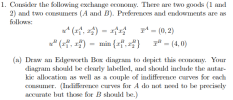 1. Consider the following exchange economy. There are two goods (1 and 2) and two consumers (A and B. Preferences and endowments are as follows: uA(イ·攻) =玲攻ヱA = (0,2) diagram should be clearly labelled, and should include the autar consumer. (Indifference curves for A do not need to be precisely accurate but those for B should be.) (b) Identify the set of Pareto efficient allocations and indicate these in your diagram.
Two individuals, a and b, consume goods x and y. Their endowments are w(2,5) and wb (10,1). Both ...
 Two individuals, a and b, consume goods x and y. Their endowments are w(2,5) and wb (10,1). Both have identical Cobb-Douglas utility functions ui(x,y') xy where i malized to 1; for simplicity we write px as just p. Then consumer i's demand for each good is i 1 2 i m and I 2 where m refers to the value of consumer i's endowment. (a) Draw the set of interior Pareto efficient allocations in an Edge- worth box for this...
 1. Consider the following exchange economy. There are two goods (1 and 2) and two consumers (A and B). Preferences and endowments are as follows: uA (イ·攻)-玲攻 TA _ (0,2) 2(4,0) (a) Draw an Edgeworth Box diagram to depict this economy. Your diagram should be clearly labelled, and should include the autar kic allocation as well as a couple of indifference curves for each consumer. (Indifference curves for A do not need to be precisely accurate but those for B...
 Pure Exchange Model 1. Consider a Pure Exchange Economy with two agents A and B and two goods X and Y in which each agent acts competitively. Their preferences are given by the following utility function U(X,Y)=X13*Y23 Their initial endowments are as follows W=(5,20) w- (25,10) a) Calculate the demand functions for Good X and Good Y for each agent. b) State the equilibrium conditions for this economy. c) Using these conditions and the demand functions found in part a)...
 1. Consider the following exchange economy. There are two goods (1 and 2) and two consumers (A and B. Preferences and endowments are as follows: uA(イ·攻) =玲攻ヱA = (0,2) diagram should be clearly labelled, and should include the autar consumer. (Indifference curves for A do not need to be precisely accurate but those for B should be.) (b) Identify the set of Pareto efficient allocations and indicate these in your diagram.
 Two individuals, a and b, consume goods x and y. Their endowments are w(2,5) and wb (10,1). Both have identical Cobb-Douglas utility functions ui(x,y') xy where i malized to 1; for simplicity we write px as just p. Then consumer i's demand for each good is i 1 2 i m and I 2 where m refers to the value of consumer i's endowment. (a) Draw the set of interior Pareto efficient allocations in an Edge- worth box for this...
Most questions answered within 3 hours.
-
Where is the error in this code sequence?
String s1 = "Hello";
String s2 = "ello";...
asked 10 months ago -
Financial data for Joel de Paris, Inc., for last year
follow:
Joel de Paris, Inc.
Balance...
asked 10 months ago -
Consider this reaction:
Al2(SO4)3 (aq)+ BaCl3
(aq) Al2Cl6 (aq)- +
3BaSO4(s) . What is the...
asked 10 months ago -
Suppose that Savneet is considering increasing her
recent random sample from 20 car rentals to 40...
asked 10 months ago -
Trucks arrive at an unloading terminal at an average rate of 120
per hour.
Trucks arrive...
asked 10 months ago -
Why are methanol and ethanol completely soluble in water while
octanol is not very little soluble....
asked 10 months ago -
A facilities manager at a university reads in a research report
that the mean amount of...
asked 10 months ago -
When the CuSO4 is rehydrated by adding water to the anhydrous
compound, is this an endothermic...
asked 10 months ago -
A ray of sunlight is passing from diamond into crown glass; the
angle of incidence is...
asked 10 months ago -
A block of mass 0.249 kg is placed on top of a light, vertical
spring of...
asked 10 months ago -
how do the kidneys compensate in the presences of acidosis
a) trigger hyperventilate
b) reserve acid...
asked 10 months ago -
Question 501 pts
The rental rate of capital to the firm increases. Which of the
following...
asked 10 months ago