Newman Corp. sold a machine with an orginal cost of $50,000 and a basis of $20,000...
Newman Corp. sold a machine with an orginal cost of $50,000 and a basis of $20,000 for $14,000. What is the nature of the gain or loss? Explain.
Homework Answers
Answer -
Step - (1) - Information Given -
Newman Corp. sold a machine with an original cost of $50000 and a basis of $20000 for $14000.
.
Step - (2) - Nature of Gain or Loss -
Loss on sale of machine = Sale price of machine - basis of machine
= $14000 - $20000
= -$6000. Ordinary loss
Loss of -$6000 is treated as Ordinary loss and not a capital loss because up to the amount of depreciation allowance of ($50000 - $20000) = $30000, either loss or gain on sale will be treated as Ordinary by Nature.
Add Answer to:
Newman Corp. sold a machine with an orginal cost of
$50,000 and a basis of $20,000...
Interest is $50,000. His distribution includes cash of $5,000, inventory (FMV -$20,000; basis $10...
 interest is $50,000. His distribution includes cash of $5,000, inventory (FMV -$20,000; basis $10,000), and equipment (FMV $2,000; basis $1,000). Sam's marginal tax rate is 24% and his long-term capital gains tax rate is 15%. 2. Sam receives a proportionate nonliquidating distribution when the basis of his partnership a. How much gain or loss does Sam recognize? Gain /Loss) b. What is Sam's tax liability/benefit on the distribution? (Liability /Benefit) c. What is Sam's basis in the inventory? d. What...
An office machine used by Josie in her accounting business was completely destroyed by fire. The...
An office machine used by Josie in her accounting business was completely destroyed by fire. The adjusted basis of the machine was $8,000 (original basis of $14,000 less accumulated depreciation of $6,000). The machine was not insured. Calculate the amount and nature of Josie's gain or loss as a result of this casualty. Amount of gain or loss Nature
The Beta Corporation owns a building with a basis of $20,000 that is subject to a...
The Beta Corporation owns a building with a basis of $20,000 that is subject to a debt of $80,000. The FMV of the building is $50,000. Beta distributes the property in a nonliquidating distribution (along with the debt) to Ben, its sole shareholder. What is Ben’s basis in the building received from Beta in the distribution? a. $80,000. b. $50,000. c. zero d. $30,000. e. none of the above. The Beta Corporation owns a building with a basis of $20,000...
Yong contributes a machine having an adjusted basis of $20,000 and an FMV of $25,000 for...
Yong contributes a machine having an adjusted basis of $20,000 and an FMV of $25,000 for a 10% partnership interest. Yong had taken $10,000 of depreciation prior to the contribution. The partnership has no liabilities. As a result of the contribution, Yong must recognize...? Please show your work. no gain or loss. a $5,000 Sec. 1245 gain. a $5,000 capital gain. $10,000 ordinary income.
Problem 4 On October 16, 2014 Round Rock Corp. sold an old machine for $50,000, having...
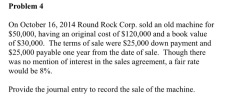 Problem 4 On October 16, 2014 Round Rock Corp. sold an old machine for $50,000, having an original cost of $120,000 and a book value of $30,000. The terms of sale were $25,000 down payment and $25,000 payable one year from the date of sale. Though there was no mention of interest in the sales agreement, a fair rate would be 8%. Provide the journal entry to record the sale of the machine.
Lassen Corporation sold a machine to a machine dealer for $35,000. Lassen bought the machine for...
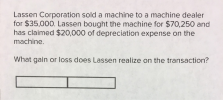 Lassen Corporation sold a machine to a machine dealer for $35,000. Lassen bought the machine for $70,250 and has claimed $20,000 of depreciation expense on the machine. What gain or loss does Lassen realize on the transaction?
Project Management 3. O'Leary Engineering Corp. has been depreciating a $50,000 machine for the last 3 years. The a...
 Project Management
3. O'Leary Engineering Corp. has been depreciating a $50,000 machine for the last 3 years. The asset was just sold for 60% of its first cost. What is the size of the recaptured depreciation or loss at disposal using following depreciation methods. (a) Sum-of-years' digits with N = 8 and S = 2000 (b) Straight line depreciation with N = 8 and S = 2000 (c) MACRS GDS depreciation, classified as a 7-year property.
Project Management
3. O'Leary Engineering Corp. has been depreciating a $50,000 machine for the last 3 years. The asset was just sold for 60% of its first cost. What is the size of the recaptured depreciation or loss at disposal using following depreciation methods. (a) Sum-of-years' digits with N = 8 and S = 2000 (b) Straight line depreciation with N = 8 and S = 2000 (c) MACRS GDS depreciation, classified as a 7-year property.
A machine with a cost of $130,000 and accumulated depreciation of $85,000 is sold for $50,000...
A machine with a cost of $130,000 and accumulated depreciation of $85,000 is sold for $50,000 cash. The amount that should be reported as a source of cash under cash flows from investing activities is
The original cost of a machine was $50,000. This machine can be sold for $25,000 now,...
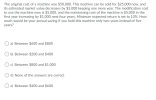 The original cost of a machine was $50,000. This machine can be sold for $25,000 now, and its estimated market value decreases by $5,000 keeping one more year. The modification cost to use the machine now is $5,000, and the maintaining cost of the machine is $5,000 in the first year increasing by $1,000 next four years. Minimum expected return is set to 10%. How much would be your annual saving if you hold this machine only two years instead...
Metro Corp. traded Land A for Land B. Metro originally purchased Land A for $50,000 and Land A's adjusted basi...
 Metro Corp. traded Land A for Land B. Metro originally purchased Land A for $50,000 and Land A's adjusted basis was $25,000 at the time of the exchange. What is Metro's realized gain or loss, recognized gain or loss, and adjusted basis in Land B in each of the following alternative scenarios? (Loss amounts should be indicated by a minus sign. Input all other amounts as positive values. Leave no answer blank. Enter zero is applicable.) a. The fair market...
 interest is $50,000. His distribution includes cash of $5,000, inventory (FMV -$20,000; basis $10,000), and equipment (FMV $2,000; basis $1,000). Sam's marginal tax rate is 24% and his long-term capital gains tax rate is 15%. 2. Sam receives a proportionate nonliquidating distribution when the basis of his partnership a. How much gain or loss does Sam recognize? Gain /Loss) b. What is Sam's tax liability/benefit on the distribution? (Liability /Benefit) c. What is Sam's basis in the inventory? d. What...
 Problem 4 On October 16, 2014 Round Rock Corp. sold an old machine for $50,000, having an original cost of $120,000 and a book value of $30,000. The terms of sale were $25,000 down payment and $25,000 payable one year from the date of sale. Though there was no mention of interest in the sales agreement, a fair rate would be 8%. Provide the journal entry to record the sale of the machine.
 Lassen Corporation sold a machine to a machine dealer for $35,000. Lassen bought the machine for $70,250 and has claimed $20,000 of depreciation expense on the machine. What gain or loss does Lassen realize on the transaction?
 Project Management
3. O'Leary Engineering Corp. has been depreciating a $50,000 machine for the last 3 years. The asset was just sold for 60% of its first cost. What is the size of the recaptured depreciation or loss at disposal using following depreciation methods. (a) Sum-of-years' digits with N = 8 and S = 2000 (b) Straight line depreciation with N = 8 and S = 2000 (c) MACRS GDS depreciation, classified as a 7-year property.
Project Management
3. O'Leary Engineering Corp. has been depreciating a $50,000 machine for the last 3 years. The asset was just sold for 60% of its first cost. What is the size of the recaptured depreciation or loss at disposal using following depreciation methods. (a) Sum-of-years' digits with N = 8 and S = 2000 (b) Straight line depreciation with N = 8 and S = 2000 (c) MACRS GDS depreciation, classified as a 7-year property.
 The original cost of a machine was $50,000. This machine can be sold for $25,000 now, and its estimated market value decreases by $5,000 keeping one more year. The modification cost to use the machine now is $5,000, and the maintaining cost of the machine is $5,000 in the first year increasing by $1,000 next four years. Minimum expected return is set to 10%. How much would be your annual saving if you hold this machine only two years instead...
 Metro Corp. traded Land A for Land B. Metro originally purchased Land A for $50,000 and Land A's adjusted basis was $25,000 at the time of the exchange. What is Metro's realized gain or loss, recognized gain or loss, and adjusted basis in Land B in each of the following alternative scenarios? (Loss amounts should be indicated by a minus sign. Input all other amounts as positive values. Leave no answer blank. Enter zero is applicable.) a. The fair market...
Most questions answered within 3 hours.
-
Where is the error in this code sequence?
String s1 = "Hello";
String s2 = "ello";...
asked 10 months ago -
Financial data for Joel de Paris, Inc., for last year
follow:
Joel de Paris, Inc.
Balance...
asked 10 months ago -
Consider this reaction:
Al2(SO4)3 (aq)+ BaCl3
(aq) Al2Cl6 (aq)- +
3BaSO4(s) . What is the...
asked 10 months ago -
Suppose that Savneet is considering increasing her
recent random sample from 20 car rentals to 40...
asked 10 months ago -
Trucks arrive at an unloading terminal at an average rate of 120
per hour.
Trucks arrive...
asked 10 months ago -
Why are methanol and ethanol completely soluble in water while
octanol is not very little soluble....
asked 10 months ago -
A facilities manager at a university reads in a research report
that the mean amount of...
asked 10 months ago -
When the CuSO4 is rehydrated by adding water to the anhydrous
compound, is this an endothermic...
asked 10 months ago -
A ray of sunlight is passing from diamond into crown glass; the
angle of incidence is...
asked 10 months ago -
A block of mass 0.249 kg is placed on top of a light, vertical
spring of...
asked 10 months ago -
how do the kidneys compensate in the presences of acidosis
a) trigger hyperventilate
b) reserve acid...
asked 10 months ago -
Question 501 pts
The rental rate of capital to the firm increases. Which of the
following...
asked 10 months ago