
Homework Answers
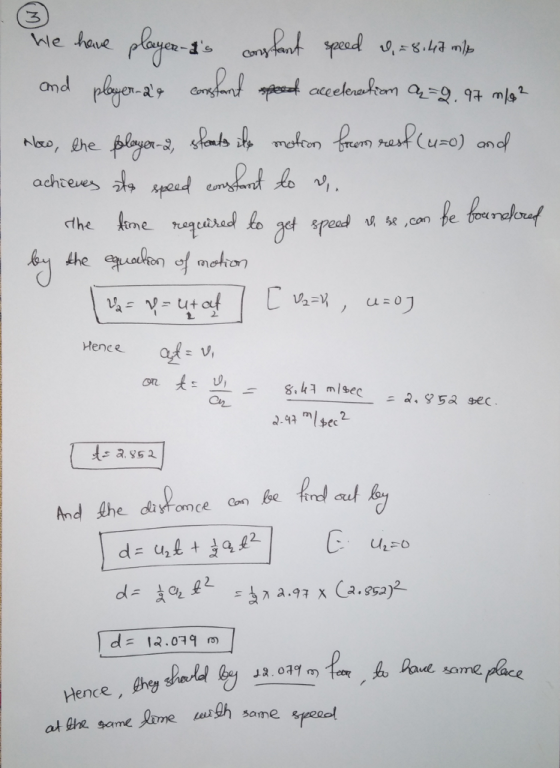
The equations of motion can be used to solve the above given problem as I did.
Add Answer to:
3, (8 points) (Like 2.88) In a relay race, runner #1 (already in motion) must hand...
Name: Lecture Section: 8amロ11am ロ3pm give y PHYS 141-written Homework #02 Due Date: 11:59pm on Wednesday,...
 Name: Lecture Section: 8amロ11am ロ3pm give y PHYS 141-written Homework #02 Due Date: 11:59pm on Wednesday, January 30, 2019 For full credit, clear, legible, and correctly-rotated pages must be submitted to the correct location. 1. (6 points) (Based on 2.31) Using this graph showing velocity of an elevator in a tall building as a function of time, calculate 25 20 15 (a) the average acceleration from t-1s to t-3s, (b) the instantaneous acceleration at t-16s, (c) the distance travelled between...
Sally and David are runners participating in a relay race. Sally runs at a constant speed...
Sally and David are runners participating in a relay race. Sally runs at a constant speed of 2.0 m/s. When she is 1.8 m behind David, he starts from rest and begins to run in the same direction as Sally with a constant acceleration of 0.5 m/s^2. When Sally reaches him, she hands him the baton. a) (20 points) How far has David run when he gets the baton? b) (5 points) What is David’s speed at the moment he...
1. A runner dashes from the starting line (x0) to a point 98 m away and...
 1. A runner dashes from the starting line (x0) to a point 98 m away and then turns around and runs to a point I19 m away from the starting point in 21 seconds. To the nearest tenth of a mis what is the average speed? 2. What is the runner's average velocity in the previous problem? 3. A car accelerates at a constant rate from zero to 33.5 m/s in 10 seconds and then slows to 16.4 m/s in...
1) A 67-kg base runner begins his slide into second base when he is moving at...
1) A 67-kg base runner begins his slide into second base when he is moving at a speed of 3.7 m/s. The coefficient of friction between his clothes and Earth is 0.70. He slides so that his speed is zero just as he reaches the base. (a) How much mechanical energy is lost due to friction acting on the runner? (b) How far does he slide? 2) A running 53-kg cheetah has a top speed of 31 m/s. (a) What...
1. a race car driver must average 200.0 km/hr over the course of a time trial...
1. a race car driver must average 200.0 km/hr over the course of a time trial lasting ten laps. if the first nine laps were done at at 199.0 km/r, what average speed must be maintained for the last lap. 2. A 90-m-long train begins accelerating uniformly from rest. The front of the train has a speed of 20 m/s when it passes a railway worker who is standing 180 m from where the front of the train started. What...
1. A 67-kg base runner begins his slide into second base when he is moving at...
1. A 67-kg base runner begins his slide into second base when he is moving at a speed of 4.5 m/s. The coefficient of friction between his clothes and Earth is 0.70. He slides so that his speed is zero just as he reaches the base. (a) How much mechanical energy is lost due to friction acting on the runner? (b) How far does he slide? 2. A 0.32-kg stone is held 1.4 m above the top edge of a...
Draw a correctly labeled motion diagram for each of the following scenarios. Make sure you include...
Draw a correctly labeled motion diagram for each of the following scenarios. Make sure you include both velocity and acceleration vectors. a. A car travels along a straight, flat road at a steady speed. b. A truck slows down and comes to a stop as it approaches a red traffic light. c. A train accelerates as it leaves the train station and then keeps moving at a constant speed. d. A bungee jumper jumps from a high bridge. Initially the...
mitaj (dm49222)-Homework 8, torque 18-19-ma his mista 021 (part 1 of 2) 10.0 points A student...
 mitaj (dm49222)-Homework 8, torque 18-19-ma his mista 021 (part 1 of 2) 10.0 points A student sits on a rotating stool holding two 2 kg objects. When his arms are extended horizontally, the objects are 1 m from the axis of rotation, and he rotates with angular speed of 0.6 rad/sec. The moment of inertia of thee student plus the stool is 7 kg m2 and is as- sumed to be constant. The student then pulls the objects horizontally to...
Part 1 (12 marks): Indicate the answer choice that best completes the statement or answers the...
 Part 1 (12 marks): Indicate the answer choice that best completes the statement or answers the question Q1. Which of the following is a scalar quantity? a) weight b) speed c) momentum d) impulse Q2. When you jump on a trampoline straight up you land on the same position. This is because: a) Earth does not move, otherwise the ground will be swept away b) Earth moves very slowly c) your body continues to move with Earth because of its...
5:16 lLTE ) Done 1 of 5 Assessment #1 (Kinematics of a Particle) Rectilinear Motion (Straight...
 5:16 lLTE ) Done 1 of 5 Assessment #1 (Kinematics of a Particle) Rectilinear Motion (Straight linc Motion 3. The position of a point during the interval of time from r otor 6 is given by ** * m. (a) What is the maximum velocity during this interval of time, and at what time does it occur? (b) What is the acceleration when the velocity is a maximum? (20 m/s, 0 m/s 3. A test projectile is fired horizontally into...
 Name: Lecture Section: 8amロ11am ロ3pm give y PHYS 141-written Homework #02 Due Date: 11:59pm on Wednesday, January 30, 2019 For full credit, clear, legible, and correctly-rotated pages must be submitted to the correct location. 1. (6 points) (Based on 2.31) Using this graph showing velocity of an elevator in a tall building as a function of time, calculate 25 20 15 (a) the average acceleration from t-1s to t-3s, (b) the instantaneous acceleration at t-16s, (c) the distance travelled between...
 1. A runner dashes from the starting line (x0) to a point 98 m away and then turns around and runs to a point I19 m away from the starting point in 21 seconds. To the nearest tenth of a mis what is the average speed? 2. What is the runner's average velocity in the previous problem? 3. A car accelerates at a constant rate from zero to 33.5 m/s in 10 seconds and then slows to 16.4 m/s in...
 mitaj (dm49222)-Homework 8, torque 18-19-ma his mista 021 (part 1 of 2) 10.0 points A student sits on a rotating stool holding two 2 kg objects. When his arms are extended horizontally, the objects are 1 m from the axis of rotation, and he rotates with angular speed of 0.6 rad/sec. The moment of inertia of thee student plus the stool is 7 kg m2 and is as- sumed to be constant. The student then pulls the objects horizontally to...
 Part 1 (12 marks): Indicate the answer choice that best completes the statement or answers the question Q1. Which of the following is a scalar quantity? a) weight b) speed c) momentum d) impulse Q2. When you jump on a trampoline straight up you land on the same position. This is because: a) Earth does not move, otherwise the ground will be swept away b) Earth moves very slowly c) your body continues to move with Earth because of its...
 5:16 lLTE ) Done 1 of 5 Assessment #1 (Kinematics of a Particle) Rectilinear Motion (Straight linc Motion 3. The position of a point during the interval of time from r otor 6 is given by ** * m. (a) What is the maximum velocity during this interval of time, and at what time does it occur? (b) What is the acceleration when the velocity is a maximum? (20 m/s, 0 m/s 3. A test projectile is fired horizontally into...
Most questions answered within 3 hours.
-
Where is the error in this code sequence?
String s1 = "Hello";
String s2 = "ello";...
asked 10 months ago -
Financial data for Joel de Paris, Inc., for last year
follow:
Joel de Paris, Inc.
Balance...
asked 10 months ago -
Consider this reaction:
Al2(SO4)3 (aq)+ BaCl3
(aq) Al2Cl6 (aq)- +
3BaSO4(s) . What is the...
asked 10 months ago -
Suppose that Savneet is considering increasing her
recent random sample from 20 car rentals to 40...
asked 10 months ago -
Trucks arrive at an unloading terminal at an average rate of 120
per hour.
Trucks arrive...
asked 10 months ago -
Why are methanol and ethanol completely soluble in water while
octanol is not very little soluble....
asked 10 months ago -
A facilities manager at a university reads in a research report
that the mean amount of...
asked 10 months ago -
When the CuSO4 is rehydrated by adding water to the anhydrous
compound, is this an endothermic...
asked 10 months ago -
A ray of sunlight is passing from diamond into crown glass; the
angle of incidence is...
asked 10 months ago -
A block of mass 0.249 kg is placed on top of a light, vertical
spring of...
asked 10 months ago -
how do the kidneys compensate in the presences of acidosis
a) trigger hyperventilate
b) reserve acid...
asked 10 months ago -
Question 501 pts
The rental rate of capital to the firm increases. Which of the
following...
asked 10 months ago