
Homework Answers
Add Answer to:
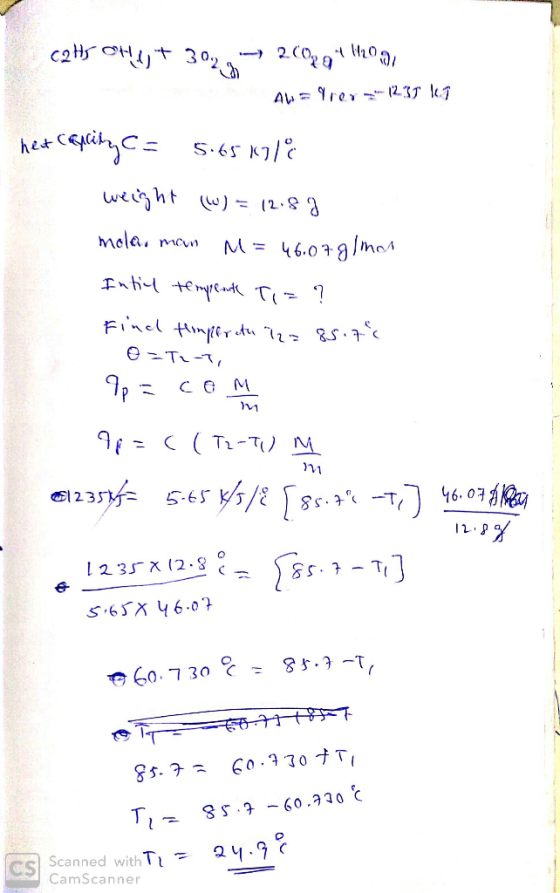
6.A 12.8 g sample of ethanol (C,H,OH) is burned in a calorimeter with a heat capacity...
A 12.8 g sample of ethanol (C2H5OH) is burned in a bomb calorimeter with a heat capacity of 5.65 kJ/�C. Using the inform...
A 12.8 g sample of ethanol (C2H5OH) is burned in a bomb calorimeter with a heat capacity of 5.65 kJ/�C. Using the information below, determine the final temperature of the calorimeter if the initial temperature is 25.0�C. The molar mass of ethanol is 46.07 g/mol.
A 2.11 g sample of ethanol (C2H5OH) is burned in a bomb calorimeter with a heat capacity, C-5.65 kJ/"C. C2H5OH() + 3 O2...
 A 2.11 g sample of ethanol (C2H5OH) is burned in a bomb calorimeter with a heat capacity, C-5.65 kJ/"C. C2H5OH() + 3 O2(g) + 2 CO2(g) + 3 H2O(g) AH'rxn=-1235 kJ If the initial temperature is 25.0°C, what is the final temperature (in "C) of the calorimeter? The molar mass of ethanol is 46.07 g/mol. Remember, in the heat equation, q=m's'AT, heat capacity is equivalent to Cum's, giving Heat capacity is extensive whereas specific heat is intensive. -CAT.
please answer the full thing 1. What would be the AE (in kJ) for the following...
 please answer the full thing
1. What would be the AE (in kJ) for the following reaction if 6.300 moles of H20 were decomposed? 2 H2O + 2H2 + O AE = 483.6 kJ (for reaction as written) 2. The value of AE for the reaction below is -336 kJ. Determine the amount of heat (in kJ) evolved when 13.0 g of HCl is formed. CH4(9) + 3 Cl2(g) - CHCI) + 3HCIO) 3. If 1.00 cal = 4.18 J,...
please answer the full thing
1. What would be the AE (in kJ) for the following reaction if 6.300 moles of H20 were decomposed? 2 H2O + 2H2 + O AE = 483.6 kJ (for reaction as written) 2. The value of AE for the reaction below is -336 kJ. Determine the amount of heat (in kJ) evolved when 13.0 g of HCl is formed. CH4(9) + 3 Cl2(g) - CHCI) + 3HCIO) 3. If 1.00 cal = 4.18 J,...
QUESTION 4 0.5 points Save Answer A 6.32 g sample of ethanol (C2H5OH) is burned in...
 QUESTION 4 0.5 points Save Answer A 6.32 g sample of ethanol (C2H5OH) is burned in a bomb calorimeter with a heat capacity, C = 5.65 kJ/°C. C2H5OH() + 3 O2(g) 2 CO2(g) + 3 H2O(g) AH®rxn = -1235 kJ If the initial temperature is 25.0°C, what is the final temperature (in °C) of the calorimeter? The molar mass of ethanol is 46.07 g/mol. Remember, in the heat equation, q = m*s*AT, heat capacity is equivalent to C= m*s, giving...
5) A 35.6 g sample of ethanol (C2HsOH) is burned in a bomb calorimeter, according to...
 5) A 35.6 g sample of ethanol (C2HsOH) is burned in a bomb calorimeter, according to the following on. If the temperature rose from 35.0 to 76.0°C and the heat capacity of the calorimeter is 23.3 kJ/PC, what is the value of AHrxn? The molar mass of ethanol is 46.07 gmol C2HsOH)+302() 2 Co2()+3 H20) frxn7 A) -1.24 x 10³ kJ/mol C)-809 x 103 kJ/rnol B) +1.24 x 10³ kJ/mol E) +9.55 x 10³ kJ/mol D) -9.55 x 10³ kJ/mol...
A 35.6 g sample of ethanol (C2H5OH) is burned in a bomb calorimeter, according to the following reaction. If the...
A 35.6 g sample of ethanol (C2H5OH) is burned in a bomb calorimeter, according to the following reaction. If the temperature rose from 35.0 to 76.0°C and the heat capacity of the calorimeter is 23.3 kJ/°C, what is the value of DH°rxn? The molar mass of ethanol is 46.07 g/mol. C2H5OH(l) + O2(g) → CO2(g) + H2O(g) ΔH°rxn = ? (Points : 1) -1.24 × 10³ kJ/mol +1.24 × 10³ kJ/mol -8.09 × 10³ kJ/mol -9.55 × 10³ kJ/mol...
A 35.6 g sample of ethanol (C2H5OH) is burned in a bomb calorimeter, according to the following reaction. If the...
A 35.6 g sample of ethanol (C2H5OH) is burned in a bomb calorimeter, according to the following reaction. If the temperature rose from 35.0 to 76.0°C and the heat capacity of the calorimeter is 23.3 kJ/°C, what is the value of DH°rxn? The molar mass of ethanol is 46.07 g/mol. C2H5OH(l) + O2(g) → CO2(g) + H2O(g) ΔH°rxn = ? (Points : 1) -1.24 × 10³ kJ/mol +1.24 × 10³ kJ/mol -8.09 × 10³ kJ/mol -9.55 × 10³ kJ/mol...
Heat Capacity and Calorimetry A sample of ethanol, C2H5OH, weighing 2.84 g was burned in an...
 Heat Capacity and Calorimetry
A sample of ethanol, C2H5OH, weighing 2.84 g was burned in an
excess of oxygen in a bomb calorimeter. The temperature of the
calorimeter rose from 25C to 33.73C. If the heat capacity of the
calorimeter and contents is 9.63kJ/C, what is the value of q for
burning 1.00 lol of ethanol at constant volume and 25.00C.
Is q equal to U or H?
214e Questions and Problems the enthalpy change when 0.710 mol of calcium...
Heat Capacity and Calorimetry
A sample of ethanol, C2H5OH, weighing 2.84 g was burned in an
excess of oxygen in a bomb calorimeter. The temperature of the
calorimeter rose from 25C to 33.73C. If the heat capacity of the
calorimeter and contents is 9.63kJ/C, what is the value of q for
burning 1.00 lol of ethanol at constant volume and 25.00C.
Is q equal to U or H?
214e Questions and Problems the enthalpy change when 0.710 mol of calcium...
Substance molar heat capacity (C.)/J•mol-1.°C-1 75.3 specific heat capacity (C.) /J•g-lo°C-1 0.384 H2O(1) Cu(s) C,H,OH(l) (ethanol)...
 Substance molar heat capacity (C.)/J•mol-1.°C-1 75.3 specific heat capacity (C.) /J•g-lo°C-1 0.384 H2O(1) Cu(s) C,H,OH(l) (ethanol) Fe(s) 111.5 0.449 1. Fill in the empty entries in the table above. 2. If the same amount of energy is transferred to 1.0 g samples of each of the substances listed above, order them from largest AT to smallest AT. Explain. 3. Which is the consequence of copper's relatively low specific heat (0.385 J/(g°C)) compared to water (4.18 J/(g°C)) on the temperature change...
Please help with these two questions :( 1. How much energy (in kJ) is evolved during...
 Please help with these two questions :(
1. How much energy (in kJ) is evolved during the reaction of
76.9 g of Al, according to the reaction below?
Fe2O3(s) + 2 Al(s) →
Al2O3(s) + 2 Fe(s) ΔH°rxn = -852
kJ
Assume that there is excess Fe2O3.
2. A 12.43 g sample of ethanol (C2H5OH) is
burned in a bomb calorimeter with a heat capacity, C = 5.65
kJ/°C.
C2H5OH(l) + 3 O2(g) → 2
CO2(g) + 3 H2O(g) ΔH°rxn...
Please help with these two questions :(
1. How much energy (in kJ) is evolved during the reaction of
76.9 g of Al, according to the reaction below?
Fe2O3(s) + 2 Al(s) →
Al2O3(s) + 2 Fe(s) ΔH°rxn = -852
kJ
Assume that there is excess Fe2O3.
2. A 12.43 g sample of ethanol (C2H5OH) is
burned in a bomb calorimeter with a heat capacity, C = 5.65
kJ/°C.
C2H5OH(l) + 3 O2(g) → 2
CO2(g) + 3 H2O(g) ΔH°rxn...
 A 2.11 g sample of ethanol (C2H5OH) is burned in a bomb calorimeter with a heat capacity, C-5.65 kJ/"C. C2H5OH() + 3 O2(g) + 2 CO2(g) + 3 H2O(g) AH'rxn=-1235 kJ If the initial temperature is 25.0°C, what is the final temperature (in "C) of the calorimeter? The molar mass of ethanol is 46.07 g/mol. Remember, in the heat equation, q=m's'AT, heat capacity is equivalent to Cum's, giving Heat capacity is extensive whereas specific heat is intensive. -CAT.
 please answer the full thing
1. What would be the AE (in kJ) for the following reaction if 6.300 moles of H20 were decomposed? 2 H2O + 2H2 + O AE = 483.6 kJ (for reaction as written) 2. The value of AE for the reaction below is -336 kJ. Determine the amount of heat (in kJ) evolved when 13.0 g of HCl is formed. CH4(9) + 3 Cl2(g) - CHCI) + 3HCIO) 3. If 1.00 cal = 4.18 J,...
please answer the full thing
1. What would be the AE (in kJ) for the following reaction if 6.300 moles of H20 were decomposed? 2 H2O + 2H2 + O AE = 483.6 kJ (for reaction as written) 2. The value of AE for the reaction below is -336 kJ. Determine the amount of heat (in kJ) evolved when 13.0 g of HCl is formed. CH4(9) + 3 Cl2(g) - CHCI) + 3HCIO) 3. If 1.00 cal = 4.18 J,...
 QUESTION 4 0.5 points Save Answer A 6.32 g sample of ethanol (C2H5OH) is burned in a bomb calorimeter with a heat capacity, C = 5.65 kJ/°C. C2H5OH() + 3 O2(g) 2 CO2(g) + 3 H2O(g) AH®rxn = -1235 kJ If the initial temperature is 25.0°C, what is the final temperature (in °C) of the calorimeter? The molar mass of ethanol is 46.07 g/mol. Remember, in the heat equation, q = m*s*AT, heat capacity is equivalent to C= m*s, giving...
 5) A 35.6 g sample of ethanol (C2HsOH) is burned in a bomb calorimeter, according to the following on. If the temperature rose from 35.0 to 76.0°C and the heat capacity of the calorimeter is 23.3 kJ/PC, what is the value of AHrxn? The molar mass of ethanol is 46.07 gmol C2HsOH)+302() 2 Co2()+3 H20) frxn7 A) -1.24 x 10³ kJ/mol C)-809 x 103 kJ/rnol B) +1.24 x 10³ kJ/mol E) +9.55 x 10³ kJ/mol D) -9.55 x 10³ kJ/mol...
 Heat Capacity and Calorimetry
A sample of ethanol, C2H5OH, weighing 2.84 g was burned in an
excess of oxygen in a bomb calorimeter. The temperature of the
calorimeter rose from 25C to 33.73C. If the heat capacity of the
calorimeter and contents is 9.63kJ/C, what is the value of q for
burning 1.00 lol of ethanol at constant volume and 25.00C.
Is q equal to U or H?
214e Questions and Problems the enthalpy change when 0.710 mol of calcium...
Heat Capacity and Calorimetry
A sample of ethanol, C2H5OH, weighing 2.84 g was burned in an
excess of oxygen in a bomb calorimeter. The temperature of the
calorimeter rose from 25C to 33.73C. If the heat capacity of the
calorimeter and contents is 9.63kJ/C, what is the value of q for
burning 1.00 lol of ethanol at constant volume and 25.00C.
Is q equal to U or H?
214e Questions and Problems the enthalpy change when 0.710 mol of calcium...
 Substance molar heat capacity (C.)/J•mol-1.°C-1 75.3 specific heat capacity (C.) /J•g-lo°C-1 0.384 H2O(1) Cu(s) C,H,OH(l) (ethanol) Fe(s) 111.5 0.449 1. Fill in the empty entries in the table above. 2. If the same amount of energy is transferred to 1.0 g samples of each of the substances listed above, order them from largest AT to smallest AT. Explain. 3. Which is the consequence of copper's relatively low specific heat (0.385 J/(g°C)) compared to water (4.18 J/(g°C)) on the temperature change...
 Please help with these two questions :(
1. How much energy (in kJ) is evolved during the reaction of
76.9 g of Al, according to the reaction below?
Fe2O3(s) + 2 Al(s) →
Al2O3(s) + 2 Fe(s) ΔH°rxn = -852
kJ
Assume that there is excess Fe2O3.
2. A 12.43 g sample of ethanol (C2H5OH) is
burned in a bomb calorimeter with a heat capacity, C = 5.65
kJ/°C.
C2H5OH(l) + 3 O2(g) → 2
CO2(g) + 3 H2O(g) ΔH°rxn...
Please help with these two questions :(
1. How much energy (in kJ) is evolved during the reaction of
76.9 g of Al, according to the reaction below?
Fe2O3(s) + 2 Al(s) →
Al2O3(s) + 2 Fe(s) ΔH°rxn = -852
kJ
Assume that there is excess Fe2O3.
2. A 12.43 g sample of ethanol (C2H5OH) is
burned in a bomb calorimeter with a heat capacity, C = 5.65
kJ/°C.
C2H5OH(l) + 3 O2(g) → 2
CO2(g) + 3 H2O(g) ΔH°rxn...
Most questions answered within 3 hours.
-
Where is the error in this code sequence?
String s1 = "Hello";
String s2 = "ello";...
asked 11 months ago -
Financial data for Joel de Paris, Inc., for last year
follow:
Joel de Paris, Inc.
Balance...
asked 11 months ago -
Consider this reaction:
Al2(SO4)3 (aq)+ BaCl3
(aq) Al2Cl6 (aq)- +
3BaSO4(s) . What is the...
asked 11 months ago -
Suppose that Savneet is considering increasing her
recent random sample from 20 car rentals to 40...
asked 11 months ago -
Trucks arrive at an unloading terminal at an average rate of 120
per hour.
Trucks arrive...
asked 11 months ago -
Why are methanol and ethanol completely soluble in water while
octanol is not very little soluble....
asked 11 months ago -
A facilities manager at a university reads in a research report
that the mean amount of...
asked 11 months ago -
When the CuSO4 is rehydrated by adding water to the anhydrous
compound, is this an endothermic...
asked 11 months ago -
A ray of sunlight is passing from diamond into crown glass; the
angle of incidence is...
asked 11 months ago -
A block of mass 0.249 kg is placed on top of a light, vertical
spring of...
asked 11 months ago -
how do the kidneys compensate in the presences of acidosis
a) trigger hyperventilate
b) reserve acid...
asked 11 months ago -
Question 501 pts
The rental rate of capital to the firm increases. Which of the
following...
asked 11 months ago