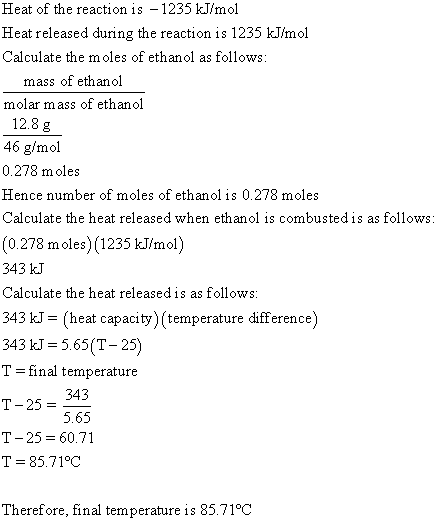
A 12.8 g sample of ethanol (C2H5OH) is burned in a bomb calorimeter with a heat capacity of 5.65 kJ/�C. Using the inform...
Homework Answers
Add Answer to:
A 12.8 g sample of ethanol (C2H5OH) is burned in a bomb calorimeter with a heat capacity of 5.65 kJ/�C. Using the inform...
A 2.11 g sample of ethanol (C2H5OH) is burned in a bomb calorimeter with a heat capacity, C-5.65 kJ/"C. C2H5OH() + 3 O2...
 A 2.11 g sample of ethanol (C2H5OH) is burned in a bomb calorimeter with a heat capacity, C-5.65 kJ/"C. C2H5OH() + 3 O2(g) + 2 CO2(g) + 3 H2O(g) AH'rxn=-1235 kJ If the initial temperature is 25.0°C, what is the final temperature (in "C) of the calorimeter? The molar mass of ethanol is 46.07 g/mol. Remember, in the heat equation, q=m's'AT, heat capacity is equivalent to Cum's, giving Heat capacity is extensive whereas specific heat is intensive. -CAT.
6.A 12.8 g sample of ethanol (C,H,OH) is burned in a calorimeter with a heat capacity...
 6.A 12.8 g sample of ethanol (C,H,OH) is burned in a calorimeter with a heat capacity of 5.65 kJ/°C. Assume the heat from the sample is negligible compared to the calorimeter. Determine the initial temperature of the calorimeter if the final temperature is 85.7°C. The molar mass of ethanol is 46.07 g/mol. С-Н,ОН , + 3 О,ее — 2 СОде + 3 Н,0 qrxn -1235 kJ 7. Two solutions, initially at 24.60 °C, are mixed in a coffee cup calorimeter...
QUESTION 4 0.5 points Save Answer A 6.32 g sample of ethanol (C2H5OH) is burned in...
 QUESTION 4 0.5 points Save Answer A 6.32 g sample of ethanol (C2H5OH) is burned in a bomb calorimeter with a heat capacity, C = 5.65 kJ/°C. C2H5OH() + 3 O2(g) 2 CO2(g) + 3 H2O(g) AH®rxn = -1235 kJ If the initial temperature is 25.0°C, what is the final temperature (in °C) of the calorimeter? The molar mass of ethanol is 46.07 g/mol. Remember, in the heat equation, q = m*s*AT, heat capacity is equivalent to C= m*s, giving...
A 35.6 g sample of ethanol (C2H5OH) is burned in a bomb calorimeter, according to the following reaction. If the...
A 35.6 g sample of ethanol (C2H5OH) is burned in a bomb calorimeter, according to the following reaction. If the temperature rose from 35.0 to 76.0°C and the heat capacity of the calorimeter is 23.3 kJ/°C, what is the value of DH°rxn? The molar mass of ethanol is 46.07 g/mol. C2H5OH(l) + O2(g) → CO2(g) + H2O(g) ΔH°rxn = ? (Points : 1) -1.24 × 10³ kJ/mol +1.24 × 10³ kJ/mol -8.09 × 10³ kJ/mol -9.55 × 10³ kJ/mol...
A 35.6 g sample of ethanol (C2H5OH) is burned in a bomb calorimeter, according to the following reaction. If the...
A 35.6 g sample of ethanol (C2H5OH) is burned in a bomb calorimeter, according to the following reaction. If the temperature rose from 35.0 to 76.0°C and the heat capacity of the calorimeter is 23.3 kJ/°C, what is the value of DH°rxn? The molar mass of ethanol is 46.07 g/mol. C2H5OH(l) + O2(g) → CO2(g) + H2O(g) ΔH°rxn = ? (Points : 1) -1.24 × 10³ kJ/mol +1.24 × 10³ kJ/mol -8.09 × 10³ kJ/mol -9.55 × 10³ kJ/mol...
Please help with these two questions :( 1. How much energy (in kJ) is evolved during...
 Please help with these two questions :(
1. How much energy (in kJ) is evolved during the reaction of
76.9 g of Al, according to the reaction below?
Fe2O3(s) + 2 Al(s) →
Al2O3(s) + 2 Fe(s) ΔH°rxn = -852
kJ
Assume that there is excess Fe2O3.
2. A 12.43 g sample of ethanol (C2H5OH) is
burned in a bomb calorimeter with a heat capacity, C = 5.65
kJ/°C.
C2H5OH(l) + 3 O2(g) → 2
CO2(g) + 3 H2O(g) ΔH°rxn...
Please help with these two questions :(
1. How much energy (in kJ) is evolved during the reaction of
76.9 g of Al, according to the reaction below?
Fe2O3(s) + 2 Al(s) →
Al2O3(s) + 2 Fe(s) ΔH°rxn = -852
kJ
Assume that there is excess Fe2O3.
2. A 12.43 g sample of ethanol (C2H5OH) is
burned in a bomb calorimeter with a heat capacity, C = 5.65
kJ/°C.
C2H5OH(l) + 3 O2(g) → 2
CO2(g) + 3 H2O(g) ΔH°rxn...
Heat Capacity and Calorimetry A sample of ethanol, C2H5OH, weighing 2.84 g was burned in an...
 Heat Capacity and Calorimetry
A sample of ethanol, C2H5OH, weighing 2.84 g was burned in an
excess of oxygen in a bomb calorimeter. The temperature of the
calorimeter rose from 25C to 33.73C. If the heat capacity of the
calorimeter and contents is 9.63kJ/C, what is the value of q for
burning 1.00 lol of ethanol at constant volume and 25.00C.
Is q equal to U or H?
214e Questions and Problems the enthalpy change when 0.710 mol of calcium...
Heat Capacity and Calorimetry
A sample of ethanol, C2H5OH, weighing 2.84 g was burned in an
excess of oxygen in a bomb calorimeter. The temperature of the
calorimeter rose from 25C to 33.73C. If the heat capacity of the
calorimeter and contents is 9.63kJ/C, what is the value of q for
burning 1.00 lol of ethanol at constant volume and 25.00C.
Is q equal to U or H?
214e Questions and Problems the enthalpy change when 0.710 mol of calcium...
5) A 35.6 g sample of ethanol (C2HsOH) is burned in a bomb calorimeter, according to...
 5) A 35.6 g sample of ethanol (C2HsOH) is burned in a bomb calorimeter, according to the following on. If the temperature rose from 35.0 to 76.0°C and the heat capacity of the calorimeter is 23.3 kJ/PC, what is the value of AHrxn? The molar mass of ethanol is 46.07 gmol C2HsOH)+302() 2 Co2()+3 H20) frxn7 A) -1.24 x 10³ kJ/mol C)-809 x 103 kJ/rnol B) +1.24 x 10³ kJ/mol E) +9.55 x 10³ kJ/mol D) -9.55 x 10³ kJ/mol...
If 4.290 g of ethanol C2H5OH(l) is burned completely in a bomb calorimeter at 298.15 K,...
If 4.290 g of ethanol C2H5OH(l) is burned completely in a bomb calorimeter at 298.15 K, the heat produced is 124.34 kJ . Part A Calculate ΔH∘c for ethanol at 298.15 K. Part B Calculate ΔH∘f of ethanol at 298.15 K. The enthalpies of formation of CO2(g) and H2O(l) are −393.5 and −285.8 kJ⋅mol-1, respectively.
A 5.0L bomb calorimeter, with a heat capacity of 14.25 kJ/°C, is filled to a pressure...
A 5.0L bomb calorimeter, with a heat capacity of 14.25 kJ/°C, is filled to a pressure of 5.0 atm with O2 gas at 32.9°C. A 6.55 g sample of aniline (C6H5NH2, molar mass = 93.13 g/mol) was then combusted in this calorimeter. Determine the value of the final temperature of the calorimeter. 4 C6H5NH2(l) + 35 O2(g) → 24 CO2(g) + 7 H2O(g) + 2 NO2(g) ΔH°rxn= -1.28 x 10⁴kJ/mol
 A 2.11 g sample of ethanol (C2H5OH) is burned in a bomb calorimeter with a heat capacity, C-5.65 kJ/"C. C2H5OH() + 3 O2(g) + 2 CO2(g) + 3 H2O(g) AH'rxn=-1235 kJ If the initial temperature is 25.0°C, what is the final temperature (in "C) of the calorimeter? The molar mass of ethanol is 46.07 g/mol. Remember, in the heat equation, q=m's'AT, heat capacity is equivalent to Cum's, giving Heat capacity is extensive whereas specific heat is intensive. -CAT.
 6.A 12.8 g sample of ethanol (C,H,OH) is burned in a calorimeter with a heat capacity of 5.65 kJ/°C. Assume the heat from the sample is negligible compared to the calorimeter. Determine the initial temperature of the calorimeter if the final temperature is 85.7°C. The molar mass of ethanol is 46.07 g/mol. С-Н,ОН , + 3 О,ее — 2 СОде + 3 Н,0 qrxn -1235 kJ 7. Two solutions, initially at 24.60 °C, are mixed in a coffee cup calorimeter...
 QUESTION 4 0.5 points Save Answer A 6.32 g sample of ethanol (C2H5OH) is burned in a bomb calorimeter with a heat capacity, C = 5.65 kJ/°C. C2H5OH() + 3 O2(g) 2 CO2(g) + 3 H2O(g) AH®rxn = -1235 kJ If the initial temperature is 25.0°C, what is the final temperature (in °C) of the calorimeter? The molar mass of ethanol is 46.07 g/mol. Remember, in the heat equation, q = m*s*AT, heat capacity is equivalent to C= m*s, giving...
 Please help with these two questions :(
1. How much energy (in kJ) is evolved during the reaction of
76.9 g of Al, according to the reaction below?
Fe2O3(s) + 2 Al(s) →
Al2O3(s) + 2 Fe(s) ΔH°rxn = -852
kJ
Assume that there is excess Fe2O3.
2. A 12.43 g sample of ethanol (C2H5OH) is
burned in a bomb calorimeter with a heat capacity, C = 5.65
kJ/°C.
C2H5OH(l) + 3 O2(g) → 2
CO2(g) + 3 H2O(g) ΔH°rxn...
Please help with these two questions :(
1. How much energy (in kJ) is evolved during the reaction of
76.9 g of Al, according to the reaction below?
Fe2O3(s) + 2 Al(s) →
Al2O3(s) + 2 Fe(s) ΔH°rxn = -852
kJ
Assume that there is excess Fe2O3.
2. A 12.43 g sample of ethanol (C2H5OH) is
burned in a bomb calorimeter with a heat capacity, C = 5.65
kJ/°C.
C2H5OH(l) + 3 O2(g) → 2
CO2(g) + 3 H2O(g) ΔH°rxn...
 Heat Capacity and Calorimetry
A sample of ethanol, C2H5OH, weighing 2.84 g was burned in an
excess of oxygen in a bomb calorimeter. The temperature of the
calorimeter rose from 25C to 33.73C. If the heat capacity of the
calorimeter and contents is 9.63kJ/C, what is the value of q for
burning 1.00 lol of ethanol at constant volume and 25.00C.
Is q equal to U or H?
214e Questions and Problems the enthalpy change when 0.710 mol of calcium...
Heat Capacity and Calorimetry
A sample of ethanol, C2H5OH, weighing 2.84 g was burned in an
excess of oxygen in a bomb calorimeter. The temperature of the
calorimeter rose from 25C to 33.73C. If the heat capacity of the
calorimeter and contents is 9.63kJ/C, what is the value of q for
burning 1.00 lol of ethanol at constant volume and 25.00C.
Is q equal to U or H?
214e Questions and Problems the enthalpy change when 0.710 mol of calcium...
 5) A 35.6 g sample of ethanol (C2HsOH) is burned in a bomb calorimeter, according to the following on. If the temperature rose from 35.0 to 76.0°C and the heat capacity of the calorimeter is 23.3 kJ/PC, what is the value of AHrxn? The molar mass of ethanol is 46.07 gmol C2HsOH)+302() 2 Co2()+3 H20) frxn7 A) -1.24 x 10³ kJ/mol C)-809 x 103 kJ/rnol B) +1.24 x 10³ kJ/mol E) +9.55 x 10³ kJ/mol D) -9.55 x 10³ kJ/mol...
Most questions answered within 3 hours.
-
Where is the error in this code sequence?
String s1 = "Hello";
String s2 = "ello";...
asked 11 months ago -
Financial data for Joel de Paris, Inc., for last year
follow:
Joel de Paris, Inc.
Balance...
asked 11 months ago -
Consider this reaction:
Al2(SO4)3 (aq)+ BaCl3
(aq) Al2Cl6 (aq)- +
3BaSO4(s) . What is the...
asked 11 months ago -
Suppose that Savneet is considering increasing her
recent random sample from 20 car rentals to 40...
asked 11 months ago -
Trucks arrive at an unloading terminal at an average rate of 120
per hour.
Trucks arrive...
asked 11 months ago -
Why are methanol and ethanol completely soluble in water while
octanol is not very little soluble....
asked 11 months ago -
A facilities manager at a university reads in a research report
that the mean amount of...
asked 11 months ago -
When the CuSO4 is rehydrated by adding water to the anhydrous
compound, is this an endothermic...
asked 11 months ago -
A ray of sunlight is passing from diamond into crown glass; the
angle of incidence is...
asked 11 months ago -
A block of mass 0.249 kg is placed on top of a light, vertical
spring of...
asked 11 months ago -
how do the kidneys compensate in the presences of acidosis
a) trigger hyperventilate
b) reserve acid...
asked 11 months ago -
Question 501 pts
The rental rate of capital to the firm increases. Which of the
following...
asked 11 months ago