
Homework Answers
2.
Ans:
a.
This can be explained using law of variable proportions.
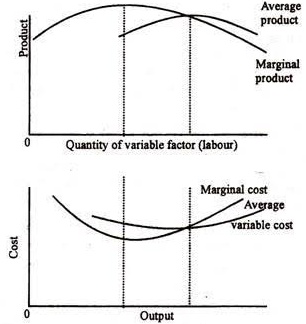
Important factor: Law of diminishing returns.
When diminishing returns exist, Marginal product falls with more input use. This implies that to keep increasing output, we need to incur higher marginal costs (less MP implies sacrifice) to bring MP to previous levels and to avoid it from falling.
b.
Marginal cost is the cost of the last unit produced. If the marginal cost is lower than the average cost, it pulls the average down. If the marginal cost is higher than the average cost, it pulls the average up. So when the marginal cost curve intersects the average cost curve, it goes from being below the average to above the average. This can be explained by the fact that when the cost of the marginal output is equal to the average cost of the output, then the AC neither falls nor rises (i.e. it reaches its minimum).
If you are satisfied with the answer, please provide a positive rating. Feel free to comment in case of queries.
Have a nice day ahead!
Add Answer to:
please as soon as possible
2. How does marginal productivity translate to marginal cost and represent...
4) (20 pts) The marginal product curve intersects the average product curve at the maximum point...
 4) (20 pts) The marginal product curve intersects the average product curve at the maximum point of the AP curve. Conversely, the marginal cost curve intersects the average variable cost curve at the minimum point of the AVC curve. a. Explain why this necessarily has to be the case. Present your answer both in mathematical and intuitive terms. Be as detailed as you possibly can in answering this question. b. Explain why the marginal cost curve above the average variable...
in the drop down menu is possible or not possible A perfectly competitive firm's marginal cost...
 in the drop down menu is possible or not possible
A perfectly competitive firm's marginal cost curve is upward sloping but not vertical. If the price of the product increases, in the short run it is for the firm's economic profit to decrease (or for its economic loss to increase) Which of the following statements explain the above argument? (Check all that apply.) A. It is not possible if the firm produces at any point on the marginal cost curve....
in the drop down menu is possible or not possible
A perfectly competitive firm's marginal cost curve is upward sloping but not vertical. If the price of the product increases, in the short run it is for the firm's economic profit to decrease (or for its economic loss to increase) Which of the following statements explain the above argument? (Check all that apply.) A. It is not possible if the firm produces at any point on the marginal cost curve....
Which of the following statements is false? a. When the marginal product of labor is increasing,...
Which of the following statements is false? a. When the marginal product of labor is increasing, marginal cost is also increasing. b. The average fixed cost curve is downward sloping and approaches the horizontal axis as output increases. c. The marginal cost curve intersects the average variable cost curve at the minimum point of the average variable cost curved. d. When the marginal cost is greater than the average total cost, the average total cost must be increasing. please explain...
Please show as much work and explanation as possible, thank you so much! Part 2: For...
 Please show as much work and
explanation as possible, thank you so much!
Part 2: For each question below, select all answers that are correct (there may be more than one correct answer, there may be none). Each potential answer is worth 2 points. MPK then we can conclude that: PK MPL 1. If PL (a) The firm should use more capital (K) and less labor (L) (b) The firm is not operating on its Long Run Average Cost Curve....
Please show as much work and
explanation as possible, thank you so much!
Part 2: For each question below, select all answers that are correct (there may be more than one correct answer, there may be none). Each potential answer is worth 2 points. MPK then we can conclude that: PK MPL 1. If PL (a) The firm should use more capital (K) and less labor (L) (b) The firm is not operating on its Long Run Average Cost Curve....
QUESTION 43 i5) shaped The Marginal cost curve usually cuts through the minimum of the average...
 QUESTION 43 i5) shaped The Marginal cost curve usually cuts through the minimum of the average total cost curve. cuts through the minimum of the average variable cost curve. all of the options are correct. QUESTION 44 The Total Cost Function in the book is an up-ward sloping straight line. is U-shaped is shaped as an upside down U. begins by sharply rising, flattens out, then sharply rises again!
please answer me this question part a. and b.as soon as possible. Wacky Wintersports Inc. can...
 please answer me this question part a. and b.as soon
as possible.
Wacky Wintersports Inc. can produce snowboards according to the following schedule. Units of Labour No. of Snowboards (per week) (per week) Average Product Marginal product 000WN a. Complete the table by calculating the marginal and average products. (10 marks) b. Plot the AP and MP curves on a single graph, and identify the point of diminishing marginal productivity. (10 marks)
please answer me this question part a. and b.as soon
as possible.
Wacky Wintersports Inc. can produce snowboards according to the following schedule. Units of Labour No. of Snowboards (per week) (per week) Average Product Marginal product 000WN a. Complete the table by calculating the marginal and average products. (10 marks) b. Plot the AP and MP curves on a single graph, and identify the point of diminishing marginal productivity. (10 marks)
Where does the marginal resource curve lie in relationship to the supply curve? Please explain why they have this relationship. Thanks!! MFC (Marginal Factor Cost) Wage Independent Variable (Supply)...
 Where does the marginal resource curve lie in relationship to
the supply curve? Please explain why they have this relationship.
Thanks!!
MFC (Marginal Factor Cost) Wage Independent Variable (Supply) MRP MFC D MRP (Demand) Q0 Quantity of Labor Dependent Variablee
MFC (Marginal Factor Cost) Wage Independent Variable (Supply) MRP MFC D MRP (Demand) Q0 Quantity of Labor Dependent Variablee
Where does the marginal resource curve lie in relationship to
the supply curve? Please explain why they have this relationship.
Thanks!!
MFC (Marginal Factor Cost) Wage Independent Variable (Supply) MRP MFC D MRP (Demand) Q0 Quantity of Labor Dependent Variablee
MFC (Marginal Factor Cost) Wage Independent Variable (Supply) MRP MFC D MRP (Demand) Q0 Quantity of Labor Dependent Variablee
Explain why the industry supply curve is not the long-run industry marginal cost curve. The industry...
 Explain why the industry supply curve is not the long-run industry marginal cost curve. The industry supply curve is not the long-run industry marginal cost curve because O A. production will only occur along the long-run marginal cost curve for prices above average variable cost. O B. at prices above the minimum long-run average cost of production, firms will exit the industry. O C. production will only occur along the long-run marginal cost curve when profits are earned. O D....
13. We have learned that the Marginal Cost Curve equaled the Supply Curve. However, the actual...
13. We have learned that the Marginal Cost Curve equaled the Supply Curve. However, the actual short-run supply curve technically starts at the point where the market price (or total revenue), and the Marginal Cost curve intersects with the Average Variable Cost curve. True – Bubble A False – Bubble B 14. Do you know what the Long-Run Average Total Cost looks like? As you move from the left to the right along the Long-Run Average Total Cost curve, at...
How does the law of diminishing marginal productivity and supply and demand apply to demand for...
How does the law of diminishing marginal productivity and supply and demand apply to demand for health care services?
 4) (20 pts) The marginal product curve intersects the average product curve at the maximum point of the AP curve. Conversely, the marginal cost curve intersects the average variable cost curve at the minimum point of the AVC curve. a. Explain why this necessarily has to be the case. Present your answer both in mathematical and intuitive terms. Be as detailed as you possibly can in answering this question. b. Explain why the marginal cost curve above the average variable...
 in the drop down menu is possible or not possible
A perfectly competitive firm's marginal cost curve is upward sloping but not vertical. If the price of the product increases, in the short run it is for the firm's economic profit to decrease (or for its economic loss to increase) Which of the following statements explain the above argument? (Check all that apply.) A. It is not possible if the firm produces at any point on the marginal cost curve....
in the drop down menu is possible or not possible
A perfectly competitive firm's marginal cost curve is upward sloping but not vertical. If the price of the product increases, in the short run it is for the firm's economic profit to decrease (or for its economic loss to increase) Which of the following statements explain the above argument? (Check all that apply.) A. It is not possible if the firm produces at any point on the marginal cost curve....
 Please show as much work and
explanation as possible, thank you so much!
Part 2: For each question below, select all answers that are correct (there may be more than one correct answer, there may be none). Each potential answer is worth 2 points. MPK then we can conclude that: PK MPL 1. If PL (a) The firm should use more capital (K) and less labor (L) (b) The firm is not operating on its Long Run Average Cost Curve....
Please show as much work and
explanation as possible, thank you so much!
Part 2: For each question below, select all answers that are correct (there may be more than one correct answer, there may be none). Each potential answer is worth 2 points. MPK then we can conclude that: PK MPL 1. If PL (a) The firm should use more capital (K) and less labor (L) (b) The firm is not operating on its Long Run Average Cost Curve....
 QUESTION 43 i5) shaped The Marginal cost curve usually cuts through the minimum of the average total cost curve. cuts through the minimum of the average variable cost curve. all of the options are correct. QUESTION 44 The Total Cost Function in the book is an up-ward sloping straight line. is U-shaped is shaped as an upside down U. begins by sharply rising, flattens out, then sharply rises again!
 please answer me this question part a. and b.as soon
as possible.
Wacky Wintersports Inc. can produce snowboards according to the following schedule. Units of Labour No. of Snowboards (per week) (per week) Average Product Marginal product 000WN a. Complete the table by calculating the marginal and average products. (10 marks) b. Plot the AP and MP curves on a single graph, and identify the point of diminishing marginal productivity. (10 marks)
please answer me this question part a. and b.as soon
as possible.
Wacky Wintersports Inc. can produce snowboards according to the following schedule. Units of Labour No. of Snowboards (per week) (per week) Average Product Marginal product 000WN a. Complete the table by calculating the marginal and average products. (10 marks) b. Plot the AP and MP curves on a single graph, and identify the point of diminishing marginal productivity. (10 marks)
 Where does the marginal resource curve lie in relationship to
the supply curve? Please explain why they have this relationship.
Thanks!!
MFC (Marginal Factor Cost) Wage Independent Variable (Supply) MRP MFC D MRP (Demand) Q0 Quantity of Labor Dependent Variablee
MFC (Marginal Factor Cost) Wage Independent Variable (Supply) MRP MFC D MRP (Demand) Q0 Quantity of Labor Dependent Variablee
Where does the marginal resource curve lie in relationship to
the supply curve? Please explain why they have this relationship.
Thanks!!
MFC (Marginal Factor Cost) Wage Independent Variable (Supply) MRP MFC D MRP (Demand) Q0 Quantity of Labor Dependent Variablee
MFC (Marginal Factor Cost) Wage Independent Variable (Supply) MRP MFC D MRP (Demand) Q0 Quantity of Labor Dependent Variablee
 Explain why the industry supply curve is not the long-run industry marginal cost curve. The industry supply curve is not the long-run industry marginal cost curve because O A. production will only occur along the long-run marginal cost curve for prices above average variable cost. O B. at prices above the minimum long-run average cost of production, firms will exit the industry. O C. production will only occur along the long-run marginal cost curve when profits are earned. O D....
Most questions answered within 3 hours.
-
Where is the error in this code sequence?
String s1 = "Hello";
String s2 = "ello";...
asked 10 months ago -
Financial data for Joel de Paris, Inc., for last year
follow:
Joel de Paris, Inc.
Balance...
asked 10 months ago -
Consider this reaction:
Al2(SO4)3 (aq)+ BaCl3
(aq) Al2Cl6 (aq)- +
3BaSO4(s) . What is the...
asked 10 months ago -
Suppose that Savneet is considering increasing her
recent random sample from 20 car rentals to 40...
asked 10 months ago -
Trucks arrive at an unloading terminal at an average rate of 120
per hour.
Trucks arrive...
asked 10 months ago -
Why are methanol and ethanol completely soluble in water while
octanol is not very little soluble....
asked 10 months ago -
A facilities manager at a university reads in a research report
that the mean amount of...
asked 10 months ago -
When the CuSO4 is rehydrated by adding water to the anhydrous
compound, is this an endothermic...
asked 10 months ago -
A ray of sunlight is passing from diamond into crown glass; the
angle of incidence is...
asked 10 months ago -
A block of mass 0.249 kg is placed on top of a light, vertical
spring of...
asked 10 months ago -
how do the kidneys compensate in the presences of acidosis
a) trigger hyperventilate
b) reserve acid...
asked 10 months ago -
Question 501 pts
The rental rate of capital to the firm increases. Which of the
following...
asked 10 months ago