
Homework Answers
Add Answer to:
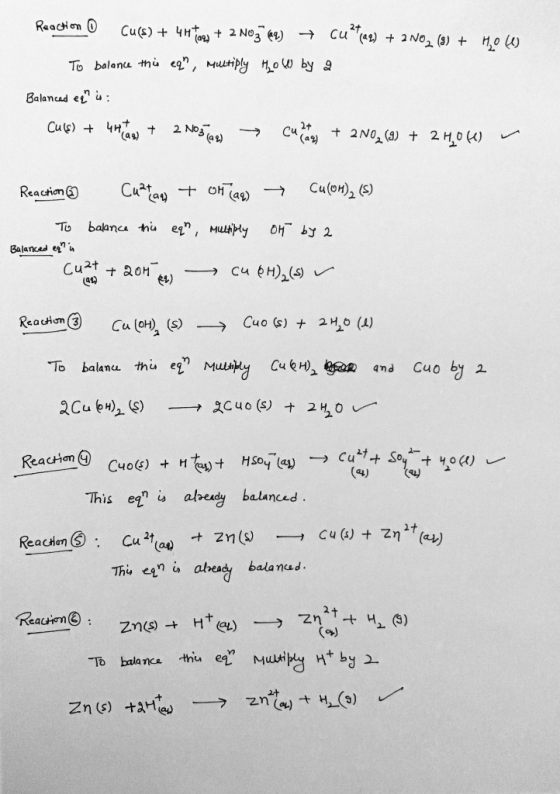
Lawine six chemical equations describe the six reactions that you used to convert copper into compounds...
Reactions and Neutralization in the Copper Cycle A Cycle of Chemical Reactions of Copper PRE-LABORATORY ASSIGNMENT...
 Reactions and Neutralization in the Copper Cycle
A Cycle of Chemical Reactions of Copper PRE-LABORATORY ASSIGNMENT Finish the pre-laboratory assignments before the laboratory experiment. Read the manual of this experiment and complete the following questions. 1. a. Identify oxidation-reduction reactions in the copper cycle experiment. For each oxidation-reduction reaction, write half reactions to show what is oxidized and what is reduced. Identify acid-base reactions and precipitation reactions in the copper cycle experi- ment. Write equations for the corresponding reactions. b....
Reactions and Neutralization in the Copper Cycle
A Cycle of Chemical Reactions of Copper PRE-LABORATORY ASSIGNMENT Finish the pre-laboratory assignments before the laboratory experiment. Read the manual of this experiment and complete the following questions. 1. a. Identify oxidation-reduction reactions in the copper cycle experiment. For each oxidation-reduction reaction, write half reactions to show what is oxidized and what is reduced. Identify acid-base reactions and precipitation reactions in the copper cycle experi- ment. Write equations for the corresponding reactions. b....
A Sequence of Chemical Reactions 5 Identify the following equations as single or double displacement, redox,...
 A Sequence of Chemical Reactions 5 Identify the following equations as single or double displacement, redox, acid-oues combination, or decompostion reactions. Some may fit in more than one category. Cu(s) + 4HNO, (aq) → Cu(NO)/(aq) + 2NO, + 2H,0 b. Mg(s) + H,80 (aq) - MgSO (aq) + H/ Cu(s) + HCl(aq) → CuCl(aq) + H,00 d. Cu(NO),(aq) + 2NaOH(aq - Cu(OH)(s) + 2NaNO, (aq) Cu(NO)/aq) + Mg(s) > Mg(NO/(aq) + Cu(s) A student dissolved a piece of copper wire,...
Complete and balance the unfinished equations: A) Cu(s) + 4HNO3(aq) ? Cu(NO3)2(aq) + 2NO2(g) +2H20(l) B)...
Complete and balance the unfinished equations: A) Cu(s) + 4HNO3(aq) ? Cu(NO3)2(aq) + 2NO2(g) +2H20(l) B) Cu(NO3)2(aq) +NaOH(aq) ? ? C) Cu(OH)2(s) ? CuO(s) + H2O(l) D) CuO(s) + H2SO4(aq) ? CuSO4(aq) + H2O(l) E) CuSO4(aq) + Zn(s) ? ?
A Sequence of Chemical Reacrions 3. ldentify the following equations as single or double displacement, redox, acid-b...
 A Sequence of Chemical Reacrions 3. ldentify the following equations as single or double displacement, redox, acid-base, combination, or decompostion reactions. Some may fit in more than one category. 2NO, 2H,O Cu(NO,)(aq) Cu(s) + а. 4HNO,(aq) + H,SO,(aq) MgSO,(aq) b. H,(g) Mg(s) CuO(s) HCI(aq) CuCl,(aq) H,O( c. 2NANO (aq) Cu(OH)(s) + d. Cu(NO,)(aq) 2NaOH(aq Cu(s) Cu(NO)(aq) Mg(NOs)(aq) Mg(s) + е. A student dissolved a piece of copper wire, then converted it to CuO, filtered the CuO from solution, and determined...
In this laboratory exploration various reactions of copper will illustrate these properties. First, begin with copper...
In this laboratory exploration various reactions of copper will illustrate these properties. First, begin with copper metal. When concentrated nitric acid is added, dramatic changes occur and the metal dissolves forming a brightly colored copper ion-containing solution. Cu(s) + 4HNO3(aq) à Cu(NO3)2(aq) + 2NO2(g) + 2H2O(l) _____________ equation Cu(s) + 4H+ + 4NO3-(aq) à Cu+2(aq) +2NO3-(aq)+ 2NO2(g) + 2H2O(l) _____________ equation Reaction type_______________ What advantage(s) is/are there to the second version of the reaction equation? However, if diluted...
Classify the type of reactions 1. Cu(s) + 4HNO3 (aq) -> Cu(NO3)2(aq) + 2H2O (l) + 2NO2(g) 2. Cu(s) + 4H...
Classify the type of reactions 1. Cu(s) + 4HNO3 (aq) -> Cu(NO3)2(aq) + 2H2O (l) + 2NO2(g) 2. Cu(s) + 4H3O+ (aq) + 2NO3- (aq) -> [Cu(H2O)6]2+ (aq)+ 2NO2(g) 3. [Cu(H2O)6]2+ (aq)+ NaOH (aq)-> Cu(OH)2 (s) + 5H2O (l) 4. Cu(OH)2 (s) (+ heat) -> CuO (s) + H2O (l) 5. CuO (s) + H2SO4 (aq) -> CuSO4 (aq) + H2O(l) 6. CuSO4 (aq) + Zn (s) -> Cu (s) + ZnSO4 (aq) 7. Zn (s) + H2SO4 (aq) -> ZnSO4...
b. Assuming that a student started with 0.5g of copper, calculate the theoretical yield at each...
b. Assuming that a student started with 0.5g of copper, calculate the theoretical yield at each step. #1: Cu (s) + 4HNO₃ (aq) → Cu(NO₃)₂ (aq) + 2NO₂ (g) + 2H₂O (l) #2: Cu(NO₃)₂ (aq) + 2NaOH (aq) → Cu(OH)₂ (s) + 2NaNO₃ (aq) #3: Cu(OH)₂ (s) + heat → CuO (s) + H₂O (l) #4: CuO (s) + 2HCl (aq) → CuCl₂ (aq) + H₂O (l) #5: 3CuCl₂ (aq) + 2Al (s) → 3Cu (s) + AlCl₃ (aq) (#1:copper...
Write the five equations (balanced and including states). Label them step 1 through 5. HINT gor the step 1 reaction: ge...
 Write the five equations (balanced and including states). Label
them step 1 through 5. HINT gor the step 1 reaction: get rid of O2
and 2 moles of NO2 is made for every 4 moles of HNO3.
Unbalanced reactions for each step: Step 1: HNO3(aq) + Cu(s) + O2 (g) → Cu(NO3)2(aq) + H2O(l) + NO2(g) Step 2: Cu(NO3)2(aq) + NaOH(aq) → Cu(OH)2(s) + NaNO3(aq) Step 3: Cu(OH)2(s) → CuO(s) + H2O(1) Step 4: CuO(s) + H2SO4(aq) → CuSO4(aq) +...
Write the five equations (balanced and including states). Label
them step 1 through 5. HINT gor the step 1 reaction: get rid of O2
and 2 moles of NO2 is made for every 4 moles of HNO3.
Unbalanced reactions for each step: Step 1: HNO3(aq) + Cu(s) + O2 (g) → Cu(NO3)2(aq) + H2O(l) + NO2(g) Step 2: Cu(NO3)2(aq) + NaOH(aq) → Cu(OH)2(s) + NaNO3(aq) Step 3: Cu(OH)2(s) → CuO(s) + H2O(1) Step 4: CuO(s) + H2SO4(aq) → CuSO4(aq) +...
volve separation and purification of th Fom unwanted side products. Common methods of separation an edimentation,...
 volve separation and purification of th Fom unwanted side products. Common methods of separation an edimentation, decantation, extraction, and sublimation. This esigned to be a quantitative evaluation of laboratory skills in carr hese operations. The reactions used in this lab are as follows. B ab, write these chemical equations in your lab notebook. Com alance the unfinished equations. exp A. Cu(s)+4HNO3(aq) B. Cu(NO3)2(aqg) + NaOH(aq) C. Cu(OH)2(s) D. CuO(s)+H2 SO4 (aq) CuSO4(aq) E. CuSO4(aq) + Zn(s) + ? Cu(NO3)2(aq) +...
there are reactions from 1 to 5. Q: what is %yield of Cu?, and % error?...
there are reactions from 1 to 5. Q: what is %yield of Cu?, and % error? -reaction 1: 0.2134g of Cu, 2ml 6Mol HNO3 -reaction 5:0.1646g of Cu (solid) left. Balanced Equation reaction.1 Cu (s) + 4HNO3(aq) → Cu(NO3)2 (aq) + 2NO2 (g) + 2H2O (l) reaction 2: Cu(NO3)2 (aq) + 2NaOH (aq) → Cu(OH)2 (s) + 2NaNO3(aq) reaction 3: Cu(OH)2 (s) → CuO (s) + H2O (l) reaction 4: CuO (s) + H2SO4 (aq) → CuSO4 (aq) + H2O(l)...
 Reactions and Neutralization in the Copper Cycle
A Cycle of Chemical Reactions of Copper PRE-LABORATORY ASSIGNMENT Finish the pre-laboratory assignments before the laboratory experiment. Read the manual of this experiment and complete the following questions. 1. a. Identify oxidation-reduction reactions in the copper cycle experiment. For each oxidation-reduction reaction, write half reactions to show what is oxidized and what is reduced. Identify acid-base reactions and precipitation reactions in the copper cycle experi- ment. Write equations for the corresponding reactions. b....
Reactions and Neutralization in the Copper Cycle
A Cycle of Chemical Reactions of Copper PRE-LABORATORY ASSIGNMENT Finish the pre-laboratory assignments before the laboratory experiment. Read the manual of this experiment and complete the following questions. 1. a. Identify oxidation-reduction reactions in the copper cycle experiment. For each oxidation-reduction reaction, write half reactions to show what is oxidized and what is reduced. Identify acid-base reactions and precipitation reactions in the copper cycle experi- ment. Write equations for the corresponding reactions. b....
 A Sequence of Chemical Reactions 5 Identify the following equations as single or double displacement, redox, acid-oues combination, or decompostion reactions. Some may fit in more than one category. Cu(s) + 4HNO, (aq) → Cu(NO)/(aq) + 2NO, + 2H,0 b. Mg(s) + H,80 (aq) - MgSO (aq) + H/ Cu(s) + HCl(aq) → CuCl(aq) + H,00 d. Cu(NO),(aq) + 2NaOH(aq - Cu(OH)(s) + 2NaNO, (aq) Cu(NO)/aq) + Mg(s) > Mg(NO/(aq) + Cu(s) A student dissolved a piece of copper wire,...
 A Sequence of Chemical Reacrions 3. ldentify the following equations as single or double displacement, redox, acid-base, combination, or decompostion reactions. Some may fit in more than one category. 2NO, 2H,O Cu(NO,)(aq) Cu(s) + а. 4HNO,(aq) + H,SO,(aq) MgSO,(aq) b. H,(g) Mg(s) CuO(s) HCI(aq) CuCl,(aq) H,O( c. 2NANO (aq) Cu(OH)(s) + d. Cu(NO,)(aq) 2NaOH(aq Cu(s) Cu(NO)(aq) Mg(NOs)(aq) Mg(s) + е. A student dissolved a piece of copper wire, then converted it to CuO, filtered the CuO from solution, and determined...
 Write the five equations (balanced and including states). Label
them step 1 through 5. HINT gor the step 1 reaction: get rid of O2
and 2 moles of NO2 is made for every 4 moles of HNO3.
Unbalanced reactions for each step: Step 1: HNO3(aq) + Cu(s) + O2 (g) → Cu(NO3)2(aq) + H2O(l) + NO2(g) Step 2: Cu(NO3)2(aq) + NaOH(aq) → Cu(OH)2(s) + NaNO3(aq) Step 3: Cu(OH)2(s) → CuO(s) + H2O(1) Step 4: CuO(s) + H2SO4(aq) → CuSO4(aq) +...
Write the five equations (balanced and including states). Label
them step 1 through 5. HINT gor the step 1 reaction: get rid of O2
and 2 moles of NO2 is made for every 4 moles of HNO3.
Unbalanced reactions for each step: Step 1: HNO3(aq) + Cu(s) + O2 (g) → Cu(NO3)2(aq) + H2O(l) + NO2(g) Step 2: Cu(NO3)2(aq) + NaOH(aq) → Cu(OH)2(s) + NaNO3(aq) Step 3: Cu(OH)2(s) → CuO(s) + H2O(1) Step 4: CuO(s) + H2SO4(aq) → CuSO4(aq) +...
 volve separation and purification of th Fom unwanted side products. Common methods of separation an edimentation, decantation, extraction, and sublimation. This esigned to be a quantitative evaluation of laboratory skills in carr hese operations. The reactions used in this lab are as follows. B ab, write these chemical equations in your lab notebook. Com alance the unfinished equations. exp A. Cu(s)+4HNO3(aq) B. Cu(NO3)2(aqg) + NaOH(aq) C. Cu(OH)2(s) D. CuO(s)+H2 SO4 (aq) CuSO4(aq) E. CuSO4(aq) + Zn(s) + ? Cu(NO3)2(aq) +...
Most questions answered within 3 hours.
-
Where is the error in this code sequence?
String s1 = "Hello";
String s2 = "ello";...
asked 11 months ago -
Financial data for Joel de Paris, Inc., for last year
follow:
Joel de Paris, Inc.
Balance...
asked 11 months ago -
Consider this reaction:
Al2(SO4)3 (aq)+ BaCl3
(aq) Al2Cl6 (aq)- +
3BaSO4(s) . What is the...
asked 11 months ago -
Suppose that Savneet is considering increasing her
recent random sample from 20 car rentals to 40...
asked 11 months ago -
Trucks arrive at an unloading terminal at an average rate of 120
per hour.
Trucks arrive...
asked 11 months ago -
Why are methanol and ethanol completely soluble in water while
octanol is not very little soluble....
asked 11 months ago -
A facilities manager at a university reads in a research report
that the mean amount of...
asked 11 months ago -
When the CuSO4 is rehydrated by adding water to the anhydrous
compound, is this an endothermic...
asked 11 months ago -
A ray of sunlight is passing from diamond into crown glass; the
angle of incidence is...
asked 11 months ago -
A block of mass 0.249 kg is placed on top of a light, vertical
spring of...
asked 11 months ago -
how do the kidneys compensate in the presences of acidosis
a) trigger hyperventilate
b) reserve acid...
asked 11 months ago -
Question 501 pts
The rental rate of capital to the firm increases. Which of the
following...
asked 11 months ago