
Homework Answers
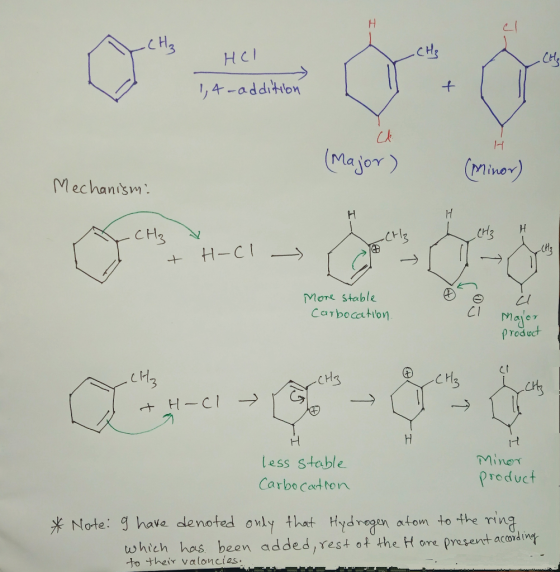
1,4-addition reaction is shown by conjugated diens.
Add Answer to:
Predict the major product formed by 1,4-addition of HCl to 2-methyl-1,3-cyclohexadiene You do not have to...
Consider the reaction of 2-methyl-1,3-cyclohexadiene with HCI.
 Consider the reaction of 2-methyl-1,3-cyclohexadiene with HCI. Assuming that the reaction takes place at a very low temperature: (a) draw the intermediate and product structures, Including any formal charges. (b) What is the major product of the reaction at very low temperatures? Both products are formed in equal amounts. The 1,2-addition product. The 1,4-addition product. (c) Is the reaction under rate control or equilibrium control under the conditions stated above? The reaction is under rate control (kinetic). The reaction is under equilibrium control (thermodynamic). Unable to determine.
Consider the reaction of 2-methyl-1,3-cyclohexadiene with HCl. Assuming that the reaction takes place at a very...
 Consider the reaction of 2-methyl-1,3-cyclohexadiene with HCl. Assuming that the reaction takes place at a very low temperature: (a) draw the intemediate and product structures, including any formal charges. more stable resonance form less stable resonance form НC cr сг Cl Scroll down for parts (b) and (c). Cl Exit Next Try Again Give Up & View Solution Previqus (b) What is the major product of the reaction at very low temperatures? Both products are formed in equal amounts. O...
Predict the structure of the major product formed by 1, 2-addition of HCI to 2-methyl-1, 3-butadiene...
 Predict the structure of the major product formed by 1, 2-addition of HCI to 2-methyl-1, 3-butadiene (isoprene). Predict the major product formed by 1, 4-addition of HCI to isoprene. Predict the structure of the major 1, 2-addition product formed by reaction of one mole of Br_2 with isoprene. Also predict the structure of the major 1, 4-addition product formed under these conditions. Which of the two molecules shown do you expect to be the major product formed by 1, 2-addition...
Consider the reaction of 2-methyl-1,3-cyclohexadiene with HCI. Assuming that the reaction takes place at a very...
 Consider the reaction of 2-methyl-1,3-cyclohexadiene with HCI. Assuming that the reaction takes place at a very low temperature: (a) draw the intermediate and product structures, indluding any formnal charges. more stable resonance formless stable resonance form HCI CI CI Scroll down for parts (b) and (c) (b) What is the major product of the reaction at very low temperatures? O Both products are formed in equal amounts. O The 1,2-addition product O The 1,4-addition product. (c) Is the reaction under...
I just need the less stable forms Consider the reaction of 2-methyl-1,3-cyclohexadiene with HCl. Assuming that...
 I just need the less stable forms
Consider the reaction of 2-methyl-1,3-cyclohexadiene with HCl. Assuming that the reaction takes place at a very low temperature: draw the intermediate and product structures, including any formal charges.
I just need the less stable forms
Consider the reaction of 2-methyl-1,3-cyclohexadiene with HCl. Assuming that the reaction takes place at a very low temperature: draw the intermediate and product structures, including any formal charges.
Also Draw Product A and B Consider the reaction of 2-methyl-1,3-cyclohexadiene with HCl Intermediate A Intermediate...
 Also Draw Product A and B
Consider the reaction of 2-methyl-1,3-cyclohexadiene with HCl Intermediate A Intermediate B НCІ (Less stable resonance form) (More stable resonance form) CIT CI Product B Product A Assuming that the reaction takes place at a very low temperature, draw the intermediate and product structures, including any formal charges. Draw intermediate A Draw intermediate B Rings Select Draw More Select Draw Rings More Erase Erase Cl C н C н
Also Draw Product A and B
Consider the reaction of 2-methyl-1,3-cyclohexadiene with HCl Intermediate A Intermediate B НCІ (Less stable resonance form) (More stable resonance form) CIT CI Product B Product A Assuming that the reaction takes place at a very low temperature, draw the intermediate and product structures, including any formal charges. Draw intermediate A Draw intermediate B Rings Select Draw More Select Draw Rings More Erase Erase Cl C н C н
5. a) Draw the major 1,2-addition product and the major 1,4-addition product of each of the...
 5. a) Draw the major 1,2-addition product and the major 1,4-addition product of each of the following reactions. Label each product as either the 1,2-addition product or 1,4-addition product and as either the thermodynamic or kinetic product. (12 pts) H" catalyst H catalyst b) Consider the reaction of a nucleophile with conjugated carbonyl. Provide an example of a nucleophile that would favor the 1,2-addition product and explain why. Provide an example of a nucleophile that would favor the 1,4-addition product...
6 6) Starting from 1,3-cyclohexadiene and (E)-methyl but-2-enoate, draw a reasonable synthesis for the product shown...
 6
6) Starting from 1,3-cyclohexadiene and (E)-methyl but-2-enoate, draw a reasonable synthesis for the product shown below. (12 points) он CH3 + enantiomer 0 CO Me
6
6) Starting from 1,3-cyclohexadiene and (E)-methyl but-2-enoate, draw a reasonable synthesis for the product shown below. (12 points) он CH3 + enantiomer 0 CO Me
3. 1,2-dimethyl-1,3-cyclohexadiene reacts with HCl to form up to four different products. HCI 4 possible products...
 3. 1,2-dimethyl-1,3-cyclohexadiene reacts with HCl to form up to four different products. HCI 4 possible products a. b. Give the structures for the four products. When the reaction is run at low temperature, two products are formed preferentially ldentify these two products. c. When the reaction temperature is increased, a single product is favored. Identify the major product under these reaction conditions
What is the major product of the following reaction? (1,2 vs 1,4 addition) HCl 40°C CI...
 What is the major product of the following reaction? (1,2 vs 1,4 addition) HCl 40°C CI OCI
 Consider the reaction of 2-methyl-1,3-cyclohexadiene with HCl. Assuming that the reaction takes place at a very low temperature: (a) draw the intemediate and product structures, including any formal charges. more stable resonance form less stable resonance form НC cr сг Cl Scroll down for parts (b) and (c). Cl Exit Next Try Again Give Up & View Solution Previqus (b) What is the major product of the reaction at very low temperatures? Both products are formed in equal amounts. O...
 Predict the structure of the major product formed by 1, 2-addition of HCI to 2-methyl-1, 3-butadiene (isoprene). Predict the major product formed by 1, 4-addition of HCI to isoprene. Predict the structure of the major 1, 2-addition product formed by reaction of one mole of Br_2 with isoprene. Also predict the structure of the major 1, 4-addition product formed under these conditions. Which of the two molecules shown do you expect to be the major product formed by 1, 2-addition...
 Consider the reaction of 2-methyl-1,3-cyclohexadiene with HCI. Assuming that the reaction takes place at a very low temperature: (a) draw the intermediate and product structures, indluding any formnal charges. more stable resonance formless stable resonance form HCI CI CI Scroll down for parts (b) and (c) (b) What is the major product of the reaction at very low temperatures? O Both products are formed in equal amounts. O The 1,2-addition product O The 1,4-addition product. (c) Is the reaction under...
 I just need the less stable forms
Consider the reaction of 2-methyl-1,3-cyclohexadiene with HCl. Assuming that the reaction takes place at a very low temperature: draw the intermediate and product structures, including any formal charges.
I just need the less stable forms
Consider the reaction of 2-methyl-1,3-cyclohexadiene with HCl. Assuming that the reaction takes place at a very low temperature: draw the intermediate and product structures, including any formal charges.
 Also Draw Product A and B
Consider the reaction of 2-methyl-1,3-cyclohexadiene with HCl Intermediate A Intermediate B НCІ (Less stable resonance form) (More stable resonance form) CIT CI Product B Product A Assuming that the reaction takes place at a very low temperature, draw the intermediate and product structures, including any formal charges. Draw intermediate A Draw intermediate B Rings Select Draw More Select Draw Rings More Erase Erase Cl C н C н
Also Draw Product A and B
Consider the reaction of 2-methyl-1,3-cyclohexadiene with HCl Intermediate A Intermediate B НCІ (Less stable resonance form) (More stable resonance form) CIT CI Product B Product A Assuming that the reaction takes place at a very low temperature, draw the intermediate and product structures, including any formal charges. Draw intermediate A Draw intermediate B Rings Select Draw More Select Draw Rings More Erase Erase Cl C н C н
 5. a) Draw the major 1,2-addition product and the major 1,4-addition product of each of the following reactions. Label each product as either the 1,2-addition product or 1,4-addition product and as either the thermodynamic or kinetic product. (12 pts) H" catalyst H catalyst b) Consider the reaction of a nucleophile with conjugated carbonyl. Provide an example of a nucleophile that would favor the 1,2-addition product and explain why. Provide an example of a nucleophile that would favor the 1,4-addition product...
 6
6) Starting from 1,3-cyclohexadiene and (E)-methyl but-2-enoate, draw a reasonable synthesis for the product shown below. (12 points) он CH3 + enantiomer 0 CO Me
6
6) Starting from 1,3-cyclohexadiene and (E)-methyl but-2-enoate, draw a reasonable synthesis for the product shown below. (12 points) он CH3 + enantiomer 0 CO Me
 3. 1,2-dimethyl-1,3-cyclohexadiene reacts with HCl to form up to four different products. HCI 4 possible products a. b. Give the structures for the four products. When the reaction is run at low temperature, two products are formed preferentially ldentify these two products. c. When the reaction temperature is increased, a single product is favored. Identify the major product under these reaction conditions
 What is the major product of the following reaction? (1,2 vs 1,4 addition) HCl 40°C CI OCI
Most questions answered within 3 hours.
-
Where is the error in this code sequence?
String s1 = "Hello";
String s2 = "ello";...
asked 10 months ago -
Financial data for Joel de Paris, Inc., for last year
follow:
Joel de Paris, Inc.
Balance...
asked 10 months ago -
Consider this reaction:
Al2(SO4)3 (aq)+ BaCl3
(aq) Al2Cl6 (aq)- +
3BaSO4(s) . What is the...
asked 10 months ago -
Suppose that Savneet is considering increasing her
recent random sample from 20 car rentals to 40...
asked 10 months ago -
Trucks arrive at an unloading terminal at an average rate of 120
per hour.
Trucks arrive...
asked 10 months ago -
Why are methanol and ethanol completely soluble in water while
octanol is not very little soluble....
asked 10 months ago -
A facilities manager at a university reads in a research report
that the mean amount of...
asked 10 months ago -
When the CuSO4 is rehydrated by adding water to the anhydrous
compound, is this an endothermic...
asked 10 months ago -
A ray of sunlight is passing from diamond into crown glass; the
angle of incidence is...
asked 10 months ago -
A block of mass 0.249 kg is placed on top of a light, vertical
spring of...
asked 10 months ago -
how do the kidneys compensate in the presences of acidosis
a) trigger hyperventilate
b) reserve acid...
asked 10 months ago -
Question 501 pts
The rental rate of capital to the firm increases. Which of the
following...
asked 10 months ago