
Homework Answers
Answer:
Given reaction is
CHCl2(g) + Cl2(g) -------> CHCl3(g) + Cl(g)
(a) The Arrhenius equation is
k=Ae(-Ea/RT)
Where k=rate constant, Ea=activation energy, A= Pre-exponential factor, R=gas constant=8.314 J/mol.K, T=temperature.
(or) lnk=(-Ea/R)(1/T) + lnA
y=mx + b
Here y-axis is lnk and the x-axis is (1/T). Then slope is equall to m= -Ea/R and y-intercept, b=lnA.
The values are shown in below table
| T(K) | k(M-1s-1) | 1/T(K-1) | lnk |
| 357 | 1.72E+07 | 0.002801 | 16.66042 |
| 400 | 2.53E+07 | 0.0025 | 17.04631 |
| 458 | 3.82E+07 | 0.002183 | 17.45835 |
| 524 | 5.20E+07 | 0.001908 | 17.76675 |
| 533 | 5.61E+07 | 0.001876 | 17.84265 |
| 615 | 7.65E+07 | 0.001626 | 18.1528 |
The Arrhenius plot, lnk vs 1/T is
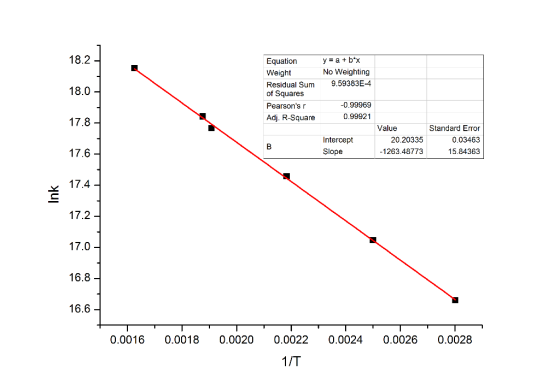
(b) From the plot, slope=-Ea/R=-1263.4877 K
Ea=1263.4877 K x 8.314 J/mol. K
Ea=10504.6 J/mol
(or) Ea ~ 10.505 kJ/mol. (Since 1kJ=1000 J)
and y-intercept=lnA=20.20335
A=e20.20335=5.946 x 10⁸ M-1 s-1.
A=5.946 x 10⁸ M-1 s-1.
Thanks and I hope you like this.
Add Answer to:
2. The rate constants for the reaction CHCI3 (g)+CI (g) CHCI2 (g)+Cl2 (g) at different temperatures...
Can someone help me 2. Reaction: 2 NOCI (g) 2 NO (g) +Cl2(g) Its rate constants...
 Can
someone help me
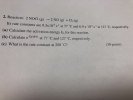
2. Reaction: 2 NOCI (g) 2 NO (g) +Cl2(g) Its rate constants are 9.3x 10⁶ s1 at 77 C and 6.9 x 10⁴ s1 at 127 C, respectively. (a) Calculate the activation energy Ea for this reaction. (b) Calculate eER at 77 'C and 127 C, respectively. (c) What is the rate constant at 200 °C? (30 points)
Can
someone help me
2. Reaction: 2 NOCI (g) 2 NO (g) +Cl2(g) Its rate constants are 9.3x 10⁶ s1 at 77 C and 6.9 x 10⁴ s1 at 127 C, respectively. (a) Calculate the activation energy Ea for this reaction. (b) Calculate eER at 77 'C and 127 C, respectively. (c) What is the rate constant at 200 °C? (30 points)
The following data show the rate constant of a reaction measured at several different temperatures. Temperature...
The following data show the rate constant of a reaction measured at several different temperatures. Temperature (K) Rate Constant (1/s) 300 1.19×10⁻² 310 3.64×10⁻² 320 0.104 330 0.278 340 0.703 Part A Part complete Use an Arrhenius plot to determine the activation barrier for the reaction. Express your answer using three significant figures. -- SubmitPrevious AnswersRequest Answer Part B Part complete Use an Arrhenius plot to determine frequency factor for the reaction. Express your answer using two significant figures. --...
A student measures the reaction H2(g) + Cl2(g) <=> 2 HCl(g) concentrations at a few different...
 A student measures the reaction H2(g) + Cl2(g) <=> 2 HCl(g) concentrations at a few different temperatures and obtains the equilibrium constant. The student wants to use the van't Hoff equation to roughly determine the reaction enthalpy assuming that it does not change over the region of interest. T(K) 300 500 1000 Keq 4x1031 4x10⁸ So the student plots the data in the Ink vs 1/T diagram and obtains a linear fitting shown below: 80 4x10¹⁸ 60 In(K) 40 20...
The reaction 2 NO2(g) → 2 NO (g) + O2(g) has rate constants of 2.70 x...
The reaction 2 NO2(g) → 2 NO (g) + O2(g) has rate constants of 2.70 x 10⁻² M-1s-1 at 227 oC and 0.240 M-1s-1 at 277oC. What is the activation energy of this reaction? (Given: Arrhenius equation, k = Ae-Ea/RT ) A) 99.6 kJ/mol B) 22.8 kJ/mol C) 49.8 kJ/mol D) -22.8 kJ/mol E) 65.3 kJ/mol I'm unsure on how to do it since you're not given the frequency factor
 Can
someone help me
2. Reaction: 2 NOCI (g) 2 NO (g) +Cl2(g) Its rate constants are 9.3x 10⁶ s1 at 77 C and 6.9 x 10⁴ s1 at 127 C, respectively. (a) Calculate the activation energy Ea for this reaction. (b) Calculate eER at 77 'C and 127 C, respectively. (c) What is the rate constant at 200 °C? (30 points)
Can
someone help me
2. Reaction: 2 NOCI (g) 2 NO (g) +Cl2(g) Its rate constants are 9.3x 10⁶ s1 at 77 C and 6.9 x 10⁴ s1 at 127 C, respectively. (a) Calculate the activation energy Ea for this reaction. (b) Calculate eER at 77 'C and 127 C, respectively. (c) What is the rate constant at 200 °C? (30 points)
 A student measures the reaction H2(g) + Cl2(g) <=> 2 HCl(g) concentrations at a few different temperatures and obtains the equilibrium constant. The student wants to use the van't Hoff equation to roughly determine the reaction enthalpy assuming that it does not change over the region of interest. T(K) 300 500 1000 Keq 4x1031 4x10⁸ So the student plots the data in the Ink vs 1/T diagram and obtains a linear fitting shown below: 80 4x10¹⁸ 60 In(K) 40 20...
Most questions answered within 3 hours.
-
Where is the error in this code sequence?
String s1 = "Hello";
String s2 = "ello";...
asked 11 months ago -
Financial data for Joel de Paris, Inc., for last year
follow:
Joel de Paris, Inc.
Balance...
asked 11 months ago -
Consider this reaction:
Al2(SO4)3 (aq)+ BaCl3
(aq) Al2Cl6 (aq)- +
3BaSO4(s) . What is the...
asked 11 months ago -
Suppose that Savneet is considering increasing her
recent random sample from 20 car rentals to 40...
asked 11 months ago -
Trucks arrive at an unloading terminal at an average rate of 120
per hour.
Trucks arrive...
asked 11 months ago -
Why are methanol and ethanol completely soluble in water while
octanol is not very little soluble....
asked 11 months ago -
A facilities manager at a university reads in a research report
that the mean amount of...
asked 11 months ago -
When the CuSO4 is rehydrated by adding water to the anhydrous
compound, is this an endothermic...
asked 11 months ago -
A ray of sunlight is passing from diamond into crown glass; the
angle of incidence is...
asked 11 months ago -
A block of mass 0.249 kg is placed on top of a light, vertical
spring of...
asked 11 months ago -
how do the kidneys compensate in the presences of acidosis
a) trigger hyperventilate
b) reserve acid...
asked 11 months ago -
Question 501 pts
The rental rate of capital to the firm increases. Which of the
following...
asked 11 months ago